

Plant bioactive compounds
Each class of plant bioactive has a structural feature that sets its size, polarity and stability, and through them how it extracts and how it is absorbed. Representative compounds with PubChem data, the rest of the plant from USDA records, EMA's extract definitions, and what “adaptogen” means in EU and US rules.
Status. EUTECNIQ is in formation and has no laboratory, data or customers. This page is reference material; it makes no health claim for any compound or plant.
Classes at a glance
Plant bioactives are grouped by the structure that defines them, and that structure sets solubility, stability and what happens in the gut. The drawing shows one PubChem structure per class with the defining feature in teal; the table gives the ranges for the 60 representative compounds listed in the class tables.
| Class | Defining structural feature | Compounds listed | MW range, g/mol | XLogP3 range |
|---|---|---|---|---|
| Alkaloids | Nitrogen in a ring; most are amines, some quaternary (berberine) | 12 | 180–1,034 | −0.8 to 4 |
| Terpenoids | Built from C₅ units: C₁₀, C₁₅, C₂₀, C₄₀ skeletons; iridoids are cyclopentanopyran monoterpenoids | 11 | 150–854 | −3 to 15.6 |
| Steroids and saponins | Four-ring steroid nucleus (sterols) or a sapogenin carrying one or more sugar chains (saponins) | 5 | 415–1,109 | −1.3 to 9.3 |
| Phenolics | Hydroxyl groups on aromatic rings; flavonoids share a C₆–C₃–C₆ skeleton | 19 | 228–1,085 | −1.3 to 3.8 |
| Glycosides | A sugar bound to a non-sugar aglycone that sets the class (cardenolide, nitrile, thiohydroximate) | 7 | 177–781 | −2.7 to 2.3 |
| Polyacetylenes | Conjugated carbon–carbon triple bonds (C≡C–C≡C) | 2 | 244–260 | 4.4 to 5.5 |
| Organosulfur | Sulfur as sulfoxide, thiosulfinate or sulfide; garlic compounds interconvert on crushing | 4 | 146–177 | −3.5 to 2.2 |
Ranges computed from the PubChem records of the compounds in the class tables below. Cyanidin 3-glucoside (a cation) has no PubChem XLogP3 and is excluded from the phenolic XLogP3 range.
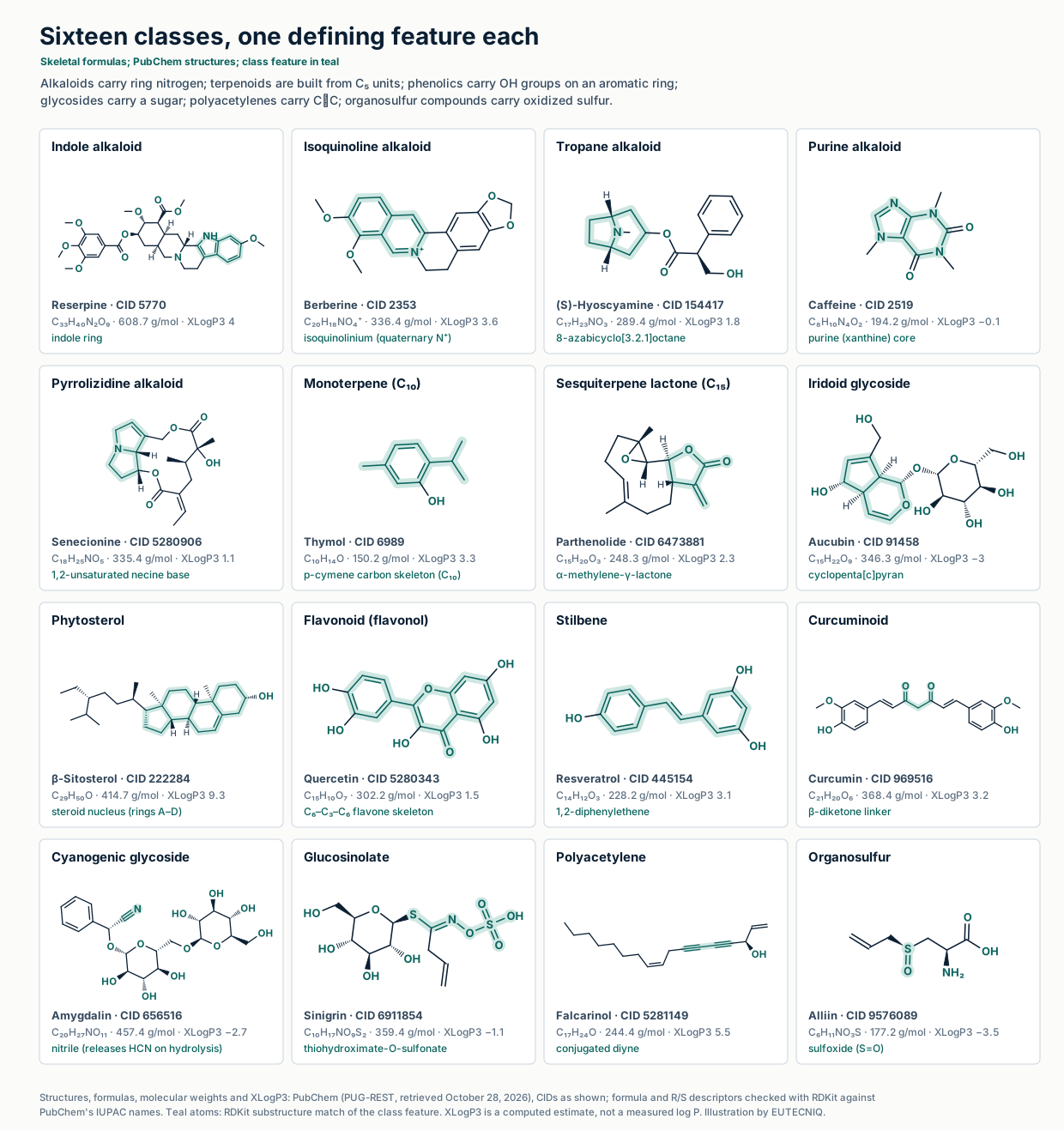
Alkaloids
Alkaloids carry nitrogen, usually in a ring, and the ring system names the subclass. Charge decides much of their absorption. Caffeine, an uncharged purine, reached an absolute oral bioavailability of 108.3 ± 3.6% in ten men; berberine, whose isoquinolinium nitrogen carries a permanent positive charge, reached 0.68% in rats, with P-glycoprotein efflux implicated. Pyrrolizidine alkaloids are made in the root of Senecio vulgaris as N-oxides and moved to the flower heads. More on absorption and PBPK.
| Subclass | Compound | Plant and part | PubChem CID | Formula | MW, g/mol | XLogP3 | Plant source |
|---|---|---|---|---|---|---|---|
| Indole | Reserpine | Rauvolfia serpentina, root | 5770 | C₃₃H₄₀N₂O₉ | 608.7 | 4 | ChEBI via PubChem |
| Indole | Vinblastine | Catharanthus roseus, leaf | 13342 | C₄₆H₅₈N₄O₉ | 811.0 | 3.7 | Yousefi et al. 2025 |
| Isoquinoline | Berberine | Hydrastis canadensis, rhizome and root | 2353 | C₂₀H₁₈NO₄⁺ | 336.4 | 3.6 | NTP |
| Isoquinoline | Morphine | Papaver somniferum, latex (opium is its “coagulated juice”) | 5288826 | C₁₇H₁₉NO₃ | 285.3 | 0.8 | UN 1961 Convention · ChEBI via PubChem |
| Tropane | (S)-Hyoscyamine | Atropa belladonna, leaf | 154417 | C₁₇H₂₃NO₃ | 289.4 | 1.8 | Zhang et al. 2022 |
| Tropane | Cocaine | Erythroxylum coca, leaf | 446220 | C₁₇H₂₁NO₄ | 303.4 | 2.3 | ChEBI via PubChem |
| Purine | Caffeine | Coffea spp., seed (coffee bean) | 2519 | C₈H₁₀N₄O₂ | 194.2 | −0.1 | ChEBI via PubChem · Aborziza et al. 2026 |
| Purine | Theobromine | Theobroma cacao, seed (cocoa bean) | 5429 | C₇H₈N₄O₂ | 180.2 | −0.8 | ChEBI via PubChem · Fukuda et al. 2026 |
| Pyrrolizidine | Senecionine | Senecio vulgaris, made in the root, stored in flower heads | 5280906 | C₁₈H₂₅NO₅ | 335.4 | 1.1 | Hartmann et al. 1989 |
| Pyrrolizidine | Echimidine | Symphytum officinale, root | 5281729 | C₂₀H₃₁NO₇ | 397.5 | −0.1 | Kim et al. 2001 |
| Steroidal glycoalkaloid | α-Solanine | Solanum tuberosum, tuber peel, sprouts, leaf | 9549171 | C₄₅H₇₃NO₁₅ | 868.1 | 1.8 | Wei et al. 2025 |
| Steroidal glycoalkaloid | Tomatine | Solanum lycopersicum, green (unripe) fruit | 28523 | C₅₀H₈₃NO₂₁ | 1,034.2 | −0.7 | Faria-Silva et al. 2025 |
MW and XLogP3: PubChem computed properties (retrieved October 28, 2026). XLogP3 is a computed estimate of the octanol–water partition coefficient, not a measurement. Plant and part: sources in the last column.
Terpenoids and iridoids
Terpenoids are assembled from five-carbon units: thymol and 1,8-cineole are C₁₀, artemisinin and parthenolide C₁₅, forskolin a C₂₀ diterpene (C₂₂ with its acetyl group), the carotenoids C₄₀. Without sugar, XLogP3 runs from 1 for forskolin to 15.6 for lycopene; both carotenoids sit far above the log P of 5 usually taken as the threshold for lymphatic transport of drugs. Iridoids such as harpagoside and aucubin occur as glucosides, with XLogP3 of −0.6 and −3. See absorption and PBPK.
| Subclass | Compound | Plant and part | PubChem CID | Formula | MW, g/mol | XLogP3 | Plant source |
|---|---|---|---|---|---|---|---|
| Monoterpene (C₁₀) | Thymol | Thymus vulgaris, leaf and flower | 6989 | C₁₀H₁₄O | 150.2 | 3.3 | EMA, Thymi herba · Garzoli et al. 2026 |
| Monoterpene (C₁₀) | 1,8-Cineole | Eucalyptus globulus, leaf (steam-distilled oil) | 2758 | C₁₀H₁₈O | 154.2 | 2.5 | EMA, Eucalypti aetheroleum |
| Sesquiterpene lactone (C₁₅) | Artemisinin | Artemisia annua, leaf glandular trichomes | 68827 | C₁₅H₂₂O₅ | 282.3 | 2.8 | Fu et al. 2026 |
| Sesquiterpene lactone (C₁₅) | Parthenolide | Tanacetum parthenium, leaf | 6473881 | C₁₅H₂₀O₃ | 248.3 | 2.3 | LactMed |
| Sesquiterpene lactone (C₁₅) | Helenalin | Arnica montana, flower | 23205 | C₁₅H₁₈O₄ | 262.3 | 1.4 | Parafiniuk et al. 2023 · EMA HMPC list 2026 |
| Diterpene (C₂₀) | Paclitaxel | Taxus brevifolia, bark | 36314 | C₄₇H₅₁NO₁₄ | 853.9 | 2.5 | ChEBI via PubChem |
| Diterpene (C₂₀) | Forskolin | Coleus forskohlii, root | 47936 | C₂₂H₃₄O₇ | 410.5 | 1 | Sun et al. 2026 |
| Iridoid glycoside | Harpagoside | Harpagophytum procumbens, secondary root | 5281542 | C₂₄H₃₀O₁₁ | 494.5 | −0.6 | Kondamudi et al. 2016 |
| Iridoid glycoside | Aucubin | Plantago lanceolata, leaf | 91458 | C₁₅H₂₂O₉ | 346.3 | −3 | Knerl and Bowers 2013 · EMA HMPC list 2026 |
| Tetraterpene (C₄₀, carotenoid) | β-Carotene | Daucus carota, root | 5280489 | C₄₀H₅₆ | 536.9 | 13.5 | Arshad et al. 2025 |
| Tetraterpene (C₄₀, carotenoid) | Lycopene | Solanum lycopersicum, ripe fruit | 446925 | C₄₀H₅₆ | 536.9 | 15.6 | ChEBI via PubChem |
MW and XLogP3: PubChem computed properties (retrieved October 28, 2026). XLogP3 is a computed estimate of the octanol–water partition coefficient, not a measurement. Plant and part: sources in the last column.
Sterols and saponins
Phytosterols keep the four-ring steroid nucleus with one hydroxyl and a side chain; β-sitosterol has an XLogP3 of 9.3. Saponins attach sugar chains to a steroidal or triterpene sapogenin. Ginsenoside Rb1 (1,109.3 g/mol, 15 H-bond donors) and protodioscin (1,049.2 g/mol, 13 donors) exceed every size and donor limit of the rule of 5. Gut-microbial enzymes convert ginsenosides into metabolites such as compound K, which a 2026 review describes as more absorbable. See absorption and PBPK.
| Subclass | Compound | Plant and part | PubChem CID | Formula | MW, g/mol | XLogP3 | Plant source |
|---|---|---|---|---|---|---|---|
| Phytosterol | β-Sitosterol | sunflower, pumpkin, sesame and other oilseeds, seed (pressed oil) | 222284 | C₂₉H₅₀O | 414.7 | 9.3 | Dean 2025 |
| Steroidal saponin / sapogenin | Diosgenin (aglycone) | Dioscorea zingiberensis, rhizome | 99474 | C₂₇H₄₂O₃ | 414.6 | 5.7 | Sun et al. 2024 |
| Steroidal saponin / sapogenin | Protodioscin | Trigonella foenum-graecum, seed | 441891 | C₅₁H₈₄O₂₂ | 1,049.2 | −1.3 | LactMed |
| Triterpene saponin | Glycyrrhizin | Glycyrrhiza glabra, root | 14982 | C₄₂H₆₂O₁₆ | 822.9 | 3.7 | LactMed |
| Triterpene saponin | Ginsenoside Rb1 | Panax ginseng, root | 9898279 | C₅₄H₉₂O₂₃ | 1,109.3 | 0.3 | ChEBI via PubChem · EMA, Ginseng radix |
MW and XLogP3: PubChem computed properties (retrieved October 28, 2026). XLogP3 is a computed estimate of the octanol–water partition coefficient, not a measurement. Plant and part: sources in the last column.
Phenolics
Phenolics carry hydroxyl groups on aromatic rings, and the attached sugar matters: lactase-phlorizin hydrolase of the small intestine cleaves flavonol and isoflavone glucosides, and quercetin glucosides from onion were absorbed at 52% against 17% for the rutinoside. Size matters too: 2 h after cocoa, plasma held 41 nmol/L of procyanidin dimer against 5.92 µmol/L of its monomer, epicatechin.
The quoted “2000%” for curcumin with piperine (Shoba et al. 1998) compares 2 g of curcumin plus 20 mg of piperine with curcumin alone, which was undetectable or very low at most time points in ten men. See absorption and PBPK.
| Subclass | Compound | Plant and part | PubChem CID | Formula | MW, g/mol | XLogP3 | Plant source |
|---|---|---|---|---|---|---|---|
| Flavonol | Quercetin (as glucosides) | Allium cepa, bulb | 5280343 | C₁₅H₁₀O₇ | 302.2 | 1.5 | Hollman et al. 1995 |
| Flavonol glycoside | Rutin (quercetin rutinoside) | Camellia sinensis, leaf (tea) | 5280805 | C₂₇H₃₀O₁₆ | 610.5 | −1.3 | Hollman et al. 1995 |
| Flavone | Apigenin | Matricaria chamomilla, flower | 5280443 | C₁₅H₁₀O₅ | 270.2 | 1.7 | Vujčić Bok et al. 2026 |
| Flavanone glycoside | Hesperidin | Citrus sinensis, fruit peel | 10621 | C₂₈H₃₄O₁₅ | 610.6 | −1.1 | Rekeb et al. 2026 |
| Flavan-3-ol | EGCG | Camellia sinensis, leaf | 65064 | C₂₂H₁₈O₁₁ | 458.4 | 1.2 | Zhao et al. 2026 |
| Anthocyanin | Cyanidin 3-glucoside | Sambucus nigra; Vaccinium spp., fruit (berry) | 441667 | C₂₁H₂₁O₁₁⁺ | 449.4 | n/a | Xie et al. 2024 |
| Isoflavone | Genistein | Glycine max, seed | 5280961 | C₁₅H₁₀O₅ | 270.2 | 2.7 | Vidya et al. 2026 |
| Phenolic acid (ester) | Chlorogenic acid (5-CQA) | Coffea spp., green seed (bean) | 1794427 | C₁₆H₁₈O₉ | 354.3 | −0.4 | Hamadneh et al. 2026 |
| Phenolic acid (ester) | Rosmarinic acid | Melissa officinalis, leaf | 5281792 | C₁₈H₁₆O₈ | 360.3 | 2.4 | Salako et al. 2026 · EMA HMPC list 2026 |
| Stilbene | Resveratrol | Polygonum cuspidatum, root | 445154 | C₁₄H₁₂O₃ | 228.2 | 3.1 | Fletes-Vargas et al. 2025 |
| Stilbene | Pterostilbene | Vaccinium spp., fruit (blueberry) | 5281727 | C₁₆H₁₆O₃ | 256.3 | 3.8 | Zhu et al. 2026 |
| Lignan | Secoisolariciresinol diglucoside | Linum usitatissimum, seed | 9917980 | C₃₂H₄₆O₁₆ | 686.7 | −0.7 | Babu et al. 2026 |
| Lignan | Sesamin | Sesamum indicum, seed | 72307 | C₂₀H₁₈O₆ | 354.4 | 2.7 | Harada et al. 2026 |
| Hydrolyzable tannin | Punicalagin | Punica granatum, fruit peel | 16129719 | C₄₈H₂₈O₃₀ | 1,084.7 | 1.5 | Sateriale et al. 2026 |
| Hydrolyzable tannin | Pentagalloyl glucose | Mangifera indica, seed kernel | 65238 | C₄₁H₃₂O₂₆ | 940.7 | 3.6 | Wen et al. 2023 |
| Condensed tannin (proanthocyanidin) | Procyanidin B2 | Theobroma cacao; Cinnamomum verum, seed; bark | 122738 | C₃₀H₂₆O₁₂ | 578.5 | 2.4 | Holt et al. 2002 · ChEBI via PubChem |
| Curcuminoid | Curcumin | Curcuma longa, rhizome | 969516 | C₂₁H₂₀O₆ | 368.4 | 3.2 | Anukanon et al. 2025 |
| Curcuminoid | Demethoxycurcumin | Curcuma longa, rhizome | 5469424 | C₂₀H₁₈O₅ | 338.4 | 3.3 | Anukanon et al. 2025 |
| Curcuminoid | Bisdemethoxycurcumin | Curcuma longa, rhizome | 5315472 | C₁₉H₁₆O₄ | 308.3 | 3.3 | Anukanon et al. 2025 |
MW and XLogP3: PubChem computed properties (retrieved October 28, 2026). XLogP3 is a computed estimate of the octanol–water partition coefficient, not a measurement. Plant and part: sources in the last column.
Glycosides, polyacetylenes, organosulfur
For cyanogenic glycosides and glucosinolates, what reaches the gut depends on plant enzymes released by processing. Chewing or grinding apricot kernels releases cyanide from amygdalin; EFSA set an acute reference dose of 20 µg/kg body weight, which one small kernel exceeds in a toddler. Myrosinase turns glucoraphanin into sulforaphane but is destroyed by heat: urinary isothiocyanate fell from 32.3% of the dose after fresh broccoli to 10.2% after steamed. Crushing garlic lets alliinase turn alliin (XLogP3 −3.5) into allicin (1.3). Polyacetylenes such as falcarinol (5.5) are lipophilic and carry no sugar. See absorption and PBPK.
| Subclass | Compound | Plant and part | PubChem CID | Formula | MW, g/mol | XLogP3 | Plant source |
|---|---|---|---|---|---|---|---|
| Cardiac (cardenolide) | Digoxin | Digitalis lanata, leaf | 2724385 | C₄₁H₆₄O₁₄ | 780.9 | 1.3 | El Gameel et al. 2023 |
| Cardiac (cardenolide) | Digitoxin | Digitalis purpurea, leaf | 441207 | C₄₁H₆₄O₁₃ | 764.9 | 2.3 | Lehmann et al. 2021 · Negroni et al. 2019 |
| Cyanogenic | Amygdalin | Prunus armeniaca, seed (kernel) | 656516 | C₂₀H₂₇NO₁₁ | 457.4 | −2.7 | EFSA 2016 |
| Cyanogenic | Linamarin | Manihot esculenta, root | 11128 | C₁₀H₁₇NO₆ | 247.2 | −1.8 | Zidenga et al. 2017 |
| Glucosinolate | Sinigrin | Brassica spp. (mustard), seed | 6911854 | C₁₀H₁₇NO₉S₂ | 359.4 | −1.1 | Guijarro-Real et al. 2021 |
| Glucosinolate | Glucoraphanin | Brassica oleracea var. italica, head (broccoli) | 9548634 | C₁₂H₂₃NO₁₀S₃ | 437.5 | −2.1 | Conaway et al. 2000 |
| Isothiocyanate (hydrolysis product) | Sulforaphane | formed from glucoraphanin, by myrosinase hydrolysis | 5350 | C₆H₁₁NOS₂ | 177.3 | 1.4 | Conaway et al. 2000 |
| Subclass | Compound | Plant and part | PubChem CID | Formula | MW, g/mol | XLogP3 | Plant source |
|---|---|---|---|---|---|---|---|
| Falcarinol type | Falcarinol (panaxynol) | Daucus carota; Panax ginseng, root | 5281149 | C₁₇H₂₄O | 244.4 | 5.5 | Dunemann et al. 2022 · Saita et al. 1993 |
| Falcarinol type | Falcarindiol | Daucus carota, root (carrot) | 5281148 | C₁₇H₂₄O₂ | 260.4 | 4.4 | Dunemann et al. 2022 |
| Subclass | Compound | Plant and part | PubChem CID | Formula | MW, g/mol | XLogP3 | Plant source |
|---|---|---|---|---|---|---|---|
| Cysteine sulfoxide | Alliin | Allium sativum, bulb (intact clove) | 9576089 | C₆H₁₁NO₃S | 177.2 | −3.5 | Nguyen et al. 2024 |
| Thiosulfinate | Allicin | Allium sativum, formed when the clove is crushed | 65036 | C₆H₁₀OS₂ | 162.3 | 1.3 | Bunstine and Lloyd 2025 |
| Sulfide | Diallyl disulfide | Allium sativum, bulb | 16590 | C₆H₁₀S₂ | 146.3 | 2.2 | ChEBI via PubChem |
| S-alkyl cysteine | S-Allylcysteine | Allium sativum, bulb | 9793905 | C₆H₁₁NO₂S | 161.2 | −2.1 | ChEBI via PubChem |
MW and XLogP3: PubChem computed properties (retrieved October 28, 2026). XLogP3 is a computed estimate of the octanol–water partition coefficient, not a measurement. Plant and part: sources in the last column.
Size, polarity and absorption
Plotted together, 38 of the 59 compounds with a PubChem XLogP3 sit inside both the molecular-weight and log P limits of Lipinski's rule of 5. The ones outside are mostly glycosides, saponins and tannins (too large and too polar) and carotenoids and sterols (too lipophilic). The rule predicts which molecules are likely to have trouble; the measurements below show that chemical form, food processing and charge can move absorption more than class does. See absorption and PBPK.
The rest of the plant
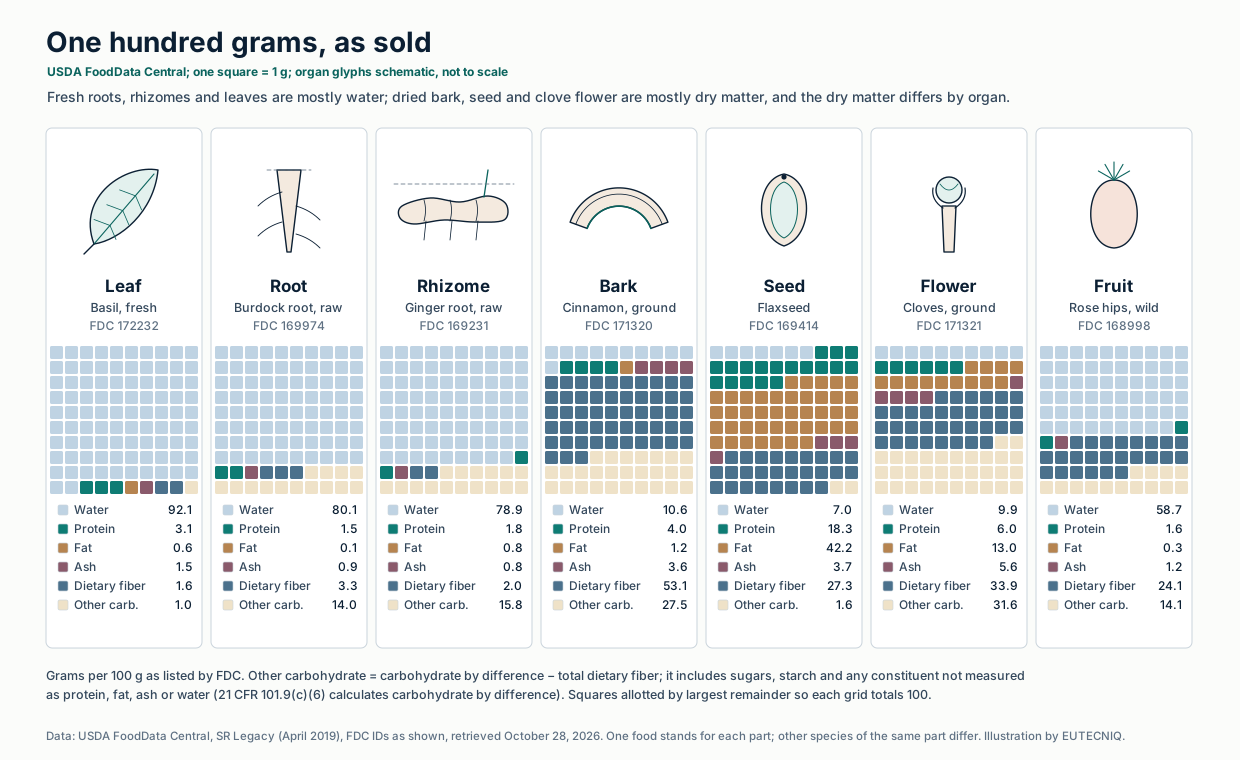
Most of a plant part is water, cell wall, storage carbohydrate, protein, fat and minerals. A proximate analysis measures moisture, protein, fat and ash and calculates carbohydrate as the remainder (21 CFR 101.9(c)(6)), so polyphenols, saponins and organic acids that are not measured separately land in “carbohydrate by difference”. On a dry basis the parts differ sharply: protein is 39.7% of basil leaf, fat 45.3% of flaxseed, fiber 59.4% of cinnamon bark.

| Constituent | What it is | Where a proximate analysis puts it | Source |
|---|---|---|---|
| Water | 92.06 g/100 g in fresh basil, 6.96 g in flaxseed | Water (moisture) | USDA FDC |
| Starch | Branched glucose polymer: amylopectin (many short branches) and amylose (few long branches) | Carbohydrate by difference | Zhang et al. 2026 |
| Sugars | Reported by FDC as “Sugars, total”; 3.21 g/100 g in ground turmeric | Inside carbohydrate by difference; listed separately where measured | USDA FDC |
| Inulin | Storage carbohydrate; 5,008 mg/100 g fresh weight reported in burdock root | Carbohydrate by difference | Burabaev et al. 2026 |
| Cellulose | Linear chain of β1,4-linked D-glucose in crystalline microfibrils about 3 nm thick | Dietary fiber | Cosgrove 2022 |
| Hemicellulose (e.g., xyloglucan) | β-(1,4)-glucan backbone with xylose on carbon-6 of three in four glucose units | Dietary fiber | Cosgrove 2022 |
| Pectin | Galacturonic acid-rich polysaccharides: homogalacturonan, rhamnogalacturonan-I and -II | Dietary fiber | Cosgrove 2022 |
| Lignin | Phenolic polymer from oxidative coupling of p-coumaryl, coniferyl and sinapyl alcohols | Dietary fiber (named in 21 CFR 101.9) | Wang et al. 2025 |
| Protein | 3.15 g/100 g in fresh basil, 18.29 g in flaxseed | Protein | USDA FDC |
| Lipids | 42.16 g/100 g in flaxseed, 0.15 g in raw burdock root | Total fat | USDA FDC |
| Minerals | K, Ca, Mg and other elements; ash 7.08 g/100 g in ground turmeric | Ash | USDA FDC |
| Polyphenols, saponins, organic acids, other actives | The compounds in the tables above | Not a proximate fraction: fall into carbohydrate by difference unless measured | 21 CFR 101.9 |
21 CFR 101.9(c)(6) and (c)(6)(i), eCFR current to October 23, 2026. Cosgrove DJ. Plant Physiol 2022;189:1246-1277. Wang N et al. Front Plant Sci 2025;16:1543168. Zhang S et al. Carbohydr Res 2026. Burabaev A et al. Nat Prod Res 2026. Proximate values: USDA FoodData Central.
| Food (FDC ID) | Plant part, form | Water, g | Protein, g | Fat, g | Ash, g | Carbohydrate by difference, g | of which fiber, g | Sugars, g | K, mg | Ca, mg |
|---|---|---|---|---|---|---|---|---|---|---|
| Basil, fresh (172232) | Leaf, fresh | 92.1 | 3.15 | 0.64 | 1.49 | 2.65 | 1.60 | 0.30 | 295 | 177 |
| Burdock root, raw (169974) | Root, raw | 80.1 | 1.53 | 0.15 | 0.89 | 17.3 | 3.30 | 2.90 | 308 | 41 |
| Ginger root, raw (169231) | Rhizome (ginger), raw | 78.9 | 1.82 | 0.75 | 0.77 | 17.8 | 2.00 | 1.70 | 415 | 16 |
| Spices, turmeric, ground (172231) | Rhizome (turmeric), dried, ground | 12.8 | 9.68 | 3.25 | 7.08 | 67.1 | 22.7 | 3.21 | 2,080 | 168 |
| Spices, cinnamon, ground (171320) | Bark (cinnamon), dried, ground | 10.6 | 3.99 | 1.24 | 3.60 | 80.6 | 53.1 | 2.17 | 431 | 1,002 |
| Seeds, flaxseed (169414) | Seed (flax), whole | 6.96 | 18.3 | 42.2 | 3.72 | 28.9 | 27.3 | 1.55 | 813 | 255 |
| Spices, mustard seed, ground (170929) | Seed (mustard), dried, ground | 5.27 | 26.1 | 36.2 | 4.33 | 28.1 | 12.2 | 6.79 | 738 | 266 |
| Spices, cloves, ground (171321) | Flower (clove), dried, ground | 9.87 | 5.97 | 13.0 | 5.63 | 65.5 | 33.9 | 2.38 | 1,020 | 632 |
| Roselle, raw (168170) | Calyx (roselle), raw | 86.6 | 0.96 | 0.64 | 0.51 | 11.3 | – | – | 208 | 215 |
| Spices, pepper, black (170931) (the five values sum to 94.55 g) | Fruit (black pepper), dried | 12.5 | 10.4 | 3.26 | 4.49 | 64.0 | 25.3 | 0.64 | 1,329 | 443 |
| Rose Hips, wild (Northern Plains Indians) (168998) | Fruit (rose hip), raw | 58.7 | 1.60 | 0.34 | 1.18 | 38.2 | 24.1 | 2.58 | 429 | 169 |
| Garlic, raw (169230) | Bulb (garlic), raw | 58.6 | 6.36 | 0.50 | 1.50 | 33.1 | 2.10 | 1.00 | 401 | 181 |
USDA FoodData Central, SR Legacy records as linked (published April 2019; API retrieved October 28, 2026). “–”: not reported in the record. Plant parts: basil leaves (Chaves et al. 2026); EMA HMPC herbal-substance names (Arctii radix, Zingiberis rhizoma, Curcumae longae rhizoma, Cinnamomi cortex, Lini semen, Caryophylli floris, Allii sativi bulbus); roselle calyces (Dada et al. 2026); black pepper fruit (Hadibrata et al. 2026); rose hip fruits (Raal et al. 2026); mustard seeds (Guijarro-Real et al. 2021).
Powder and extract
Powdering changes particle size, not composition. Extraction changes composition. EMA's herbal guideline gives the extract types defined meanings: an extract adjusted to a marker whose therapeutic activity is not established is a quantified extract, not a standardized one. The drug–extract ratio (DER) counts kilograms of herb per kilogram of genuine extract, excipients excluded. It does not state potency: marker content also depends on how much of the marker the process recovers, as the worked batch shows.
| Form | Definition | How it is declared (EMA/HMPC example) |
|---|---|---|
| Herbal substance (whole or cut part) | The dried plant part, named by its Latin herbal-substance name (for example Valerianae radix, Lini semen) | Species and part; no ratio |
| Powdered herbal substance | The same part, comminuted; composition unchanged, so the proximate table above still applies | Mass of powder per dose |
| Standardized extract | “Adjusted within an acceptable tolerance to a given content of constituents with known therapeutic activity”, by adding excipients or blending batches | Horse chestnut seed: 140–190 mg dry extract “corresponding to 38 mg triterpene glycosides, calculated as anhydrous ß-aescin”; methanol 80% V/V |
| Quantified extract | “Adjusted to a defined range of constituents (active markers)”, by blending batches | Ginkgo leaf: 60 mg refined dry extract (35–67 : 1) |
| Other extract | “Essentially defined by their production process and their specifications” | Valerian root: 160 mg dry extract (3–6 : 1); ethanol 70% V/V |
| DER genuine | Herbal substance used ÷ genuine (excipient-free) preparation obtained | Written as a range, for example 3–6 : 1 |
EMA/HMPC/CHMP/CVMP/287539/2005 Rev.1 (in effect October 1, 2010), sections 6.2.1–6.2.3 and definitions; quotations are from the guideline. A Revision 2 draft has been published for consultation.
Adaptogens
The word “adaptogen” was coined in 1947 by Lazarev. EMA's herbal committee reviewed the concept in 2008 and concluded that “the term is not accepted in pharmacological and clinical terminology that is commonly used in the EU”. Its monographs for rhodiola, eleutherococcus and ginseng rest on traditional use, for symptoms such as fatigue and weakness, not on the adaptogen concept. For withania it adopted no monograph, and schisandra is not on its inventory.
| Plant | Part | Marker compounds (CID; MW, g/mol; XLogP3) | EMA HMPC status, October 2026 | Sources |
|---|---|---|---|---|
| Rhodiola rosea | rhizome and root | Salidroside (159278; 300.3; −0.6) Rosavin (9823887; 428.4; −2) | EU herbal monograph, traditional use; Revision 1 (EMA/HMPC/24177/2023) published August 2, 2023 | EMA, Rhodiola · Erst et al. 2023 |
| Withania somnifera | root and leaf | Withaferin A (265237; 470.6; 3.8) Withanolide A (11294368; 470.6; 3.3) | No EU monograph: public statement adopted July 9, 2013; HMPC found no adequate evidence of 30 years of medicinal use, 15 in the EU, and no adequate extract specification | EMA public statement 2013 · Yukta et al. 2026 |
| Eleutherococcus senticosus | root and rhizome | Eleutheroside B (syringin) (5316860; 372.4; −1.3) Eleutheroside E (71312557; 742.7; −1.4) | EU herbal monograph, traditional use (EMA/HMPC/680618/2013, published October 6, 2014); second review opened February 2025 | EMA, Eleutherococcus · Yang et al. 2022 |
| Panax ginseng | root | Ginsenoside Rb1 (9898279; 1109.3; 0.3) Ginsenoside Rg1 (441923; 801.0; 2.7) | EU herbal monograph, traditional use; Revision 1 (EMA/HMPC/27744/2023) published July 12, 2024 | EMA, Ginseng radix · ChEBI via PubChem |
| Schisandra chinensis | fruit | Schisandrin A (155256; 416.5; 5.3) Schisandrin B (108130; 400.5; 5.1) | No row on the HMPC inventory and priority list of January 2026 | EMA HMPC list 2026 · Hong et al. 2026 · Yadav and Yadav 2025 |
EMA herbal medicinal product pages and HMPC inventory (January 2026), opened October 28, 2026. Markers and parts: Rhodiola, Erst et al. 2023 (rosavins in the underground part) and EMA; Withania, Yukta et al. 2026 (withaferin A and withanolides from roots and leaves); Eleutherococcus, Yang et al. 2022 (eleutherosides B and E in roots and rhizomes); ginseng, ChEBI and EMA; Schisandra, Hong et al. 2026 and Yadav and Yadav 2025 (lignans from the fruit). PubChem properties retrieved October 28, 2026.
How US law treats these claims
21 CFR 101.93 does not use the word adaptogen. A supplement label may carry a structure/function statement under that section, with a disclaimer and a notification to FDA, and FDA does not pre-approve it. What decides legality is what the statement claims: a reference to the signs or symptoms of a disease, through words, the product name, a cited publication or a picture, makes it a disease claim under 101.93(g)(2). EMA monograph indications are written for herbal medicinal products, not for supplement labels.
| Requirement | Rule | Citation |
|---|---|---|
| What may be said | A statement on the role of a nutrient or dietary ingredient intended to affect the normal structure or function of the body | 21 CFR 101.93(f); FDA structure/function page |
| Notification | Notify FDA no later than 30 days after first marketing the product with the statement | 21 CFR 101.93(a)(1) |
| Disclaimer | “This statement has not been evaluated by the Food and Drug Administration. This product is not intended to diagnose, treat, cure, or prevent any disease.” In boldface, letters at least 1/16 inch | 21 CFR 101.93(c), (e) |
| Placement | Adjacent to the statement, or linked to it by a symbol such as an asterisk; if not adjacent, set off in a box | 21 CFR 101.93(d) |
| What makes it a disease claim | Ten criteria, including an effect on a specific disease or its characteristic signs or symptoms, through the product name, a cited publication, pictures, or by suggesting the product substitutes for a therapy | 21 CFR 101.93(g)(2)(i)–(x) |
| Disease | “Damage to an organ, part, structure, or system of the body such that it does not function properly” | 21 CFR 101.93(g)(1) |
| Approval | Not pre-approved by FDA; the firm must hold substantiation that the claim is truthful and not misleading | FDA, Structure/Function Claims (March 28, 2024) |
eCFR, 21 CFR 101.93, up to date as of October 23, 2026; FDA, Structure/Function Claims, content current as of March 28, 2024.
Where EUTECNIQ would work
Proposed capability EUTECNIQ is designed to identify a botanical's marker compounds, measure them with validated methods, and specify extracts by EMA-style type and genuine DER, with recovery reported. It has no laboratory, data or customers yet.
Related: Absorption and PBPK · Extraction · Purification and standardization · Discovery and characterization · Bioavailability design · Plant identity · Why no disease claims · NDI notifications
Health information notice
These statements have not been evaluated by the Food and Drug Administration. Nothing on this site is intended to diagnose, treat, cure or prevent any disease. The information is for general education only. It is not medical advice and does not replace advice, diagnosis or treatment from a qualified health professional, or any medication a clinician has prescribed.
Do not start, stop or change any medicine, supplement or herbal product because of something you read here. Talk to your doctor or pharmacist first, especially if you are pregnant or breastfeeding, have a medical condition, take any medicines, are preparing for surgery, or are caring for a child. Research findings, traditional uses and safety data are reported as their sources state them; they are not recommendations or claims about any product. If you think you may have a medical emergency, call your doctor or 911 at once.
EUTECNIQ Sciences sells no supplements or health products today and receives nothing from any product or ingredient mentioned on this site; any commercial interest it later has in an ingredient will be stated on that ingredient’s page.