EUTECNIQAtlas

Every page of EUTECNIQ on one mapArrow keys move through results · Enter opens · Esc closes

Reference library EUR-Lex, eCFR, FDA and EPA records ICH, IARC and PubChem data Peer-reviewed methods

Contaminants in botanicals

Five families of contaminant reach botanical products: mycotoxins, pesticide residues, toxic elements, toxins made by plants, and residual solvents. Each family is limited by different instruments, in different units and on a different basis, so the limits below are shown side by side with the record they come from.

0.01 mg/kgEU default pesticide residue limit where no specific limit is set (Regulation (EC) No 396/2005, Art. 18(1)(b))
5.0 µg/kgEU maximum level for aflatoxin B1 in dried spices and dried ginger (Regulation (EU) 2023/915, entries 1.1.14–1.1.15)
5 µg/dayICH Q3D(R2) oral permitted daily exposure for lead, and for cadmium, in medicines
2 ppmICH Q3C(R9) limit for benzene, a Class 1 solvent to be avoided

EUR-Lex: Regulation (EC) No 396/2005 and Regulation (EU) 2023/915, consolidated text of July 1, 2025; ICH Q3D(R2) (2022), Table A.2.1; ICH Q3C(R9) (EMA Step 5, April 2024), Table 1. Opened October 27, 2026.

Status. EUTECNIQ is in formation. It has no laboratory, has tested no samples and holds no results. Statements about EUTECNIQ are proposals.

Related: Quality standards · CFR atlas · Extraction · Lessons learned · Reading a certificate of analysis

Selector Limits restated from this page

Pick a plant and a jurisdiction to see which limits on this page apply, and what to watch for

The same plant meets different limits in different markets, and some limits apply only to one product form. Choose a material, a jurisdiction and, if you like, a contaminant family. The selector shows only values already published on this page, plus the turmeric and curcumin values on the curcumin case, each with its instrument and what it applies to.

The selector needs JavaScript. Every value it shows is in the tables below.

Values from the sections below: Regulation (EU) 2023/915 (consolidated July 1, 2025); Regulation (EC) No 396/2005; Regulation (EC) No 1334/2008, Annex III; Directive 2009/32/EC; FDA action levels (CPG 555.400); 21 CFR Parts 111, 173 and 189; FDA Import Alert 54-10; 40 CFR Part 180; ICH Q3C(R9) and Q3D(R2); OEHHA Proposition 65. Curcumin color specifications: JECFA (2003) and Regulation (EU) No 231/2012, E 100, as cited on the curcumin case.

Overview

Five contaminant families

The families differ in where they enter and in who sets the limit. Food law (EU regulations, FDA action levels, EPA tolerances) sets concentrations in the food. Drug guidelines (ICH Q3C, Q3D) set permitted daily exposures and convert them to concentrations through an assumed daily dose. California's Proposition 65 publishes safe harbor levels in µg/day: a No Significant Risk Level (cancer) and a Maximum Allowable Dose Level (reproductive toxicity).

Five contaminant families: origin, examples, main instruments and units
FamilyOriginExamplesMain instrumentsUsual units
MycotoxinsFungal metabolites formed in the field or in storageAflatoxins, ochratoxin A, fumonisinsEU 2023/915 Annex I, section 1; FDA action, advisory and guidance levelsµg/kg
Pesticide residuesCrop-protection productsChlorpyrifos, glyphosate, mancozebEU 396/2005 (limits, 0.01 mg/kg default); EPA tolerances, 40 CFR Part 180mg/kg
Toxic elementsAir, water and soil; taken up by the growing plantLead, cadmium, arsenic, mercuryEU 2023/915 section 3; ICH Q3D (medicines); USP ⟨2232⟩ (finished supplements); Proposition 65mg/kg, µg/g, µg/day
Plant-made toxinsMade by the plant itself or by weeds harvested with itPyrrolizidine alkaloids, aristolochic acids, safroleEU 2023/915 section 2.4; EU 1334/2008 Annex III; 21 CFR Part 189; FDA Import Alert 54-10µg/kg, mg/kg
Residual solventsExtraction and purificationHexane, methanol, dichloromethaneICH Q3C; USP ⟨467⟩; 21 CFR Part 173; Directive 2009/32/ECppm, mg/day, mg/kg

FDA, toxic metals in foods (content current as of April 20, 2018): elements “occur naturally and as environmental pollutants in air, water and soil and they enter the food supply when plants take them up as they grow.” eCFR Title 40 Part 180 and Title 21 Parts 173 and 189, up to date as of October 26, 2026. Instruments are detailed in the sections below.

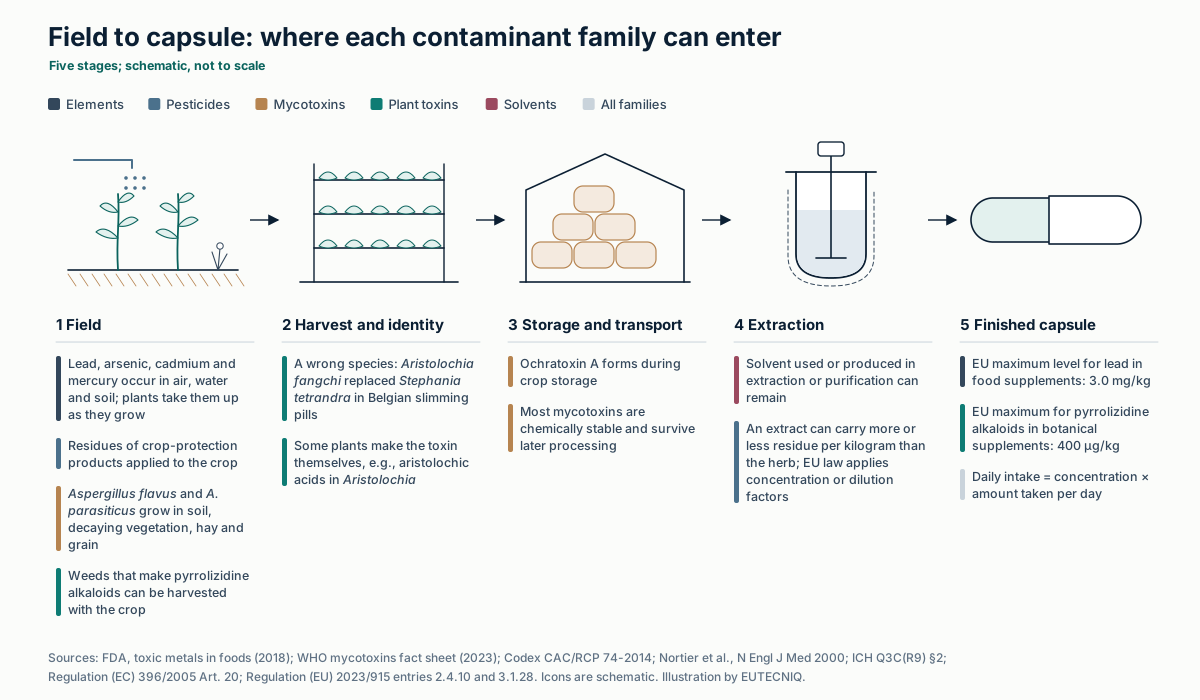
Each family enters at a different stage, from the soil to the extraction vessel, and the limit applies to the finished productSchematic
Schematic of five stages from field to finished capsule: field, harvest and identity, storage and transport, extraction, and the finished capsule. Under each stage, color-coded entries show which contaminant family can enter there: elements from soil, water and air; pesticide residues; mycotoxins from Aspergillus and storage; pyrrolizidine alkaloids from co-harvested weeds and toxins made by the plant itself; residual solvents from extraction; and the EU limits that apply to the finished food supplement.
FDA, toxic metals in foods (2018); WHO mycotoxins fact sheet (October 2, 2023); Codex CAC/RCP 74-2014; Nortier JL, et al. N Engl J Med. 2000;342:1686–1692; ICH Q3C(R9) Section 2; Regulation (EC) No 396/2005, Art. 20; Regulation (EU) 2023/915, entries 2.4.10 and 3.1.28. Schematic, not to scale. Illustration by EUTECNIQ. Full-size SVG
Mycotoxins

Mycotoxins by fungus and organ

Mycotoxins are toxic metabolites of molds. WHO states that “most mycotoxins are chemically stable and survive food processing,” so drying, extraction and encapsulation are not removal steps. An IARC group states the strength of evidence that an agent can cause cancer; IARC says it “does not indicate the level of risk” at a given exposure.

Mycotoxins: producing fungi, main foods, main target or effect, IARC classification
ToxinProducing fungiMain foodsMain target or effectIARC group (volume, year evaluated)
Aflatoxins B1, B2, G1, G2Aspergillus flavus, A. parasiticusCereals, oilseeds, spices, tree nutsLiver; genotoxic; liver cancer in humans1, aflatoxins (100F, 2009)
Aflatoxin M1Occurs in the milk of animals fed contaminated feedMilkAs for the aflatoxins1, within “aflatoxins”
Ochratoxin AAspergillus and Penicillium speciesCereals, coffee, dried vine fruit, wine, spices, licorice; forms in storageKidney; also fetal development and immune system2B (56, 1992)
Fumonisins B1, B2Fusarium speciesMaizeLinked to esophageal cancer in humans; liver and kidney in animals2B, fumonisin B1 (82, 2002)
DeoxynivalenolFusarium speciesWheatAcute gut and skin irritation; immune suppression in animals3 (56, 1992)
ZearalenoneFusarium speciesWheatEstrogenic; infertility, particularly in pigs3 (56, 1992)
T-2 and HT-2 toxinsFusarium speciesOatsTrichothecenes: gut and skin irritation; immune suppression in animals3, T-2 toxin (56, 1992)
PatulinAspergillus, Penicillium, ByssochlamysRotting apples, apple juiceNausea and vomiting in humans; liver, spleen, kidney in animals3 (40, 1987)
CitrininAspergillus, Penicillium, MonascusStored grains; red yeast riceKidney; rat NOAEL 20 µg/kg bw/day; level of no concern 0.2 µg/kg bw/day3 (40, 1987)
Ergot alkaloidsClaviceps purpurea (most widespread in Europe)Rye and other cerealsVasoconstriction; group TDI 0.6 µg/kg bw/day, ARfD 1 µg/kg bwNot evaluated
Alternaria toxinsAlternaria speciesUnder EU monitoring (Recommendation (EU) 2022/553)Alternariol and its monomethyl ether are genotoxic; exposure exceeded the TTC, so more data are neededNot evaluated

WHO, Mycotoxins fact sheet, October 2, 2023. IARC Monographs list of classifications (agent data served by monographs.iarc.who.int, read October 27, 2026); IARC, Questions and Answers. EFSA CONTAM Panel: citrinin, EFSA J 2012;10(3):2605; ergot alkaloids, EFSA J 2012;10(7):2798; Alternaria toxins, EFSA J 2011;9(10):2407.

Mechanism

How aflatoxin B1 damages DNA

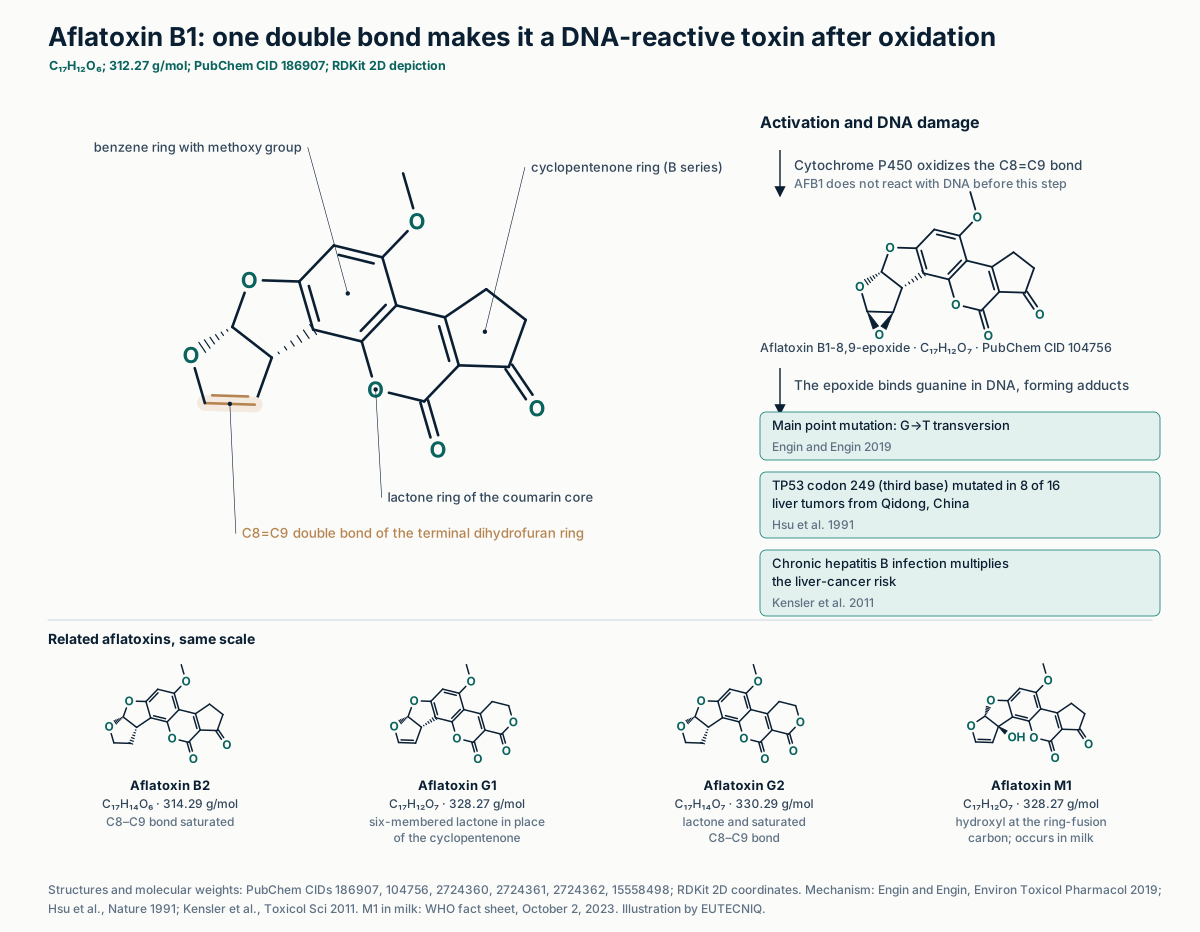
Aflatoxin B1 cannot react with DNA until cytochrome P450 enzymes oxidize it to the 8,9-epoxide, which binds guanine. Its main point mutation is a G→T transversion. In liver tumors from Qidong, China, 8 of 16 carried a mutation at the third base of TP53 codon 249.

Five aflatoxins: formula, molecular weight, PubChem identifier and the structural difference from aflatoxin B1
AflatoxinFormulaMolecular weight, g/molPubChem CIDDifference from B1
B1C₁₇H₁₂O₆312.27186907Reference: C8=C9 double bond, cyclopentenone ring
B2C₁₇H₁₄O₆314.292724360C8–C9 bond saturated
G1C₁₇H₁₂O₇328.272724361Six-membered lactone in place of the cyclopentenone
G2C₁₇H₁₄O₇330.292724362Both changes
M1C₁₇H₁₂O₇328.2715558498Hydroxyl at the ring-fusion carbon

PubChem compound records (formula, computed molecular weight, isomeric SMILES), read October 27, 2026. Engin AB, Engin A. Environ Toxicol Pharmacol. 2019;65:90–96. Hsu IC, et al. Nature. 1991;350:427–428. Kensler TW, et al. Toxicol Sci. 2011;120(Suppl 1):S28–S48.

Aflatoxin B1 becomes DNA-reactive only after its C8=C9 double bond is oxidized to an epoxide; B2 and G2 lack that bondReference structures, RDKit depiction
Skeletal formula of aflatoxin B1, C17H12O6, 312.27 g/mol, with the double bond of the terminal dihydrofuran ring highlighted. An arrow shows cytochrome P450 oxidation of that bond to aflatoxin B1-8,9-epoxide, which binds guanine in DNA. Notes give the G-to-T transversion, the TP53 codon 249 finding in liver tumors and the interaction with hepatitis B. A lower row compares aflatoxins B2, G1, G2 and M1.
Structures: PubChem CIDs 186907, 104756, 2724360, 2724361, 2724362, 15558498, drawn from RDKit 2D coordinates aligned to a common core. Mechanism: Engin AB, Engin A. Environ Toxicol Pharmacol. 2019;65:90–96; Hsu IC, et al. Nature. 1991;350:427–428; Kensler TW, et al. Toxicol Sci. 2011;120(Suppl 1):S28–S48. Illustration by EUTECNIQ. Full-size SVG
Limits

Mycotoxin limits compared

The EU sets binding maximum levels by toxin and commodity. Wherever a toxin has an entry for foods for infants and young children, that entry is the lowest; for deoxynivalenol, zearalenone, fumonisins and T-2/HT-2 the highest applies to unprocessed grain. FDA instead publishes action levels, at or above which it may take enforcement action, plus advisory and guidance levels. USP ⟨561⟩, the pharmacopeial chapter for articles of botanical origin, is subscription-only; its values are covered in the certificate-of-analysis course.

EU maximum levels span more than five orders of magnitude; herbs and spices sit at 5–20 µg/kgEU regulation and FDA levels
Strip chart of maximum levels for eleven mycotoxin groups in Regulation (EU) 2023/915 on a log scale from 0.025 to 4,000 micrograms per kilogram, with botanical entries highlighted and FDA action levels markedHerbs, spices, botanical supplementsHerbs, spices, botanical supplementsOther foodsOther foodsFoods for infants and young childrenFoods for infants and young childrenFDA action, advisory or guidance levelFDA action, advisory or guidance levelBotanical entries, µg/kgAflatoxin B1Aflatoxin B1, Foods for infants and young children (entry 1.1.18): 0.10 µg/kgAflatoxin B1, Cereals and cereal products (entry 1.1.12): 2 µg/kgAflatoxin B1, Groundnuts and tree nuts for the final consumer (entry 1.1.5, 1.1.7): 2 µg/kgAflatoxin B1, Dried Capsicum, pepper, nutmeg, turmeric, ginger and mixtures (entry 1.1.14, 1.1.15): 5 µg/kgAflatoxin B1, Groundnuts to be sorted (entry 1.1.4): 8 µg/kgAflatoxin B1, Almonds, pistachios, apricot kernels (entry 1.1.9): 8 µg/kgDried spices and ginger: 5.0Aflatoxins, sum of fourAflatoxins, sum of four, Cereals and cereal products (entry 1.1.12): 4 µg/kgAflatoxins, sum of four, Groundnuts and tree nuts for the final consumer (entry 1.1.5, 1.1.7): 4 µg/kgAflatoxins, sum of four, Dried spices and ginger (entry 1.1.14, 1.1.15): 10 µg/kgAflatoxins, sum of four, Almonds, pistachios, apricot kernels (entry 1.1.9): 10 µg/kgAflatoxins, sum of four, Groundnuts to be sorted (entry 1.1.4): 15 µg/kgFDA action level, total aflatoxins in foods (CPG 555.400): 20 µg/kgDried spices and ginger: 10.0Aflatoxin M1Aflatoxin M1, Infant, follow-on and young-child formulae (entry 1.1.17): 0.025 µg/kgAflatoxin M1, Raw and heat-treated milk (entry 1.1.16): 0.05 µg/kgFDA action level, milk (CPG 527.400): 0.50 µg/kgOchratoxin AOchratoxin A, Roasted coffee (entry 1.2.14): 3 µg/kgOchratoxin A, Unprocessed cereal grains (entry 1.2.9): 5 µg/kgOchratoxin A, Dried herbs (entry 1.2.5): 10 µg/kgOchratoxin A, Dried spices (entry 1.2.17): 15 µg/kgOchratoxin A, Capsicum (entry 1.2.18): 20 µg/kgOchratoxin A, Licorice root, dried (entry 1.2.19.1): 20 µg/kgOchratoxin A, Marshmallow root, dandelion root, orange blossom, dried (entry 1.2.7): 20 µg/kgHerbs 10 · spices 15 · Capsicum, licorice,marshmallow and dandelion root, orangeblossom 20PatulinPatulin, Apple juice, solid apple products and baby food for infants and young children (entry 1.3.4, 1.3.5): 10 µg/kgPatulin, Solid apple products for the final consumer (entry 1.3.3): 25 µg/kgPatulin, Fruit juices and nectars (entry 1.3.1): 50 µg/kgFDA action level, apple juice (CPG 510.150): 50 µg/kgDeoxynivalenolDeoxynivalenol, Foods for infants and young children (entry 1.4.9): 150 µg/kgDeoxynivalenol, Bakery wares, cereal snacks, breakfast cereals (entry 1.4.7): 400 µg/kgDeoxynivalenol, Unprocessed cereal grains (entry 1.4.1): 1,000 µg/kgDeoxynivalenol, Unprocessed durum wheat and maize (entry 1.4.2): 1,500 µg/kgDeoxynivalenol, Unprocessed oats with inedible husk (entry 1.4.3): 1,750 µg/kgFDA advisory level, finished wheat products (2010): 1,000 µg/kgZearalenoneZearalenone, Foods for infants and young children (entry 1.5.8): 20 µg/kgZearalenone, Bread, pastries, biscuits, breakfast cereals (entry 1.5.4): 50 µg/kgZearalenone, Unprocessed cereal grains (entry 1.5.1): 100 µg/kgZearalenone, Unprocessed maize (entry 1.5.2): 350 µg/kgFumonisins B1 + B2Fumonisins B1 + B2, Maize-based foods for infants and young children (entry 1.6.5): 200 µg/kgFumonisins B1 + B2, Maize for the final consumer (entry 1.6.2): 1,000 µg/kgFumonisins B1 + B2, Unprocessed maize (entry 1.6.1): 4,000 µg/kgFDA guidance level, degermed dry-milled corn, total fumonisins (2001): 2,000 µg/kgT-2 + HT-2T-2 + HT-2, Foods for infants and young children (entry 1.9.9): 10 µg/kgT-2 + HT-2, Cereals for the final consumer (entry 1.9.2): 20 µg/kgT-2 + HT-2, Unprocessed cereal grains (entry 1.9.1): 50 µg/kgT-2 + HT-2, Unprocessed oats with inedible husk (entry 1.9.1.4): 1,250 µg/kgCitrininCitrinin, Food supplements based on rice fermented with Monascus purpureus (entry 1.7.1): 100 µg/kgRed yeast rice supplements: 100Ergot alkaloidsErgot alkaloids, Processed cereal-based food for infants and young children (entry 1.8.2.5): 20 µg/kgErgot alkaloids, Barley, spelt and oat milling products (entry 1.8.2.1): 50 µg/kgErgot alkaloids, Wheat milling products (entry 1.8.2.1a): 100 µg/kgErgot alkaloids, Rye milling products (entry 1.8.2.3): 500 µg/kg0.010.11101001,00010,000Maximum level, µg/kg (log scale); dots at the same value are stackedMaximum levels for eleven mycotoxin groups in Regulation (EU) 2023/915, log scale, with botanical entries highlighted and FDA levels markedHerbs, spices, botanical supplementsHerbs, spices, botanical supplementsOther foodsOther foodsFoods for infants and young childrenFoods for infants and young childrenFDA action, advisory or guidance levelFDA action, advisory or guidance levelAflatoxin B1Aflatoxin B1, Foods for infants and young children: 0.10 µg/kgAflatoxin B1, Cereals and cereal products: 2 µg/kgAflatoxin B1, Groundnuts and tree nuts for the final consumer: 2 µg/kgAflatoxin B1, Dried Capsicum, pepper, nutmeg, turmeric, ginger and mixtures: 5 µg/kgAflatoxin B1, Groundnuts to be sorted: 8 µg/kgAflatoxin B1, Almonds, pistachios, apricot kernels: 8 µg/kgAflatoxins, sum of fourAflatoxins, sum of four, Cereals and cereal products: 4 µg/kgAflatoxins, sum of four, Groundnuts and tree nuts for the final consumer: 4 µg/kgAflatoxins, sum of four, Dried spices and ginger: 10 µg/kgAflatoxins, sum of four, Almonds, pistachios, apricot kernels: 10 µg/kgAflatoxins, sum of four, Groundnuts to be sorted: 15 µg/kgFDA action level, total aflatoxins in foods (CPG 555.400): 20 µg/kgAflatoxin M1Aflatoxin M1, Infant, follow-on and young-child formulae: 0.025 µg/kgAflatoxin M1, Raw and heat-treated milk: 0.05 µg/kgFDA action level, milk (CPG 527.400): 0.50 µg/kgOchratoxin AOchratoxin A, Roasted coffee: 3 µg/kgOchratoxin A, Unprocessed cereal grains: 5 µg/kgOchratoxin A, Dried herbs: 10 µg/kgOchratoxin A, Dried spices: 15 µg/kgOchratoxin A, Capsicum: 20 µg/kgOchratoxin A, Licorice root, dried: 20 µg/kgOchratoxin A, Marshmallow root, dandelion root, orange blossom, dried: 20 µg/kgPatulinPatulin, Apple juice, solid apple products and baby food for infants and young children: 10 µg/kgPatulin, Solid apple products for the final consumer: 25 µg/kgPatulin, Fruit juices and nectars: 50 µg/kgFDA action level, apple juice (CPG 510.150): 50 µg/kgDeoxynivalenolDeoxynivalenol, Foods for infants and young children: 150 µg/kgDeoxynivalenol, Bakery wares, cereal snacks, breakfast cereals: 400 µg/kgDeoxynivalenol, Unprocessed cereal grains: 1,000 µg/kgDeoxynivalenol, Unprocessed durum wheat and maize: 1,500 µg/kgDeoxynivalenol, Unprocessed oats with inedible husk: 1,750 µg/kgFDA advisory level, finished wheat products (2010): 1,000 µg/kgZearalenoneZearalenone, Foods for infants and young children: 20 µg/kgZearalenone, Bread, pastries, biscuits, breakfast cereals: 50 µg/kgZearalenone, Unprocessed cereal grains: 100 µg/kgZearalenone, Unprocessed maize: 350 µg/kgFumonisins B1 + B2Fumonisins B1 + B2, Maize-based foods for infants and young children: 200 µg/kgFumonisins B1 + B2, Maize for the final consumer: 1,000 µg/kgFumonisins B1 + B2, Unprocessed maize: 4,000 µg/kgFDA guidance level, degermed dry-milled corn, total fumonisins (2001): 2,000 µg/kgT-2 + HT-2T-2 + HT-2, Foods for infants and young children: 10 µg/kgT-2 + HT-2, Cereals for the final consumer: 20 µg/kgT-2 + HT-2, Unprocessed cereal grains: 50 µg/kgT-2 + HT-2, Unprocessed oats with inedible husk: 1,250 µg/kgCitrininCitrinin, Food supplements based on rice fermented with Monascus purpureus: 100 µg/kgErgot alkaloidsErgot alkaloids, Processed cereal-based food for infants and young children: 20 µg/kgErgot alkaloids, Barley, spelt and oat milling products: 50 µg/kgErgot alkaloids, Wheat milling products: 100 µg/kgErgot alkaloids, Rye milling products: 500 µg/kg0.01110010,000Maximum level, µg/kg (log scale)
Regulation (EU) 2023/915, Annex I, consolidated text of July 1, 2025 (EUR-Lex), entries as listed in the table. Ergot alkaloids at the levels in force in October 2026. FDA: action levels guidance (CPG 555.400, 527.400, 510.150); DON advisory levels (2010); fumonisin guidance (2001).
Mycotoxin limits for botanical commodities in the EU and the corresponding FDA levels
Toxin and commodityEU maximum level, µg/kgEU entryFDA level
Aflatoxin B1, dried Capsicum, pepper, nutmeg, turmeric, mixtures; dried ginger5.01.1.14, 1.1.1520 ppb total aflatoxins in foods (action level, CPG 555.400)
Sum of aflatoxins B1, B2, G1, G2, same spices10.01.1.14, 1.1.15
Ochratoxin A, dried herbs101.2.5None published
Ochratoxin A, dried spices151.2.17None published
Ochratoxin A, Capsicum201.2.18None published
Ochratoxin A, dried licorice root, including for herbal infusions201.2.19.1None published
Ochratoxin A, dried marshmallow root, dandelion root, orange blossom201.2.7None published
Citrinin, food supplements of rice fermented with Monascus purpureus1001.7.1None published
Aflatoxin M1, raw and heat-treated milk0.0501.1.160.5 ppb (action level, CPG 527.400)
Patulin, fruit juices and nectars501.3.150 µg/kg in apple juice (action level, CPG 510.150)
Deoxynivalenol, unprocessed cereal grains1,0001.4.11 ppm in finished wheat products (advisory level)
Fumonisins B1 + B2, unprocessed maize4,0001.6.12–4 ppm total fumonisins in dry-milled corn products (guidance level)

EUR-Lex, Regulation (EU) 2023/915, consolidated July 1, 2025. FDA: Action Levels for Poisonous or Deleterious Substances in Human Food and Animal Feed (content current as of September 20, 2018); CPG Sec. 510.150 (August 24, 2018); Advisory Levels for Deoxynivalenol (2010); Fumonisin Levels in Human Foods and Animal Feeds (November 2001). FDA's mycotoxin page (July 6, 2026) lists no regulatory level for ochratoxin A. 1 ppb = 1 µg/kg.

Pesticides

Pesticide classes and targets

Resistance-management committees group active substances by the molecular target they hit: IRAC for insecticides, HRAC for herbicides, FRAC for fungicides. IRAC notes that most current insecticides act on nerve and muscle targets. An IARC group, where one exists, is a hazard classification, not a risk estimate.

Pesticide classes with examples, mode-of-action group, target and IARC classification
ClassExamplesMode-of-action groupTargetIARC group (examples)
OrganophosphatesChlorpyrifos, diazinon, malathionIRAC 1BAcetylcholinesterase inhibitionMalathion 2A, diazinon 2A, parathion 2B; chlorpyrifos not evaluated
CarbamatesCarbaryl, methomyl, aldicarbIRAC 1AAcetylcholinesterase inhibitionCarbaryl 3
OrganochlorinesChlordane, endosulfan; DDTIRAC 2A (cyclodienes); 3B (DDT)GABA-gated chloride channel block; sodium channel modulation (DDT)Lindane 1, DDT 2A, dieldrin 2A, chlordane 2B
PyrethroidsPermethrin, deltamethrin, cypermethrinIRAC 3ASodium channels held openPermethrin 3, deltamethrin 3
NeonicotinoidsImidacloprid, thiamethoxam, clothianidin, acetamipridIRAC 4ANicotinic acetylcholine receptor, competitive modulationNot evaluated
TriazinesAtrazine, simazineHRAC 5Photosystem II (D1 serine-264 binders)Atrazine 2A (vol. 140, evaluated 2025, in preparation); simazine 3
Phenoxy acids2,4-DHRAC 4Auxin mimics2,4-D 2B
GlyphosateGlyphosateHRAC 9EPSP synthase inhibition2A (vol. 112, 2015)
Pyridiniums (bipyridyliums)Paraquat, diquatHRAC 22Photosystem I electron diversionNot evaluated
DithiocarbamatesMancozeb, maneb, thiram, ziramFRAC M03Multi-site contact activityManeb 3, thiram 3, ziram 3
Azole fungicides (DMIs)Tebuconazole, propiconazoleFRAC 3Sterol C14-demethylase (CYP51)Not evaluated

IRAC Mode of Action Classification, version 11.5 (February 2026); HRAC Global Herbicide MoA Classification (2024); FRAC Code List (2019). IARC Monographs list of classifications, read October 27, 2026; “not evaluated” means no entry for that agent. IRAC: “Most current insecticides act on nerve and muscle targets.”

Regulatory status

Same active, different status

In the EU, a residue with no specific limit must not exceed 0.01 mg/kg (Regulation (EC) No 396/2005, Art. 18(1)(b)); for processed products the raw-commodity limit is adjusted by concentration or dilution factors (Art. 20). In the U.S., EPA sets tolerances in 40 CFR Part 180. The same molecule can be withdrawn in one market and in use in another, and its status can reverse in court.

Regulatory status of six pesticide actives in the United States, the European Union and Brazil
ActiveUnited States (EPA)European UnionBrazil (Anvisa)
ChlorpyrifosTolerances in force pending a final rule; December 2024 proposal keeps 11 crops; use on the canceled crops unlawful from July 1, 2025Approval not renewed, Implementing Regulation (EU) 2020/18 (January 10, 2020)Not checked
GlyphosateEPA 2017: “not likely to be carcinogenic to humans”; 2020 interim decision withdrawn in September 2022 after a court vacated its human-health part; updated assessment expected late 2026Renewed to December 15, 2033 (Implementing Regulation (EU) 2023/2660); ECHA's risk committee found it does not meet the criteria for classification as carcinogenicNot checked
ParaquatRestricted use; certified applicators only, with paraquat-specific training; 2021 interim decision; November 2025 memo on volatilizationCommission Directive 2003/112/EC annulled by the Court of First Instance, case T-229/04 (July 11, 2007)Banned from September 22, 2020 (RDC No. 177/2017)
AtrazineNot checkedNot included as an active substance, Decision 2004/248/EC: groundwater could exceed 0.1 µg/LNot checked
Imidacloprid, clothianidin, thiamethoxamNot checkedOutdoor uses banned from 2018 (Regulations (EU) 2018/783, 784, 785); approvals expired 2019–2020; acetamiprid renewed to February 28, 2033Not checked
MancozebNot checkedApproval not renewed, Implementing Regulation (EU) 2020/2087 (December 14, 2020)Not checked

EUR-Lex: Regulation (EC) No 396/2005, Arts. 2, 18, 20; Implementing Regulations (EU) 2020/18, 2020/2087, 2023/2660; Decision 2004/248/EC; judgment T-229/04. European Commission, neonicotinoids page. EPA: chlorpyrifos (updated August 24, 2026), glyphosate (August 26, 2026) and paraquat dichloride (November 13, 2025) pages. Anvisa, excluded monograph P01 (paraquate). “Not checked”: not verified for this page; China and India were not verified and are omitted.

Chlorpyrifos: withdrawn in the EU in 2020; in the U.S., revoked, reinstated by a court and still awaiting a final ruleRegulation and court records
Timeline of chlorpyrifos regulation 2020 to 2026: the EU did not renew approval in January 2020; in the U.S. EPA revoked all tolerances in 2021, a court vacated that rule in 2023, tolerances returned, and EPA proposed in 2024 to keep only 11 crops, with no final rule as of August 2026European UnionUnited States2020202120222023202420252026Approval not renewed: Implementing Regulation (EU) 2020/18, Jan 10, 2020Approval not renewedImplementing Regulation(EU) 2020/18, Jan 10, 2020Grace periods end: Apr 16, 2020; authorizations withdrawn by Feb 16Grace periods endApr 16, 2020;authorizations withdrawnby Feb 16All tolerances revoked: EPA final rule, Aug 2021All tolerances revokedEPA final rule, Aug 2021Rule vacated: Eighth Circuit, Nov 2, 2023Rule vacatedEighth Circuit, Nov 2, 2023Tolerances back in force: Court mandate, Dec 28, 2023Tolerances back inforceCourt mandate, Dec 28,2023Proposal: keep 11 crops: EPA proposed rule, Dec 2024Proposal: keep 11 cropsEPA proposed rule, Dec2024Cancelled uses unlawful: From Jul 1, 2025, except the 11 cropsCancelled uses unlawfulFrom Jul 1, 2025, exceptthe 11 cropsNo final rule yet: EPA page, Aug 24, 2026No final rule yetEPA page, Aug 24, 2026Timeline of chlorpyrifos regulation in the EU and the U.S., 2020 to 20262020EUApproval not renewedImplementing Regulation (EU) 2020/18, Jan 10,20202020EUGrace periods endApr 16, 2020; authorizations withdrawn by Feb 162021USAll tolerances revokedEPA final rule, Aug 20212023USRule vacatedEighth Circuit, Nov 2, 20232023USTolerances back in forceCourt mandate, Dec 28, 20232024USProposal: keep 11 cropsEPA proposed rule, Dec 20242025USCancelled uses unlawfulFrom Jul 1, 2025, except the 11 crops2026USNo final rule yetEPA page, Aug 24, 2026
Implementing Regulation (EU) 2020/18, Arts. 1, 3, 4 (EUR-Lex). U.S. EPA, Chlorpyrifos, page updated August 24, 2026: 2021 final rule, Eighth Circuit decision of November 2, 2023, mandate of December 28, 2023, proposed rule of December 2024, cancellation orders effective July 1, 2025.
Method

Multiresidue analysis by QuEChERS

QuEChERS (quick, easy, cheap, effective, rugged, safe) extracts a wide range of residues in one pass, including very polar and basic ones. Acetonitrile dissolves the residues; magnesium sulfate and salt force the water out into a separate layer; a primary secondary amine sorbent then strips organic acids, some polar pigments and sugars. The extract then goes to GC-MS and LC-MS/MS.

Five steps from a homogenized sample to an injection-ready extractPeer-reviewed method
QuEChERS sample preparation in five steps: weigh 10 g, extract with 10 mL acetonitrile, partition with magnesium sulfate and sodium chloride, clean up by dispersive solid-phase extraction with PSA, then measure by GC-MS or LC-MS/MS1Weigh10 g homogenizedsample in a tube2ExtractAdd 10 mLacetonitrile; shake(single phase)3PartitionAdd 4 g anhydrousMgSO₄ + 1 g NaCl;water separates fromacetonitrile;centrifuge4Clean up(dispersive SPE)1 mL extract + 150 mgMgSO₄ + 25 mg PSAsorbent; PSAremoves organicacids, some polarpigments and sugars5MeasureGC-MS in 2003;GC-MS andLC-MS/MS in the2007 collaborativestudyOriginal method (Anastassiades et al. 2003); AOAC 2007.01 scales it to 15 g, 15 mL acetonitrile with 1% acetic acid, 6 g MgSO₄ + 1.5 g sodium acetateSchematic, not to scale. PSA = primary secondary amine sorbent; MS/MS = tandem mass spectrometry.QuEChERS sample preparation in five steps1Weigh10 g homogenized sample in a tube2ExtractAdd 10 mL acetonitrile; shake (single phase)3PartitionAdd 4 g anhydrous MgSO₄ + 1 g NaCl; waterseparates from acetonitrile; centrifuge4Clean up (dispersive SPE)1 mL extract + 150 mg MgSO₄ + 25 mg PSA sorbent;PSA removes organic acids, some polar pigments andsugars5MeasureGC-MS in 2003; GC-MS and LC-MS/MS in the 2007collaborative studyAOAC 2007.01: 15 g, 15 mL acetonitrile with 1% acetic acid, 6g MgSO₄ + 1.5 g sodium acetate.
Anastassiades M, Lehotay SJ, Štajnbaher D, Schenck FJ. J AOAC Int. 2003;86(2):412–431. Lehotay SJ. J AOAC Int. 2007;90(2):485–520 (AOAC Official Method 2007.01 collaborative study).
Thirteen laboratories, 20 pesticides: mean recoveries of 68–96% with reproducibility RSDs of 15–34%Collaborative study data
Dot chart of mean recoveries of 20 pesticides in the QuEChERS collaborative study (grapes, lettuce, oranges; 7 to 13 laboratories): 68 to 96 percent, with reproducibility RSDs of 15 to 34 percentRecovery of 20 pesticides spiked at 10–1000 ng/g; dot teal at 85% or above, copper belowCarbarylCarbaryl (Carbamate): mean recovery 96%, RSD(R) 20%96Carbaryl: RSD(R) 20%20ImidaclopridImidacloprid (Neonicotinoid): mean recovery 96%, RSD(R) 16%96Imidacloprid: RSD(R) 16%16MethomylMethomyl (Carbamate): mean recovery 96%, RSD(R) 17%96Methomyl: RSD(R) 17%17AzoxystrobinAzoxystrobin (Fungicide): mean recovery 93%, RSD(R) 15%93Azoxystrobin: RSD(R) 15%15AtrazineAtrazine (Triazine herbicide): mean recovery 92%, RSD(R) 18%92Atrazine: RSD(R) 18%18ProcymidoneProcymidone (Fungicide): mean recovery 91%, RSD(R) 20%91Procymidone: RSD(R) 20%20BifenthrinBifenthrin (Pyrethroid): mean recovery 90%, RSD(R) 16%90Bifenthrin: RSD(R) 16%16ChlorpyrifosChlorpyrifos (Organophosphate): mean recovery 89%, RSD(R) 25%89Chlorpyrifos: RSD(R) 25%25CyprodinilCyprodinil (Fungicide): mean recovery 89%, RSD(R) 19%89Cyprodinil: RSD(R) 19%19o,p′-DDDo,p′-DDD (Organochlorine): mean recovery 89%, RSD(R) 18%89o,p′-DDD: RSD(R) 18%18LinuronLinuron (Herbicide): mean recovery 89%, RSD(R) 19%89Linuron: RSD(R) 19%19TebuconazoleTebuconazole (Azole fungicide): mean recovery 89%, RSD(R) 15%89Tebuconazole: RSD(R) 15%15MethamidophosMethamidophos (Organophosphate): mean recovery 87%, RSD(R) 17%87Methamidophos: RSD(R) 17%17TrifluralinTrifluralin (Herbicide): mean recovery 85%, RSD(R) 20%85Trifluralin: RSD(R) 20%20DichlorvosDichlorvos (Organophosphate): mean recovery 82%, RSD(R) 21%82Dichlorvos: RSD(R) 21%21Endosulfan sulfateEndosulfan sulfate (Organochlorine): mean recovery 80%, RSD(R) 27%80Endosulfan sulfate: RSD(R) 27%27ImazalilImazalil (Azole fungicide): mean recovery 77%, RSD(R) 33%77Imazalil: RSD(R) 33%33ChlorothalonilChlorothalonil (Fungicide): mean recovery 70%, RSD(R) 34%70Chlorothalonil: RSD(R) 34%34PymetrozinePymetrozine (Insecticide): mean recovery 69%, RSD(R) 19%69Pymetrozine: RSD(R) 19%19TolylfluanidTolylfluanid (Fungicide): mean recovery 68%, RSD(R) 33%68Tolylfluanid: RSD(R) 33%335060708090100110Mean recovery, %02040RSD(R), %Mean recoveries and reproducibility RSDs of 20 pesticides in the QuEChERS collaborative studyCarbarylCarbaryl (Carbamate): mean recovery 96%, RSD(R) 20%96Carbaryl: RSD(R) 20%20ImidaclopridImidacloprid (Neonicotinoid): mean recovery 96%, RSD(R) 16%96Imidacloprid: RSD(R) 16%16MethomylMethomyl (Carbamate): mean recovery 96%, RSD(R) 17%96Methomyl: RSD(R) 17%17AzoxystrobinAzoxystrobin (Fungicide): mean recovery 93%, RSD(R) 15%93Azoxystrobin: RSD(R) 15%15AtrazineAtrazine (Triazine herbicide): mean recovery 92%, RSD(R) 18%92Atrazine: RSD(R) 18%18ProcymidoneProcymidone (Fungicide): mean recovery 91%, RSD(R) 20%91Procymidone: RSD(R) 20%20BifenthrinBifenthrin (Pyrethroid): mean recovery 90%, RSD(R) 16%90Bifenthrin: RSD(R) 16%16ChlorpyrifosChlorpyrifos (Organophosphate): mean recovery 89%, RSD(R) 25%89Chlorpyrifos: RSD(R) 25%25CyprodinilCyprodinil (Fungicide): mean recovery 89%, RSD(R) 19%89Cyprodinil: RSD(R) 19%19o,p′-DDDo,p′-DDD (Organochlorine): mean recovery 89%, RSD(R) 18%89o,p′-DDD: RSD(R) 18%18LinuronLinuron (Herbicide): mean recovery 89%, RSD(R) 19%89Linuron: RSD(R) 19%19TebuconazoleTebuconazole (Azole fungicide): mean recovery 89%, RSD(R) 15%89Tebuconazole: RSD(R) 15%15MethamidophosMethamidophos (Organophosphate): mean recovery 87%, RSD(R) 17%87Methamidophos: RSD(R) 17%17TrifluralinTrifluralin (Herbicide): mean recovery 85%, RSD(R) 20%85Trifluralin: RSD(R) 20%20DichlorvosDichlorvos (Organophosphate): mean recovery 82%, RSD(R) 21%82Dichlorvos: RSD(R) 21%21Endosulfan sulfateEndosulfan sulfate (Organochlorine): mean recovery 80%, RSD(R) 27%80Endosulfan sulfate: RSD(R) 27%27ImazalilImazalil (Azole fungicide): mean recovery 77%, RSD(R) 33%77Imazalil: RSD(R) 33%33ChlorothalonilChlorothalonil (Fungicide): mean recovery 70%, RSD(R) 34%70Chlorothalonil: RSD(R) 34%34PymetrozinePymetrozine (Insecticide): mean recovery 69%, RSD(R) 19%69Pymetrozine: RSD(R) 19%19TolylfluanidTolylfluanid (Fungicide): mean recovery 68%, RSD(R) 33%68Tolylfluanid: RSD(R) 33%33507090110Mean recovery, %02040RSD(R), %
Lehotay SJ. J AOAC Int. 2007;90(2):485–520, abstract: averages over 7–13 laboratories (no internal standard) for 18 blind duplicates at 9 spiking levels (10–1000 ng/g) in grapes, lettuce and oranges. Intralaboratory repeatability averaged 9.8% RSD. Produce matrices, not dried botanicals.
Elements

Toxic elements and daily intake

ICH Q3D sets permitted daily exposures for medicines and states that it “does not apply to herbal products”; applying its numbers to a supplement is a choice, not a requirement. USP ⟨2232⟩ covers finished supplement dosage forms labeled as meeting USP standards and is “not intended to set limits for dietary ingredients.” A concentration limit becomes a dose only when multiplied by the amount taken each day.

Lead, cadmium, arsenic and mercury: ICH Q3D daily exposures, Option 1 concentrations, IARC groups, Proposition 65 levels and EU limits
ElementICH Q3D oral PDE, µg/dayParenteral PDE, µg/dayInhalation PDE, µg/dayOption 1 oral, µg/g (10 g/day)IARC groupProposition 65 safe harbor
Lead5550.52A (inorganic compounds)MADL 0.5 µg/day; NSRL 15 µg/day oral
Cadmium5230.51MADL 4.1 µg/day oral; NSRL 0.05 µg/day inhalation
Arsenic (inorganic)151521.51NSRL 10 µg/day (not inhalation); 0.06 µg/day inhalation
Mercury (inorganic)303133; methylmercury 2BNot checked

ICH Q3D(R2) (2022), Tables A.2.1 and A.2.2 and Section 2 (scope); all four are Class 1. USP ⟨2232⟩ preview (doi.usp.org). OEHHA Proposition 65 chemical pages for lead, cadmium and inorganic arsenic, read October 27, 2026. IARC list of classifications. EU: lead in food supplements 3.0 mg/kg (Regulation (EU) 2023/915, entry 3.1.28).

At the EU lead limit for supplements, 1.67 g of product a day reaches the 5 µg/day ICH Q3D oral PDEComputed from published limits
Log-log chart of daily lead intake against grams of product taken per day for a product at the EU food-supplement maximum level of 3.0 mg/kg and at the ICH Q3D Option 1 concentration of 0.5 µg/g, with the ICH Q3D oral PDE of 5 µg/day and the Proposition 65 levels of 0.5 and 15 µg/day as horizontal lines0.010.1110100Lead per day, µg (log)0.10.31310Product taken per day, g (log)ICH Q3D oral PDE, 5 µg/dayProp. 65 NSRL (cancer), 15 µg/dayProp. 65 MADL (reproductive), 0.5 µg/dayEU 2023/915 food supplements, 3.0 mg/kgICH Q3D Option 1 oral, 0.5 µg/gAt the EU limit, 1.67 g/day delivers 5 µgProducts at a concentration limitEU 2023/915 food supplements, 3.0mg/kgICH Q3D Option 1 oral, 0.5 µg/g1.67 g/day at 3.0 mg/kg delivers 5µg/dayDaily benchmarks (dashed)A concentration limit becomes a daily doseonly after it is multiplied by the amounttaken: µg/day = µg/g × g/day.Daily lead intake against grams of product per day at two concentration limits, with daily benchmarks0.010.1110100Lead per day, µg (log)0.10.31310Product taken per day, g (log)ICH Q3D oral PDE, 5 µg/dayProp. 65 NSRL (cancer), 15 µg/dayProp. 65 MADL (reproductive), 0.5 µg/dayEU 2023/915 food supplements, 3.0 mg/kgICH Q3D Option 1 oral, 0.5 µg/gAt the EU limit, 1.67 g/day delivers 5 µgEU 2023/915 food supplements, 3.0 mg/kgICH Q3D Option 1 oral, 0.5 µg/gµg/day = µg/g × g/day. Dot: 1.67 g/day at 3.0 mg/kg reachesthe 5 µg/day PDE.
Lines: µg/day = limit (µg/g) × product (g/day). Limits: Regulation (EU) 2023/915 entry 3.1.28 (3.0 mg/kg = 3.0 µg/g); ICH Q3D(R2) Tables A.2.1 and A.2.2; OEHHA, lead (MADL 0.5 µg/day; NSRL 15 µg/day oral). 5 ÷ 3.0 = 1.67 g/day.
FDA Closer to Zero lead action levels for processed food intended for babies and young children
FDA action levels for lead in processed food for babies and young children (final guidance, January 2025)ppb
Fruits, vegetables (except single-ingredient root vegetables), mixtures, yogurts, custards and puddings, single-ingredient meats10
Single-ingredient root vegetables20
Dry infant cereals20

FDA, Guidance for Industry: Action Levels for Lead in Processed Food Intended for Babies and Young Children (January 2025). Closer to Zero covers arsenic, lead, cadmium and mercury; its four stages run from evaluating the science to finalizing action levels (FDA page, content current as of January 6, 2025).

Plant-made toxins

Toxins the plant makes

Some contaminants are the plant's own chemistry, or that of a weed or a substituted species. Over 6,000 plant species are expected to contain pyrrolizidine alkaloids, whose main target is the liver. In Belgian slimming pills, Aristolochia fangchi replaced Stephania tetrandra; of 39 patients with end-stage nephropathy who had surgery, 18 had urothelial carcinoma (46%).

Plant-made toxins: source, IARC group, U.S. status and EU status
ToxinSourceIARC groupUnited StatesEuropean Union
Pyrrolizidine alkaloidsOver 6,000 species; weeds harvested with cropsRiddelliine, lasiocarpine, monocrotaline 2BNot checkedMaximum levels, Regulation (EU) 2023/915 section 2.4 (table below)
Aristolochic acidsAristolochia; also named in the FDA alert: Asarum, Cocculus, Thottea1 (aristolochic acid and plants containing it)Import Alert 54-10: detention without physical examination of supplements containing aristolochic acidNot checked
SafroleSassafras; sassafras oil is about 80% safrole2BFood with added safrole or sassafras oil is adulterated (21 CFR 189.180)Not to be added as such; maximum levels in some foods (1334/2008, Annex III)
β-AsaroneCalamus, Acorus calamus rhizome oilNot evaluatedFood with added calamus, its oil or extract is adulterated (21 CFR 189.110)Not to be added as such; 1.0 mg/kg in alcoholic beverages
MethyleugenolAlkenylbenzene naturally present in flavorings (Annex III Part B)2A (vol. 134, 2023)Not checkedNot to be added as such; 1–60 mg/kg by food category
EstragoleAlkenylbenzene naturally present in flavorings (Annex III Part B)Not evaluatedNot checkedNot to be added as such; 10–50 mg/kg by food category. EMA: a genotoxic carcinogen; keep exposure “as low as practically achievable”
PulegoneAnnex III limits are set for mint and peppermint products2BNot checkedNot to be added as such; 20–2,000 mg/kg in mint products

Codex CAC/RCP 74-2014. Nortier JL, et al. N Engl J Med. 2000;342:1686–1692. FDA Import Alert 54-10 (published December 10, 2020). eCFR 21 CFR 189.110, 189.180 (October 26, 2026). Regulation (EC) No 1334/2008, Art. 6(1) and Annex III Parts A–B (EUR-Lex). EMA/HMPC/137212/2005 Rev. 1. IARC list of classifications.

EU maximum levels for pyrrolizidine alkaloids
Pyrrolizidine alkaloids, Regulation (EU) 2023/915 section 2.4µg/kgEntry
Tea and herbal infusions for infants and young children, liquid1.02.4.6
Tea and herbal infusions for infants and young children, dried752.4.5
Tea (Camellia sinensis) and flavoured tea1502.4.4
Herbal infusions, dried (general)2002.4.7
Rooibos, anise, lemon balm, chamomile, thyme, peppermint, lemon verbena and mixtures, dried4002.4.8
Dried herbs (general); cumin4002.4.2; 2.4.9
Food supplements with botanical preparations4002.4.10
Pollen-based food supplements and pollen products5002.4.11
Borage leaves, fresh or frozen7502.4.1
Borage, lovage, marjoram, oregano, dried, and mixtures1,0002.4.3

EUR-Lex, Regulation (EU) 2023/915, consolidated July 1, 2025: lower-bound sum of 21 listed alkaloids plus 14 that co-elute. EFSA CONTAM Panel 2017 (EFSA J 15(7):4908): reference point BMDL10 of 237 µg/kg bw/day (riddelliine); a margin of exposure of 10,000 or more is of low concern.

Residual solvents

Residual solvents under ICH Q3C

ICH Q3C sorts solvents into Class 1 (avoid: carcinogens and environmental hazards), Class 2 (limit: a permitted daily exposure, PDE) and Class 3 (low toxic potential: up to 50 mg/day without justification). Option 1 converts a PDE into a concentration for a 10 g daily dose: ppm = 1000 × PDE (mg/day) ÷ dose (g/day). Hexane, at 2.9 mg/day, gives 290 ppm. USP ⟨467⟩ applies these controls to compendial drug products.

Class 2 PDEs run 90-fold, from 0.5 mg/day to 45 mg/day; all sit below the 50 mg/day Class 3 defaultICH Q3C(R9) Table 2
Bar chart of the permitted daily exposures of the 31 ICH Q3C(R9) Class 2 solvents on a log scale, from 0.5 mg/day (2-methoxyethanol, methylbutyl ketone, nitromethane) to 45 mg/day (methylisobutylketone), with Option 1 concentration limits and the 50 mg/day Class 3 defaultCopper bars: solvents that U.S. or EU food law also limits as extraction residues (see the next section)50 mg/day: Class 3 defaultOption 1, ppm2-Methoxyethanol2-Methoxyethanol: PDE 0.5 mg/day; Option 1 limit 50 ppm0.550Methylbutyl ketoneMethylbutyl ketone: PDE 0.5 mg/day; Option 1 limit 50 ppm0.550NitromethaneNitromethane: PDE 0.5 mg/day; Option 1 limit 50 ppm0.550ChloroformChloroform: PDE 0.6 mg/day; Option 1 limit 60 ppm0.660CumeneCumene: PDE 0.7 mg/day; Option 1 limit 70 ppm0.7701,1,2-Trichloroethene1,1,2-Trichloroethene: PDE 0.8 mg/day; Option 1 limit 80 ppm0.8801,2-Dimethoxyethane1,2-Dimethoxyethane: PDE 1.0 mg/day; Option 1 limit 100 ppm1.0100TetralinTetralin: PDE 1.0 mg/day; Option 1 limit 100 ppm1.01002-Ethoxyethanol2-Ethoxyethanol: PDE 1.6 mg/day; Option 1 limit 160 ppm1.6160SulfolaneSulfolane: PDE 1.6 mg/day; Option 1 limit 160 ppm1.6160PyridinePyridine: PDE 2.0 mg/day; Option 1 limit 200 ppm2.0200FormamideFormamide: PDE 2.2 mg/day; Option 1 limit 220 ppm2.2220HexaneHexane: PDE 2.9 mg/day; Option 1 limit 290 ppm2.9290ChlorobenzeneChlorobenzene: PDE 3.6 mg/day; Option 1 limit 360 ppm3.63601,4-Dioxane1,4-Dioxane: PDE 3.8 mg/day; Option 1 limit 380 ppm3.8380AcetonitrileAcetonitrile: PDE 4.1 mg/day; Option 1 limit 410 ppm4.1410N-MethylpyrrolidoneN-Methylpyrrolidone: PDE 5.3 mg/day; Option 1 limit 530 ppm5.3530DichloromethaneDichloromethane: PDE 6.0 mg/day; Option 1 limit 600 ppm6.0600Ethylene glycolEthylene glycol: PDE 6.2 mg/day; Option 1 limit 620 ppm6.2620TetrahydrofuranTetrahydrofuran: PDE 7.2 mg/day; Option 1 limit 720 ppm7.2720N,N-DimethylformamideN,N-Dimethylformamide: PDE 8.8 mg/day; Option 1 limit 880 ppm8.8880TolueneToluene: PDE 8.9 mg/day; Option 1 limit 890 ppm8.9890N,N-DimethylacetamideN,N-Dimethylacetamide: PDE 10.9 mg/day; Option 1 limit 1,090 ppm10.91,090MethylcyclohexaneMethylcyclohexane: PDE 11.8 mg/day; Option 1 limit 1,180 ppm11.81,180Cyclopentyl methyl etherCyclopentyl methyl ether: PDE 15.0 mg/day; Option 1 limit 1,500 ppm15.01,5001,2-Dichloroethene1,2-Dichloroethene: PDE 18.7 mg/day; Option 1 limit 1,870 ppm18.71,870XyleneXylene: PDE 21.7 mg/day; Option 1 limit 2,170 ppm21.72,170MethanolMethanol: PDE 30.0 mg/day; Option 1 limit 3,000 ppm30.03,000tert-Butyl alcoholtert-Butyl alcohol: PDE 35.0 mg/day; Option 1 limit 3,500 ppm35.03,500CyclohexaneCyclohexane: PDE 38.8 mg/day; Option 1 limit 3,880 ppm38.83,880MethylisobutylketoneMethylisobutylketone: PDE 45.0 mg/day; Option 1 limit 4,500 ppm45.04,5000.3131030100PDE, mg/day (log scale)Permitted daily exposures of the 31 ICH Q3C(R9) Class 2 solvents, log scaleCopper: also limited by food law50 mg/day: Class 3 default2-Methoxyethanol2-Methoxyethanol: PDE 0.5 mg/day; Option 1 limit 50 ppm0.5Methylbutyl ketoneMethylbutyl ketone: PDE 0.5 mg/day; Option 1 limit 50 ppm0.5NitromethaneNitromethane: PDE 0.5 mg/day; Option 1 limit 50 ppm0.5ChloroformChloroform: PDE 0.6 mg/day; Option 1 limit 60 ppm0.6CumeneCumene: PDE 0.7 mg/day; Option 1 limit 70 ppm0.71,1,2-Trichloroethene1,1,2-Trichloroethene: PDE 0.8 mg/day; Option 1 limit 80 ppm0.81,2-Dimethoxyethane1,2-Dimethoxyethane: PDE 1.0 mg/day; Option 1 limit 100 ppm1.0TetralinTetralin: PDE 1.0 mg/day; Option 1 limit 100 ppm1.02-Ethoxyethanol2-Ethoxyethanol: PDE 1.6 mg/day; Option 1 limit 160 ppm1.6SulfolaneSulfolane: PDE 1.6 mg/day; Option 1 limit 160 ppm1.6PyridinePyridine: PDE 2.0 mg/day; Option 1 limit 200 ppm2.0FormamideFormamide: PDE 2.2 mg/day; Option 1 limit 220 ppm2.2HexaneHexane: PDE 2.9 mg/day; Option 1 limit 290 ppm2.9ChlorobenzeneChlorobenzene: PDE 3.6 mg/day; Option 1 limit 360 ppm3.61,4-Dioxane1,4-Dioxane: PDE 3.8 mg/day; Option 1 limit 380 ppm3.8AcetonitrileAcetonitrile: PDE 4.1 mg/day; Option 1 limit 410 ppm4.1N-MethylpyrrolidoneN-Methylpyrrolidone: PDE 5.3 mg/day; Option 1 limit 530 ppm5.3DichloromethaneDichloromethane: PDE 6.0 mg/day; Option 1 limit 600 ppm6.0Ethylene glycolEthylene glycol: PDE 6.2 mg/day; Option 1 limit 620 ppm6.2TetrahydrofuranTetrahydrofuran: PDE 7.2 mg/day; Option 1 limit 720 ppm7.2N,N-DimethylformamideN,N-Dimethylformamide: PDE 8.8 mg/day; Option 1 limit 880 ppm8.8TolueneToluene: PDE 8.9 mg/day; Option 1 limit 890 ppm8.9N,N-DimethylacetamideN,N-Dimethylacetamide: PDE 10.9 mg/day; Option 1 limit 1,090 ppm10.9MethylcyclohexaneMethylcyclohexane: PDE 11.8 mg/day; Option 1 limit 1,180 ppm11.8Cyclopentyl methyl etherCyclopentyl methyl ether: PDE 15.0 mg/day; Option 1 limit 1,500 ppm15.01,2-Dichloroethene1,2-Dichloroethene: PDE 18.7 mg/day; Option 1 limit 1,870 ppm18.7XyleneXylene: PDE 21.7 mg/day; Option 1 limit 2,170 ppm21.7MethanolMethanol: PDE 30.0 mg/day; Option 1 limit 3,000 ppm30.0tert-Butyl alcoholtert-Butyl alcohol: PDE 35.0 mg/day; Option 1 limit 3,500 ppm35.0CyclohexaneCyclohexane: PDE 38.8 mg/day; Option 1 limit 3,880 ppm38.8MethylisobutylketoneMethylisobutylketone: PDE 45.0 mg/day; Option 1 limit 4,500 ppm45.00.3131030100PDE, mg/day (log scale)
ICH Q3C(R9), Step 5 (EMA/CHMP/ICH/82260/2006, effective April 29, 2024), Section 3.3 and Table 2. PDEs to the nearest 0.1 mg/day; concentrations to the nearest 10 ppm. Xylene: usually 60% m-xylene, 14% p-xylene, 9% o-xylene and 17% ethylbenzene.
ICH Q3C Class 1 solvents with concentration limits and concerns
Class 1 solventLimit, ppmConcern
Benzene2Carcinogen
Carbon tetrachloride4Toxic and environmental hazard
1,2-Dichloroethane5Toxic
1,1-Dichloroethene8Toxic
1,1,1-Trichloroethane1,500Environmental hazard
ICH Q3C Class 3 solvents and Table 4 solvents without adequate toxicological data
GroupSolvents
Class 3 (27), limited by GMP; 50 mg/day (5,000 ppm, 0.5%) acceptable without justificationAcetic acid, acetone, anisole, 1-butanol, 2-butanol, butyl acetate, tert-butylmethyl ether, dimethyl sulfoxide, ethanol, ethyl acetate, ethyl ether, ethyl formate, formic acid, heptane, isobutyl acetate, isopropyl acetate, methyl acetate, 3-methyl-1-butanol, methylethyl ketone, 2-methyl-1-propanol, 2-methyltetrahydrofuran, pentane, 1-pentanol, 1-propanol, 2-propanol, propyl acetate, triethylamine
Table 4, no adequate toxicological data; residues must be justified1,1-Diethoxypropane, 1,1-dimethoxymethane, 2,2-dimethoxypropane, isooctane, isopropyl ether, methylisopropyl ketone, petroleum ether, trichloroacetic acid, trifluoroacetic acid

ICH Q3C(R9), Sections 3.1, 3.3, 3.4, 4.1–4.4, Tables 1, 3 and 4. FDA, Residual Solvents in Drug Products Marketed in the United States (November 2009): USP ⟨467⟩ took effect July 1, 2008 for drug products with a USP monograph and “does not apply to noncompendial drug products.” If only Class 3 solvents are present, a validated loss-on-drying method may be used (Q3C 3.4).

Food law

Extraction solvents in food law

Food law limits named solvents in named foods rather than by class. In the U.S., 21 CFR Part 173 sets residue tolerances mostly for spice oleoresins, hops extract and decaffeinated coffee. The EU's Directive 2009/32/EC lists permitted extraction solvents and sets residue limits by food.

Extraction-solvent residue limits in 21 CFR Part 173 and Directive 2009/32/EC, with the ICH Q3C class
Solvent21 CFR Part 173 (U.S.)Directive 2009/32/EC (EU)ICH Q3C
Hexane25 ppm in spice oleoresins; 2.2% in hops extract (§ 173.270)1 mg/kg fats, oils, cocoa butter; 10 mg/kg defatted protein products and flours (30 mg/kg defatted soya as sold); 5 mg/kg defatted cereal germs; 1 mg/kg in flavorings from natural materials; not to be combined with ethyl methyl ketoneClass 2, PDE 2.9 mg/day
Acetone30 ppm in spice oleoresins (§ 173.210)Not checkedClass 3
Isopropyl alcohol50 ppm in spice oleoresins; 6 ppm in lemon oil; 2.0% in hops extract (§ 173.240)Not checkedClass 3 (2-propanol)
Methanol50 ppm in spice oleoresins; 2.2% in hops extract (§ 173.250)Not checkedClass 2, PDE 30.0 mg/day
Methylene chloride (dichloromethane)30 ppm in spice oleoresins, all chlorinated solvents combined; 2.2% in hops extract; 10 ppm in decaffeinated coffee (§ 173.255)Not checkedClass 2, PDE 6.0 mg/day
Ethylene dichloride (1,2-dichloroethane)30 ppm in spice oleoresins, chlorinated solvents combined (§ 173.230)Not checkedClass 1, 5 ppm
Trichloroethylene30 ppm in spice oleoresins; 25 ppm decaffeinated ground coffee; 10 ppm decaffeinated instant coffee (§ 173.290)Not checkedClass 2 (1,1,2-trichloroethene), PDE 0.8 mg/day
Cyclohexane, methyl acetate, butan-1-olNot listed in this subpart1 mg/kg in flavorings from natural materialsCyclohexane Class 2, PDE 38.8 mg/day; methyl acetate and 1-butanol Class 3
Carbon dioxideNot listed in this subpartListed in Part I of the AnnexNot listed

eCFR, 21 CFR 173.210, 173.230, 173.240, 173.250, 173.255, 173.270, 173.290, up to date as of October 26, 2026. Directive 2009/32/EC, Annex I (EUR-Lex). ICH Q3C(R9), Tables 1–3. “Not checked”: the Directive's entries for that solvent were not verified for this page. Engineering context: extraction and the CFR atlas.

Proposed work Proposed

Where EUTECNIQ would work

EUTECNIQ is in formation and has no laboratory. Once equipped, it would write contaminant specifications against the limit that applies in each target market, plan multiresidue, mycotoxin, element and solvent testing with accredited laboratories, and convert concentration results into daily intake for each product.

Related: Quality standards · CFR atlas · Extraction · Lessons learned · Reference library

Health information notice

These statements have not been evaluated by the Food and Drug Administration. Nothing on this site is intended to diagnose, treat, cure or prevent any disease. The information is for general education only. It is not medical advice and does not replace advice, diagnosis or treatment from a qualified health professional, or any medication a clinician has prescribed.

Do not start, stop or change any medicine, supplement or herbal product because of something you read here. Talk to your doctor or pharmacist first, especially if you are pregnant or breastfeeding, have a medical condition, take any medicines, are preparing for surgery, or are caring for a child. Research findings, traditional uses and safety data are reported as their sources state them; they are not recommendations or claims about any product. If you think you may have a medical emergency, call your doctor or 911 at once.

EUTECNIQ Sciences sells no supplements or health products today and receives nothing from any product or ingredient mentioned on this site; any commercial interest it later has in an ingredient will be stated on that ingredient’s page.

Ready to check what you take?

Free tools built on published reference values, each with its sources and its limits. Your lists stay in your browser.