

Toxicology and risk assessment
The terms, test guidelines and arithmetic that turn a toxicity study into an intake limit or a cancer risk estimate, and the methods that show how uncertain that number is.
Status. EUTECNIQ is in formation and has run no studies or assessments. The calculators on this page do illustrative arithmetic with stated inputs; they are not a safety assessment of any product.
Related: Course 9, Toxicology and dose · Toxicology programs · NDIN strategy and dossiers
Dose–response vocabulary
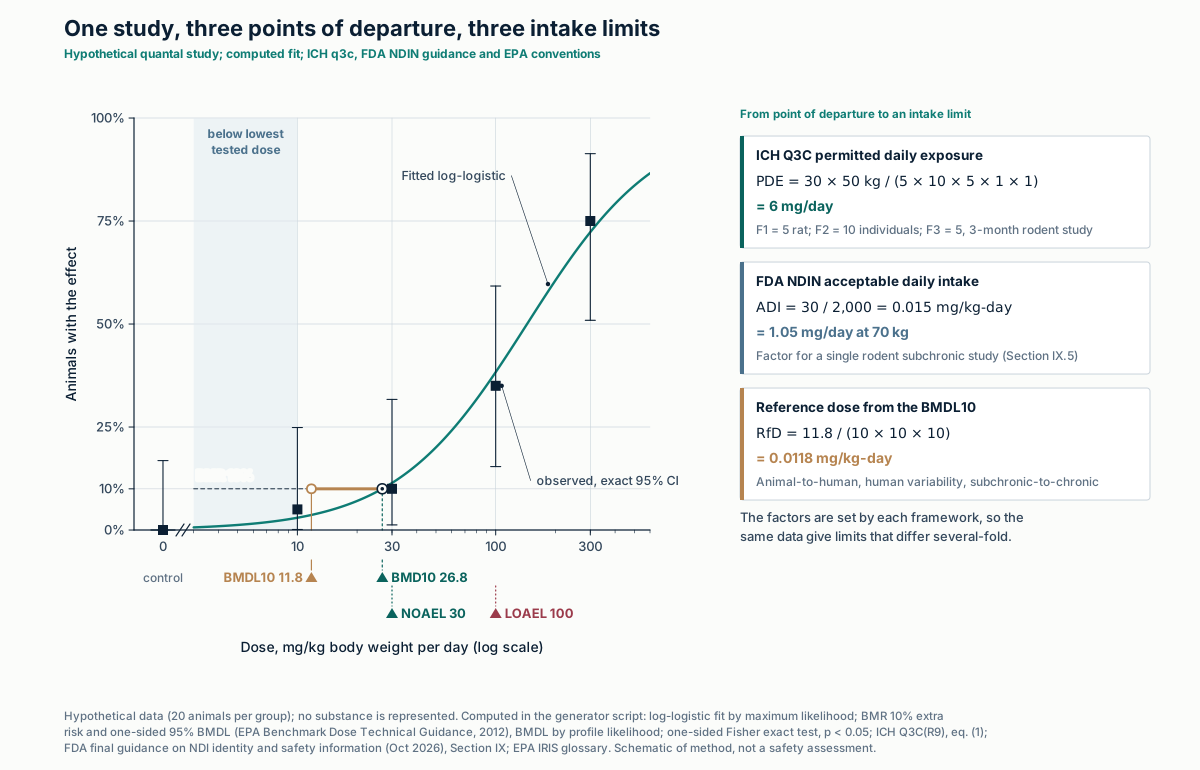
Median values (LD50, LC50, EC50, IC50) locate the middle of a dose–response curve. Regulatory limits start lower, at a point of departure near the low end of the observed range: a NOAEL, a LOAEL or a BMDL. The definitions below are quoted from the IUPAC toxicology glossary and EPA's IRIS glossary.
| Term | Definition (quoted) | Usual unit | Source |
|---|---|---|---|
| LD50, median lethal dose | “Statistically derived median dose of a chemical or physical agent (radiation) expected to kill 50% of organisms in a given population under a defined set of conditions.” | mg/kg body weight | IUPAC 2007 |
| LC50, median lethal concentration | “Statistically derived median concentration of a substance in an environmental medium expected to kill 50% of organisms in a given population under a defined set of conditions.” | mg/L air or water; ppmV for gases | IUPAC 2007 |
| EC50, median effective concentration | “Statistically derived median concentration of a substance in an environmental medium expected to produce a certain effect in 50% of test organisms in a given population under a defined set of conditions.” | mg/L, µM | IUPAC 2007 |
| ED50, median effective dose | Median dose “expected to produce a certain effect in 50% of test organisms in a given population or to produce a half-maximal effect in a biological system under a defined set of conditions.” | mg/kg | IUPAC 2007 |
| IC50 | “the median concentration that causes 50% inhibition” of a given system. | µM, µg/mL | IUPAC 2007 |
| NOAEL | “The highest exposure level at which there are no biologically significant increases in the frequency or severity of adverse effect between the exposed population and its appropriate control; some effects may be produced at this level, but they are not considered adverse or precursors of adverse effects.” | mg/kg-day | EPA IRIS |
| LOAEL | “The lowest exposure level at which there are biologically significant increases in frequency or severity of adverse effects between the exposed population and its appropriate control group.” | mg/kg-day | EPA IRIS |
| BMD | “A dose or concentration that produces a predetermined change in response rate of an adverse effect (called the benchmark response or BMR) compared to background.” For quantal data EPA's standard reporting BMR is a 10% extra risk (BMD10). | mg/kg-day | EPA IRIS; EPA 2012 |
| BMDL | “A statistical lower confidence limit on the dose or concentration at the BMD or BMC, respectively.” EPA reports a one-sided 95% limit. | mg/kg-day | EPA IRIS; EPA 2012 |
| Point of departure | “The dose-response point that marks the beginning of a low-dose extrapolation.” It can be a BMDL, a NOAEL or a LOAEL. | mg/kg-day | EPA IRIS |
Sources: Duffus JH, Nordberg M, Templeton DM. Glossary of terms used in toxicology, 2nd edition (IUPAC Recommendations 2007), NLM archived text; U.S. EPA IRIS Glossary (updated April 13, 2026); U.S. EPA Benchmark Dose Technical Guidance, EPA/100/R-12/001 (June 2012).
From point of departure to limit
Each framework divides a point of departure by factors for the gaps between the study and people. The names differ by regulator: PDE (ICH, pharmaceutical impurities), ADI (food additives, and FDA's NDI guidance), TDI (contaminants), RfD (EPA). The factors differ too, so one study can yield several limits.
| Term | Definition | Calculation | Source |
|---|---|---|---|
| PDE, permitted daily exposure | “The maximum acceptable intake per day of residual solvent in pharmaceutical products.” | NO(A)EL × 50 kg ÷ (F1 × F2 × F3 × F4 × F5), in mg/day | ICH Q3C(R9) |
| ADI, acceptable daily intake | “An estimate of the amount of a substance in food or drinking water that can be consumed daily over a lifetime without presenting an appreciable risk to health.” | FDA NDI guidance: NOAEL ÷ combined safety factor (usually 100 for a chronic study, 1,000 from two subchronic studies, 2,000 from one rodent subchronic study) | EFSA glossary; FDA 2026, IX.5 |
| TDI, tolerable daily intake | “An estimate of the amount of a substance in food or drinking water which is not added deliberately (e.g. contaminants) and which can be consumed over a lifetime without presenting an appreciable risk to health.” | Reference point ÷ uncertainty factors | EFSA glossary |
| RfD, reference dose | “An estimate (with uncertainty spanning perhaps an order of magnitude) of a daily oral exposure to the human population (including sensitive subgroups) that is likely to be without an appreciable risk of deleterious effects during a lifetime.” | Point of departure ÷ UFs | EPA IRIS |
| UF, uncertainty factor | “One of several, generally 10-fold, default factors”: human variability, animal to human, subchronic to chronic, LOAEL to NOAEL, incomplete database. | Multiplied together | EPA IRIS |
| Margin of safety (FDA NDIN) | “a measure of how close the EDI is to the NOAEL”; the EDI is the highest total daily intake under the proposed conditions of use. | NOAEL ÷ EDI; FDA also asks for EDI ÷ ADI ≤ 1 | FDA 2026, IX.2, IX.6 |
| Factor | Accounts for | Values in ICH Q3C(R9), Appendix 3 |
|---|---|---|
| F1 | Extrapolation between species | 5 rat; 12 mouse; 2 dog; 2.5 rabbit; 3 monkey; 10 other animals |
| F2 | Variability between individuals | 10 |
| F3 | Short-term exposure studies | 1 for at least half a lifetime (1 year rodents or rabbits); 2 for a 6-month rodent study; 5 for a 3-month rodent study; 10 for shorter studies |
| F4 | Severe toxicity | Reproductive studies: 1 fetal toxicity with maternal toxicity; 5 fetal toxicity without it; 5 teratogenic effect with maternal toxicity; 10 teratogenic effect without it |
| F5 | No-effect level not established | Up to 10 when only a LOEL is available |
Sources: ICH Q3C(R9), Appendix 3, eq. (1) and the 50 kg body weight convention (EMA/CHMP/ICH/82260/2006, April 2024); EFSA glossary (ADI, TDI); U.S. EPA IRIS Glossary; FDA final guidance, NDI Notifications and Related Issues: Identity and Safety Information About the NDI (October 2026), Section IX.
Margin of exposure and TTC
For a substance that is both genotoxic and carcinogenic, EFSA divides the BMDL10 by the estimated exposure; a margin of exposure of 10,000 or more, “if it is based on the BMDL10 from an animal study,” is of low concern. When a substance has no toxicity data, the threshold of toxicological concern (TTC) uses its chemical structure to set an exposure below which the probability of harm is very low.
| Class | What the class contains (EFSA 2019, Table 1, abridged) | µg/person per day | µg/kg bw per day |
|---|---|---|---|
| Potential DNA-reactive mutagens or carcinogens | Structural alerts for genotoxicity, on the weight of evidence | 0.15 | 0.0025 |
| Organophosphates and carbamates | Organophosphate or carbamate structures | 18 | 0.3 |
| Cramer Class III | Structures that “permit no strong initial presumption of safety or may even suggest significant toxicity or have reactive functional groups” | 90 | 1.5 |
| Cramer Class II | Less innocuous than Class I, without the features of Class III | 540 | 9.0 |
| Cramer Class I | “Simple chemical structures and for which efficient modes of metabolism exist, suggesting a low order of oral toxicity” | 1,800 | 30 |
The µg/kg bw values are the per-person values divided by 60 kg, the body weight Munro et al. used. Not applicable to inorganic substances, proteins, nanomaterials, radioactive substances, organosilicon substances, metals, high-potency carcinogens (aflatoxin-like, azoxy- or N-nitroso substances, benzidines), steroids and bioaccumulating substances. Sources: EFSA Scientific Committee, Guidance on the use of the TTC approach in food safety assessment, EFSA J 2019;17(6):5708; Kroes R et al., Food Chem Toxicol 2004;42:65–83; Cramer GM, Ford RA, Hall RL, Food Cosmet Toxicol 1978;16:255–276; EFSA Scientific Committee, EFSA J 2012;10(3):2578 (MOE statement).
| PA content of the dried herb | Dried herb, g/day | PA intake, µg/day | Exposure, µg/kg bw per day | MOE = 237 ÷ exposure | Against 10,000 |
|---|---|---|---|---|---|
| 200 µg/kg (EU maximum, dried herbal infusions) | 2 | 0.4 | 0.0057 | ≈ 41,500 | Above |
| 200 µg/kg | 6 | 1.2 | 0.0171 | ≈ 13,800 | Above |
| 400 µg/kg (EU maximum, e.g. rooibos, chamomile, peppermint) | 6 | 2.4 | 0.0343 | ≈ 6,900 | Below |
Reference point: BMDL10 237 µg/kg bw per day, derived from riddelliine data (EFSA CONTAM Panel, EFSA J 2017;15(7):4908). Maximum levels: Commission Regulation (EU) 2023/915 (sum of 21 PAs plus 14 co-eluting PAs). Illustrative assumptions: 70 kg adult (EFSA default), all PAs transferred to the infusion, daily lifetime use. Product within the legal maximum can still give an MOE below 10,000 at high consumption.
GHS acute oral toxicity categories
The UN Globally Harmonized System sorts substances into five acute toxicity categories by an acute toxicity estimate (ATE), which is the LD50 where one exists. Category 5 marks relatively low hazard that may matter for vulnerable populations; GHS discourages animal testing in that range.
| Category | Oral ATE, mg/kg bw | Symbol | Signal word | Hazard statement |
|---|---|---|---|---|
| 1 | ATE ≤ 5 | Skull and crossbones | Danger | Fatal if swallowed |
| 2 | 5 < ATE ≤ 50 | Skull and crossbones | Danger | Fatal if swallowed |
| 3 | 50 < ATE ≤ 300 | Skull and crossbones | Danger | Toxic if swallowed |
| 4 | 300 < ATE ≤ 2,000 | Exclamation mark | Warning | Harmful if swallowed |
| 5 | 2,000 < ATE ≤ 5,000 | No symbol | Warning | May be harmful if swallowed |
Source: United Nations, Globally Harmonized System of Classification and Labeling of Chemicals, Rev.10 (New York and Geneva, 2023), Chapter 3.1, Tables 3.1.1 and 3.1.3 and note (g).
OECD test guidelines
Safety studies follow the OECD Guidelines for the Testing of Chemicals, Section 4, which FDA's 2026 NDI guidance names as a source of safety protocols. TG 401, the classical LD50 test, was deleted on December 17, 2002; its three replacements estimate a hazard class or an LD50 with fewer animals.
| TG | Study | Design points from the guideline | Current version |
|---|---|---|---|
| Acute oral toxicity | |||
| 420 | Fixed dose procedure | Fixed doses 5, 50, 300, 2,000 mg/kg; usually females, 5 per step; endpoint is evident toxicity rather than death | OECD Publishing |
| 423 | Acute toxic class method | Three animals per step; starting dose from 5, 50, 300, 2,000 mg/kg (300 when nothing is known); limit test at 2,000 mg/kg with six animals | Adopted Dec 17, 2001 |
| 425 | Up-and-down procedure | One animal at a time, about 48 h apart; dose down after a death, up after survival; LD50 with a confidence interval | Published Jun 29, 2022 |
| Repeated dose | |||
| 407 | 28-day oral, rodents | At least 10 animals (5 per sex) per dose; limit test at 1,000 mg/kg bw/day | Adopted Jun 25, 2025 |
| 408 | 90-day oral, rodents | At least 20 animals (10 per sex) per dose; limit test at 1,000 mg/kg bw/day | Adopted Jun 25, 2025 |
| 452 | Chronic toxicity | Normally 12 months; at least 20 rodents per sex per group | Adopted Jun 25, 2018 |
| 451 | Carcinogenicity | Normally 24 months in rodents; at least 50 animals per sex per group | Adopted Jun 25, 2018 |
| Genotoxicity | |||
| 471 | Bacterial reverse mutation (Ames) | At least five bacterial strains, including four S. Typhimurium strains; at least five analysable concentrations | Adopted Jul 21, 1997; corrected Jun 26, 2020 |
| 473 | In vitro mammalian chromosomal aberration | At least 300 well-spread metaphases scored per concentration and control | Adopted Sep 26, 2014 |
| 487 | In vitro mammalian cell micronucleus | Micronuclei scored in at least 2,000 cells per concentration | Adopted Jul 19, 2016; corrected Jul 4, 2023 |
| 474 | Mammalian erythrocyte micronucleus (in vivo) | At least 4,000 immature erythrocytes scored per animal | Adopted Jul 29, 2016 |
| Reproductive and developmental | |||
| 414 | Prenatal developmental toxicity | Rat and rabbit preferred; dosing from implantation to the day before scheduled kill; about 20 females with implantation sites per group | Published Jun 26, 2018 |
| 416 | Two-generation reproduction | Parents dosed through mating, pregnancy and weaning of F1; F1 dosed to produce F2; at least 20 pregnant females per group | Published Jan 21, 2001 |
| 443 | Extended one-generation reproductive toxicity | At least 20 pregnant females per dose group; F1 cohorts for reproductive, developmental neurotoxicity and developmental immunotoxicity endpoints | Adopted Jun 25, 2025 |
Sources: OECD Test Guidelines 407, 408, 423, 443, 451, 452, 471, 473, 474 and 487 (guideline PDFs, adoption and correction dates from their cover pages); OECD publication pages for TG 414, 416, 420 and 425. FDA final guidance (October 2026), Section VII. TG 401 deletion date: OECD publication page for Test No. 401.
GLP and the NDIN safety narrative
Good Laboratory Practice is “a quality system concerned with the organisational process and the conditions under which non-clinical health and environmental safety studies are planned, performed, monitored, recorded, archived and reported” (OECD). In the United States, 21 CFR Part 58 applies to nonclinical studies supporting applications for FDA research or marketing permits. Its scope lists food and color additives, drugs, devices and biologics; dietary supplements are not named (see NDIN strategy).
| Element | Requirement or recommendation | Source |
|---|---|---|
| Quality assurance unit | Monitors each study; “entirely separate from and independent of the personnel engaged in the direction and conduct of that study” | 21 CFR 58.35 |
| Written protocol | Each study has an approved protocol stating its objectives and all methods | 21 CFR 58.120 |
| Test article characterization | Identity, strength, purity and composition determined | 21 CFR 58.105 |
| Records and archives | Raw data, protocols, specimens and final reports retained in archives | 21 CFR 58.190, 58.195 |
| Mutual Acceptance of Data | Data from OECD test guidelines and OECD GLP “shall be accepted in other Member countries”; principles revised and adopted November 26, 1997 | OECD C(81)30(Final); C(97)186/Final |
| Safety narrative: evidence | Objective evaluation of history of safe use, safety studies or both, and why they support a reasonable expectation of safety | FDA 2026, V.2 |
| Safety narrative: intake | Estimated total daily intake, and effects of non-dietary ingredients that alter the safety profile, for example by raising bioavailability | FDA 2026, V.2 |
| Safety narrative: related test articles | Qualitative and quantitative comparison of each tested material with the NDI; whole-herb intake compared with extract intake | FDA 2026, V.2 |
| Safety narrative: calculations | One justified NOAEL from the most sensitive species; margin of safety; ADI; EDI/ADI ≤ 1 | FDA 2026, IX |
Sources: eCFR, 21 CFR Part 58 (up to date as of October 26, 2026), §§ 58.1, 58.35, 58.105, 58.120, 58.190, 58.195; OECD, Principles on Good Laboratory Practice (as revised in 1997), ENV/MC/CHEM(98)17, Section 2.1; FDA final guidance, NDI identity and safety information (October 2026), Sections V and IX.
IARC carcinogen groups
IARC classifies the strength of evidence that an agent can cause cancer, not the size of the risk at a given exposure. In its words, “probably” and “possibly” carcinogenic “have no quantitative significance.” Group 3 “is not a determination of non-carcinogenicity or overall safety.” There is no “not carcinogenic” group; a well-studied agent may instead be described as “without evidence of carcinogenic activity.”
| Group | Name | Usual basis (Preamble Table 4, simplified) | Agents |
|---|---|---|---|
| 1 | Carcinogenic to humans | Sufficient evidence in humans; or strong mechanistic evidence in exposed humans plus sufficient evidence in animals | 135 |
| 2A | Probably carcinogenic to humans | At least two of: limited evidence in humans, sufficient evidence in animals, strong mechanistic evidence, one of them involving humans or human cells | 98 |
| 2B | Possibly carcinogenic to humans | Only one of those three evaluations | 329 |
| 3 | Not classifiable as to carcinogenicity to humans | All other situations | 498 |
Sources: IARC Monographs Preamble (amended January 2019), Section 6(d), “Overall evaluation,” and Table 4; IARC, Agents classified by the IARC Monographs, Volumes 1–, list last updated July 3, 2026 (counts as shown on that page).
Cancer risk arithmetic
EPA's Superfund method averages intake over a lifetime and multiplies by a slope factor, an upper-bound estimate of risk per mg/kg-day. The result is an upper-bound excess lifetime cancer risk, not a predicted number of cases. The linear equation holds below a risk of 0.01; above it RAGS uses Risk = 1 − exp(−CDI × SF).
Inhalation (RAGS Part F, Equations 6 and 11)EC = CA × ET × EF × EDAT Risk = IUR × EC
| Symbol | Factor | Previous default | 2014 default | Basis given by EPA |
|---|---|---|---|---|
| BWa | Adult body weight, kg | 70 | 80 | EFH 2011, Table 8-3, adults 21–78 |
| BWc | Child body weight, kg | 15 | 15 | Birth to <6 years |
| IRWa | Adult drinking water, L/day | 2 | 2.5 | 90th percentile, consumers only |
| IRWc | Child drinking water, L/day | 1 | 0.78 | Weighted 90th percentile, birth to <6 years |
| IRSa | Adult soil ingestion, mg/day | 100 | 100 | 1991 value retained |
| EFr / EFw | Exposure frequency, resident / worker, days/yr | 350 / 250 | 350 / 250 | Not provided in EFH 2011 |
| EDr / EDw | Exposure duration, resident / worker, yr | 30 / 25 | 26 / 25 | Resident: 90th percentile residence time |
| ETra / ETw | Air exposure time, resident / worker, h/day | 24 / 8 | 24 / 8 | Whole day / work day |
| AT | Averaging time for carcinogens | 70 years × 365 days/year | RAGS Part A convention | |
Sources: U.S. EPA, RAGS Volume I Part A, EPA/540/1-89/002 (December 1989), Exhibits 6-9 and 6-11 and Section 8.2.1; RAGS Part F, EPA-540-R-070-002 (January 2009), Equations 6 and 11; OSWER Directive 9200.1-120 (February 6, 2014), Attachment 1; Exposure Factors Handbook 2011; 40 CFR 300.430(e)(2)(i)(A)(2).
Interactive calculator Change the inputs and the result updates. An educational simulation with stated inputs.
Gap analysis
A gap analysis lists what a safety conclusion needs, what evidence exists, and what would close each difference. FDA frames the central gap as the difference between historical and proposed conditions of use: the larger the increase in serving, frequency or duration, the more “other evidence of safety” it recommends (Appendix A).
| Step | Question | Where FDA's 2026 guidance addresses it |
|---|---|---|
| 1 | What exactly is proposed: dose, frequency, duration, population? | IV (conditions of use) |
| 2 | Is the ingredient identified and specified, and are toxins of related plants addressed? | IV (botanical identity, extracts, specifications) |
| 3 | What history of use exists, at what intake, daily or intermittent? | VI |
| 4 | Is each cited test article the same as the ingredient? If not, compare qualitatively and quantitatively | V.2 |
| 5 | Which studies fill the remaining gap? | VII; Appendix A |
| 6 | Do the calculations close: margin of safety, ADI, EDI/ADI ≤ 1? | IX |
| Evidence element | Hypothetical status | Gap | Option to close it |
|---|---|---|---|
| Identity | Binomial, plant part and voucher documented; HPTLC fingerprint | None | Keep the specification current |
| Composition | Extract ratio known; marker compounds not quantified in the historical infusion | Extract and infusion cannot be compared quantitatively | Measure markers in both; express exposure as marker intake |
| History of use | Intermittent infusion use documented; intake estimated | Proposed use is daily chronic, so history alone is insufficient | Studies per Appendix A for intermittent history and daily chronic use |
| Genetic toxicity | No data | Hazard not characterized | FDA battery: bacterial mutation (TG 471) and an in vitro mammalian test (FDA prefers the mouse lymphoma tk assay; TG 473 and 487 assess chromosomal damage), plus in vivo chromosomal damage (TG 474) when history is limited |
| Repeat-dose toxicity | Published 28-day study on a different extract | Test article differs; no 90-day NOAEL | 90-day oral study (TG 408) on the extract as specified |
| Reproductive toxicity | Not studied | Relevant only if labeled for pregnancy, lactation or children | Exclude those populations on the label, or study |
| Safety calculations | Not possible without a NOAEL | No margin of safety or EDI/ADI | Recalculate when the 90-day NOAEL is available |
Steps and study options: FDA final guidance, NDI identity and safety information (October 2026), Sections IV–VII, IX and Appendix A. Ingredient X and its status are hypothetical. FDA notes that not every listed study is always recommended and that the choice depends on the gap.
Sensitivity analysis
One-way analysis moves one input at a time and reads the change in output; sorted by swing, the bars form a tornado chart. It misses interactions. Global, variance-based analysis apportions the output variance among inputs: the first-order Sobol index Si is the share from input i alone, and the total index STi adds its interactions. EPA's 1997 policy asks that sensitivity results be presented and discussed.
| Input | Si, dose | STi, dose | Si = STi, log dose |
|---|---|---|---|
| Concentration, C | 0.551 | 0.722 | 0.640 |
| Intake, IR | 0.221 | 0.375 | 0.294 |
| Body weight, BW | 0.046 | 0.092 | 0.066 |
On the log scale the model is additive (ln D = ln C + ln IR − ln BW), so each index is σi² ÷ Σσ² and there are no interactions. On the dose itself the first-order indices sum to 0.82; the remaining 0.18 comes from interactions. Computed values, not data.
Monte Carlo simulation
Monte Carlo analysis replaces each point input with a distribution, samples them many times and reports the output distribution. EPA's 1997 Guiding Principles set the conditions: document every input distribution, report the random seed, check that the tail percentiles are stable, separate variability from uncertainty, and report the point estimate beside the distribution.
| Condition | What it requires |
|---|---|
| 1 | A problem formulation that names highly exposed or susceptible subpopulations |
| 2 | Methods, models, data and assumptions documented so the analysis can be independently reproduced |
| 3 | Sensitivity analysis presented and discussed |
| 4 | Correlations and dependencies between inputs discussed and accounted for |
| 5 | Each input and output distribution shown, with variability and uncertainty separated where possible |
| 6 | Numerical stability of the central tendency and the tail presented |
| 7 | Deterministic point estimates reported for comparison |
Source: U.S. EPA Risk Assessment Forum, Guiding Principles for Monte Carlo Analysis, EPA/630/R-97/001 (March 1997), conditions 1–7 and Principle 9 (“Random number seeds should always be recorded”).
Interactive calculator Change the inputs and the result updates. An educational simulation with stated inputs.
Where EUTECNIQ would work
EUTECNIQ would characterize ingredients analytically, run the gap analysis and safety calculations, and document exposure models with their distributions, seeds and sensitivity results. GLP toxicology would be placed with qualified contract laboratories. Proposed
Related pages: Toxicology programs · Course 9, Toxicology and dose · NDIN strategy and dossiers · Reference library
Health information notice
These statements have not been evaluated by the Food and Drug Administration. Nothing on this site is intended to diagnose, treat, cure or prevent any disease. The information is for general education only. It is not medical advice and does not replace advice, diagnosis or treatment from a qualified health professional, or any medication a clinician has prescribed.
Do not start, stop or change any medicine, supplement or herbal product because of something you read here. Talk to your doctor or pharmacist first, especially if you are pregnant or breastfeeding, have a medical condition, take any medicines, are preparing for surgery, or are caring for a child. Research findings, traditional uses and safety data are reported as their sources state them; they are not recommendations or claims about any product. If you think you may have a medical emergency, call your doctor or 911 at once.
EUTECNIQ Sciences sells no supplements or health products today and receives nothing from any product or ingredient mentioned on this site; any commercial interest it later has in an ingredient will be stated on that ingredient’s page.