

Kill steps and sanitation
A kill step is specified as a number of decimal reductions of a named organism at a stated time and temperature, dose or pressure. A surface counts as clean only when the cleaning has been verified.
eCFR, titles 21 and 40, up to date as of October 26, 2026; FAO Fisheries Circular 784 (1985), Table 1; Directive 1999/3/EC, Annex; Bowser TJ, FAPC-251 (2023).
Decimal reduction and F-value
Process design uses a first-order model: at constant temperature, each D minutes kills 90% of the surviving population, so the logarithm of survivors falls on a straight line. An FDA-commissioned review notes "various types of deviations from this historical model" with no accepted replacement, so published D-values are design inputs, not guarantees.
Low-acid canning targets 12 decimal reductions (12D) of Clostridium botulinum spores. FDA's worked example: 104 spores per can and a 12D process leave a theoretical 10−8 survivors per can.
F0: Tref = 121.1 °C (250 °F), z = 10 °C (18 °F) 12D at D121.1 = 0.23 min: 12 × 0.23 = 2.76 min
| Organism | Medium | T (°C) | D (min) | z (°C) | Source |
|---|---|---|---|---|---|
| C. botulinum A and B spores | Canning reference | 121.1 | 0.1–0.23 | 10 | FAO 1985 |
| C. botulinum 62A spores | Phosphate buffer, pH 7.0 | 110 | 0.88–1.9 | 7.6–10 | ICMSF 1996, via FDA–IFT 2000 |
| C. botulinum proteolytic B spores | Vegetable products | 110 | 0.49–12.42 | 7.4–10.8 | ICMSF 1996, via FDA–IFT 2000 |
| C. botulinum non-proteolytic B | FDA reference, "generally conservative" | 90 | 1.67* | 7 (<90 °C), 10 (>90 °C) | FDA, Appendix 4, Table A-4 |
| C. botulinum type E spores | Seafood | 74 | 6.8–13 | 9.78 | ICMSF 1996, via FDA–IFT 2000 |
| Bacillus cereus spores | Various media | 95 | 1.5–36.2 | 6.7–10.1 | ICMSF 1996, via FDA–IFT 2000 |
| Listeria monocytogenes | FDA reference, all foods | 70 | 0.33* | 7.5 | FDA, Appendix 4, Table A-3 |
| L. monocytogenes | Milk | 63.3 | 0.22–0.58 | 5.5 | ICMSF 1996, via FDA–IFT 2000 |
| Salmonella Senftenberg | Milk | 65.6 | 0.56 | 4.4 | ICMSF 1996, via FDA–IFT 2000 |
| Staphylococcus aureus | Milk | 60 | 0.9 | 9.5 | ICMSF 1996, via FDA–IFT 2000 |
*Derived: FDA gives 6D times (10 min at 90 °C; 2.0 min at 70 °C), divided here by 6. FDA, Fish and Fishery Products Hazards and Controls Guidance, Appendix 4. ICMSF data as tabulated in IFT, Kinetics of Microbial Inactivation for Alternative Food Processing Technologies, report for FDA (2000), Tables 1, 2, 9, 11 and 12. D depends on strain, medium, pH and water activity; values from one medium do not transfer to another.
Equivalent time and temperature
Because D falls tenfold for every z degrees, one lethality target can be met by many time–temperature pairs. U.S. rules fix the target in three ways: as a log reduction (juice), as legal time–temperature pairs (milk) or as commercial sterility under a scheduled process (low-acid canned foods).
| Rule | What it requires | Citation |
|---|---|---|
| Juice HACCP | At least a 5-log reduction of the pertinent microorganism, the most resistant of public health significance likely to occur in the juice, for the shelf life. Applied to the juice itself, except that citrus processors may treat fruit surfaces after culling and cleaning. Exempt: processors under Part 113 or 114, or using one thermal step that makes the juice shelf-stable. | 21 CFR 120.24 |
| Milk pasteurization | Every particle held at 63 °C for 30 min, 72 °C for 15 s, 89 °C for 1 s, 90 °C for 0.5 s, 94 °C for 0.1 s, 96 °C for 0.05 s or 100 °C for 0.01 s; the first two rise by 3 °C at 10% fat or more or with added sweeteners. | 21 CFR 1240.61(b) |
| Ultra-pasteurized dairy | At or above 138 °C (280 °F) for at least 2 s, for an extended shelf life under refrigeration. | 21 CFR 131.3(c) |
| Low-acid canned food | Finished equilibrium pH above 4.6 and water activity above 0.85. A scheduled process from a competent processing authority must achieve commercial sterility: no microorganisms that can grow in the food unrefrigerated, and no viable spores of public health significance. | 21 CFR 113.3(e), (n), (r) |
| Acidified food | A low-acid food with added acid, water activity above 0.85 and finished equilibrium pH of 4.6 or below. Refrigerated foods, jams, jellies and carbonated beverages are excluded. | 21 CFR 114.3(b) |
eCFR, 21 CFR 113.3, 114.3, 120.24, 131.3 and 1240.61, up to date as of October 26, 2026. The definitions are given as reference points; which part applies to a given product is a question for counsel.
Hot, cold, aseptic and ambient fill
The filling route decides where the kill happens. Hot fill uses the product's own heat to treat the container. Cold fill moves the kill upstream and relies on pH and preservatives. Aseptic filling sterilizes product and containers separately and joins them in a sterile zone. Dry products filled at ambient temperature have no kill step in the line.
| Route | Conditions stated by the source | What it requires |
|---|---|---|
| Hot fill and hold | Product heated to about 82–93 °C (180–200 °F) and held 2–5 min in the inverted container [1]. For acidified foods at pH 4.1–4.6, a 5-log reduction of E. coli O157:H7, Salmonella and L. monocytogenes takes 5.6 min at 71.1 °C and 0.4 min at 82.2 °C [2]. | Equilibrium pH below 4.6; a container validated for the fill temperature [1]; a process set by a process authority. |
| Cold fill with preservatives | No heat in the container. At pH 3.3 or below with acetic acid, a 5-log reduction of E. coli O157:H7 took 5.7 days at 10 °C and 34.3 h at 25 °C [3]. Sodium benzoate is GRAS, with current usage up to 0.1% [4]; potassium sorbate is GRAS at good manufacturing practice [5]. | A juice still needs a validated 5-log reduction applied to the juice [6]; hygienic filling; pH and preservative levels held within specification. |
| Aseptic | Product sterilized in a holding tube sloped upward at least 2.1 cm per meter, with the recorder at the tube outlet; in a product regenerator, sterile product is kept at higher pressure than unsterile product [7]. Container sterilant example: hydrogen peroxide solution of at most 35%, leaving no more than 0.5 ppm in water packaged under production conditions [8]. | Commercial sterility of the product and of the equipment and containers [9]; a scheduled process. |
| Ambient (dry) | No kill step in the line. Contact surfaces for low-moisture products must be dry and sanitary in use, and dried after wet cleaning [10]. Release against limits such as USP ⟨2023⟩: dried or powdered botanicals, total aerobic count 105 cfu/g and yeasts and molds 103 cfu/g, Salmonella and E. coli absent in 10 g [11]. | Water activity low enough to stop growth (see below); any reduction must happen upstream, on the raw material. |
[1] Casulli K. UGA Extension Circular 1328-02 (June 2025). [2] Breidt F, et al. Food Prot Trends. 2014;34(3):132–138, Table 4. [3] Breidt F, Hayes J, McFeeters RF. J Food Prot. 2007;70(11):2638–2641. [4] 21 CFR 184.1733(d). [5] 21 CFR 182.3640. [6] 21 CFR 120.24(b). [7] 21 CFR 113.40(g)(1). [8] 21 CFR 178.1005(a), (d). [9] 21 CFR 113.3(e). [10] 21 CFR 111.27(d)(2). [11] USP ⟨2023⟩, Table 2 (USP 35–NF 30).
Pressure, electric fields and UV-C
High pressure, pulsed electric fields and UV-C inactivate vegetative cells with little heating. None is a sterilization step on its own: bacterial spores resist high pressure and electric fields, and UV-C acts only where the light reaches.
High-pressure processing is a pasteurization; a 2022 review calls it "a cold pasteurization technology". C. botulinum 17B and Cap 9B spore suspensions tolerated 30 min at 827 MPa and 75 °C, beyond the 600 MPa at which most commercial machines operate.
| Technology | Operating range | Inactivates | Does not reliably inactivate | Rule or note |
|---|---|---|---|---|
| High pressure processing (HPP) | 300–600 MPa, isostatic, in the final package; most commercial machines run at up to 600 MPa and below 45 °C after compression; a typical cycle holds 3 min at 600 MPa [1] | Vegetative cells, including pathogens, at 600 MPa and room temperature [1] | Most bacterial spores and enzymes [1]; C. botulinum spores survived 827 MPa at 75 °C for 30 min [2] | Low-acid HPP products need cold chain (1–8 °C) and a limited shelf life [1]. Juice must still meet 5-log [3]. |
| Pulsed electric field (PEF) | 20–80 kV/cm pulses, near ambient temperature, under 1 s of treatment [2] | Vegetative cells; kinetic data scarce [2] | Bacillus spores resisted fields up to 30 kV/cm; heat shock and lysozyme with PEF gave 2–4 log; one study reported 3.4 and 5 log at 50 kV/cm [2] | Survivor data "too limited" for definite conclusions on kinetic parameters [2] |
| UV-C | 200–280 nm; at least 400 J/m² in every part of the product [2] | Microorganisms in the light path, through DNA damage [2] | Shaded regions; critical factors include product transmissivity and reactor geometry [2] | 21 CFR 179.39: low-pressure mercury lamps, 90% of emission at 253.7 nm; juice in turbulent flow, Reynolds number at least 2,200 [4] |
[1] Houška M, Silva FVM, Evelyn, Buckow R, Terefe NS, Tonello C. Foods. 2022;11(2):223. [2] IFT, report for FDA, Kinetics of Microbial Inactivation for Alternative Food Processing Technologies (2000), HPP, PEF and UV chapters and overview. [3] 21 CFR 120.24. [4] 21 CFR 179.39(a), (b).
Gamma, electron beam and X-ray
Gamma rays, electron beams and X-rays deposit energy measured in kilograys (kGy). U.S. rules allow up to 30 kGy for dried culinary herbs, seeds, spices and vegetable seasonings. The EU's only Union-wide authorization covers the same category at 10 kGy, and the Codex standard caps doses at 10 kGy unless a legitimate technological purpose requires more.
Electrons penetrate about 5 cm of food and X-rays 60–400 cm, which decides package size. At the permitted energies the food does not become radioactive: an FAO/IAEA/WHO consultation concluded that X-rays up to 7.5 MeV can be used "without concern about induced radioactivity in food".
| Rule | Permitted sources | Herbs and spices | Labeling and other conditions |
|---|---|---|---|
| United States, 21 CFR 179.26 | Gamma from cobalt-60 or cesium-137; electrons up to 10 MeV; X-rays up to 5 MeV, or 7.5 MeV with a tantalum or gold target | Up to 30 kGy for dry aromatic vegetable substances used in small amounts for flavor; turmeric and paprika also as color additives | Radura logo with "Treated with radiation" or "Treated by irradiation" on retail packages; not required for foods that merely contain an irradiated ingredient; "do not irradiate again" on shipments for further processing |
| EU, Directives 1999/2/EC and 1999/3/EC | Gamma from 60Co or 137Cs; X-rays up to 5 MeV; electrons up to 10 MeV | Dried aromatic herbs, spices and vegetable seasonings: 10 kGy maximum overall average absorbed dose | "Irradiated" or "treated with ionising radiation" on the label, also beside an irradiated ingredient; Dmax/Dmin should not exceed 3; not a substitute for hygiene or good manufacturing practice; Member States may keep earlier national authorizations |
| Codex, CXS 106-1983, Rev.1-2003 | Gamma from 60Co or 137Cs; X-rays up to 5 MeV; electrons up to 10 MeV | General maximum 10 kGy, "except when necessary to achieve a legitimate technological purpose" | No re-irradiation, except low-moisture foods treated against insect reinfestation; prepackaged foods labeled |
eCFR, 21 CFR 179.26, up to date as of October 26, 2026. Directive 1999/2/EC, Article 6 and Annexes I–III, and Directive 1999/3/EC, Annex (OJ L 66, 13.3.1999). CODEX STAN 106-1983, Rev.1-2003, §§ 2.1, 2.2, 5. Penetration: IFT report for FDA (2000). Induced radioactivity: ICGFI consultants' meeting, The development of X-ray machines for food irradiation, Vienna, October 1995 (FAO/IAEA/WHO).
Ethylene oxide and steam
U.S. tolerances still cover ethylene oxide used as a postharvest fumigant on dried herbs and spices: 7 ppm for the gas and 940 ppm for its reaction product 2-chloroethanol. A 2022 review states that it is banned in the United States; the current eCFR says otherwise. The EU prohibits its use on food and limits the sum of both, expressed as ethylene oxide, to the limit of quantification.
In September 2020 Belgium reported high levels in sesame seeds from India; Member States withdrew and recalled the seeds and products made from them. A spice fumigated lawfully for the U.S. market can therefore be unsaleable in the EU.
| Treatment | United States | European Union | Documented trade-offs |
|---|---|---|---|
| Ethylene oxide fumigation | Tolerances 7 ppm ethylene oxide and 940 ppm 2-chloroethanol in dried herbs and spices (group 19, except basil), licorice root, dried mint tops, sesame seed and dried vegetables [1] | Use in food production prohibited; residue defined as the sum of ethylene oxide and 2-chloro-ethanol, expressed as ethylene oxide [2, 3]; sesame seed limit 0.05 mg/kg [4] | BfR: "mutagenic and carcinogenic"; no intake without health risk could be set [3] |
| Steam (saturated or superheated) | Water only; no chemical residue | Water only; no chemical residue | Steam at 100–200 °C; energy use, color and sensory changes, loss of volatile compounds [5]. Dried red pepper: steam at 100 °C for 16 min gave 1–2 log, gamma at 10 kGy about 5 log [5] |
| Irradiation | Up to 30 kGy, labeled [6] | Up to 10 kGy, labeled [7] | In the same red-pepper study, gamma irradiation reduced capsanthin [5] |
[1] 40 CFR 180.151(a), eCFR, up to date as of October 26, 2026. [2] Commission Regulation (EU) 2015/868, Annex. [3] BfR, FAQ on the health risk of ethylene oxide in food (2022). [4] European Commission, Food and Feed Crisis Coordinators meeting of October 9, 2020, summary record. [5] Rahmati E, Khoshtaghaza MH, Banakar A, Ebadi MT. Food Sci Nutr. 2022;10(3):784–799, reporting Rico et al. [6] 21 CFR 179.26. [7] Directive 1999/3/EC. The EU listed herbs and spices for irradiation because "contamination and/or infestation can no longer be treated with fumigants such as ethylene oxide" (1999/3/EC, recitals).
Water activity as a hurdle
Water activity is the vapor pressure of water over a product divided by that of pure water at the same temperature. Below a pathogen's minimum it cannot grow, which is why dry extracts, powders and capsules are shelf-stable without a kill step.
Low water activity stops growth, not survival, and it raises heat resistance. At 60 °C, D for S. aureus in pasta dough rose from 3 min at aw 0.92 to more than 40 min at 0.80. Salmonella Senftenberg had a D of 480 min at 70 °C in milk chocolate, against 0.56 min at 65.6 °C in milk.
The CIP cycle
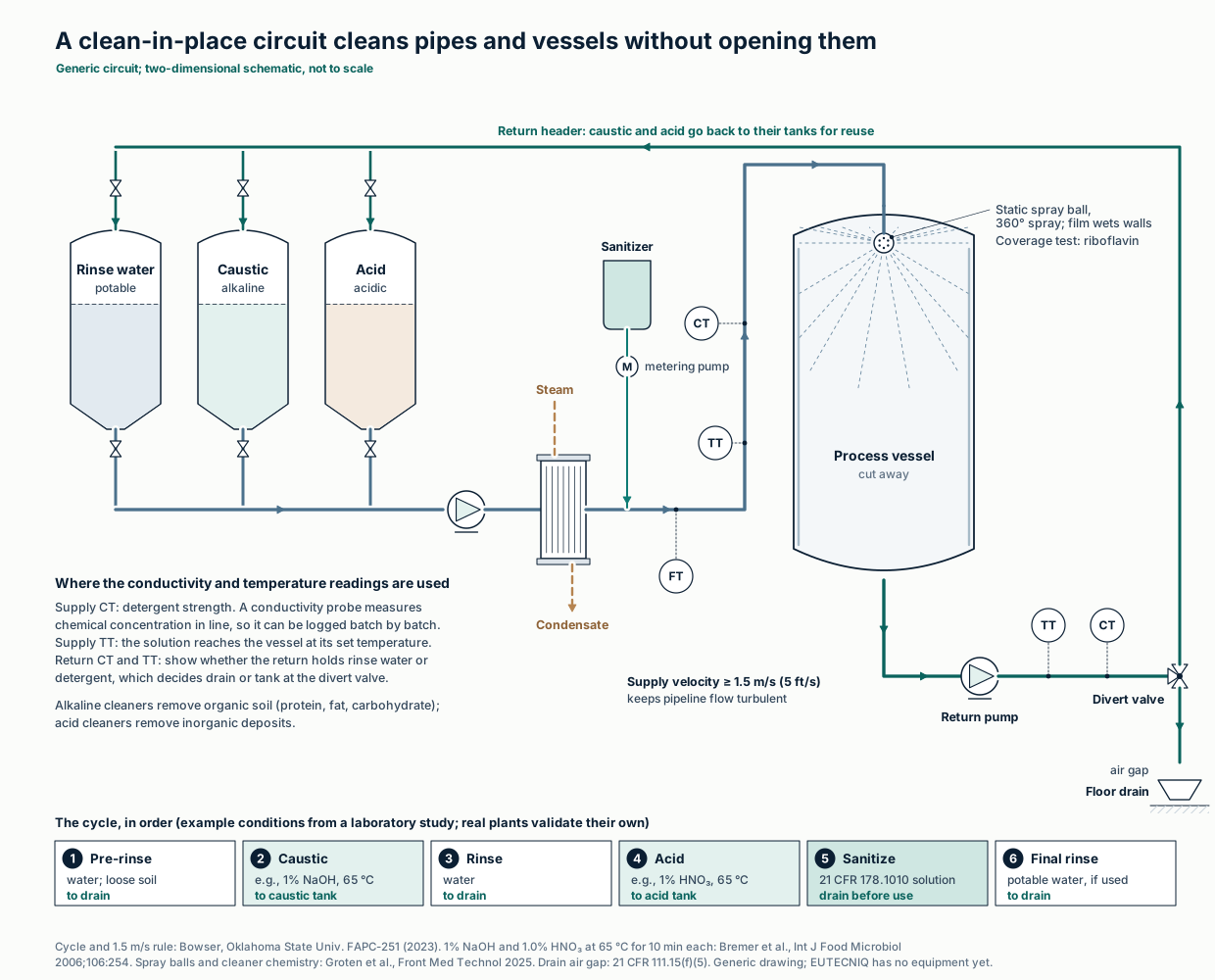
Clean-in-place circulates rinses and detergents through closed equipment in a fixed sequence: pre-rinse, caustic wash, rinse, acid rinse, sanitize, post-rinse. Alkaline cleaners remove organic soil such as protein and fat; acid cleaners remove inorganic deposits. Spray balls distribute the solutions inside vessels.
Temperature is set by the process and chemistry, concentration by the chemical supplier, and cycle time experimentally. A cycle that removes visible soil can still leave biofilm: in a laboratory study, a standard regime did not reproducibly remove bacteria attached to stainless steel.
| Step | Purpose | Example conditions | Return goes to |
|---|---|---|---|
| 1 Pre-rinse | Remove loose soil | Water | Drain |
| 2 Caustic wash | Remove organic soil (protein, fat, carbohydrate) [2] | 1% sodium hydroxide, 65 °C, 10 min [3] | Caustic tank, for reuse |
| 3 Rinse | Remove detergent | Water | Drain |
| 4 Acid rinse | Remove inorganic deposits [2] | 1.0% nitric acid, 65 °C, 10 min [3] | Acid tank, for reuse |
| 5 Sanitize | Reduce surviving microorganisms | A 21 CFR 178.1010 solution within its concentration limit | Drain; "followed by adequate draining, before contact with food" [4] |
| 6 Post-rinse | Remove sanitizer where its use calls for it | Potable water | Drain |
[1] Bowser TJ. What is Clean in Place (CIP)? Oklahoma Cooperative Extension Service FAPC-251, August 2023 (sequence; settings). [2] Groten F, et al. Front Med Technol. 2025;7:1540779. [3] Bremer PJ, Fillery S, McQuillan AJ. Int J Food Microbiol. 2006;106(3):254–262: the "standard" laboratory regime, which did not reproducibly remove biofilm. [4] 21 CFR 178.1010(a).
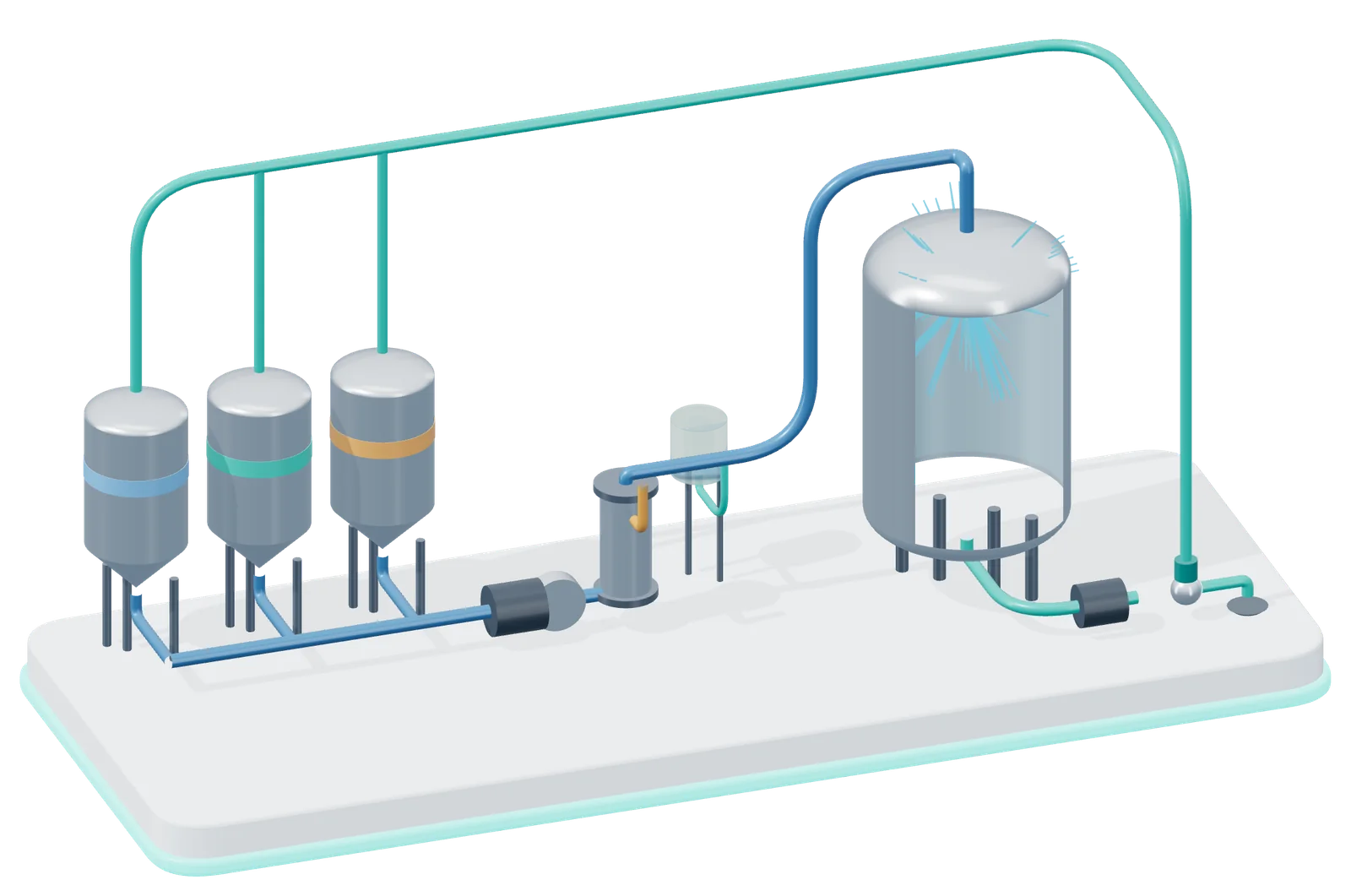
- 1 Rinse water
- 2 Caustic
- 3 Acid
- 4 Supply pump
- 5 Heat exchanger (steam)
- 6 Sanitizer dosing
- 7 Process vessel, spray ball
- 8 Return pump
- 9 Divert valve
3D rendering by EUTECNIQ, schematic. The drawing below gives the details, values and sources. EUTECNIQ has no equipment yet.
Turbulence and the Sinner circle
Sinner's circle names four factors that trade against one another in cleaning: time, temperature, mechanical action and chemical action; an extended version adds the surface being cleaned. In pipelines the mechanical action is turbulence, and a velocity of at least 1.5 m/s (5 ft/s) keeps the flow turbulent. The table converts that velocity into the flow a supply pump must deliver.
| Inside diameter (mm) | Flow at 1.5 m/s (L/min) | Flow (m³/h) | Re, water at 20 °C | Re, water at 70 °C |
|---|---|---|---|---|
| 25 | 44.2 | 2.65 | 37,400 | 90,900 |
| 38 | 102 | 6.12 | 56,800 | 138,000 |
| 50 | 177 | 10.6 | 74,800 | 182,000 |
| 75 | 398 | 23.9 | 112,000 | 273,000 |
| 100 | 707 | 42.4 | 150,000 | 363,000 |
Computed. Water properties: IAPWS-95 via CoolProp 8.0.0 at 200 kPa. Velocity rule: Bowser TJ, FAPC-251 (2023). Sinner's circle: Groten F, et al. Front Med Technol. 2025;7:1540779. For comparison, 21 CFR 179.39 sets a minimum Reynolds number of 2,200 for turbulent flow in UV treatment of juice. A larger line at the same pump flow runs slower; check the velocity in every branch as well as at the pump.
Verifying a clean
FDA's draft allergen guidance lists visual inspection, ATP swabs, protein swabs and allergen-specific test kits on surfaces or in the final CIP rinse. ATP occurs in all living cells, so ATP and total-protein tests are non-specific and "may not be sensitive enough to detect levels of a particular allergenic protein".
Methods can disagree. In an avocado packing plant, visual scores, ATP and microbial counts often gave contradictory results, and no surface reached the expected 3-log reduction.
| Method | What it shows | Limitation |
|---|---|---|
| In-line conductivity | Detergent concentration, measured continuously [1] | Says nothing about soil or microorganisms left on the surface |
| Temperature record | The solution reached its set point; a CIP that missed its target temperature is a deviation to correct [2] | Temperature at the sensor, not at every surface |
| Riboflavin coverage test | Where a spray device wets the surface [1] | Coverage, not cleanliness |
| ATP bioluminescence | ATP from food, microorganisms or skin [2, 3] | Non-specific; ATP can hydrolyze to ADP and AMP, which the test does not read [3] |
| Protein swab | Any protein [2] | Non-specific; may miss a particular allergen [2] |
| Allergen-specific kit | A named allergenic protein, on a swab, in final rinse water or in push-through material [2] | Only where a kit exists for that allergen in that matrix [2] |
| Microbial swab or count | Indicator organisms, e.g., aerobic count, Enterobacteriaceae, Listeria spp. [4] | Did not track ATP or visual scores in a packing-plant study [4] |
[1] Bowser TJ, FAPC-251 (2023). [2] FDA, Hazard Analysis and Risk-Based Preventive Controls for Human Food: Draft Guidance, Chapter 11, Food Allergen Program (September 2023), § 11.6.1 and footnote 21; draft, not for implementation. [3] Bakke M. J Food Prot. 2022;85(7):1079–1095. [4] Muñiz-Flores JA, et al. J Food Prot. 2025;88(10):100593.
Sanitizers and their limits
A sanitizer reduces microorganisms on a surface that is already clean; EPA describes sanitizers as reducing, "but not necessarily" eliminating, microorganisms. Solutions listed in 21 CFR 178.1010 may be used on food-processing equipment within the caps in paragraph (c), followed by adequate draining before contact with food. In the biofilm study above, adding a sanitizer step did not improve removal.
| Agent | U.S. listing | Limit when ready to use |
|---|---|---|
| Hypochlorite (sodium, potassium, calcium) | 21 CFR 178.1010(b)(1) | Not more than 200 ppm available halogen as available chlorine |
| Chlorinated isocyanurates | 178.1010(b)(2) | Not more than 100 ppm available chlorine |
| Iodine formulations (iodophors) | 178.1010(b)(4)–(6), (8) | Not more than 25 ppm titratable iodine |
| Quaternary ammonium, n-alkyl (C12–C18) benzyldimethylammonium chloride | 178.1010(b)(9) | Not more than 200 ppm active quaternary compound |
| Peroxyacetic acid with hydrogen peroxide, acetic and sulfuric acids | 178.1010(b)(38); also on dairy equipment | Peroxyacetic acid 200–315 ppm; hydrogen peroxide 300–465 ppm |
| Ozone | 21 CFR 173.368, antimicrobial in gas or water phase | Good manufacturing practice; Food Chemicals Codex specification |
| Hydrogen peroxide (packaging sterilant) | 21 CFR 178.1005 | Solution at most 35%; at most 0.5 ppm in water packaged under production conditions |
eCFR, 21 CFR 173.368, 178.1005 and 178.1010(a)–(c), up to date as of October 26, 2026. U.S. EPA, What are antimicrobial pesticides? (updated January 29, 2026), which counts more than 4,000 registered antimicrobial products. Bremer PJ, et al. 2006. Each paragraph of 178.1010 lists a specific formulation; a product's label and listing, not the active ingredient's name, decide whether it qualifies.
Sanitation rules for supplements
Dietary supplement manufacturing follows 21 CFR Part 111; a facility that complies with it is exempt from the preventive-controls subparts C and G of Part 117 for that work. Part 111's sanitation sections set required outcomes, written procedures and records rather than chemistries or temperatures.
| Section | Requirement |
|---|---|
| 111.10 (Subpart B, personnel) | Exclude anyone who may be a source of microbial contamination; wash hands before work and when soiled; intact, impermeable gloves; hair restraints; no eating, drinking or tobacco where materials or contact surfaces are exposed |
| 111.15(c) (Subpart C, plant) | Cleaning compounds and sanitizing agents free from microorganisms of public health significance, and safe and adequate under the conditions of use |
| 111.15(e), 111.23(c) | Water that may become a component meets Federal, State and local requirements, with records to show it |
| 111.15(f)(5) | No backflow or cross-connection between waste piping and piping that carries manufacturing or cleaning water |
| 111.15(k) | One or more sanitation supervisors qualified by education, training or experience |
| 111.16, 111.23(b) | Written, followed procedures for cleaning the physical plant and for pest control, and records of them |
| 111.20(c)(5), (d) | Separate or defined areas for cleaning and sanitizing contact surfaces; floors, walls and ceilings that can be kept clean |
| 111.27(a) (Subpart D, equipment) | Equipment installed for cleaning, corrosion-resistant and nontoxic, with smoothly bonded seams; instruments that control temperature, pH or water activity accurate and maintained |
| 111.27(d) | Clean and sanitize contact surfaces as necessary, taking equipment apart as needed; low-moisture surfaces dry and sanitary in use; for wet processing, clean and sanitize before use and after any interruption |
| 111.25(c), 111.35(b)(2) | Written procedures for maintaining, cleaning and sanitizing equipment; equipment logs of the date of use, maintenance, cleaning and sanitizing, unless kept in the batch record |
eCFR, 21 CFR 111.10, 111.15, 111.16, 111.20, 111.23, 111.25, 111.27, 111.35 and 117.5(e), up to date as of October 26, 2026. Summaries; the regulation text governs.
Where EUTECNIQ would work
Proposed EUTECNIQ would choose a kill step per product from validated data, design pilot equipment for clean-in-place with logged conductivity and temperature, and keep cleaning and sanitizing records as Part 111 requires. It has no facility, equipment or validated process yet.
Related: Microorganisms and their detection · Scale-up and tech transfer · Quality system · Drying and particle engineering
Health information notice
These statements have not been evaluated by the Food and Drug Administration. Nothing on this site is intended to diagnose, treat, cure or prevent any disease. The information is for general education only. It is not medical advice and does not replace advice, diagnosis or treatment from a qualified health professional, or any medication a clinician has prescribed.
Do not start, stop or change any medicine, supplement or herbal product because of something you read here. Talk to your doctor or pharmacist first, especially if you are pregnant or breastfeeding, have a medical condition, take any medicines, are preparing for surgery, or are caring for a child. Research findings, traditional uses and safety data are reported as their sources state them; they are not recommendations or claims about any product. If you think you may have a medical emergency, call your doctor or 911 at once.
EUTECNIQ Sciences sells no supplements or health products today and receives nothing from any product or ingredient mentioned on this site; any commercial interest it later has in an ingredient will be stated on that ingredient’s page.