

Cosmetic formulation and stability
A botanical cosmetic has to hold together, resist microbes at its own pH and keep its quality to the end of its labeled life. This page gives the emulsifier arithmetic, preservative chemistry, challenge-test criteria and stability conditions behind those three requirements.
Status. EUTECNIQ is in formation and has no laboratory, products, customers or test results. This page is reference material; nothing on it describes work EUTECNIQ has done. Regulatory text is summarized, not legal advice.
How botanicals enter a formula
A plant reaches a cosmetic as an extract, a fatty oil or butter, an essential oil or a distilled water (hydrosol), and the form decides which phase it joins. EU ingredient lists use the Commission's glossary of common ingredient names, which takes the INCI names published by the Personal Care Products Council; botanical entries read Latin genus and species, plant part, then form.
| Form | What it is | Joins | Glossary name (entry no.) |
|---|---|---|---|
| Extract | Constituents taken into a solvent, then concentrated or carried in a diluent | Water or oil phase, by solvent and polarity | CAMELLIA SINENSIS LEAF EXTRACT (1136); ACHILLEA MILLEFOLIUM FLOWER EXTRACT (1052) |
| Fatty oil, butter | Triglyceride-rich lipids pressed or extracted from seeds and fruits; butters are solid at room temperature | Oil phase | Named by the same pattern; check each name in the glossary |
| Oil (volatile or other) | Distilled or expressed oils | Oil phase; fragrance allergens may need labeling | ABIES ALBA CONE OIL (683) |
| Distilled water (hydrosol) | Aqueous distillate | Water phase | ACHILLEA MILLEFOLIUM FLOWER WATER (1053); ACORUS CALAMUS RHIZOME WATER (1123) |
Commission Decision (EU) 2022/677 of 31 March 2022, glossary of common ingredient names (recitals 1 and 3; Annex entries as numbered); applies from April 29, 2023, replacing Decision (EU) 2019/701. Regulation (EC) No 1223/2009, Article 19(1)(g): ingredient list in descending order of weight.
Six formulation types
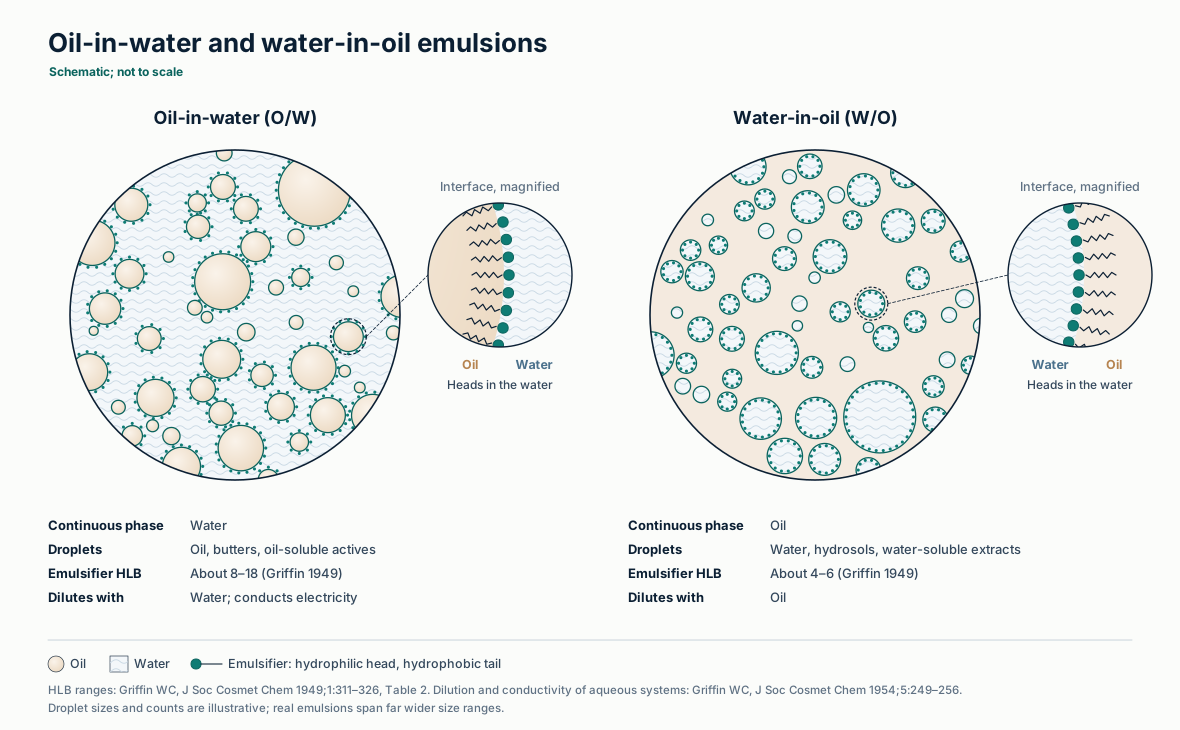
The continuous phase sets how a product feels, what dilutes it and where microbes can grow. An oil-in-water emulsion is aqueous outside, so it dilutes with water and conducts electricity; a water-in-oil emulsion is oily outside. ISO 11930 exempts products classed as low microbiological risk under its Annex A and ISO 29621; that classification is a documented assessment.
| Type | Continuous phase | Botanical forms it carries | Typical first failure |
|---|---|---|---|
| O/W emulsion (lotion, cream) | Water | Extracts and hydrosols outside; oils and butters in the droplets | Creaming, coalescence, microbial growth in the water |
| W/O emulsion | Oil | Oils outside; aqueous extracts in the droplets | Sedimentation and coalescence of water droplets |
| Aqueous gel | Water thickened by a polymer | Water-soluble extracts; oils need a solubilizer | Viscosity loss with salts, pH drift or extract load |
| Serum (aqueous or hydroalcoholic) | Water, often with glycols or ethanol | Water-soluble extracts; oils as micelle-solubilized drops | Haze or precipitation; color and odor change |
| Anhydrous balm, oil | Oils, butters, waxes | Oils, butters, oil-soluble extracts | Oxidative rancidity; wax or fat recrystallization |
| Surfactant system (cleanser, shampoo) | Water with micelles | Extracts; oils solubilized in micelles | Viscosity and clarity change; preservative loss to micelles |
Dilution and conductivity of aqueous systems: Griffin, J Soc Cosmet Chem 1954;5:249–256. Low-risk products: ISO 11930:2019 scope (ISO catalog page). Failure modes are general formulation science; see Emulsions and colloids for the physics and Cosmetics and personal care for the market view of each format.
The HLB system
Griffin's hydrophile–lipophile balance rates a nonionic emulsifier by the weight share of its water-loving part: HLB = E/5 for an ethoxylate with E% oxyethylene, which equals 20 × Mh/M. For polyol fatty esters he gave HLB = 20(1 − S/A), S the saponification number of the ester and A the acid number of the acid. Blends average by weight, and each oil phase has a required HLB at which emulsification works best.
| Chemical designation (trade name in the table) | HLB |
|---|---|
| Sorbitan trioleate (Span 85) | 1.8 |
| Glycerol monostearate (Atmul 67) | 3.8 |
| Sorbitan monooleate (Span 80) | 4.3 |
| Sorbitan monostearate (Span 60) | 4.7 |
| Sorbitan monopalmitate (Span 40) | 6.7 |
| Sorbitan monolaurate (Span 20) | 8.6 |
| Polyoxyethylene sorbitan monostearate (Tween 60) | 14.9 |
| Polyoxyethylene sorbitan monooleate (Tween 80) | 15 |
| Polyoxyethylene sorbitan monolaurate (Tween 20) | 16.7 |
| Sodium oleate (anionic) | 18 |
| Material | For W/O | For O/W |
|---|---|---|
| Cottonseed oil | – | 7.5 |
| Paraffin (household) | 4 | 9 |
| Microcrystalline wax | – | 9.5 |
| Mineral oil, heavy | 4 | 10.5 |
| Petrolatum | 4 | 10.5 |
| Beeswax | 5 | 10–16 |
| Cetyl alcohol | – | 13 |
| Lanolin, anhydrous | 8 | 15 |
| Stearic acid | – | 17 |
Data table and limits of the method
| Hydrophilic member, % by weight | Span 60 / Tween 60 | Span 80 / Tween 80 |
|---|---|---|
| 0% | 4.7 | 4.3 |
| 38.2% | 8.6 | 8.4 |
| 40.2% | 8.8 | 8.6 |
| 55% | 10.3 | 10.2 |
| 100% | 14.9 | 15.0 |
Griffin's own 1949 example blended Span 60 and Tween 60: 45/55 gave a calculated HLB of 10.3, the ratio he selected from his series for an oil phase of estimated required HLB about 10. He wrote in 1954 that the system "lacks exactness" and that a correct HLB must be paired with the right chemical type; ionic emulsifiers do not follow the weight-percentage rule and must be measured. The required HLB is a starting point for a test series, not a specification.
| HLB range | Use |
|---|---|
| 4–6 | W/O emulsifiers |
| 7–9 | Wetting agents |
| 8–18 | O/W emulsifiers |
| 13–15 | Detergents |
| 15–18 | Solubilizers |
Griffin WC. Classification of surface-active agents by "HLB". J Soc Cosmet Chem 1949;1:311–326 (Table 2; blending rule p. 313; worked example pp. 324–325). Griffin WC. Calculation of HLB values of non-ionic surfactants. J Soc Cosmet Chem 1954;5:249–256 (equations and examples pp. 250–251; Tables 1 and 2).
Why emulsions separate
An emulsion is thermodynamically unstable; formulation only slows its breakdown. Each mechanism has its own driver and its own sign in a stability sample. The physics, with calculators, is on Emulsions and colloids; this table maps each mechanism to what a cosmetic stability program looks for.
| Mechanism | Driver | Sign in a sample | Formulation lever |
|---|---|---|---|
| Creaming or sedimentation | Density difference; rate rises with droplet radius squared (Stokes) | Layer at the top or bottom; redisperses on shaking | Smaller droplets; thicker continuous phase |
| Flocculation | Weak attraction between droplets | Clusters under the microscope; viscosity change | Steric or charge stabilization |
| Coalescence | Rupture of the film between droplets | Growing droplets, then free oil or water | Emulsifier type and amount (HLB) |
| Ostwald ripening | Higher Laplace pressure in small droplets; oil diffuses through the water | Mean droplet size rises with time | Add a less water-soluble oil to the droplets |
| Phase inversion | Change in emulsifier balance with temperature or composition | O/W becomes W/O (or the reverse) | Hold composition and process temperature |
Tadros T, Izquierdo P, Esquena J, Solans C. Formation and stability of nano-emulsions. Adv Colloid Interface Sci 2004;108–109:303–318 (Ostwald ripening and its control with a less soluble oil). Izquierdo P et al. Langmuir 2004;20:6594–6598 (temperature-driven inversion). Stokes and Laplace relations as derived on Emulsions and colloids.
Scaling up an emulsion
A bigger, geometrically similar mixer cannot hold tip speed and power per volume constant at the same time, and the rule chosen changes the shear the droplets see. Phase temperatures, the order in which phases meet and the cooling rate also belong in the batch record: in the phase inversion temperature method, emulsification starts at the emulsifier's HLB temperature and the batch is then cooled quickly.
| Quantity | Laboratory | Constant tip speed | Constant power per volume |
|---|---|---|---|
| Linear scale factor k = (V₂/V₁)1/3 | 1 | 10 | 10 |
| Impeller diameter D | 0.05 m | 0.50 m | 0.50 m |
| Speed N | 1,000 rpm | 100 rpm | 215 rpm |
| Tip speed πND | 2.6 m/s | 2.6 m/s | 5.6 m/s |
| Power per volume, ∝ N³D² | 1 | 0.10× | 1 |
| Reynolds number, ∝ ND² | 1 | 10× | 21.5× |
Arithmetic from P = Po·ρ·N³·D⁵ (constant Po in turbulent flow), tip speed = πND and Re = ρND²/μ; laboratory speed and diameter are illustrative inputs. The full scale-up model is on Scale-up and tech transfer. PIT method: Izquierdo P, Esquena J, Tadros TF et al. Langmuir 2004;20(16):6594–6598.
How preservatives work
The preservatives below act mainly on the microbial membrane and the proton gradient across it. Weak organic acids work only in their undissociated form, which crosses the membrane and then releases protons inside the cell, so their activity depends on the pH of the water phase. Chelators, potentiators and low water activity add further hurdles; Leistner's hurdle concept combines several sub-lethal stresses.
| Class | Mechanism reported | Source |
|---|---|---|
| Parabens (methyl, butyl) | Selectively eliminated the pH gradient (ΔpH) across E. coli membrane vesicles; at higher concentrations inhibited DNA and RNA synthesis | Eklund, J Gen Microbiol 1985; Nes and Eklund, J Appl Bacteriol 1983 |
| Phenoxyethanol | Potassium efflux and disorganization of the outer envelope below lethal levels; leakage and gross membrane damage at lethal levels | Gilbert, Beveridge and Crone, Microbios 1977 |
| Benzoic and sorbic acids | Benzoate enters yeast cells undissociated and lowered intracellular pH by more than 1 unit, inhibiting phosphofructokinase so ATP fell; sorbic acid eliminated ΔpH across E. coli membrane vesicles | Krebs et al., Biochem J 1983; Eklund, J Gen Microbiol 1985 |
| Chelators (EDTA) | Remove Mg²⁺ and Ca²⁺ from the Gram-negative outer membrane, making it permeable | Vaara, Microbiol Rev 1992 |
| Multifunctional potentiator (ethylhexylglycerin) | 0.075% ethylhexylglycerin with 0.675% phenoxyethanol gave >5 log kill of E. coli in 30 min through membrane damage; neither alone was lethal at those levels | Langsrud et al., PLoS One 2016 (co-authors employed by a preservative maker) |
Data table
| pH | Sorbic acid | Benzoic acid |
|---|---|---|
| 3.5 | 94.8% | 83.5% |
| 4.0 | 85.2% | 61.5% |
| 4.5 | 64.5% | 33.6% |
| 5.0 | 36.5% | 13.8% |
| 5.5 | 15.4% | 4.8% |
| 6.0 | 5.4% | 1.6% |
| 7.0 | 0.57% | 0.16% |
Eklund T. J Gen Microbiol 1985;131:73–76. Nes IF, Eklund T. J Appl Bacteriol 1983;54:237–242. Gilbert P, Beveridge EG, Crone PB. Microbios 1977;19:125–141. Krebs HA et al. Biochem J 1983;214:657–663. Vaara M. Microbiol Rev 1992;56:395–411. Langsrud S et al. PLoS One 2016;11:e0165228. Leistner L. Int J Food Microbiol 2000;55:181–186.
EU preservative limits
In the EU a substance used as a preservative must be listed in Annex V of Regulation 1223/2009 and used within its conditions (Article 14(1)(d)). Limits apply to the ready-for-use product, and for acids they are expressed as the acid. The table gives the entries as they stood in the point-in-time text of December 31, 2020; check CosIng or EUR-Lex for later amendments before relying on a value.
| Entry | Substance | Maximum in ready-for-use product | Other conditions |
|---|---|---|---|
| 1 | Benzoic acid and its sodium salt | 2.5% (acid) rinse-off, except oral; 1.7% oral; 0.5% leave-on | – |
| 3 | Salicylic acid and its salts | 0.5% (acid) | Not in oral products (entry substituted by Reg. 2019/1966) |
| 4 | Sorbic acid and its salts | 0.6% (acid) | – |
| 12 | Methyl- and ethylparaben and their salts | 0.4% (as acid) single ester; 0.8% (as acid) mixtures | Substituted by Reg. 1004/2014 |
| 12a | Butyl- and propylparaben and their salts | 0.14% (as acid) for their sum; 0.8% for mixtures with entry 12 | Not in leave-on products for the nappy area of children under 3 |
| 13 | Dehydroacetic acid and its sodium salt | 0.6% (as acid) | Not in aerosol sprays |
| 29 | Phenoxyethanol | 1.0% | – |
| 34 | Benzyl alcohol | 1.0% | Other uses under Annex III |
| 50 | Chlorphenesin | 0.3% | – |
| 57 | Methylisothiazolinone | 0.0015% | Rinse-off products only |
Regulation (EC) No 1223/2009, Annex V: as adopted (legislation.gov.uk, original EU text) and point-in-time version at December 31, 2020 (legislation.gov.uk), with amending Regulations (EU) No 344/2013, 1003/2014, 1004/2014, 2017/1224 and 2019/1966 as noted there. Entry 13 and 50 values from the adopted text. Article 14(1): consolidated text, EUR-Lex, version of September 1, 2025.
Challenge testing
A challenge test inoculates the product with five reference organisms and counts survivors over 28 days. The EU safety report must include the results (Annex I, Part A, point 3). USP <51> is written for drug products; ISO 11930 for cosmetics, with two pass levels. Both standards are paywalled; the criteria below are taken from an FDA laboratory manual and a peer-reviewed reproduction.
| Standard | Organisms | Day 7 | Day 14 | Day 28 |
|---|---|---|---|---|
| USP <51> Category 2 (topical, aqueous base) | Bacteria | – | 2.0 | NI vs day 14 |
| USP <51> Category 2 | Yeasts and molds | – | NI vs initial | NI vs initial |
| ISO 11930 criterion A | Bacteria | 3 | 3 and NI | 3 and NI |
| ISO 11930 criterion A | C. albicans | 1 | 1 and NI | 1 and NI |
| ISO 11930 criterion A | A. brasiliensis | – | 0 | 1 |
| ISO 11930 criterion B | Bacteria | – | 3 | 3 and NI |
| ISO 11930 criterion B | C. albicans | – | 1 | 1 and NI |
| ISO 11930 criterion B | A. brasiliensis | – | 0 | 0 and NI |
NI, no increase: for USP, not more than 0.5 log10 above the previous value (FDA PMM); ISO 11930 accepts a 0.5 log deviation. USP <51>: as reproduced in FDA ORA, Pharmaceutical Microbiology Manual, ORA.007 revision 02 (August 25, 2020), Chapter 1. ISO 11930:2019 Annex B: as reproduced in Martins E, Reis RL, Silva TH, Mar Drugs 2023;21(2):57, Table 2; Amendment 1:2022 not checked. ISO 11930:2019 is marked "to be revised" (ISO, stage 90.92).
| Parameter | Value |
|---|---|
| Organisms (ATCC) | C. albicans 10231, A. brasiliensis 16404, E. coli 8739, P. aeruginosa 9027, S. aureus 6538 |
| Inoculum in product, Categories 1–3 | 1 × 10⁵ to 1 × 10⁶ CFU/mL; inoculum volume 0.5–1.0% of product volume |
| Incubation | 22.5 ± 2.5 °C |
| Sampling, Category 2 | Days 14 and 28 |
FDA ORA, Pharmaceutical Microbiology Manual, ORA.007 rev. 02 (August 25, 2020), Chapter 1, sections D–G. Regulation (EC) No 1223/2009, Annex I, Part A, point 3 (legislation.gov.uk, adopted text).
Stability testing conditions
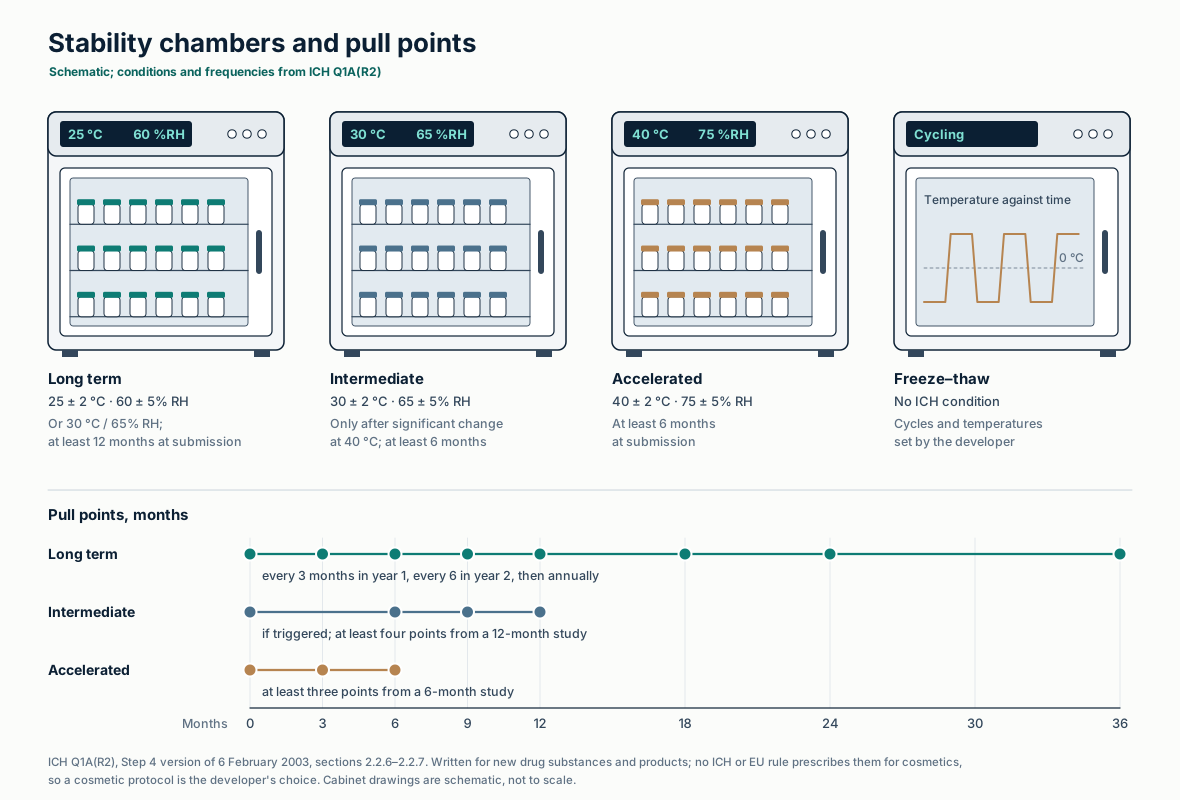
No harmonized rule sets stability conditions for cosmetics. The EU requires the safety report to cover stability "under reasonably foreseeable storage conditions" (Annex I, Part A, point 2). ICH Q1A(R2), written for new drug substances and products, supplies the reference conditions and pull points used here. A consolidated ICH Q1 that will replace it was being revised after consultation, with Step 4 planned for November 2026.
| Study | Condition | Minimum data at submission |
|---|---|---|
| Long term | 25 ± 2 °C / 60 ± 5% RH, or 30 ± 2 °C / 65 ± 5% RH | 12 months |
| Intermediate | 30 ± 2 °C / 65 ± 5% RH | 6 months (only after significant change at the accelerated condition) |
| Accelerated | 40 ± 2 °C / 75 ± 5% RH | 6 months |
| Semi-permeable containers, long term | 25 ± 2 °C / 40 ± 5% RH, or 30 ± 2 °C / 35 ± 5% RH; accelerated 40 °C / not more than 25% RH | 12 months; 6 months |
ICH Q1A(R2), Step 4 version dated February 6, 2003, sections 2.2.6–2.2.7. ICH Q1 EWG work plan, February 11, 2026 (Step 4 expected November 2026). EMA page for the Step 2b draft ICH Q1 (EMA/CHMP/ICH/130561/2025). Regulation (EC) No 1223/2009, Annex I, Part A, point 2.
What accelerated data can predict
Heat speeds a chemical reaction by a factor set by its activation energy (Arrhenius), often summarized as Q10, the rate ratio for a 10 °C rise. That arithmetic holds only while one mechanism governs; ICH Q1A says extrapolation "assumes that the same degradation relationship will continue to apply" and notes that creams may melt at accelerated conditions. Melting, phase inversion and emulsifier crystallization are threshold events, not rates, so no Q10 describes them.
| Stress or check | What it reveals | Source |
|---|---|---|
| "Significant change" criteria | For drug products: 5% assay change, a degradant over its limit, failure of appearance or physical attributes (color, phase separation), pH | ICH Q1A(R2) 2.2.7.1 |
| Freeze–thaw cycling | In W/O emulsions, stability depends on whether the emulsifier crystallizes at the interface and which phase solidifies first; no ICH condition exists, so cycles are set by the developer | Ghosh and Rousseau, J Colloid Interface Sci 2009; Degner et al., Compr Rev Food Sci Food Saf 2014 |
| Water loss through the pack | Aqueous products in semi-permeable containers are tested for water loss at low humidity | ICH Q1A(R2) 2.2.7.3 |
| Packaging compatibility | The EU safety report must cover the relevant characteristics of the packaging material, in particular purity and stability | Reg. 1223/2009, Annex I, Part A, point 4 |
ICH Q1A(R2) (2003), sections 2.2.7.1, 2.2.7.3 and 2.2.9; glossary entry "mean kinetic temperature" (Arrhenius). Waterman KC et al. Pharm Res 2007;24:780–790 (humidity-corrected Arrhenius protocol for solids). Ghosh S, Rousseau D. J Colloid Interface Sci 2009;339:91–102. Degner BM et al. Compr Rev Food Sci Food Saf 2014;13:98–113.
Regulation 1223/2009 basics
Five annexes control what may go into an EU cosmetic, and Article 19 controls what the label says about shelf life. A product with a minimum durability of 30 months or less shows a date; above 30 months it shows the period after opening: the Annex VII point 2 symbol followed by months or years. US cosmetic duties under MoCRA are covered on Cosmetics and MoCRA.
| Provision | Rule |
|---|---|
| Annex II | Substances prohibited in cosmetic products |
| Annex III | Substances allowed only under its restrictions |
| Annex IV | Colorants allowed, and their conditions |
| Annex V | Preservatives allowed, and their conditions |
| Annex VI | UV filters allowed, and their conditions |
| Article 19(1)(c) | Date of minimum durability, introduced by "best used before the end of" or the Annex VII point 3 symbol; not mandatory above 30 months, where the period after opening is shown with the Annex VII point 2 symbol |
| Reg. (EU) 2023/1545 | Fragrance allergens labeled individually above 0.001% in leave-on and 0.01% in rinse-off products; 24 allergens were already listed, the SCCS identified 56 more, and the annex adds entries 327–371, including Lavandula and Citrus oils |
| 2023/1545 transition | Non-compliant products may be placed on the market until July 31, 2026 and made available until July 31, 2028 |
Regulation (EC) No 1223/2009, Articles 14(1) and 19(1)(c) (EUR-Lex consolidated version of September 1, 2025; legislation.gov.uk adopted text) and Annex VII (symbols: enclosed information, period after opening, date of minimum durability). Commission Regulation (EU) 2023/1545 of July 26, 2023 (OJ July 27, 2023), recitals 5–7 and 11 and Annex footnotes.
Where EUTECNIQ would work
Proposed EUTECNIQ is designed to characterize botanical actives and supply formulation, stability and compatibility data that a brand's safety assessor can use. Challenge tests would be run by qualified partner laboratories. None of this work has started.
Related: Cosmetics and personal care · Cosmetics and MoCRA · Emulsions and colloids · Scale-up and tech transfer
Health information notice
These statements have not been evaluated by the Food and Drug Administration. Nothing on this site is intended to diagnose, treat, cure or prevent any disease. The information is for general education only. It is not medical advice and does not replace advice, diagnosis or treatment from a qualified health professional, or any medication a clinician has prescribed.
Do not start, stop or change any medicine, supplement or herbal product because of something you read here. Talk to your doctor or pharmacist first, especially if you are pregnant or breastfeeding, have a medical condition, take any medicines, are preparing for surgery, or are caring for a child. Research findings, traditional uses and safety data are reported as their sources state them; they are not recommendations or claims about any product. If you think you may have a medical emergency, call your doctor or 911 at once.
EUTECNIQ Sciences sells no supplements or health products today and receives nothing from any product or ingredient mentioned on this site; any commercial interest it later has in an ingredient will be stated on that ingredient’s page.