

Routes and dosage forms
The route decides whether a plant-based product can be a U.S. dietary supplement and whether its contents meet the liver before the rest of the body. The format decides how it is made, which compendial tests apply and how it fails on the shelf.
Cornell LII, 21 U.S.C. 350; PDG sign-off Q-02 Disintegration, Revision 2 (June 2025); Al-Tabakha MM. J Pharm Pharm Sci 2010;13(3):428–442; Cohen PA et al. JAMA 2023;329(16):1401–1402.
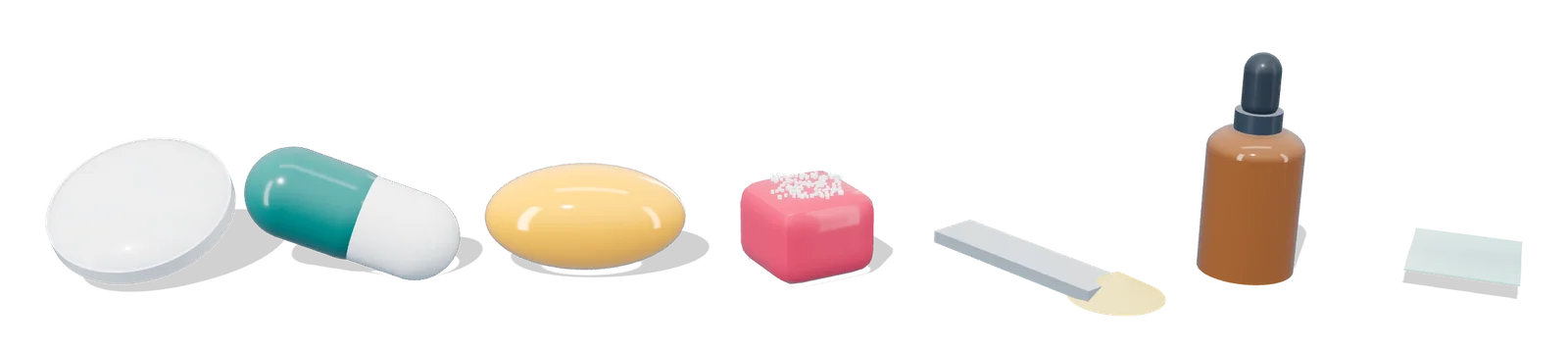
- 1 Tablet
- 2 Hard capsule
- 3 Softgel
- 4 Gummy
- 5 Powder stick pack
- 6 Liquid with dropper
- 7 Oral film
Common oral dosage forms, rendered by EUTECNIQ; generic shapes, not to scale with each other.
The route sets the first pass
A swallowed dose is absorbed in the gut and reaches the liver through the portal vein, so the gut wall and the liver can metabolize it before the rest of the body sees it. Oral mucosa, skin, lungs and nose drain to systemic veins instead. The rectum is split: the superior rectal vein drains to the portal vein, the middle and inferior rectal veins to the inferior vena cava.
When metabolism sites act in series, bioavailability is the product of the fractions that escape each one: F = Fa × FG × FH. The ADME and PBPK page treats each factor.
| Route | What the primary record shows | Source |
|---|---|---|
| Oral, swallowed | The liver is usually the main first-pass site; the gut wall, blood, lungs and vascular endothelium can add to it. Extensive first pass rules some drugs out of oral use (lidocaine, naloxone, glyceryl trinitrate). | Pond and Tozer 1984 |
| Oral transmucosal | Fentanyl from a transmucosal lozenge (15 µg/kg, 12 volunteers): systemic bioavailability 0.52 versus 0.32 for the same dose swallowed as a solution; peak plasma at 22 versus 101 min. | Streisand et al. 1991 |
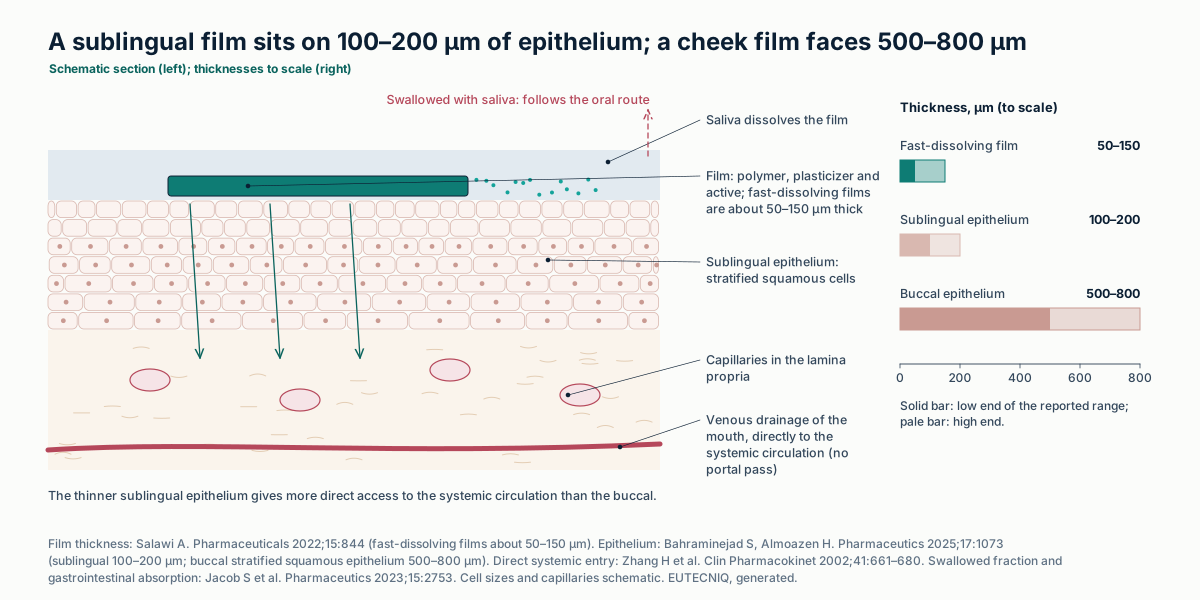
| Sublingual and buccal | Sublingual epithelium is 100–200 µm thick; the buccal stratified squamous epithelium is 500–800 µm. | Bahraminejad and Almoazen 2025 |
| Transdermal | Successful transdermal drugs have molecular masses up to a few hundred daltons, partition strongly into lipids and need doses of milligrams per day or less. | Prausnitz and Langer 2008 |
| Inhaled | Rapid absorption and avoidance of hepatic first-pass effects; deposition depends on breathing pattern and aerosol properties. | He et al. 2025 |
| Nasal | Avoids the hepatic first pass, but metabolism on the mucosal surface can keep bioavailability low. | Tai et al. 2022 |
| Rectal | Hepatic first pass of high-clearance drugs such as lidocaine is partly avoided; absorption from suppositories depends heavily on the base and additives. | de Boer et al. 1982 |
Streisand JB et al. Anesthesiology 1991;75(2):223–229. Other sources as in the figure.
U.S. status by route
A dietary supplement must be “intended for ingestion” (21 U.S.C. 321(ff)(2)(A)). The statute names six forms; any other ingested form qualifies only if it “is not represented as conventional food” and not as a sole item of a meal or the diet (21 U.S.C. 350(c)(1)(B)). FDA's warning letters treat products that enter “directly through the skin or mucosal tissues” as outside the category. The final call on a product belongs to counsel.
| Route or format | Can it be a dietary supplement? | Basis |
|---|---|---|
| Tablets, capsules, softgels, gelcaps, powders, liquids (swallowed) | Yes | Named forms, 21 U.S.C. 350(c)(1)(B)(i) Statute |
| Gummies, chews and other ingested forms | Yes, if not represented as a conventional food or a sole item of a meal or the diet | 21 U.S.C. 350(c)(1)(B)(ii); 321(ff)(2)(B) Statute |
| Liquids, tonics and shots | Supplement or beverage, decided by name, packaging, serving size, recommended daily intake and statements such as “refresh” or “rehydrate” | FDA guidance, January 2014 (docket FDA-2009-D-0542) Guidance |
| Sublingual tablets, films and sprays | No: “not dietary supplements and are not foods” | FDA warning letter to DK Vitamins, February 5, 2019 Warning letter |
| Transdermal and topical products | No: products “such as transdermal products, are not dietary supplements”; topicals are cosmetics or drugs by intended use | FDA warning-letter language quoted by RAPS, June 2013; 21 U.S.C. 321(i) Warning letters |
| Inhaled products | No; FDA: “Caffeine is not normally inhaled into the lungs and the safety of doing so has not been well studied” | FDA warning letter to Breathable Foods (2012), as quoted by RAPS Warning letter |
| Nasal products | Regulable as drugs: the court held FDA may regulate a nasal vitamin B12 gel as a drug “whether or not” it is a dietary supplement | United States v. Nature's Bounty, 72 F.3d 285 (2d Cir. 1995) Case law |
| Rectal products | Fall within FDA's “mucosal tissues” wording; no FDA letter on a rectal supplement was located for this page | Warning-letter language above Interpretation |
| Buccal lozenges and oral pouches | Depends on where the contents are intended to be absorbed: swallowed, or taken up through the oral mucosa | Intended use Depends on use |
Cornell LII, 21 U.S.C. 321 and 350 (accessed October 27, 2026). FDA, Guidance for Industry: Distinguishing Liquid Dietary Supplements from Beverages (January 2014). FDA warning letter 566205, DK Vitamins (February 5, 2019). Gaffney A. Regulatory Focus (RAPS), June 6, 2013. United States v. Nature's Bounty, Inc., 72 F.3d 285 (2d Cir. 1995). Legal classification is fact-specific; see legal status and claims.
Format by route, test and risk
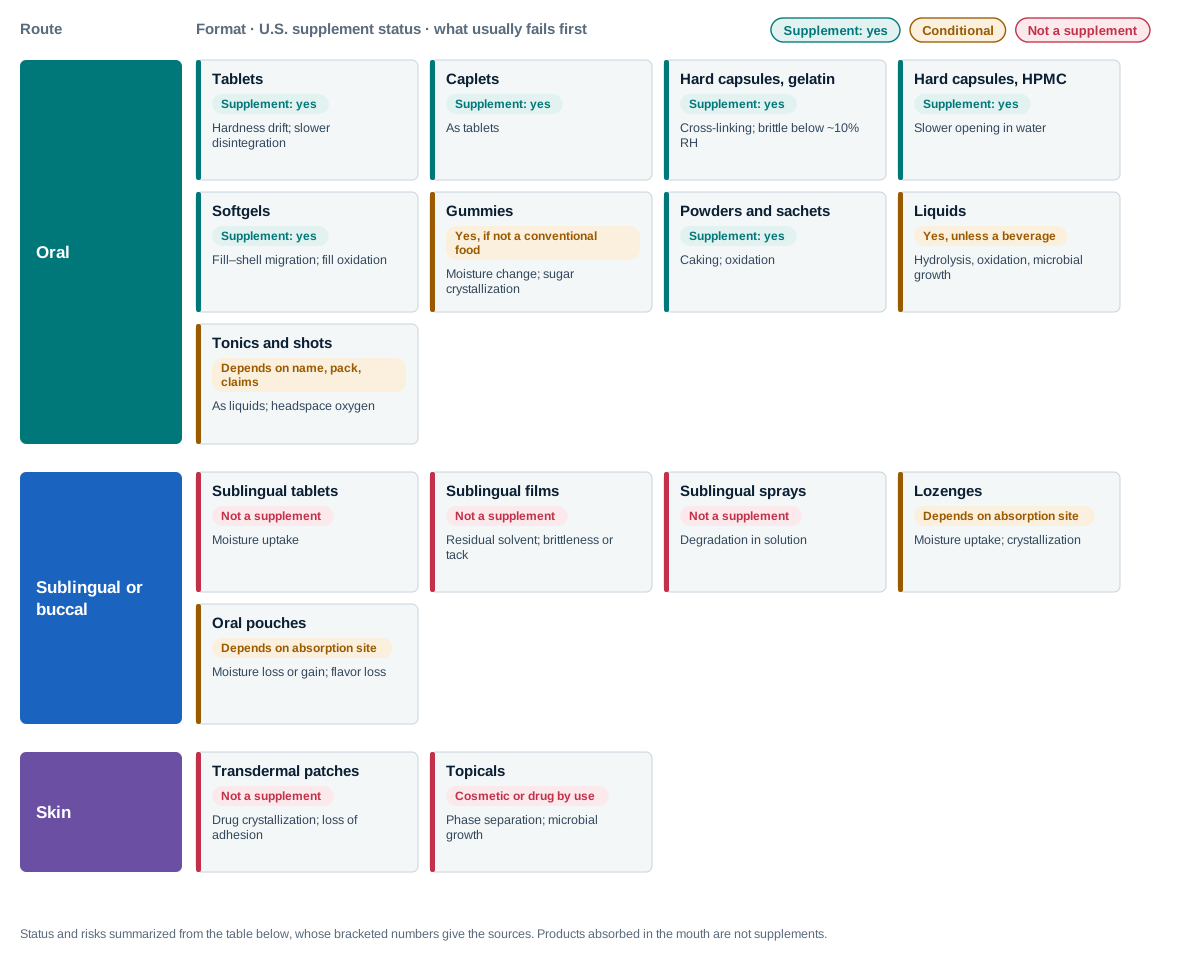
Sixteen formats on one sheet: the route each uses, its U.S. supplement status, how it is made, which tests carry the weight and what usually fails first. Bracketed numbers are sources; unbracketed cells are general manufacturing practice, not data.
| Format | Route | U.S. supplement? | How it is made | Key tests | Typical stability risks |
|---|---|---|---|---|---|
| Tablets | Oral | Yes [1] | Direct compression, or wet granulation (binder liquid, drying) or dry granulation (roller compaction or slugging), then compression; often film-coated in a rotating pan [2, 3] | Disintegration and dissolution <2040> where a monograph applies; weight variation <2091>; hardness, friability, assay [4, 5] | Hardness drift and slower disintegration with age and moisture; coating cracks without enough plasticizer [3] |
| Caplets | Oral | Yes [1] | As tablets, with an elongated, capsule-shaped punch | As tablets [4, 5] | As tablets |
| Hard capsules, gelatin | Oral | Yes [1] | Shells dip-molded: pins at 22 °C dipped in gelatin at 45–55 °C, dried, stripped, cut; filled with powder or granules and closed [6] (also: 'Dip-molded HPMC', 'deposit hot into molds', 'cooking and molding', 'Mold starch') | Disintegration <2040>; weight variation <2091>; two-tier dissolution with enzymes if pellicles form [4, 7] | Shell water 13–16%; brittle below about 10% RH; cross-linking with aldehydes or heat and humidity [6] |
| Hard capsules, HPMC | Oral | Yes [1] | Dip-molded HPMC with a gelling aid (carrageenan with potassium chloride, or gellan gum) [6] | As gelatin capsules; check media with potassium ions, which slow carrageenan-gelled shells [6] | Shell water 2–7%; no gelatin-type cross-linking; slower opening in water at 37 °C (about 4 versus 1 min in one study) [6] |
| Softgels | Oral | Yes [1] | Rotary die: two cast gelatin ribbons pass between counter-rotating die rolls; a heated wedge doses the fill; sealed at 37–40 °C; rotary-dried, then tray-dried [8] | Rupture test (<2040>: Apparatus 2, 50 rpm, 500 mL, 15 min) or disintegration; dissolution with enzymes for cross-linked shells [10] | Fill–shell migration; oxidation of the fill; cross-linking slows rupture [8, 10] |
| Gummies | Oral | Yes, if not represented as a conventional food [1] | Cook a gelatin or pectin gel with sugars and syrups (up to 75% sugar solids), deposit hot into molds, cure at about 45 °C for up to 72 h [9, 11] | Assay per unit and content uniformity; water activity; no USP disintegration requirement located for gummies | Moisture gain or loss, sugar crystallization, heat softening of gelatin [9]; active loss in cooking |
| Powders and sachets | Oral | Yes [1] | Blending; spray-dried or agglomerated ingredients for wetting; filled into stick packs or tubs | Fill weight, blend uniformity, assay, moisture, microbial limits | Caking from moisture, oxidation, color change |
| Liquids | Oral | Yes, unless represented as a beverage [1, 12] | Dissolving or emulsifying the active; preservative system; pH set; filled into bottles or dropper vials | Assay, pH, microbial limits, preservative content, appearance | Hydrolysis and oxidation in solution, sedimentation or creaming, microbial growth |
| Tonics and shots | Oral | Depends on name, packaging, serving size and claims [12] | As liquids, in single-serve units | As liquids | As liquids; headspace oxygen in small fills |
| Sublingual tablets | Sublingual | No [13] | Compression of rapidly disintegrating blends | USP <701> carries a separate national procedure for sublingual tablets [5] | Moisture uptake by fast-disintegrating excipients |
| Sublingual films | Sublingual or buccal | No [13] | Solvent casting (a polymer solution with plasticizer and active, cast and dried) or hot-melt extrusion [14, 15] | Thickness, content uniformity, disintegration time; no official pharmacopeial disintegration method for these films [14] | Residual solvent, brittleness or tack with humidity, uneven drug distribution from air bubbles or casting viscosity [15] |
| Sublingual sprays | Sublingual or buccal | No [13] | Solution or emulsion in a metered pump | Delivered dose per actuation, droplet size, assay, microbial limits | Degradation in solution; pump and container interactions |
| Lozenges | Buccal, then swallowed | Depends on intended absorption site | Compression, or cooking and molding a sugar or polyol mass | Assay per unit, weight, dissolution time in the mouth (method set by the maker) | Moisture uptake, sugar crystallization |
| Oral pouches | Buccal (between lip and gum) | Depends on intended absorption site | Powder or fiber filling sealed into a porous nonwoven pouch | Fill weight, assay, moisture | Moisture loss or gain; flavor loss |
| Transdermal patches | Transdermal | No [16] | Matrix: drug-in-adhesive coated from solvent, hydrogel or hot melt, dried, laminated to backing and release liner, die-cut; reservoir: gel heat-sealed between backing and a microporous membrane [17] | Peel adhesion, tack, release-liner peel, shear, cold flow, in vitro release, residual solvents, crystal presence [17] | Drug crystallization in the matrix, loss of adhesion, cold flow [17] |
| Topicals (creams, gels, lotions) | Topical, mostly local | No; cosmetic or drug by intended use [16, 18] | Emulsification or gelling, homogenization, filling | Viscosity, pH, assay, microbial limits, preservative efficacy | Phase separation, microbial growth, oxidation |
[1] 21 U.S.C. 321(ff), 350(c)(1)(B). [2] Shanmugam S. Bioimpacts 2015;5(1):55–63. [3] Seo KS et al. Pharmaceutics 2020;12(9):853. [4] USP–NF <2040> scope (USP DOI page); 21 U.S.C. 343(s)(2). [5] PDG sign-off Q-02 Disintegration, Rev. 2 (June 2025), USP local requirements. [6] Al-Tabakha MM. J Pharm Pharm Sci 2010;13(3):428–442. [7] FDA, Dissolution Testing of Immediate Release Solid Oral Dosage Forms (August 1997). [8] Naharros-Molinero A et al. Adv Healthc Mater 2024;13(1):e2302250. [9] Vásquez-Senador M et al. Gels 2026;12(9):841. [10] Damian F et al. Pharmaceutics 2021;13(2):214. [11] Pournemati N et al. J Texture Stud 2026;57(5):e70117. [12] FDA liquids and beverages guidance (January 2014). [13] FDA warning letter to DK Vitamins (2019). [14] Salawi A. Pharmaceuticals 2022;15(7):844. [15] Jacob S et al. Pharmaceutics 2023;15(12):2753. [16] FDA warning-letter language quoted by RAPS (2013). [17] FDA draft guidance, Transdermal and Topical Delivery Systems (November 2019). [18] 21 U.S.C. 321(i).
Tablets and hard capsules
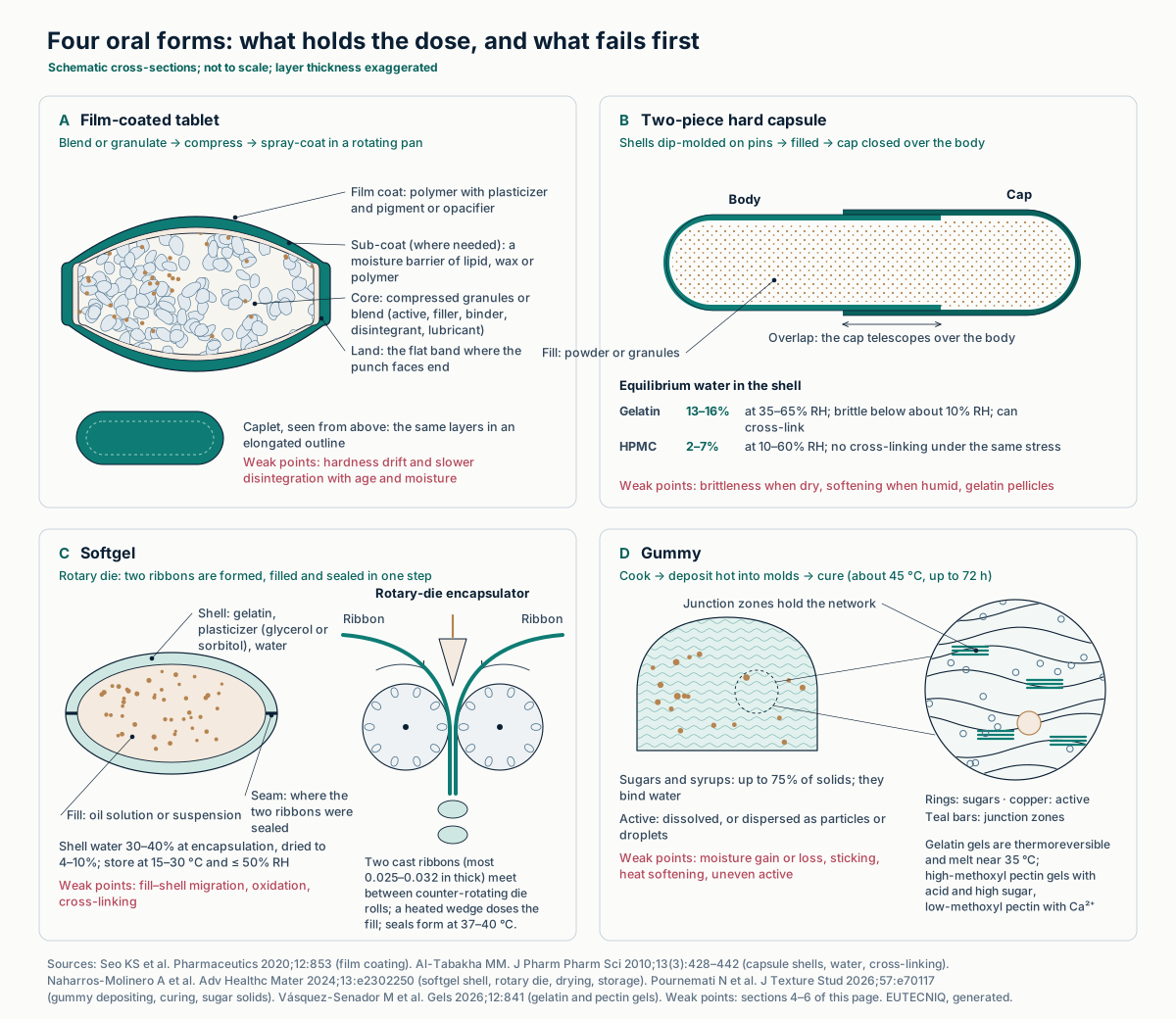
Granulation turns fine powder into free-flowing granules that compress evenly; it is wet when a binder liquid is used and dry when roller compaction or slugging does the work. Film coats are polymer solutions or suspensions with plasticizers and pigments, sprayed onto a rotating bed of tablets and dried with hot air. A capsule replaces compression with a shell, so the shell's water and chemistry become the weak point.
| Property | Gelatin shell | HPMC shell |
|---|---|---|
| Equilibrium water | 13–16% at 35–65% RH; about 14% at 50% RH | 2–7% at 10–60% RH; about 6% at 50% RH |
| Low humidity | Brittle below about 10% RH | Remains flexible even at low moisture content |
| Gelling | Gelatin gels on cooled pins (22 °C) from a 45–55 °C dip | Gels on heating, so pins run at about 70 °C; or a gelling aid: carrageenan with potassium chloride, or gellan gum |
| Cross-linking | Occurs with aldehydes such as formaldehyde and under heat and humidity stress | Not observed under the same conditions |
| Opening in water, 37 °C | About 1 min | About 4 min (carrageenan-gelled shells, one study) |
| Temperature and pH | Generally does not dissolve below 30 °C | Opened more slowly than gelatin in tests at 37 °C and above, notably in pH 6.8 phosphate buffer |
| Medium effects | Pellicles from cross-linking; enzymes added in a second tier | Potassium ions slow release from carrageenan-gelled shells |
Al-Tabakha MM. HPMC capsules: current status and future prospects. J Pharm Pharm Sci 2010;13(3):428–442 (reviewing the primary studies). Granulation: Shanmugam S. Bioimpacts 2015;5(1):55–63. Film coating: Seo KS et al. Pharmaceutics 2020;12(9):853.
| Finding | Result | Source |
|---|---|---|
| Cross-linked gelatin capsules in people | Capsules stressed with formaldehyde until they failed dissolution without enzymes ruptured later in vivo (about 71 min for the most cross-linked, fed), yet each was bioequivalent to the control by AUC and Cmax (10 subjects, six-way design). Two-tier dissolution with gastric or intestinal enzymes predicted in vivo performance. | Digenis GA et al. Pharm Res 2000;17:572–582 |
| Fill weight of a botanical capsule | Of 52 Andrographis capsule products, 24 (46%) had powder weights more than 10% from the label; 29 (56%) met all five pharmacopeial methods compared. | Wattananat T et al. J Thai Tradit Altern Med 2019;17(3):390–402 |
Softgels
A softgel holds a liquid fill, oil or suspension, in a plasticized gelatin shell. The rotary die forms, fills and seals in one step, and the shell then loses most of its water in drying. Gullapalli calls the softgel a “very dynamic” dosage form whose stability over shelf life is hard to secure; the rupture test and enzyme-assisted dissolution exist for that reason.
| Stage or test | Value | Source |
|---|---|---|
| Shell formula | Gelatin typically 40–45% of the wet shell mass; plasticizers glycerol or sorbitol; shell mass flows at about 60 °C | Naharros-Molinero 2024 |
| Ribbon casting | Cast on air-cooled drums at 13–14 °C; ribbon 0.022–0.045 in, most 0.025–0.032 in, controlled to ±0.1 mm | Naharros-Molinero 2024 |
| Sealing | Wedge doses the fill between counter-rotating die rolls; seals at 37–40 °C | Naharros-Molinero 2024 |
| Drying | Shell water 30–40% w/w after encapsulation; rotary drying 1–3 h with air below 35 °C, then tray drying at 21–24 °C and 20–30% RH for hours to days, to an equilibrium 4–10% w/w | Naharros-Molinero 2024 |
| Storage | 15–30 °C and not more than 50% RH recommended | Naharros-Molinero 2024 |
| Material loss | Gelatin waste in the rotary die can reach 50% of the gelatin used | Naharros-Molinero 2024 |
| Rupture test (<2040>, as quoted) | Apparatus 2, 50 rpm, 500 mL, 15 min; all units rupture within 15 min, or, on retest of 12 more, no more than 2 of 18 take 15–30 min | Damian et al. 2021 |
| Second-tier enzymes (<711>, as quoted) | Pepsin below pH 4; papain or bromelain at pH 4–6.8 (≤ 550,000 units/1000 mL); pancreatin above pH 6.8 (≤ 2000 protease units/1000 mL) | Damian et al. 2021 |
| Rupture versus disintegration | Vitamin softgels stored 2 and 4 weeks at 40 °C/75% RH passed conventional disintegration but failed the rupture test, while their gelatin dissolved completely by 60 min; the authors judged the methods not equivalent | Yacobucci et al. 2014 |
Naharros-Molinero A et al. Shell formulation in soft gelatin capsules. Adv Healthc Mater 2024;13(1):e2302250. Damian F et al. Challenges of dissolution methods development for soft gelatin capsules. Pharmaceutics 2021;13(2):214 (quoting USP <2040> and <711>). Yacobucci M et al. Am J Pharm Educ 2014;78(5):Article 111 (meeting abstract). Gullapalli RP. J Pharm Sci 2010;99(10):4107–4148. Kaliyamoorthy S. Pharm Dev Technol 2026;31(7):1217–1231 (die-roll designs).
Gummies
A gummy is a sugar-rich hydrogel. Gelatin gels are thermoreversible and can melt in warm storage; high-methoxyl pectin gels under acid with high sugar, low-methoxyl pectin through calcium bridges. Sugars and syrups bind water and slow syneresis. Cooking heat, acid and long curing are the steps an active must survive, and the measured label accuracy of gummies shows how often dosing goes wrong.
| Item | Value | Source |
|---|---|---|
| Sugar solids | Up to 75% in gummies and jelly candy | Pournemati et al. 2026 |
| Depositing and curing | Hot depositing; extended curing at about 45 °C for up to 72 h | Pournemati et al. 2026 |
| Mold starch | Native corn starch pre-dried to 5–7% moisture forms the cavities and absorbs surface moisture; it is not part of the finished piece | Pournemati et al. 2026 |
| Gelatin network | Chains form triple helices below about 35 °C; the gel melts near body temperature | Naharros-Molinero 2024 |
| Label accuracy | 25 melatonin gummy products: 22 (88%) inaccurately labeled; melatonin 74–347% of label; 3 (12%) within ±10%; one had none detectable | Cohen et al. 2023 |
| Gummy versus caplet | Vitamin C 1000 mg, 30 adults, crossover: no significant difference in plasma AUC0–24h or Tmax; caplet Cmax slightly higher (study funded by the gummy's maker) | Evans et al. 2020 |
Pournemati N et al. J Texture Stud 2026;57(5):e70117. Naharros-Molinero A et al. Adv Healthc Mater 2024;13(1):e2302250. Vásquez-Senador M et al. Gels 2026;12(9):841. Cohen PA et al. JAMA 2023;329(16):1401–1402. Evans M et al. J Am Coll Nutr 2020;39(5):422–431.
Powders, liquids and shots
Powders and liquids carry larger doses than a capsule can hold, but a liquid can stop being a supplement on the strength of how it is sold. FDA's 2014 guidance treats beverages as conventional foods and lists the factors that decide which side of the line a liquid sits on; usually a combination of them, sometimes the name alone.
| Factor | What FDA describes |
|---|---|
| Product or brand name | Conventional-food terms such as “beverage,” “drink,” “water” or “soda” represent the product as a conventional food; in some cases the name alone may suffice |
| Packaging | Size, shape, color and design of the container, the volume it holds, whether it is reclosable or single-serve, and its similarity to common beverage packaging |
| Serving size and daily intake | FDA estimates average daily drinking-fluid intake at about 1.2 L; directions that supply all or a large part of it (for example, “Drink up to three 16-ounce bottles per day”) represent the product as a conventional food |
| Statements and graphics | Claims to “refresh” or “rehydrate,” and serving suggestions or vignettes, can make a product with a Supplement Facts panel a conventional food |
| Use as a beverage | A product that in practice replaces ordinary sources of drinking fluid is generally considered a conventional food, even without saying so |
FDA. Guidance for Industry: Distinguishing Liquid Dietary Supplements from Beverages. January 2014; docket FDA-2009-D-0542; Section III.A.
Which tests apply
USP's dietary-supplement chapters apply where a monograph cites them, and the statute gives them teeth: a supplement covered by a compendium, represented as meeting it and failing is misbranded, and one outside any compendium is misbranded if it fails the quality specifications, “including tablet or capsule disintegration,” that it claims (21 U.S.C. 343(s)(2)). Every manufacturer must set finished-batch specifications for identity, purity, strength and composition (21 CFR 111.70(e)).
| Chapter | Covers | Publicly verifiable content |
|---|---|---|
| <701> Disintegration | Tablets and capsules (drug products) | Harmonized text (PDG Q-02, Rev. 2, June 2025): basket-rack in fluid at 37 ± 2 °C, 29–32 cycles/min over 53–57 mm; 6 units; if 1 or 2 fail, test 12 more, and at least 16 of 18 must disintegrate. The time limit comes from the monograph. USP adds national procedures for delayed-release, buccal, sublingual, chewable and orally disintegrating tablets. |
| <711> Dissolution | Solid oral dosage forms | Harmonized and declared interchangeable (ICH Q4B Annex 7(R2)). FDA's 1997 guidance: 37 ± 0.5 °C; 500, 900 or 1000 mL; basket 50–100 rpm, paddle 50–75 rpm; pepsin or pancreatin may be needed to dissolve gelatin pellicles. |
| <905> Uniformity of dosage units | Drug products | Harmonized (ICH Q4B Annex 6): acceptance value AV = |M − X̄| + ks, k = 2.4 for 10 units and 2.0 for 30; L1 = 15.0, L2 = 25.0. Weight variation may replace content uniformity only at or above 25 mg and 25%. |
| <2040> Disintegration and dissolution of dietary supplements | Dietary supplements, “where stated in the individual monographs” | Scope on USP's DOI page. Rupture test for softgels as quoted in peer-reviewed literature (section 5). Full text is by subscription. |
| <2091> Weight variation of dietary supplements | Dietary supplements | Title and existence only; the acceptance limits are in the subscription text and are not reproduced here. |
Cornell LII, 21 U.S.C. 343(s)(2)(D)–(E). eCFR, 21 CFR 111.70(e), up to date as of October 23, 2026. PDG sign-off document Q-02 Disintegration, Revision 2, June 2025 (PMDA). ICH Q4B Annex 7(R2), November 2010, and Annex 6, November 2013. Japanese Pharmacopoeia 6.02, Uniformity of Dosage Units, harmonized text (PMDA). FDA, Dissolution Testing of Immediate Release Solid Oral Dosage Forms, August 1997. USP–NF <2040> (DOI 10.31003/USPNF_M99970_04_01), introduction.
Films, sprays, lozenges, pouches
These formats release their contents in the mouth. Absorption through the mucosa skips the portal circulation, but whatever is swallowed with saliva is absorbed in the gut like any oral dose. In the United States, sublingual products are not dietary supplements, so a sublingual film or spray of a botanical sits in the drug framework unless counsel concludes otherwise.
| Format | Process and key attributes | Evidence |
|---|---|---|
| Orodispersible and sublingual films | Solvent casting and hot-melt extrusion are the most common methods; fast-dissolving films are about 50–150 µm thick and dissolve within 30 s; films of 2 × 2 cm and up to 100 µm are considered acceptable in the mouth | Salawi 2022; Jacob et al. 2023 |
| Film disintegration testing | No official pharmacopeial method; laboratories use Petri-dish or slide-frame methods, with typical times of 5–30 s | Salawi 2022 |
| Buccal spray, vitamin D3 | Systematic review: 4 randomized trials (800–3000 IU/day, 30 days to 3 months); only one, with limitations, favored the spray; buccal spray did not appear superior to other forms | Grammatikopoulou et al. 2020 |
| Transmucosal lozenge, fentanyl | Bioavailability 0.52 versus 0.32 for the swallowed solution; faster peak (22 versus 101 min) | Streisand et al. 1991 |
| Buccal lozenges and pouches | Regulatory status follows the intended absorption site: swallowed contents, or uptake through the mucosa | Interpretation of 21 U.S.C. 321(ff)(2)(A) and the FDA warning letter to DK Vitamins (February 5, 2019) |
Salawi A. Pharmaceuticals 2022;15(7):844. Jacob S et al. Pharmaceutics 2023;15(12):2753. Grammatikopoulou MG et al. Nutrients 2020;12(3):691. Streisand JB et al. Anesthesiology 1991;75(2):223–229. FDA warning letter to DK Vitamins, February 5, 2019.
Patches and topicals
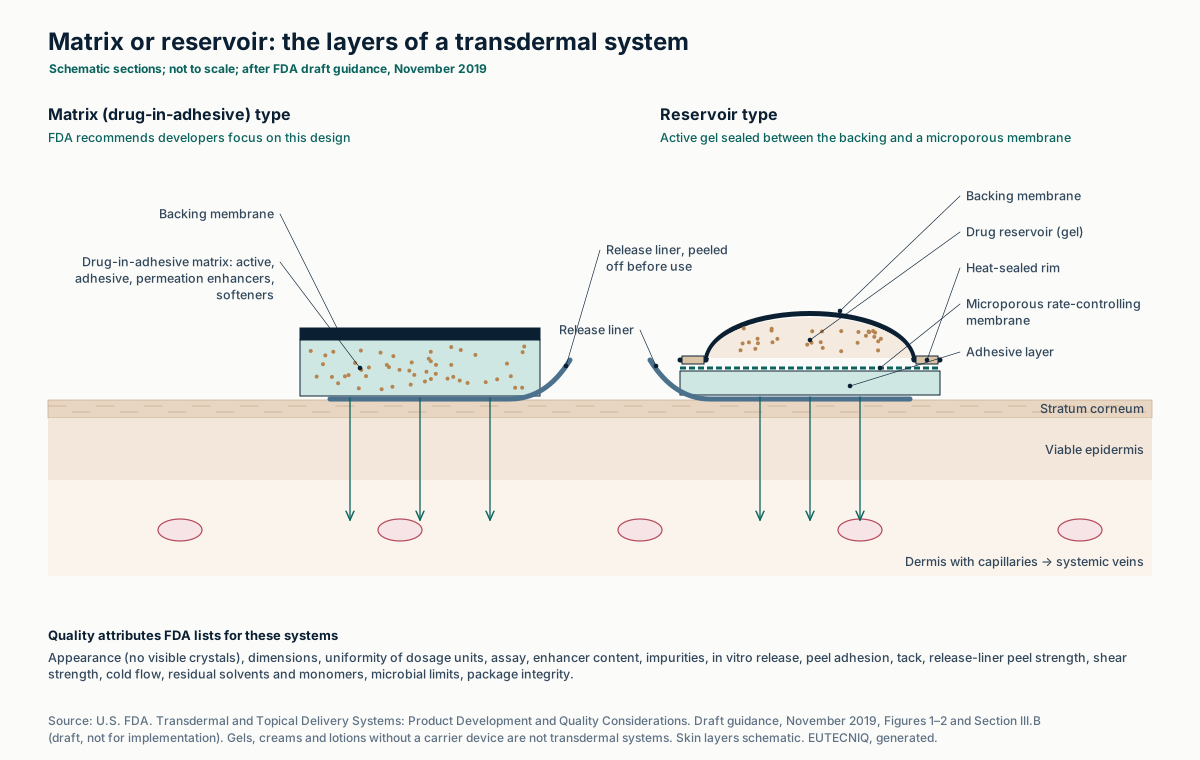
FDA describes two transdermal designs: a matrix with the active dissolved or partly suspended in adhesive, and a reservoir with an active gel heat-sealed between the backing and a microporous membrane. Because reservoir systems carry inherent failure modes, FDA recommends developers focus on matrix designs. Transdermal and topical delivery systems are combination products under 21 CFR part 3; creams, gels and lotions without a carrier device are not delivery systems in this sense.
| Layer | Function | Attributes FDA lists |
|---|---|---|
| Backing membrane | Outer layer; carries the label | Extractables and leachables; label legibility |
| Drug-in-adhesive matrix or gel reservoir | Holds the active with adhesives, permeation enhancers, softeners and preservatives | Assay, uniformity of dosage units, enhancer content, impurities, absence of visible crystals, residual drug |
| Rate-controlling membrane (reservoir type) | Microporous layer that meters release from the gel | In vitro release profile |
| Adhesive | Holds the system on skin for the wear period | Peel adhesion, tack, shear strength, cold flow, residual solvents and monomers |
| Release liner | Protects the adhesive until use | Release-liner peel strength |
FDA. Transdermal and Topical Delivery Systems: Product Development and Quality Considerations. Draft guidance, November 2019, Sections II–III (draft, not for implementation). Status as a non-supplement: FDA warning-letter language quoted by RAPS (2013).
Where EUTECNIQ would work
Proposed EUTECNIQ would fix the route and the U.S. category before formulation starts, then design the format against its weak point: shell water for capsules, fill–shell exchange for softgels, heat and moisture for gummies. It would plan disintegration, dissolution and uniformity work by external or future in-house laboratories. It has no laboratory, products or results today.
Related: Delivery technologies · ADME and PBPK · Legal status and claims · Dietary supplements · Cosmetics and MoCRA
Health information notice
These statements have not been evaluated by the Food and Drug Administration. Nothing on this site is intended to diagnose, treat, cure or prevent any disease. The information is for general education only. It is not medical advice and does not replace advice, diagnosis or treatment from a qualified health professional, or any medication a clinician has prescribed.
Do not start, stop or change any medicine, supplement or herbal product because of something you read here. Talk to your doctor or pharmacist first, especially if you are pregnant or breastfeeding, have a medical condition, take any medicines, are preparing for surgery, or are caring for a child. Research findings, traditional uses and safety data are reported as their sources state them; they are not recommendations or claims about any product. If you think you may have a medical emergency, call your doctor or 911 at once.
EUTECNIQ Sciences sells no supplements or health products today and receives nothing from any product or ingredient mentioned on this site; any commercial interest it later has in an ingredient will be stated on that ingredient’s page.