

Delivery technology starts from the molecule, and its benefit has to be measured
A carrier is chosen from the active's solubility, lipophilicity, dose, stability and route. This page maps nine botanical actives, the main delivery families and their limits.
Status. EUTECNIQ has no laboratory and no formulation data. Formulation is planned for Phase I and pilot drying for Phase II; qualified partners would run human pharmacokinetic studies (platform plan).
Academy fundamentals: Course 8, Solubility, pH and the body
PubChem, accessed October 24, 2026; ICH M9 (2019), section 2.1; Trevaskis et al., Adv Drug Deliv Rev 2008; Bos and Meinardi, Exp Dermatol 2000.
The general solubility equation splits poor solubility into crystal packing and lipophilicity, and common botanical actives fall on both sides
Data table: PubChem values and GSE estimates
| Compound | PubChem CID | Formula | MW, g/mol | XLogP3 (computed) | Melting point, °C (source) | 0.01(MP − 25) | Larger term | GSE estimate, µg/mL (derived) |
|---|---|---|---|---|---|---|---|---|
| Curcumin | 969516 | C21H20O6 | 368.4 | 3.2 | 183 (HSDB) | 1.58 | lipophilicity | 19 |
| Resveratrol | 445154 | C14H12O3 | 228.24 | 3.1 | 254 (HSDB, 253–255 (midpoint)) | 2.29 | lipophilicity | 2.9 |
| Piperine | 638024 | C17H19NO3 | 285.34 | 3.5 | 129 (HMDB) | 1.04 | lipophilicity | 26 |
| Capsaicin | 1548943 | C18H27NO3 | 305.4 | 3.6 | 65 (HSDB) | 0.40 | lipophilicity | 97 |
| Caffeine | 2519 | C8H10N4O2 | 194.19 | −0.1 | 236.2 (HSDB) | 2.11 | crystal packing | 6,000 |
| EGCG | 65064 | C22H18O11 | 458.4 | 1.2 | 141 (HMDB, 140–142 (midpoint)) | 1.16 | lipophilicity (marginal) | 6,300 |
| Quercetin | 5280343 | C15H10O7 | 302.23 | 1.5 | 316.5 (HSDB) | 2.92 | crystal packing | 37 |
| Ursolic acid | 64945 | C30H48O3 | 456.7 | 7.3 | 284 (HSDB) | 2.59 | lipophilicity | 0.00019 |
| β-Carotene | 5280489 | C40H56 | 536.9 | 13.5 | 183 (HSDB) | 1.58 | lipophilicity (off the chart) | — |
Derived columns are computed here: log S₀ = 0.5 − 0.01(MP − 25) − log P in mol/L, times MW. They are screening estimates of the intrinsic solubility of the neutral form, not measured solubilities, and they inherit the error of a computed log P.
Quercetin's barrier is mainly its crystal, curcumin's, piperine's and capsaicin's mainly lipophilicity: different barriers point to different delivery families.
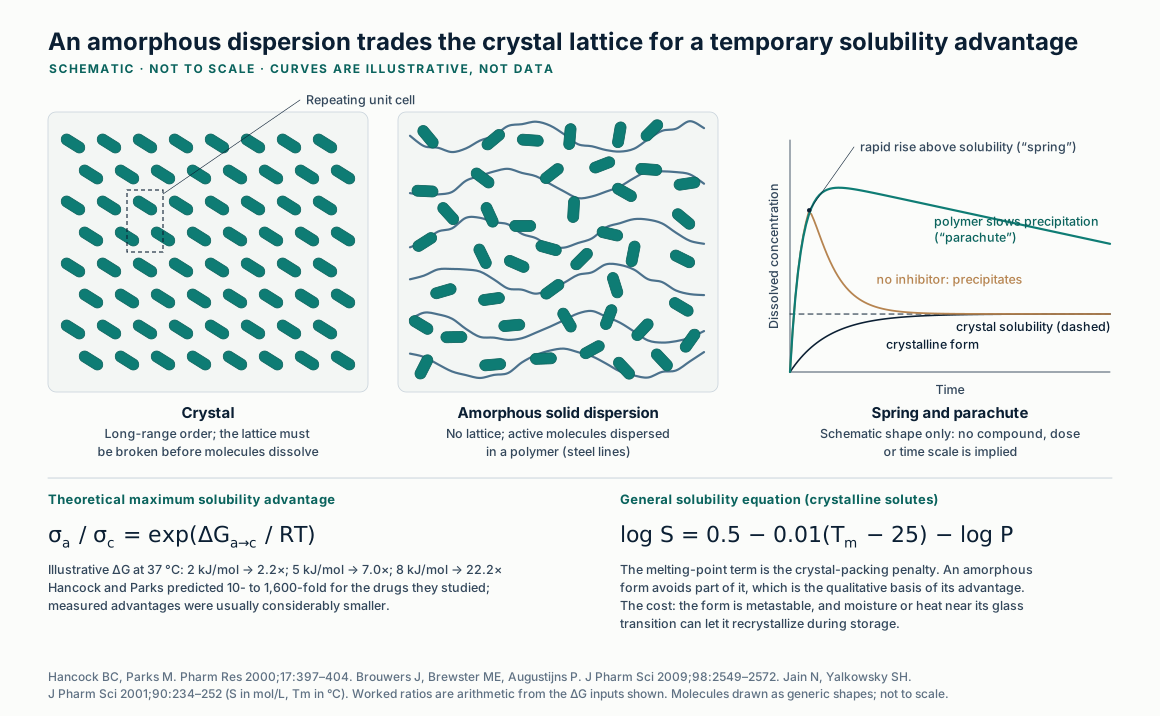
Explanation, details and sources
A delivery system is chosen from the molecule's limits: solubility, lipophilicity, melting point, dose, stability and route. Small or stable is not absorbed: a sub-100 nm droplet or a stable dispersion does not show higher systemic exposure; only a pharmacokinetic study does, and exposure is not clinical benefit. The product category also limits the toolkit: an excipient with precedent in medicines is not automatically lawful in a food, supplement or cosmetic.
Caffeine shows that a high melting point alone does not make a compound poorly soluble: its log P is low. Ursolic acid is limited by both terms. β-Carotene (XLogP3 13.5) lies far to the right of the chart.
Each step answers one question, and only the last ones are about people
Text version of the six steps
- MoleculeSolubility, log P, melting point, molecular weight, dose, stability, intended route.
- BarrierDissolution, solubility, permeability, gut-wall and liver metabolism, chemical or physical instability.
- Candidate familiesOnly those that address the identified barrier and are lawful for the product category.
- Laboratory performanceParticle size, dispersion, dissolution, digestion, stability and oxidation against preset limits.
- Human exposurePharmacokinetics against a defined comparator, by a qualified partner.
- BenefitOnly a clinical study of an outcome shows benefit; exposure alone does not.
Explanation, details and sources: what EUTECNIQ would do in house and with partners
Formulation work moves from the molecule's properties to the barrier that limits it, then to candidate carriers, laboratory performance and, if justified, human exposure. The table shows the proposed split between planned in-house work and qualified partners.
| Work | Planned in house | Qualified external partner |
|---|---|---|
| Pre-formulation | Phase I Solubility, log P and solid-state screening; excipient status check for the product category | Partner Specialist solid-state methods outside the planned equipment |
| Formulation and characterization | Phase I Laboratory emulsions, dispersions and drying; particle sizing, stability and in vitro digestion | Partner Accredited testing where a customer requires it |
| Scale-up | Phase II Pilot drying and homogenization | Partner Commercial manufacture until Phase III |
| Human exposure | Planned Study design and data interpretation | Partner Human pharmacokinetic studies and plasma bioanalysis |
Founder-reported prior experience The founder reports formulating botanical actives in liquid, emulsion, suspension and powder formats and three human clinical PK/PD programs at a prior employer. These are not EUTECNIQ results; see Founder.
Choose a model compound and see which delivery families are worth evaluating, and why
Results appear here when the page's script runs.
- Without script, read the rule table below: every rule and its condition is listed there.
Method, assumptions and limits: design a delivery system
- What it calculates
- Four published quantities for the model compound, and a sorting of ten delivery families into "worth evaluating", "possible, with conditions" and "not indicated by these inputs" using the rules in the table below.
- Equations
- Dose number Do = D/(V0·S) with V0 = 250 mL, the volume in the ICH M9 definition of a highly soluble drug. General solubility equation: log S0 = 0.5 − 0.01(MP − 25) − log P (mol/L). Potts–Guy: log kp = −2.7 + 0.71 log P − 0.0061 MW (cm/h). β-Cyclodextrin for a 1:1 complex: D × 1,135/MW (1,135 g/mol from C42H70O35).
- Variables and units
- S in µg/mL (slider is log₁₀ S, 0.01 to 100,000); D in mg (slider is log₁₀ D, 1 to 2,000); MP in °C; MW in g/mol. Inputs are clamped to the slider ranges.
- Assumptions
- Neutral, non-ionizable compound (the GSE gives intrinsic solubility; pH and salts are not modeled). One serving dissolved in 250 mL. Thresholds marked † (log P 2 and 4) are this tool's simplifications, not published criteria. Permeability, metabolism and transporters are not modeled.
- Valid range
- The GSE was validated on organic nonelectrolytes; the Potts–Guy data set spanned MW 18 to about 750 and log P −3 to +6, and the tool warns outside it.
- What it does not establish
- It does not recommend a formulation, predict bioavailability or show that any carrier is clinically superior. "Worth evaluating" means a family addresses the barrier the inputs suggest; laboratory performance and human pharmacokinetics would still have to show a benefit against a defined comparator.
- References
- ICH M9 (EMA/CHMP/ICH/493213/2018); Jain & Yalkowsky 2001; Avdeef & Kansy 2022; Potts & Guy 1992 (equation as given by Evans et al. 2023); Bos & Meinardi 2000; Pouton 2006; Gao & Morozowich 2006; Trevaskis et al. 2008; Bhujbal et al. 2021; Loftsson & Brewster 2010; Müller et al. 2002; FDA NDI identity and safety guidance (October 2026).
- Verification
- Independent Python cases for the dose number, dissolution volume, packing term, GSE estimate, β-cyclodextrin mass and skin permeability (
tests/numerics/ref/technologies-delivery.py), and Node unit tests of the rule outcomes for the four model compounds.
Show the table (39 rows): Rules used by the tool. Rows marked "Applies" fire for the current inputs.
| Rule | Condition | Effect and reason | Basis | For current inputs |
|---|---|---|---|---|
| R1a | Oral and Do ≤ 1 | Conventional formats worth evaluating; solubility-enabling carriers not indicated for solubility | ICH M9 250 mL volume | |
| R1b | Oral and Do > 1 | Conventional formats possible only if dissolution in the gut is fast enough; enabling families considered | ICH M9; Butler & Dressman 2010 | |
| R2 | Oral and Do > 1 | Particle-size reduction raises dissolution rate more than equilibrium solubility | Müller et al. 2011 | |
| R3a | 0.01(MP − 25) ≥ log P | Solid state is a main cause of low solubility: nanocrystals and amorphous dispersions move up | GSE; Bergström et al. 2007 | |
| R4 | Oral and Do > 1 | Amorphous solid dispersions considered; recrystallization is the key risk | Bhujbal et al. 2021 | |
| R5a | Oral, Do > 1, log P ≥ 4† | Lipid-based systems worth evaluating | Pouton 2006; Porter et al. 2007 | |
| R5b | Oral, Do > 1, 2† ≤ log P < 4† | Lipid systems need more hydrophilic surfactant and cosolvent; precipitation risk; supersaturable SEDDS an option | Pouton 2006; Gao & Morozowich 2006 | |
| R5c | Oral, Do > 1, log P < 2† | Lipid-based systems not indicated | Tool simplification | |
| R5d | log P > 5 | Intestinal lymphatic transport possible; long-chain lipids support it more than medium-chain lipids | Trevaskis et al. 2008 | |
| R6a | Drink or topical, log P ≥ 2† | Nanoemulsions or microemulsions worth evaluating | McClements 2012 | |
| R6b | Capsule, log P ≥ 2† | Pre-formed emulsions usually replaced by a self-emulsifying preconcentrate | Pouton 2006 | |
| R6c | log P < 2† | No oil phase needed for a hydrophilic active | Tool simplification | |
| R7a | Lipid system and oxidation-sensitive | Prefer saturated medium-chain oils, antioxidants, oxygen control | General lipid chemistry | |
| R7b | Lipid system and moisture-sensitive | Anhydrous preconcentrate keeps water away | General formulation practice | |
| R7c | Emulsion and oxidation-sensitive | Large interface speeds oxidation; antioxidants and oxygen control needed | General lipid chemistry | |
| R7d | Vesicles and moisture-sensitive | Aqueous dispersions expose the active to water; dry forms reduce this | General formulation practice | |
| R7e | Light-sensitive | Opaque or UV-blocking packaging for every format | General practice | |
| R8a | Size reduction and heat-sensitive | Milling and homogenization heat must be controlled | Müller et al. 2011 | |
| R8b | Amorphous dispersion and heat-sensitive | Hot-melt extrusion needs thermal stability; spray drying needs a volatile solvent and residual-solvent control | Bhujbal et al. 2021 | |
| R8c | Amorphous dispersion and moisture-sensitive | Moisture speeds recrystallization; protective packaging | Bhujbal et al. 2021 | |
| R8d | Solid lipid particles and heat-sensitive | Production melts the lipid; check heat exposure | Müller et al. 2002 | |
| R8e | Encapsulation and heat-sensitive | Spray-drying temperatures must suit the active; freeze drying avoids heat | See Drying | |
| R9a | Size reduction in a drink | Gives a suspension, not a clear liquid | Definition | |
| R9b | Amorphous dispersion in a drink | Powder mixed before use, not ready-to-drink | Bhujbal et al. 2021 | |
| R9c | Lipid system in a drink | Becomes a pre-formed nano- or microemulsion | Definition | |
| R10 | Emulsion in a drink | Every emulsifier needs a lawful food or supplement basis; nano forms need nano-specific safety data in an NDIN | FDA NDI guidance, October 2026 | |
| R11 | Do > 1, or topical | Cyclodextrin complex possible; shows the β-cyclodextrin mass a 1:1 complex adds | Loftsson & Brewster 2010 | |
| R12 | Always | Vesicles and phospholipid complexes: limited loading; gains are product-specific | Lu et al. 2019; Jamwal 2018 | |
| R13a | Topical, log P ≥ 1† | Solid lipid nanoparticles and NLC worth evaluating | Müller et al. 2002 | |
| R13b | Oral, log P ≥ 1† | Possible; loading and lipid recrystallization must be shown | Müller et al. 2002 | |
| R13c | log P < 1† | Poor loading into a solid lipid matrix | Tool simplification | |
| R14a | Oxidation-, light- or moisture-sensitive | Barrier microencapsulation worth evaluating, for stability | See Drying | |
| R14b | No sensitivity selected | Encapsulation would serve taste, handling or release | General practice | |
| T0 | Topical | Oral-only families not modeled for skin | Scope of the tool | |
| T1 | Topical | Start from a conventional base | General practice | |
| S1 | Topical | Shows kp from the Potts–Guy equation | Potts & Guy 1992 | |
| S2 | Topical, MW > 500 | Passive penetration of the outer skin layer unlikely | Bos & Meinardi 2000 | |
| S3 | Topical, outside MW 18–750 or log P −3 to +6 | kp is an extrapolation | Potts & Guy 1992 | |
| S4 | Topical | Intent to treat disease or reach the blood makes a drug | FD&C Act § 201(g); FDA |
Explanation, details and sources
The model compounds are hypothetical. The tool applies published relations (dose number, the general solubility equation, the Potts–Guy skin equation) and a short list of rules that are printed in full below it. It sorts families into three groups; it never names a best formulation.
† Tool simplification, not a published criterion. Basis entries marked "general" are standard formulation practice rather than a specific study.
A lipid formulation is dispersed and digested before absorption, and its chain length decides whether the active meets the liver first
Long-chain lipids: digestion products form chylomicrons, so part of a very lipophilic active can travel in lymph and bypass the liver.
Release, digestion and uptake are separate steps, so in vitro dispersion and digestion tests come before any claim about absorption.
Text version and details
The five stages shown in the animation:
- Preconcentrate. Oil, surfactant and the dissolved active in a capsule.
- Dispersion. On dilution in gut fluid the mixture forms fine droplets.
- Digestion. Lipases at the droplet surface release fatty acids and monoglycerides.
- Colloids. These form mixed micelles and vesicles with bile; the active stays dissolved only while they can hold it, otherwise it can precipitate.
- Uptake. Medium-chain fatty acids are absorbed mainly into portal blood; long-chain ones are packed into chylomicrons and enter lymph, which some very lipophilic actives can follow.
Five families, each solving a different barrier, none improving absorption for every molecule
Lipid and self-emulsifying systems
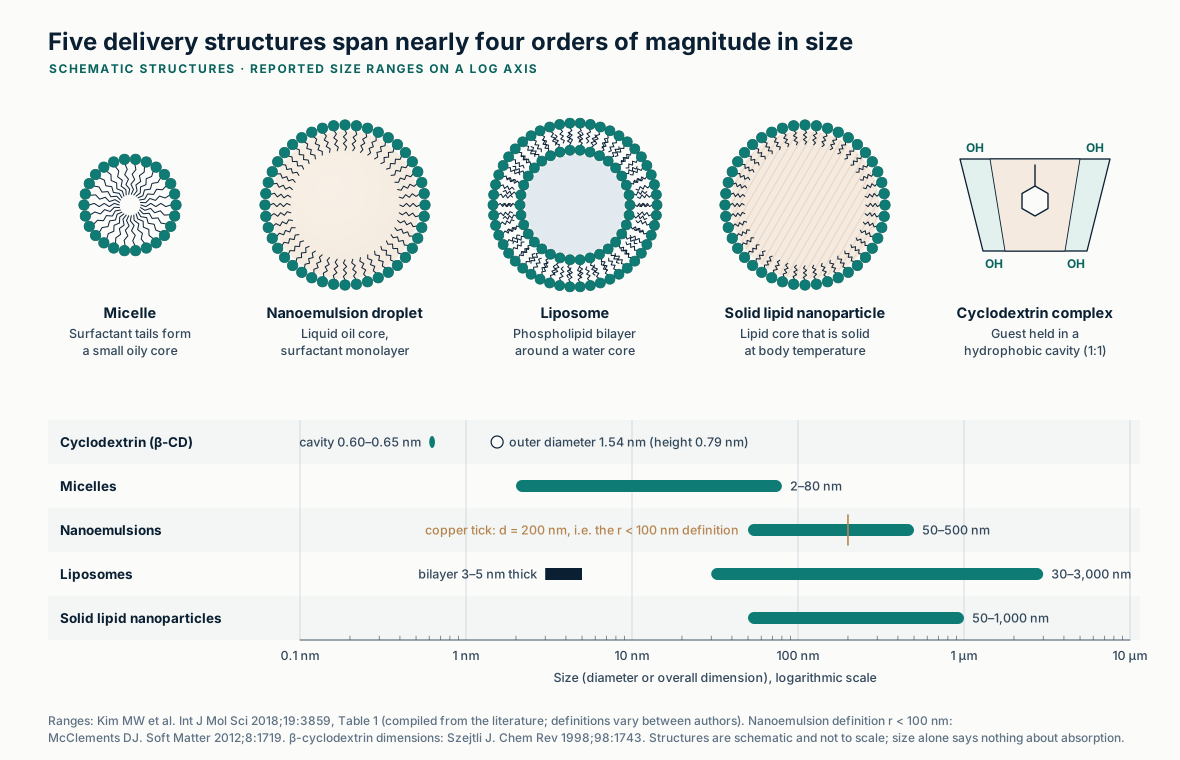
Show the table (6 rows): Lipid and self-emulsifying delivery technologies
| Technology | Principle | Typical use and limit |
|---|---|---|
| SEDDS · self-emulsifying drug delivery system | Oil, surfactant and optional cosolvent preconcentrate that forms an oil-in-water dispersion on dilution with gentle mixing | Lipophilic actives; precipitation on dilution and digestion must be tested |
| SMEDDS · self-microemulsifying | Self-dispersing systems designed to give very fine, often optically clear dispersions | Poorly water-soluble compounds; higher surfactant content |
| SNEDDS · self-nanoemulsifying | Preconcentrates designed to generate nanoscale droplets | Lipophilic actives; the terms SEDDS, SMEDDS and SNEDDS are not used consistently across publications |
| Solid SEDDS | Liquid preconcentrates converted to powders or granules by adsorption, drying or other solidification, intended to recover the dispersion on reconstitution | Capsules, tablets, sachets; the carrier can retain some of the active |
| Supersaturable SEDDS | Reduced surfactant plus a water-soluble polymer that delays precipitation and holds a supersaturated state after dispersion | Higher apparent loading; the supersaturated state is metastable and the benefit is compound-specific |
| MCT and LCT vehicles | Medium-chain (C8–C10, saturated) or long-chain triglyceride oils | See the selection notes below |
SEDDS terminology: Pouton CW. Eur J Pharm Sci. 2000;11 Suppl 2:S93–S98. Supersaturable SEDDS: Gao P, Morozowich W. Expert Opin Drug Deliv. 2006;3(1):97–110.
The Lipid Formulation Classification System sorts lipid formulations into five types by composition
Explanation
Moving from Type I to Type IV, oil gives way to water-soluble surfactant and cosolvent. Dispersion gets finer and faster, but the formulation's capacity to keep a poorly soluble active dissolved after dilution falls, and the risk of precipitation rises.
Show data
| Type | Oils (triglycerides or mixed mono- and diglycerides) | Water-insoluble surfactants (HLB < 12) | Water-soluble surfactants (HLB > 12) | Hydrophilic cosolvents |
|---|---|---|---|---|
| I | 100 | none | none | none |
| II | 40–80 | 20–60 | none | none |
| IIIA | 40–80 | none | 20–40 | 0–40 |
| IIIB | < 20 | none | 20–50 | 20–50 |
| IV | none | 0–20 | 30–80 | 0–50 |
Text version: MCT or LCT, lymphatic transport, digestion and food
MCT or LCT
Fatty acids of 14 carbons or more are carried substantially into intestinal lymph, while shorter-chain fatty acids are absorbed mainly into portal blood. Long-chain triglycerides therefore support lymphatic transport of an active more effectively than medium-chain ones. Medium-chain oils are saturated, which makes them less prone to oxidation.
Trevaskis NL, Charman WN, Porter CJH. Adv Drug Deliv Rev. 2008;60(6):702–716.
Lymphatic transport
Most absorbed molecules reach the circulation through portal blood and the liver. For some highly lipophilic compounds, typically log P above 5 with lipid solubility above 50 mg/g, association with lymph lipoproteins routes part of the dose through intestinal lymph, which can reduce first-pass metabolism.
Trevaskis et al. 2008; Porter CJH, Trevaskis NL, Charman WN. Nat Rev Drug Discov. 2007;6(3):231–248.
Digestion, precipitation and food
Lipases digest the formulation into fatty acids and monoglycerides that form mixed micelles and vesicles with bile. The active stays dissolved only while these colloids can hold it; in vitro digestion tests measure that risk. Food changes the same processes: for green tea extracts, repeated bolus doses taken fasting markedly increased EGCG exposure.
Porter et al. 2007; Williams HD, et al. Pharm Res. 2013;30(12):3059–3076; Oketch-Rabah HA, et al. Toxicol Rep. 2020;7:386–402.
Food effects
For medicines, FDA's final guidance on food-effect studies describes when and how they are run for orally administered drug products (FDA, Assessing the Effects of Food on Drugs in INDs and NDAs, content current as of May 20, 2026). No such study is required for a supplement, but the physiology is the same.
Colloidal and vesicular systems
Show the table (12 rows): Colloidal and vesicular delivery technologies
| Technology | Description | Known limits |
|---|---|---|
| Nanoemulsions | Thermodynamically unstable emulsions with fine droplets that persist because breakdown is slow (kinetic stability) | Droplet growth, creaming and oxidation over shelf life; high-energy processing |
| Microemulsions | Thermodynamically stable, isotropic systems that form spontaneously within suitable composition and temperature regions | High surfactant content; stable only inside the composition window |
| Liposomes | Phospholipid vesicles with an aqueous core that carry hydrophilic actives inside and lipophilic actives in the bilayer | Limited loading; physical and chemical stability of the lipid |
| Niosomes | Vesicles built from nonionic surfactants instead of phospholipids | Surfactant acceptability for the product category |
| Transfersomes · ethosomes | Deformable or ethanol-containing vesicles investigated for dermal delivery | Research stage for most actives |
| Phospholipid complexes (phytosomes) | Associations of phytoconstituents, often polyphenols, with phospholipids intended to change how they dissolve and cross membranes | Reported gains depend on the product, comparator, dose and analytical method (see below) |
| Solid lipid nanoparticles (SLN) · nanostructured lipid carriers (NLC) | Lipid particles with a solid matrix; NLC blend solid and liquid lipids to raise loading and stability | Lipid recrystallization and expulsion of the active during storage |
| Nanocrystals · nanosuspensions | Size-reduced crystalline active, made by precipitation or by milling and high-pressure homogenization, mainly to raise dissolution rate | A suspension, not a solution; physical stability of the particles |
| Polymeric nanoparticles · micelles | Polymer carriers, and amphiphilic-polymer assemblies that solubilize hydrophobic compounds | Polymer acceptability outside medicines |
| Cyclodextrin inclusion complexes | Host–guest complexes that can raise apparent solubility and dissolution rate and protect the guest | Carrier mass grows with dose; the guest must fit the cavity |
| Coacervates · alginate and chitosan · layer-by-layer shells | Biopolymer and polyelectrolyte shells for protection and release control | Process complexity; shell permeability |
| Pickering emulsions · hydrogels · microencapsulation | Particle-stabilized interfaces, hydrated networks and micrometer-scale capsules for flavors, nutrients and actives | Mostly protection and release, not solubility |
McClements DJ. Soft Matter. 2012;8(6):1719–1729. Akbarzadeh A, et al. Nanoscale Res Lett. 2013;8:102. Uchegbu IF, Vyas SP. Int J Pharm. 1998;172:33–70. Müller RH, Radtke M, Wissing SA. Adv Drug Deliv Rev. 2002;54 Suppl 1:S131–S155. Müller RH, Gohla S, Keck CM. Eur J Pharm Biopharm. 2011;78(1):1–9. Loftsson T, Brewster ME. J Pharm Pharmacol. 2010;62(11):1607–1621.
Phospholipid complexes and other limits
Lu M, et al. Asian J Pharm Sci. 2019;14(3):265–274. Jamwal R. J Integr Med. 2018;16(6):367–374. Stohs SJ, et al. Molecules. 2020;25(6):1397.
Every candidate system needs its components' regulatory status, exposure, particle attributes, physical stability and route of administration assessed for the intended product category.
Solid-state engineering
Show the table (8 rows): Solid-state engineering technologies
| Technology | Purpose | Engineering requirement |
|---|---|---|
| Amorphous solid dispersions · spray-dried dispersions | Hold the active in a polymer in a non-crystalline state to raise apparent solubility and dissolution rate | A common volatile solvent for active and polymer; residual-solvent control; recrystallization during storage is the key risk |
| Amorphous solid dispersions · hot-melt extrusion | Same goal, by melting and mixing the active into the polymer without solvent | The active must be thermally stable at the process temperature |
| Lyophilization · spray-freeze drying | Remove water from heat-sensitive materials; combine atomization, rapid freezing and sublimation | Formulation must not collapse during drying |
| Supercritical CO₂ particle engineering · antisolvent precipitation | Change particle size and solid state, or remove solvents | High-pressure equipment |
| Polymorph screening · crystal habit · co-crystals · salts | Find and control crystal forms and physicochemical behavior where chemically and regulatorily appropriate | Solid-state analytics (XRPD, DSC); a new solid form may be a new material for regulatory purposes |
| Eutectic systems and deep eutectic solvents | Process media or possible formulation systems | Toxicological and regulatory suitability first (see Extraction) |
| Supersaturation stabilization · controlled-release matrices · enteric protection | Slow precipitation, modulate release over time, delay release to a target region of the gut | Release testing under conditions that represent the gut |
| Taste masking | Reduce bitterness and off-flavors through encapsulation, binding or other techniques | Must not slow release more than intended |
Bhujbal SV, et al. Pharmaceutical amorphous solid dispersion: a review of manufacturing strategies. Acta Pharm Sin B. 2021;11(8):2505–2536.
Limits and related pages
Spray, freeze and fluid-bed drying are covered in depth on Drying and particle engineering, and emulsion physics on Emulsions and colloids.
Topical and dermal systems
Show the table (6 rows): Topical and dermal delivery technologies
| Technology | Application |
|---|---|
| Lamellar, liquid-crystalline and multiple emulsions (W/O/W, O/W/O) | Structured skin-care delivery, encapsulation and sensory design |
| Liposomal and NLC/SLN topical carriers | Cosmetic active delivery, stability, controlled release, occlusion and film formation |
| Film-forming systems | Protective films and longer topical residence |
| Encapsulated fragrance · antioxidant stabilization | Retention and protection of volatile or oxidation-sensitive ingredients |
| Skin-barrier lipid systems | Ceramide, cholesterol and fatty-acid formulation approaches |
| In vitro skin absorption | Diffusion cells with excised skin under OECD Test Guideline 428; measures how much passes through and stays in the skin |
Skin penetration and the cosmetic–drug line
What limits passive skin penetration
Penetration of the outer skin layer falls with molecular size and rises with lipophilicity. The Potts–Guy relation, fitted to more than 90 compounds, captures both: log kp (cm/h) = −2.7 + 0.71 log P − 0.0061 MW. Compounds above about 500 Da rarely penetrate.
Potts RO, Guy RH. Pharm Res. 1992;9(5):663–669 (equation as given by Evans MV, et al. J Appl Toxicol. 2023;43:940–950). Bos JD, Meinardi MM. Exp Dermatol. 2000;9(3):165–169. OECD. Test No. 428: Skin Absorption: In Vitro Method. 2004.
Intended use decides the law
Under the FD&C Act a product's intended use determines whether it is a cosmetic or a drug. Claims such as restoring hair growth, reducing cellulite or regenerating cells make it a drug, and FDA states that "the term 'cosmeceutical' has no meaning under the law." Delivery designed to reach the bloodstream may also invoke drug regulation.
U.S. FDA. Is It a Cosmetic, a Drug, or Both? (Or Is It Soap?) (content current as of September 11, 2024); FDA. "Cosmeceutical" (February 25, 2022). See Cosmetics and MoCRA.
Critical quality attributes: what each measurement shows, and what it does not
Show the table (10 rows): Critical quality attributes for delivery systems
| Attribute | Typical measurement | What it shows | What it does not establish |
|---|---|---|---|
| Particle or droplet size and polydispersity index (PDI) | Dynamic light scattering; nanoparticle tracking; laser diffraction; optical microscopy, SEM, TEM and cryo-TEM | Size distribution in the measured, usually diluted, sample | Absorption, or stability over time. DLS is intensity-weighted and sensitive to a few large particles |
| Zeta potential | Electrophoretic light scattering | Surface charge in the measurement medium | Stability on its own; the value changes with pH and ionic strength, and sterically stabilized systems can be stable at low charge |
| Rheology and interfaces | Rheometry; interfacial tension | Flow behavior and interfacial properties that govern processing and emulsification | Stability or absorption on their own |
| Dissolution and release | Compendial dissolution apparatus; biorelevant media; release kinetics | Rate and extent of release under test conditions | Absorption in people |
| Dispersion behavior | Self-emulsification time, dilution robustness, loading, encapsulation efficiency, redispersibility, precipitation on dilution | Whether a preconcentrate disperses and keeps the active dissolved | Behavior after digestion |
| Physical stability | Droplet growth, Ostwald ripening, creaming, sedimentation, phase separation; solid state by XRPD, DSC, TGA, FTIR, Raman and solid-state NMR; glass transition, crystallinity and moisture sorption | Physical change over time under the tested conditions | Chemical stability of the active |
| Chemical stability and oxidation | Assay and degradation products; peroxide value and secondary oxidation products; hydrolysis; photostability; packaging compatibility | Chemical change under the tested conditions | A validated shelf life, which needs real-time data on the final product and package |
| Bioaccessibility | Static in vitro digestion (INFOGEST); in vitro lipolysis | The share released into a form available for absorption in the simulated gut | Systemic bioavailability |
| Permeability | Caco-2 cell monolayers (apparent permeability, intestinal transport); artificial membranes | Transport across a cell or membrane model | Gut-wall and liver metabolism, or human exposure |
| Exposure | Human pharmacokinetics: dose-normalized AUC, Cmax, Tmax, parent and metabolite profiles, fed and fasted states; mass balance | How much reaches the blood, against a defined comparator | Clinical benefit |
Bhattacharjee S. DLS and zeta potential—what they are and what they are not? J Control Release. 2016;235:337–351. Brodkorb A, et al. INFOGEST static in vitro simulation of gastrointestinal food digestion. Nat Protoc. 2019;14(4):991–1014. Hubatsch I, Ragnarsson EGE, Artursson P. Nat Protoc. 2007;2(9):2111–2119. Bhujbal et al. 2021.
Which measurements apply
Not every measurement is needed for every system. Each delivery platform would get its own critical quality attributes, set before development starts. The Science lab has emulsion and freeze-drying calculators for several of these attributes.
Nanoemulsions and microemulsions differ in stability, not in droplet size, and neither is evidence of absorption
Text version
A microemulsion is thermodynamically stable and forms spontaneously under the right composition and temperature. A nanoemulsion is thermodynamically unstable and persists only because breakdown is slow (kinetic stability). Both can have droplet radii below about 100 nm.
- Physical stability of a dispersion≠Demonstrated bioavailability
- Higher solubility or dispersibility≠Higher absorption
- Bioaccessibility in vitro≠Systemic bioavailability
- Higher systemic exposure≠Greater efficacy or lower toxicity
- Stability testing≠Validated shelf life
- One formulation's study≠Evidence for another product
McClements DJ. Nanoemulsions versus microemulsions: terminology, differences, and similarities. Soft Matter. 2012;8(6):1719–1729. McClements DJ. Soft Matter. 2011;7:2297–2316 notes that nanoemulsions "can" increase bioavailability and may also change the biological fate of components.
A claim of better delivery needs exposure data for that formulation against a stated comparator; a claim of benefit needs an outcome study.
The same carrier can be acceptable in a medicine and unproven in a supplement, food or cosmetic
Text version: the rule for each category, and nanoscale forms
The product category and intended use decide which excipients and carriers may be used. EUTECNIQ would check every component's status for the target category before formulation starts (proposal).
Precedent by route and level
FDA's Inactive Ingredient Database lists inactive ingredients in approved drug products. Once an inactive ingredient has appeared in an approved product for a route, it "is not considered new and may require a less extensive review" in a new drug product for that route. That precedent applies to drugs.
FDA. Inactive Ingredients in Approved Drug Products Search: Frequently Asked Questions (content current as of January 26, 2022).
Each component needs a lawful basis for that use
In conventional foods a substance needs an authorization for its intended use, such as a food-additive regulation or a GRAS conclusion. In supplements, dietary ingredients follow the DSHEA and NDI framework, and GRAS is not the route for dietary ingredients. Carriers, emulsifiers and solvents left in the product need their own basis. See GRAS and food ingredients and NDIN.
Intended use and claims decide
FDA does not approve cosmetics. Under MoCRA the responsible person must ensure, and keep records showing, adequate substantiation of each product's safety. Claims to treat disease or to change the structure or function of the body make the product a drug. See Cosmetics and MoCRA.
MoCRA safety substantiation: FD&C Act § 608 (21 U.S.C. 364d). FDA. New Dietary Ingredient (NDI) Notifications and Related Issues; Identity and Safety Information About the NDI: Guidance for Industry. Final, October 2026, Section VIII; docket FDA-2025-D-6501; 91 FR 66336 (October 20, 2026). Proposed GRAS rule, 91 FR 51834 (August 11, 2026), on dietary ingredients and GRAS. See also Toxicology.
Working on an ingredient that is hard to dissolve, disperse or stabilize?
Share the molecule's known properties and the product category. EUTECNIQ is in formation and would respond with a proposed evaluation plan and the evidence each step would produce.