

EUTECNIQ Sciences

See every page on one mapArrow keys move through results · Enter opens · Esc closes

Academy · Course 6 Regulatory requirement Calculators

Every number on a certificate of analysis is a result against a limit, and every limit has a stated basis

A botanical certificate of analysis (COA), read the way a quality reviewer reads it: the ICH and USP rules behind each contaminant line, and the measurement uncertainty that decides a result near a limit.

Level
Intermediate
Reading time
About 35 minutes
Builds on
Botanical identity
Tools
4 calculators, 2 heat maps, 15 diagrams
24elements with ICH Q3D daily limits; oral PDEs run from 5 to 11,000 µg/day
5µg/day lead PDE in ICH Q3D, for every route, and in USP ⟨2232⟩
70pesticides with a listed limit in USP ⟨561⟩ Table 4; a formula covers the rest
2.3%worst-case false-acceptance risk with a guard band equal to U, against 50% without one
At a glance

The same element can be 3,667 times more restricted by inhalation than by mouth, so a limit is only meaningful with its route

ICH Q3D permitted daily exposures for 24 elements by route (µg/day; color on a log scale)ICH guideline values
ICH Q3D(R2) Guideline for Elemental Impurities (2022), Table A.2.1. Select a column heading to sort. Q3D states that it does not apply to herbal products; it is used here as a technical reference.
Data table: PDEs by route
ICH Q3D(R2) Table A.2.1, permitted daily exposures (µg/day)
ElementClassOralParenteralInhalationOral ÷ inhalation
Cd15232
Pb15551
As1151528
Hg1303130
Co2A505317
V2A100101100
Ni2A20020633
Tl2B8881
Au2B3003003100
Pd2B100101100
Ir2B100101100
Os2B100101100
Rh2B100101100
Ru2B100101100
Se2B150801301
Ag2B15015721
Pt2B100101100
Li35502502522
Sb31,200902060
Ba31,4007003005
Mo33,0001,50010300
Cu33,00030030100
Sn36,00060060100
Cr311,0001,10033,667

Chromium is 11,000 µg/day orally but 3 µg/day by inhalation; lead is 5 µg/day by every route.

You will learn

  1. Which COA lines answer 21 CFR 111.70, and what makes a COA usable under § 111.75.
  2. How ICH Q3D sets element PDEs and how USP ⟨2232⟩ applies them to supplements.
  3. How ICH Q3C classes and options set residual-solvent limits.
  4. How USP ⟨561⟩ sets pesticide limits, including unlisted pesticides.
  5. Which aflatoxin and ochratoxin A limits apply in the U.S. and the EU.
  6. How uncertainty and a decision rule change a pass near the limit.
1 · Anatomy

Every line of a COA serves one of three specification categories in 21 CFR 111.70(b)

The zones of a botanical COA and the requirement each one servesSchematic, no real lot
Schematic certificate of analysis for a botanical ingredient, with each zone mapped to the 21 CFR 111.70 specification it supports and the standards behind the contaminant testsCertificate of analysisSchematicIssued bylaboratory, address, accreditation scopeMaterialLatin binomial, plant part, extract type and solventLotbatch number, manufacture and retest datesTestMethodLimitResultIdentityHPTLC vs botanicalreferenceMatchesfingerprintMarker compoundsHPLC-UV, specific assayRange, %Loss on drying, ashGravimetricMaximum, %As, Cd, Pb, HgICP-MS, USP <233>µg/g, eachResidual solventsHeadspace GC, USP<467>ppm, eachPesticide residuesGC-MS/MS, LC-MS/MSmg/kg, eachAflatoxins B1, totalHPLC-FLD after IACµg/kgMicrobial countsUSP <2021>, <2022>cfu/g; absentDecision rule · conclusionName, signature, dateWho tested which lotTesting laboratory and original manufacturer named; Latinbinomial and plant part; lot, manufacture and retest dates (WHOTRS 1010, Annex 4)Identity specification, § 111.70(b)(1)The buyer must still test the identity of every dietary-ingredientlot itself, § 111.75(a)(1)(i)Purity, strength and composition, § 111.70(b)(2)Specific methods, not UV 'totals', for marker compoundsLimits on contamination, § 111.70(b)(3)USP <2232> and <233> · ICH Q3C and USP <467> · USP <561>and EPA tolerances · EU 2023/915 · USP <2021> to <2023>Decision rule and releaseThe rule used for 'conforms' is stated (ISO/IEC 17025:2017,7.8.6.2); a named person signs and datesColumns: § 111.75(a)(2)(ii)(B) requires a COA to state the method, the limits and the actual results for each test.Schematic certificate of analysis for a botanical ingredient, with each zone mapped to the 21 CFR 111.70 specification it supportsCertificate of analysisSchematicIssued bylaboratory, accreditationMaterialbinomial, plant part, extractLotnumber, datesTestMethodIdentityHPTLC vs botanical referenceMarker compoundsHPLC-UV, specific assayLoss on drying, ashGravimetricAs, Cd, Pb, HgICP-MS, USP <233>Residual solventsHeadspace GC, USP <467>Pesticide residuesGC-MS/MS, LC-MS/MSAflatoxins B1, totalHPLC-FLD after IACMicrobial countsUSP <2021>, <2022>Decision rule · conclusionName, signature, date11Who tested which lotTesting laboratory and original manufacturer named;Latin binomial and plant part; lot, manufacture andretest dates (WHO TRS 1010, Annex 4)22Identity specification, § 111.70(b)(1)The buyer must still test the identity of everydietary-ingredient lot itself, § 111.75(a)(1)(i)33Purity, strength and composition, § 111.70(b)(2)Specific methods, not UV 'totals', for markercompounds44Limits on contamination, § 111.70(b)(3)USP <2232> and <233> · ICH Q3C and USP <467> ·USP <561> and EPA tolerances · EU 2023/915 · USP<2021> to <2023>55Decision rule and releaseThe rule used for 'conforms' is stated (ISO/IEC17025:2017, 7.8.6.2); a named person signs and datesEach row states method, limits and actual result,§ 111.75(a)(2)(ii)(B).
21 CFR 111.70(b) and 111.75(a) (eCFR, read October 23, 2026); WHO TRS No. 1010, Annex 4, model certificate of analysis; ISO/IEC 17025:2017 clause 7.8.6.2 as quoted in ILAC-G8:09/2019.
Text version of the COA anatomy
  1. Header. The testing laboratory and the original manufacturer, the Latin binomial and plant part, the extract type and solvent, and the lot with manufacture and retest dates.
  2. Identity serves § 111.70(b)(1). The buyer must still "conduct at least one appropriate test or examination to verify the identity" of each dietary-ingredient lot, § 111.75(a)(1)(i).
  3. Strength, composition, purity (marker assay, loss on drying, ash) serve § 111.70(b)(2).
  4. Contaminants serve § 111.70(b)(3): elements (USP ⟨2232⟩, ⟨233⟩), residual solvents (ICH Q3C, USP ⟨467⟩), pesticides (USP ⟨561⟩, EPA tolerances), mycotoxins (USP ⟨561⟩, EU 2023/915) and microbial counts (USP ⟨2021⟩–⟨2023⟩).
  5. Sign-off. A conformity statement names the decision rule applied (ISO/IEC 17025:2017, 7.8.6.2), and a named person approves the certificate.

Columns: among other conditions, a COA may be relied on if it "includes a description of the test or examination method(s) used, limits of the test or examinations, and actual results" (§ 111.75(a)(2)(ii)(B)).

Each contaminant class has a technique family named in its USP chapterUSP chapter text
Matrix of contaminant classes against analytical techniques: which technique each USP chapter describes, and where contract laboratories use tandem mass spectrometry insteadICP-OESICP-MSHPLC-ICP-MSHeadspaceGC-FIDGC withECD, FPD orAFIDGC-MS/MS,LC-MS/MSHPLC-FLDafter IACTLC orHPTLCAs, Cd, Pb, Hg and other elements, total · <233>As, Cd, Pb, Hg and other elements, total · ⟨233⟩ · ICP-OES: highAs, Cd, Pb, Hg and other elements, total · ⟨233⟩ · ICP-MS: highInorganic arsenic · <2232>Inorganic arsenic · ⟨2232⟩ · ICP-MS: highMethylmercury · <2232>Methylmercury · ⟨2232⟩ · HPLC-ICP-MS: highResidual solvents · <467>Residual solvents · ⟨467⟩ · Headspace GC-FID: highPesticide residues · <561>Pesticide residues · ⟨561⟩ · GC with ECD, FPD or AFID: highPesticide residues · ⟨561⟩ · GC-MS/MS, LC-MS/MS: mediumAflatoxins B1, B2, G1, G2 · <561>Aflatoxins B1, B2, G1, G2 · ⟨561⟩ · HPLC-FLD after IAC: highAflatoxins B1, B2, G1, G2 · ⟨561⟩ · TLC or HPTLC: highProcedure given in the USP chapter text (USP 38–NF 33)Used by contract laboratories for most <561> pesticides (Eurofins)
ICP-OES: inductively coupled plasma optical emission spectroscopy. ICP-MS: ICP mass spectrometry. FID: flame-ionization detector. ECD, FPD, AFID: electron-capture, flame-photometric and alkali flame-ionization detectors. IAC: immunoaffinity column. FLD: fluorescence detection.USP 38–NF 33 Second Supplement: ⟨233⟩ Procedures 1 and 2; ⟨2232⟩ inorganic-arsenic and methylmercury procedures; ⟨467⟩ Procedures A–C; ⟨561⟩ pesticide and aflatoxin tests. Eurofins, "Multiresidue pesticides analysis (USP ⟨561⟩)": "The majority of the pesticides listed in USP <561> are analyzed by GC-MS/MS and LC-MS/MS" (read October 23, 2026). Instrument principles: ICP-MS, GC-MS, LC-MS/MS.
Text version of the method matrix
  • Total elements: ICP-OES (⟨233⟩ Procedure 1) or ICP-MS (Procedure 2).
  • Inorganic arsenic: distillation, then ICP-MS (⟨2232⟩), when total arsenic exceeds the limit.
  • Methylmercury: HPLC separation with ICP-MS detection at m/z 202 (⟨2232⟩), when total mercury exceeds the methylmercury limit.
  • Residual solvents: headspace gas chromatography with flame-ionization detection (⟨467⟩).
  • Pesticides: gas chromatography with selective detectors in the ⟨561⟩ text; contract laboratories use GC-MS/MS and LC-MS/MS for most listed pesticides.
  • Aflatoxins: thin-layer or high-performance thin-layer chromatography, or HPLC with fluorescence after immunoaffinity clean-up (⟨561⟩).

Related courses: where metals come from (Course 5) · microbial counts and specified organisms (Course 7) · identity tests (Course 3)

Explanation, details and sources

A dietary-supplement manufacturer must set, for each component, an identity specification; specifications for purity, strength and composition; and "limits on those types of contamination that may adulterate" the finished batch (21 CFR 111.70(b)(1)–(3)). A COA reports results against those specifications.

Reliance on a supplier COA also requires a qualified supplier and periodic re-confirmation; the regulatory course on USP, ICH and COA walks through those five conditions and an annotated specimen with red flags. This course goes one level down, to the science behind each contaminant line.

2 · Elemental impurities

ICH Q3D derives a daily limit for 24 elements from toxicology; the oral limits span more than three orders of magnitude

ICH Q3D(R2), Appendix 1, Equation A.1.1PDE = NO(A)EL × mass adjustmentF1 × F2 × F3 × F4 × F5
Worked example, vanadium, oral: 0.12 mg/kg/day × 50 kg1 × 10 × 5 × 1 × 1 = 120 µg/day → 100 µg/day in Table A.2.1
Oral PDEs of the 24 Q3D elements on a log scale: cadmium and lead at 5 µg/day, chromium at 11,000ICH guideline data
Periodic table heat map of ICH Q3D(R2) oral permitted daily exposures for 24 elements on a log scale, from 5 µg/day for cadmium and lead to 11,000 µg/day for chromium123456789101112131415161718HHeLithium (Li), Class 3: oral PDE 550 µg/day; parenteral 250; inhalation 25Li3550BeBCNOFNeNaMgAlSiPSClArKCaScTiVanadium (V), Class 2A: oral PDE 100 µg/day; parenteral 10; inhalation 1V2A100Chromium (Cr), Class 3: oral PDE 11,000 µg/day; parenteral 1,100; inhalation 3Cr311,000MnFeCobalt (Co), Class 2A: oral PDE 50 µg/day; parenteral 5; inhalation 3Co2A50Nickel (Ni), Class 2A: oral PDE 200 µg/day; parenteral 20; inhalation 6Ni2A200Copper (Cu), Class 3: oral PDE 3,000 µg/day; parenteral 300; inhalation 30Cu33,000ZnGaGeArsenic (As), Class 1: oral PDE 15 µg/day; parenteral 15; inhalation 2As115Selenium (Se), Class 2B: oral PDE 150 µg/day; parenteral 80; inhalation 130Se2B150BrKrRbSrYZrNbMolybdenum (Mo), Class 3: oral PDE 3,000 µg/day; parenteral 1,500; inhalation 10Mo33,000TcRuthenium (Ru), Class 2B: oral PDE 100 µg/day; parenteral 10; inhalation 1Ru2B100Rhodium (Rh), Class 2B: oral PDE 100 µg/day; parenteral 10; inhalation 1Rh2B100Palladium (Pd), Class 2B: oral PDE 100 µg/day; parenteral 10; inhalation 1Pd2B100Silver (Ag), Class 2B: oral PDE 150 µg/day; parenteral 15; inhalation 7Ag2B150Cadmium (Cd), Class 1: oral PDE 5 µg/day; parenteral 2; inhalation 3Cd15InTin (Sn), Class 3: oral PDE 6,000 µg/day; parenteral 600; inhalation 60Sn36,000Antimony (Sb), Class 3: oral PDE 1,200 µg/day; parenteral 90; inhalation 20Sb31,200TeIXeCsBarium (Ba), Class 3: oral PDE 1,400 µg/day; parenteral 700; inhalation 300Ba31,400La–LuHfTaWReOsmium (Os), Class 2B: oral PDE 100 µg/day; parenteral 10; inhalation 1Os2B100Iridium (Ir), Class 2B: oral PDE 100 µg/day; parenteral 10; inhalation 1Ir2B100Platinum (Pt), Class 2B: oral PDE 100 µg/day; parenteral 10; inhalation 1Pt2B100Gold (Au), Class 2B: oral PDE 300 µg/day; parenteral 300; inhalation 3Au2B300Mercury (Hg), Class 1: oral PDE 30 µg/day; parenteral 3; inhalation 1Hg130Thallium (Tl), Class 2B: oral PDE 8 µg/day; parenteral 8; inhalation 8Tl2B8Lead (Pb), Class 1: oral PDE 5 µg/day; parenteral 5; inhalation 5Pb15BiPoAtRnFrRaAc–LrRfDbSgBhHsMtDsRgCnNhFlMcLvTsOgOral PDE, µg/day (bins of half a decade)310301003001,0003,000Corner label = Q3D class. Class 1 and 2A: assess in every product; 2B: if added; 3: by route(see the next figure). Grey cells: elements Q3D does not cover.Source: ICH Q3D(R2), Table A.2.1 (rounded PDEs). Lanthanides (La–Lu) and actinides (Ac–Lr) are condensed to one cell.ICH Q3D(R2) oral permitted daily exposures for 24 elements, grouped by class, colored on a log scaleOral PDE, µg/day (bins of half a decade)310301003001,0003,000Class 1: assess for every product and routecadmium: oral PDE 5 µg/dayCd5lead: oral PDE 5 µg/dayPb5arsenic: oral PDE 15 µg/dayAs15mercury: oral PDE 30 µg/dayHg30Class 2A: assess for every product and routecobalt: oral PDE 50 µg/dayCo50vanadium: oral PDE 100 µg/dayV100nickel: oral PDE 200 µg/dayNi200Class 2B: assess if intentionally addedthallium: oral PDE 8 µg/dayTl8palladium: oral PDE 100 µg/dayPd100iridium: oral PDE 100 µg/dayIr100osmium: oral PDE 100 µg/dayOs100rhodium: oral PDE 100 µg/dayRh100ruthenium: oral PDE 100 µg/dayRu100platinum: oral PDE 100 µg/dayPt100selenium: oral PDE 150 µg/daySe150silver: oral PDE 150 µg/dayAg150gold: oral PDE 300 µg/dayAu300Class 3: assess by routelithium: oral PDE 550 µg/dayLi550antimony: oral PDE 1,200 µg/daySb1,200barium: oral PDE 1,400 µg/dayBa1,400molybdenum: oral PDE 3,000 µg/dayMo3,000copper: oral PDE 3,000 µg/dayCu3,000tin: oral PDE 6,000 µg/daySn6,000chromium: oral PDE 11,000 µg/dayCr11,000Source: ICH Q3D(R2), Table A.2.1.
ICH Q3D(R2) Guideline for Elemental Impurities, adopted April 26, 2022, Table A.2.1. Q3D(R2) corrected the PDEs for gold, silver and nickel.
Show data: ICH Q3D(R2) PDEs and Option 1 concentrations for all 24 elements
ICH Q3D(R2) Table A.2.1 permitted daily exposures and Table A.2.2 oral Option 1 concentrations
ElementClassOral PDE, µg/dayParenteral PDE, µg/dayInhalation PDE, µg/dayOral Option 1, µg/g
Cadmium (Cd)15230.5
Lead (Pb)15550.5
Arsenic (As)1151521.5
Mercury (Hg)130313
Cobalt (Co)2A50535
Vanadium (V)2A10010110
Nickel (Ni)2A20020620
Thallium (Tl)2B8880.8
Gold (Au)2B300300330
Palladium (Pd)2B10010110
Iridium (Ir)2B10010110
Osmium (Os)2B10010110
Rhodium (Rh)2B10010110
Ruthenium (Ru)2B10010110
Selenium (Se)2B1508013015
Silver (Ag)2B15015715
Platinum (Pt)2B10010110
Lithium (Li)35502502555
Antimony (Sb)31,2009020120
Barium (Ba)31,400700300140
Molybdenum (Mo)33,0001,50010300
Copper (Cu)33,00030030300
Tin (Sn)36,00060060600
Chromium (Cr)311,0001,10031,100

ICH Q3D(R2), Tables A.2.1 and A.2.2 (database.ich.org, read October 23, 2026). Option 1 concentrations assume a maximum daily intake of 10 g.

Route matters: the inhalation PDE is the lowest of the three for 20 of the 24 elementsICH guideline data
Dot plot of ICH Q3D(R2) permitted daily exposures by route for 24 elements: the inhalation PDE is the lowest of the three for 20 elements, and the parenteral PDE equals the oral PDE for lead, arsenic, thallium and goldOralParenteralInhalationCadmium (Cd) · 1cadmium, inhalation: 3 µg/daycadmium, parenteral: 2 µg/daycadmium, oral: 5 µg/dayLead (Pb) · 1lead, inhalation: 5 µg/daylead, parenteral: 5 µg/daylead, oral: 5 µg/dayall three routes equalArsenic (As) · 1arsenic, inhalation: 2 µg/dayarsenic, parenteral: 15 µg/dayarsenic, oral: 15 µg/dayoral = parenteralMercury (Hg) · 1mercury, inhalation: 1 µg/daymercury, parenteral: 3 µg/daymercury, oral: 30 µg/dayCobalt (Co) · 2Acobalt, inhalation: 3 µg/daycobalt, parenteral: 5 µg/daycobalt, oral: 50 µg/dayVanadium (V) · 2Avanadium, inhalation: 1 µg/dayvanadium, parenteral: 10 µg/dayvanadium, oral: 100 µg/dayNickel (Ni) · 2Anickel, inhalation: 6 µg/daynickel, parenteral: 20 µg/daynickel, oral: 200 µg/dayThallium (Tl) · 2Bthallium, inhalation: 8 µg/daythallium, parenteral: 8 µg/daythallium, oral: 8 µg/dayall three routes equalPalladium (Pd) · 2Bpalladium, inhalation: 1 µg/daypalladium, parenteral: 10 µg/daypalladium, oral: 100 µg/dayIridium (Ir) · 2Biridium, inhalation: 1 µg/dayiridium, parenteral: 10 µg/dayiridium, oral: 100 µg/dayOsmium (Os) · 2Bosmium, inhalation: 1 µg/dayosmium, parenteral: 10 µg/dayosmium, oral: 100 µg/dayRhodium (Rh) · 2Brhodium, inhalation: 1 µg/dayrhodium, parenteral: 10 µg/dayrhodium, oral: 100 µg/dayRuthenium (Ru) · 2Bruthenium, inhalation: 1 µg/dayruthenium, parenteral: 10 µg/dayruthenium, oral: 100 µg/dayPlatinum (Pt) · 2Bplatinum, inhalation: 1 µg/dayplatinum, parenteral: 10 µg/dayplatinum, oral: 100 µg/daySelenium (Se) · 2Bselenium, inhalation: 130 µg/dayselenium, parenteral: 80 µg/dayselenium, oral: 150 µg/daySilver (Ag) · 2Bsilver, inhalation: 7 µg/daysilver, parenteral: 15 µg/daysilver, oral: 150 µg/dayGold (Au) · 2Bgold, inhalation: 3 µg/daygold, parenteral: 300 µg/daygold, oral: 300 µg/dayoral = parenteralLithium (Li) · 3lithium, inhalation: 25 µg/daylithium, parenteral: 250 µg/daylithium, oral: 550 µg/dayAntimony (Sb) · 3antimony, inhalation: 20 µg/dayantimony, parenteral: 90 µg/dayantimony, oral: 1,200 µg/dayBarium (Ba) · 3barium, inhalation: 300 µg/daybarium, parenteral: 700 µg/daybarium, oral: 1,400 µg/dayMolybdenum (Mo) · 3molybdenum, inhalation: 10 µg/daymolybdenum, parenteral: 1,500 µg/daymolybdenum, oral: 3,000 µg/dayCopper (Cu) · 3copper, inhalation: 30 µg/daycopper, parenteral: 300 µg/daycopper, oral: 3,000 µg/dayTin (Sn) · 3tin, inhalation: 60 µg/daytin, parenteral: 600 µg/daytin, oral: 6,000 µg/dayChromium (Cr) · 3chromium, inhalation: 3 µg/daychromium, parenteral: 1,100 µg/daychromium, oral: 11,000 µg/day1101001,00010,000Permitted daily exposure, µg/day (log scale)
The numbers are in the table above. Where route-specific data were insufficient, Q3D divided the oral PDE by 100, 10, 2 or 1 for oral bioavailability below 1%, 1–50%, 50–90% and 90% or more.ICH Q3D(R2), Section 3.1 and Table A.2.1.
Which elements a Q3D risk assessment must consider, by class and routeICH guidance
Matrix from ICH Q3D(R2) Table 5.1: Class 1 and 2A elements are always considered; Class 2B when intentionally added; Class 3 elements are not considered for oral products unless addedIf intentionally added(all routes)OralParenteralInhalationClass 1: Cd, Pb, As, HgClass 1: Cd, Pb, As, Hg · If intentionally added (all routes): highClass 1: Cd, Pb, As, Hg · Oral: highClass 1: Cd, Pb, As, Hg · Parenteral: highClass 1: Cd, Pb, As, Hg · Inhalation: highClass 2A: Co, V, NiClass 2A: Co, V, Ni · If intentionally added (all routes): highClass 2A: Co, V, Ni · Oral: highClass 2A: Co, V, Ni · Parenteral: highClass 2A: Co, V, Ni · Inhalation: highClass 2B: Tl, Au, Pd, Ir, Os, Rh, Ru, Se, Ag, PtClass 2B: Tl, Au, Pd, Ir, Os, Rh, Ru, Se, Ag, Pt · If intentionally added (all routes): highClass 3: Li, Sb, CuClass 3: Li, Sb, Cu · If intentionally added (all routes): highClass 3: Li, Sb, Cu · Parenteral: highClass 3: Li, Sb, Cu · Inhalation: highClass 3: Ba, Mo, Sn, CrClass 3: Ba, Mo, Sn, Cr · If intentionally added (all routes): highClass 3: Ba, Mo, Sn, Cr · Inhalation: highIf not intentionally addedConsider in the risk assessmentNot required for that route
ICH Q3D(R2), Section 4 (classes) and Table 5.1. The control threshold is "30% of the established PDE in the drug product".

Scope. Q3D states: "This guideline does not apply to herbal products". USP ⟨232⟩, its drug counterpart, says "Dietary supplements and their ingredients are addressed in" ⟨2232⟩. Q3D is used here as a technical reference for how a PDE becomes a concentration limit, as on USP, ICH and COA.

Explanation, details and sources

Q3D defines the permitted daily exposure (PDE) as "the maximum acceptable intake of elemental impurity in pharmaceutical products per day". It derives each PDE from the no-observed-adverse-effect level (NOAEL) of a key study, scaled to a 50 kg person and divided by modifying factors.

F1 covers species extrapolation (5 for rat), F2 = 10 covers variability between people, F3 study duration, F4 severe toxicity, F5 the absence of a NOEL. Table values are rounded to one or two significant figures, so vanadium's computed 120 µg/day appears as 100.

3 · Supplements

USP ⟨2232⟩ caps four elements per day; a concentration limit equals that cap at one stated intake

At 2 g/day, a product at the EU lead limit for supplements delivers 6 µg, above the USP ⟨2232⟩ PDECalculated from published limits
Log-log chart of the lead a person would take in per day at each published lead limit, against the daily amount of product. Concentration limits rise with intake; the USP 2232 PDE (5 µg/day) and the Proposition 65 MADL (0.5 µg/day) do not.0.010.1110100Lead intake at the limit, µg/day (log)0.10.3131030Daily amount of product or article, g/day (log)USP ⟨561⟩ botanical article, 5 µg/gEU 2023/915 food supplements, 3.0 mg/kgUSP ⟨2232⟩ component limit and ICH Q3D Option 1, 0.5 µg/gUSP ⟨2232⟩ component limit and ICH Q3D Option 1, 0.5 µg/g (option limited to 10 g/day)reaches 5 µg/day at 1.00 g/dayreaches 5 µg/day at 1.67 g/dayreaches 5 µg/day at 10.00 g/dayUSP <561> botanical article, Pb ≤ 5 µg/gEU 2023/915 food supplements, Pb ≤ 3.0 mg/kgUSP <2232> component limit = Q3D Option 1, 0.5µg/g (dotted beyond the 10 g basis)USP <2232> PDE = ICH Q3D oral PDE, 5 µg/dayProposition 65 MADL (reproductive), 0.5 µg/dayDots: intake at which each concentration limit reaches 5 µg/day (1 g, 1.7 g, 10 g)
Daily lead intake = concentration × daily amount. The four frameworks answer different questions: ⟨2232⟩ and Q3D limit daily intake; ⟨561⟩ limits a botanical article; Regulation (EU) 2023/915 limits lead in a food supplement; the Proposition 65 MADL is a warning threshold, not a product limit.USP ⟨2232⟩ Tables 1–2 and ⟨561⟩ Table 5 (USP 38–NF 33 Second Supplement text; confirm against the current USP–NF); ICH Q3D(R2) Tables A.2.1–A.2.2; Regulation (EU) 2023/915, Annex I, entry 3.1.28; OEHHA, Proposition 65, lead.
Show data: lead intake at each limit, µg/day
Lead intake at each published limit for several daily amounts
Daily amount, g/dayUSP ⟨561⟩ 5 µg/gEU 2023/915 3.0 mg/kgUSP ⟨2232⟩ component 0.5 µg/gUSP ⟨2232⟩ PDEProp 65 MADL
0.52.51.50.2550.5
1530.550.5
2106150.5
525152.550.5
105030550.5

Products of the limits above and the daily amount. The ⟨2232⟩ component option applies to products taken at no more than 10 g/day.

ICH Q3D Equation 2 · USP ⟨2232⟩ Summation Optiondaily intake = N × Σ Ck Wk  ≤  PDE
Daily intake, µg/day1.2
Share of the PDE, %24
Product, g/day2.5
Common limit at this intake (Option 2a), µg/g2
Common limit at 10 g/day (Option 1), µg/g0.5
30% of the PDE (Q3D control threshold), µg/day1.5

Within the PDE and below the Q3D control threshold.

Components: mass per serving, concentration and daily contribution
Componentg per serving, Wµg/g, Cµg/day
Drug substance0
Microcrystalline cellulose0.11
Lactose0.045
Calcium phosphate0.35
Crospovidone0.0265
Magnesium stearate0.0175
HPMC0.006
Titanium dioxide0.5
Iron oxide0.15
Each component's share of the daily limitCalculator; values you set
"<LoQ" entries in the ICH tables are entered as 0. The capsule preset is illustrative, not a real product.
Method, assumptions and limits
What it calculates
The daily intake of one element from a multi-component product, its share of the PDE, the common concentration limits under Q3D Options 1 and 2a, and 30% of the PDE (the Q3D control threshold).
Equations
Intake (µg/day) = N × Σ Ck Wk. Option 2a limit = PDE / (N × Σ Wk). Option 1 limit = PDE / 10 g.
Variables and units
Wk: grams of component k per serving (0–100). Ck: µg/g (= mg/kg = ppm by mass). N: servings per day (1–6). PDE: µg/day from USP ⟨2232⟩ Table 1 or ICH Q3D(R2) Table A.2.1 (oral).
Assumptions
Concentrations are the maximum expected in each component. Results below the limit of quantitation are entered as zero, as in Q3D Table A.4.8. Negative or non-numeric entries are treated as zero.
Valid range
The ⟨2232⟩ individual component option and Q3D Option 1 assume no more than 10 g/day; the summation option has no such limit.
What it does not establish
Compliance with state law (e.g., Proposition 65), food-law limits in other markets, or the adequacy of the analytical method. Q3D does not apply to herbal products; its PDEs are shown for comparison.
References
ICH Q3D(R2), Section 7 and Appendix 4 (Tables A.4.1, A.4.5, A.4.8); USP ⟨2232⟩ (USP 38–NF 33 text).
Verification
Unit tests reproduce the Q3D Table A.4.8 totals (lead 1.2, vanadium 9.5, nickel 12.5 µg); an independent Python reference checks the page (tests/numerics/ref/academy_coa-science.py).

USP ⟨233⟩ Elemental Impurities—Procedures, Validation (USP 38–NF 33 Second Supplement text). J is the target-limit concentration diluted to the instrument's working range. Wide acceptance windows matter for decision rules.

Explanation, details and sources

USP ⟨2232⟩ sets PDEs for inorganic arsenic (15 µg/day), cadmium (5), lead (5), total mercury (15) and methylmercury (2). Its individual component limits (1.5, 0.5, 0.5, 1.5 and 0.2 µg/g) "are based on a maximum daily intake of 10 g". USP ⟨561⟩ sets separate limits for articles of botanical origin, including lead at 5 µg/g.

⟨2232⟩ offers three routes to compliance: analyze the finished product (result per serving × servings per day), show that every component meets the Table 2 limits, or sum the components. The summation option is the same arithmetic as Q3D Option 2b. A daily-exposure calculator for one measured concentration is on the regulatory page; the tool below handles a multi-component formula.

USP ⟨233⟩ acceptance criteria for an alternative elemental procedure
Procedure typeCriterionRequirement
Limit procedureDetectability, spike at the target concentrationWithin ±15% of the standard (instrumental)
Limit procedureRepeatability, 6 spiked samplesRSD ≤ 20%
Quantitative procedureAccuracy, spikes at 50–150% of JMean recovery 70–150%
Quantitative procedureRepeatability, 6 samplesRSD ≤ 20%
Quantitative procedureIntermediate precision, 12 resultsRSD ≤ 25%
4 · Residual solvents

ICH Q3C sorts solvents into three classes; a Class 2 limit in ppm is the PDE spread over 10 g of product

ICH Q3C(R9), Equation 1concentration (ppm) = 1000 × PDE (mg/day)dose (g/day)
Option 1: dose = 10 g/day   Option 2: Σ (mass × ppm) / 1000 ≤ PDE
Class 2 PDEs span 0.5 to 45 mg/day; Class 1 limits run from 2 ppm (benzene) to 1,500 ppmICH guideline data
Bar chart of the ICH Q3C(R9) permitted daily exposures of 31 Class 2 solvents on a log scale, from 0.5 mg/day (2-methoxyethanol, methylbutyl ketone, nitromethane) to 45 mg/day (methylisobutylketone), with the Class 1 concentration limits and the Class 3 listmg/dayppm2-Methoxyethanol2-Methoxyethanol: PDE 0.5 mg/day; Option 1 limit 50 ppm0.550Methylbutyl ketoneMethylbutyl ketone: PDE 0.5 mg/day; Option 1 limit 50 ppm0.550NitromethaneNitromethane: PDE 0.5 mg/day; Option 1 limit 50 ppm0.550ChloroformChloroform: PDE 0.6 mg/day; Option 1 limit 60 ppm0.660CumeneCumene: PDE 0.7 mg/day; Option 1 limit 70 ppm0.7701,1,2-Trichloroethene1,1,2-Trichloroethene: PDE 0.8 mg/day; Option 1 limit 80 ppm0.8801,2-Dimethoxyethane1,2-Dimethoxyethane: PDE 1 mg/day; Option 1 limit 100 ppm1100TetralinTetralin: PDE 1 mg/day; Option 1 limit 100 ppm11002-Ethoxyethanol2-Ethoxyethanol: PDE 1.6 mg/day; Option 1 limit 160 ppm1.6160SulfolaneSulfolane: PDE 1.6 mg/day; Option 1 limit 160 ppm1.6160PyridinePyridine: PDE 2 mg/day; Option 1 limit 200 ppm2200FormamideFormamide: PDE 2.2 mg/day; Option 1 limit 220 ppm2.2220HexaneHexane: PDE 2.9 mg/day; Option 1 limit 290 ppm2.9290ChlorobenzeneChlorobenzene: PDE 3.6 mg/day; Option 1 limit 360 ppm3.63601,4-Dioxane1,4-Dioxane: PDE 3.8 mg/day; Option 1 limit 380 ppm3.8380AcetonitrileAcetonitrile: PDE 4.1 mg/day; Option 1 limit 410 ppm4.1410N-MethylpyrrolidoneN-Methylpyrrolidone: PDE 5.3 mg/day; Option 1 limit 530 ppm5.3530DichloromethaneDichloromethane: PDE 6 mg/day; Option 1 limit 600 ppm6600Ethylene glycolEthylene glycol: PDE 6.2 mg/day; Option 1 limit 620 ppm6.2620TetrahydrofuranTetrahydrofuran: PDE 7.2 mg/day; Option 1 limit 720 ppm7.2720N,N-DimethylformamideN,N-Dimethylformamide: PDE 8.8 mg/day; Option 1 limit 880 ppm8.8880TolueneToluene: PDE 8.9 mg/day; Option 1 limit 890 ppm8.9890N,N-DimethylacetamideN,N-Dimethylacetamide: PDE 10.9 mg/day; Option 1 limit 1,090 ppm10.91,090MethylcyclohexaneMethylcyclohexane: PDE 11.8 mg/day; Option 1 limit 1,180 ppm11.81,180Cyclopentyl methyl etherCyclopentyl methyl ether: PDE 15 mg/day; Option 1 limit 1,500 ppm151,5001,2-Dichloroethene1,2-Dichloroethene: PDE 18.7 mg/day; Option 1 limit 1,870 ppm18.71,870XyleneXylene: PDE 21.7 mg/day; Option 1 limit 2,170 ppm21.72,170MethanolMethanol: PDE 30 mg/day; Option 1 limit 3,000 ppm303,000Tertiary-butyl alcoholTertiary-butyl alcohol: PDE 35 mg/day; Option 1 limit 3,500 ppm353,500CyclohexaneCyclohexane: PDE 38.8 mg/day; Option 1 limit 3,880 ppm38.83,880MethylisobutylketoneMethylisobutylketone: PDE 45 mg/day; Option 1 limit 4,500 ppm454,500Class 3: 50 mg/day0.3131030PDE, mg/day (log scale)Class 2 solvents: PDE and Option 1 limitClass 1: avoid; if unavoidable, limit toBenzene2 ppmCarcinogenCarbon tetrachloride4 ppmToxic and environmental hazard1,2-Dichloroethane5 ppmToxic1,1-Dichloroethene8 ppmToxic1,1,1-Trichloroethane1,500 ppmEnvironmental hazardClass 3 (27 solvents): ≤ 50 mg/day, or 0.5%under Option 1, without justificationAcetic acid, Acetone, Anisole, 1-Butanol,2-Butanol, Butyl acetate, tert-Butylmethyl ether,Dimethyl sulfoxide, Ethanol, Ethyl acetate, Ethylether, Ethyl formate, Formic acid, Heptane,Isobutyl acetate, Isopropyl acetate, Methylacetate, 3-Methyl-1-butanol, Methylethyl ketone,2-Methyl-1-propanol, 2-Methyltetrahydrofuran,Pentane, 1-Pentanol, 1-Propanol, 2-Propanol,Propyl acetate, TriethylamineOption 1 limit, ppm = 1,000 × PDE ÷ 10 g/day;for hexane, 1,000 × 2.9 ÷ 10 = 290 ppmICH Q3C(R9) Class 2 solvent PDEs, Class 1 limits and Class 3 listClass 2: PDE, mg/daymg/day2-Methoxyethanol2-Methoxyethanol: PDE 0.5 mg/day; Option 1 limit 50 ppm0.5Methylbutyl ketoneMethylbutyl ketone: PDE 0.5 mg/day; Option 1 limit 50 ppm0.5NitromethaneNitromethane: PDE 0.5 mg/day; Option 1 limit 50 ppm0.5ChloroformChloroform: PDE 0.6 mg/day; Option 1 limit 60 ppm0.6CumeneCumene: PDE 0.7 mg/day; Option 1 limit 70 ppm0.71,1,2-Trichloroethene1,1,2-Trichloroethene: PDE 0.8 mg/day; Option 1 limit 80 ppm0.81,2-Dimethoxyethane1,2-Dimethoxyethane: PDE 1 mg/day; Option 1 limit 100 ppm1TetralinTetralin: PDE 1 mg/day; Option 1 limit 100 ppm12-Ethoxyethanol2-Ethoxyethanol: PDE 1.6 mg/day; Option 1 limit 160 ppm1.6SulfolaneSulfolane: PDE 1.6 mg/day; Option 1 limit 160 ppm1.6PyridinePyridine: PDE 2 mg/day; Option 1 limit 200 ppm2FormamideFormamide: PDE 2.2 mg/day; Option 1 limit 220 ppm2.2HexaneHexane: PDE 2.9 mg/day; Option 1 limit 290 ppm2.9ChlorobenzeneChlorobenzene: PDE 3.6 mg/day; Option 1 limit 360 ppm3.61,4-Dioxane1,4-Dioxane: PDE 3.8 mg/day; Option 1 limit 380 ppm3.8AcetonitrileAcetonitrile: PDE 4.1 mg/day; Option 1 limit 410 ppm4.1N-MethylpyrrolidoneN-Methylpyrrolidone: PDE 5.3 mg/day; Option 1 limit 530 ppm5.3DichloromethaneDichloromethane: PDE 6 mg/day; Option 1 limit 600 ppm6Ethylene glycolEthylene glycol: PDE 6.2 mg/day; Option 1 limit 620 ppm6.2TetrahydrofuranTetrahydrofuran: PDE 7.2 mg/day; Option 1 limit 720 ppm7.2N,N-DimethylformamideN,N-Dimethylformamide: PDE 8.8 mg/day; Option 1 limit 880 ppm8.8TolueneToluene: PDE 8.9 mg/day; Option 1 limit 890 ppm8.9N,N-DimethylacetamideN,N-Dimethylacetamide: PDE 10.9 mg/day; Option 1 limit 1,090 ppm10.9MethylcyclohexaneMethylcyclohexane: PDE 11.8 mg/day; Option 1 limit 1,180 ppm11.8Cyclopentyl methyl etherCyclopentyl methyl ether: PDE 15 mg/day; Option 1 limit 1,500 ppm151,2-Dichloroethene1,2-Dichloroethene: PDE 18.7 mg/day; Option 1 limit 1,870 ppm18.7XyleneXylene: PDE 21.7 mg/day; Option 1 limit 2,170 ppm21.7MethanolMethanol: PDE 30 mg/day; Option 1 limit 3,000 ppm30Tertiary-butyl alcoholTertiary-butyl alcohol: PDE 35 mg/day; Option 1 limit 3,500 ppm35CyclohexaneCyclohexane: PDE 38.8 mg/day; Option 1 limit 3,880 ppm38.8MethylisobutylketoneMethylisobutylketone: PDE 45 mg/day; Option 1 limit 4,500 ppm45Class 3: 50 mg/day0.3131030PDE, mg/day (log scale)Class 1: avoid; if unavoidable, limit toBenzene2 ppmCarcinogenCarbon tetrachloride4 ppmToxic and environmental hazard1,2-Dichloroethane5 ppmToxic1,1-Dichloroethene8 ppmToxic1,1,1-Trichloroethane1,500 ppmEnvironmental hazardClass 3 (27 solvents): ≤ 50 mg/day, or 0.5% underOption 1, without justificationAcetic acid, Acetone, Anisole, 1-Butanol, 2-Butanol, Butylacetate, tert-Butylmethyl ether, Dimethyl sulfoxide, Ethanol,Ethyl acetate, Ethyl ether, Ethyl formate, Formic acid,Heptane, Isobutyl acetate, Isopropyl acetate, Methyl acetate,3-Methyl-1-butanol, Methylethyl ketone,2-Methyl-1-propanol, 2-Methyltetrahydrofuran, Pentane,1-Pentanol, 1-Propanol, 2-Propanol, Propyl acetate,TriethylamineOption 1 limit, ppm = 1,000 × PDE ÷ 10 g/day; for hexane,1,000 × 2.9 ÷ 10 = 290 ppm
ICH Q3C(R9), Step 4 version dated January 24, 2024, Tables 1–3 (copy hosted by PMDA). ICH's Q3C(R10) work plan (July 25, 2026) lists revised monographs for N,N-dimethylformamide, dichloromethane and ethylene glycol, with Step 4 planned for March 2027; values here are R9.
Show data: ICH Q3C(R9) Class 2 PDEs and Option 1 limits
ICH Q3C(R9) Table 2
SolventPDE, mg/dayOption 1 limit, ppm
Acetonitrile4.1410
Chlorobenzene3.6360
Chloroform0.660
Cumene0.770
Cyclohexane38.83,880
Cyclopentyl methyl ether15.01,500
1,2-Dichloroethene18.71,870
Dichloromethane6.0600
1,2-Dimethoxyethane1.0100
N,N-Dimethylacetamide10.91,090
N,N-Dimethylformamide8.8880
1,4-Dioxane3.8380
2-Ethoxyethanol1.6160
Ethylene glycol6.2620
Formamide2.2220
Hexane2.9290
Methanol30.03,000
2-Methoxyethanol0.550
Methylbutyl ketone0.550
Methylcyclohexane11.81,180
Methylisobutylketone454,500
N-Methylpyrrolidone5.3530
Nitromethane0.550
Pyridine2.0200
Sulfolane1.6160
Tertiary-butyl alcohol353,500
Tetrahydrofuran7.2720
Tetralin1.0100
Toluene8.9890
1,1,2-Trichloroethene0.880
Xylene21.72,170

ICH Q3C(R9), Table 2. Class 1 (Table 1): benzene 2 ppm, carbon tetrachloride 4, 1,2-dichloroethane 5, 1,1-dichloroethene 8, 1,1,1-trichloroethane 1,500. Class 3 (Table 3): 27 solvents, 50 mg/day or 0.5% under Option 1.

For a botanical extract, the solvent used decides which residual-solvent rule appliesUSP and ICH text
Decision ladder for residual solvents in a botanical extract: water and ethanol extracts under USP 565; Class 1 avoided; Class 2 by Option 1 or Option 2; Class 3 up to 50 mg per dayQuestionConsequence of the answer shown on the arrow1Was the extract made with water, ethanol or awater–ethanol mixture alone?USP <565> Botanical Extracts<565> does not call for <467>Ethanol is a Class 3 solvent; a buyer may still set a limitYesUSP 38–NF 332Was a Class 1 solvent used?Benzene, carbon tetrachloride, 1,2-dichloroethane,1,1-dichloroethene, 1,1,1-trichloroethaneAvoid; if unavoidable, Table 1 limits2, 4, 5, 8 and 1,500 ppmYesICH Q3C(R9) 4.1No3Was a Class 2 solvent used?31 solvents with PDEs, e.g., hexane, methanol, dichloromethaneOption 1 (ppm, 10 g/day basis) or Option 2Option 2: the sum over all components, in mg/day,stays below the PDEYesICH Q3C(R9) 3.3No4Are all solvents used Class 3?e.g., acetone, ethyl acetate, heptane, 2-propanol≤ 50 mg/day (0.5%) without justificationLoss on drying may be used if the method is validatedYesICH Q3C(R9) 3.4, 4.3NoSolvent with no adequate toxicological dataQ3C Table 4 (e.g., petroleum ether): justify the residuallevelNoDecision ladder for residual solvents in a botanical extract: water and ethanol extracts under USP 565; Class 1 avoided; Class 2 by Option 1 or Option 2; Class 3 up to 50 mg per day1Was the extract made with water, ethanol or awater–ethanol mixture alone?USP <565> Botanical Extracts<565> does not call for <467>Ethanol is a Class 3 solvent; a buyer may still set alimitYes · USP 38–NF 332Was a Class 1 solvent used?Benzene, carbon tetrachloride, 1,2-dichloroethane,1,1-dichloroethene, 1,1,1-trichloroethaneNoAvoid; if unavoidable, Table 1 limits2, 4, 5, 8 and 1,500 ppmYes · ICH Q3C(R9) 4.13Was a Class 2 solvent used?31 solvents with PDEs, e.g., hexane, methanol,dichloromethaneNoOption 1 (ppm, 10 g/day basis) or Option 2Option 2: the sum over all components, in mg/day,stays below the PDEYes · ICH Q3C(R9) 3.34Are all solvents used Class 3?e.g., acetone, ethyl acetate, heptane, 2-propanolNo≤ 50 mg/day (0.5%) without justificationLoss on drying may be used if the method isvalidatedYes · ICH Q3C(R9) 3.4, 4.3Solvent with no adequate toxicological dataQ3C Table 4 (e.g., petroleum ether): justify theresidual levelNo
USP ⟨565⟩ Botanical Extracts, Residual Solvents (USP 38–NF 33 Second Supplement): "If prepared with solvents other than alcohol, water, or alcohol-water mixtures, it meets the requirements for Residual Solvents ⟨467⟩." ICH Q3C(R9), Sections 3.3–3.5 and 4.1–4.4.
Text version of the residual-solvent ladder
  1. Water, ethanol or water–ethanol extract: USP ⟨565⟩ does not call for ⟨467⟩. Ethanol is a Class 3 solvent, and a buyer may still specify a limit.
  2. Class 1 solvent used: avoid; if unavoidable, Table 1 limits of 2, 4, 5, 8 and 1,500 ppm.
  3. Class 2 solvent used: Option 1 (ppm, 10 g/day basis) or Option 2 (sum in mg/day below the PDE).
  4. All solvents Class 3: up to 50 mg/day (0.5%) without justification; loss on drying may be used if the method is validated.
  5. Solvent with no adequate toxicological data (Q3C Table 4, e.g., petroleum ether): the residual level must be justified.
ICH Q3C Option 2exposure (mg/day) = Σ mk × ppmk / 1000  ≤  PDE
Product, g/day5
Solvent intake, mg/day3.64
Product concentration, ppm728
Option 1 limit, ppm410
Option 2 limit for this product, ppm820
PDE, mg/day4.1

Meets Option 2 although two components exceed the Option 1 limit.

Components: daily mass, residual solvent content and daily exposure
Componentg/dayppmmg/dayOption 1
Drug substance0.24above
Excipient 10.36meets
Excipient 23.04above
Daily solvent intake by component against the PDECalculator; values you set
The hexane preset is illustrative, not a real product.
Method, assumptions and limits
What it calculates
Daily intake of one residual solvent summed over up to three components, the product concentration, and the Q3C Option 1 and Option 2 limits.
Equations
ppm = 1000 × PDE / dose (Q3C Equation 1). Option 1 uses dose = 10 g/day. Intake (mg/day) = Σ mk × ppmk / 1000; product ppm = 1000 × intake / Σ mk.
Variables and units
m: grams of component per day (0–100). ppm: mg of solvent per kg of component. PDE: mg/day, ICH Q3C(R9) Table 2; Class 3, 50 mg/day; Class 1, Table 1 ppm.
Assumptions
No solvent is lost during formulation. Q3C notes that a product failing the summation may be tested, because formulation can reduce the level.
Valid range
Option 1 assumes a daily dose of no more than 10 g. Class 1 has no Option 2.
What it does not establish
That a solvent was removed "to the practical minimum", which Option 2 also requires, or the validity of the GC method.
References
ICH Q3C(R9), Sections 3.3 and 4; USP ⟨467⟩; USP ⟨565⟩.
Verification
Reproduces both ICH acetonitrile examples (3.64 mg/day and 728 ppm; 5.08 mg/day and 1,016 ppm); independent Python reference cases.
Explanation, details and sources

Class 1 solvents are to be avoided. Class 2 solvents have PDEs and are to be limited. Class 3 solvents have "low toxic potential"; up to 50 mg/day is acceptable without justification.

Editions matter. The USP 38–NF 33 text of ⟨467⟩ still listed methylisobutylketone in Class 3; ICH moved it to Class 2 (PDE 45 mg/day) in a revision that reached Step 4 in November 2016. A COA should name the edition its limit comes from.

5 · Pesticides

USP ⟨561⟩ lists 70 pesticide limits and gives a formula for the rest; for U.S. food-labeled botanicals, EPA tolerances govern

A pesticide limit comes from the monograph, Table 4, the EPA, or the ADI formula, in that orderUSP text
Decision ladder for a pesticide residue limit under USP 561 and 565: monograph, Table 4, EPA tolerance, extract rule, and the ADI-based formula for unlisted pesticidesQuestionConsequence of the answer shown on the arrow1Does the individual monograph set a pesticide limit?Use the monograph limitYesUSP <561>2Is the pesticide one of the 70 entries in Table 4?'Pesticide' covers agents against pests, unwanted plants andfungiUse the Table 4 limit, mg/kgYesUSP <561> Table 4No3Does an EPA tolerance (40 CFR Part 180) or FDA actionlevel exist?Comply with the EPA regulationIn the U.S., a botanical labeled for food use falls underEPA tolerances, not Table 4YesUSP <561>; 40 CFR 180No4Is the article an extract or a preparation that changesthe residue level?USP <565> for extractsE ≤ 10: L × E; E > 10: A·M / (100 B)E = plant-to-extract ratio; L = the article's limit; B =daily dose of the extract, kgYesUSP <565>NoLimit = A·M / (100 B)A = FAO-WHO ADI, mg/kg bw; M = 60 kg; B = dailydose of the article, kgNoDecision ladder for a pesticide residue limit under USP 561 and 565: monograph, Table 4, EPA tolerance, extract rule, and the ADI-based formula for unlisted pesticides1Does the individual monograph set apesticide limit?Use the monograph limitYes · USP <561>2Is the pesticide one of the 70 entries in Table4?'Pesticide' covers agents against pests, unwantedplants and fungiNoUse the Table 4 limit, mg/kgYes · USP <561> Table 43Does an EPA tolerance (40 CFR Part 180) orFDA action level exist?NoComply with the EPA regulationIn the U.S., a botanical labeled for food use fallsunder EPA tolerances, not Table 4Yes · USP <561>; 40 CFR 1804Is the article an extract or a preparation thatchanges the residue level?USP <565> for extractsNoE ≤ 10: L × E; E > 10: A·M / (100 B)E = plant-to-extract ratio; L = the article's limit; B =daily dose of the extract, kgYes · USP <565>Limit = A·M / (100 B)A = FAO-WHO ADI, mg/kg bw; M = 60 kg; B =daily dose of the article, kgNo
USP ⟨561⟩ Articles of Botanical Origin, Pesticide Residue Analysis, and ⟨565⟩ Botanical Extracts, Pesticide Residues (USP 38–NF 33 Second Supplement text); confirm against the current USP–NF. USP stakeholder-forum slides (R. Marles, 2018–2019) restate both formulas.
Text version of the pesticide-limit ladder
  1. The individual monograph sets a limit: use it.
  2. The pesticide is in ⟨561⟩ Table 4: use that limit (mg/kg).
  3. Otherwise, comply with EPA regulations (40 CFR Part 180) or an FDA action level. "For pesticide chemicals without EPA-established tolerance levels or FDA action levels, the residues should be below the detection limit of the specified method."
  4. Extracts (⟨565⟩): if the plant-to-extract ratio E ≤ 10, Limit = L × E; if E > 10, Limit = AM/(100B), with B the daily dose of the extract.
  5. Not listed and no EPA regulation: Limit (mg/kg) = AM/(100B), with A the FAO-WHO acceptable daily intake (mg/kg body weight), M = 60 kg and B the daily dose of the article in kg.
USP ⟨561⟩, unlisted pesticidesLimit (mg/kg) = A × M100 × B   preparation: A × M × E100 × B   M = 60 kg
Most Table 4 limits sit at 0.05 or 0.1 mg/kg; the median of the 70 entries is 0.1 mg/kgUSP compendial data
Strip chart of the 70 pesticide limits in USP 561 Table 4 on a log scale: 22 entries at 0.05 mg/kg, a median of 0.1 mg/kg, and a range from 0.01 mg/kg to 125 mg/kg for inorganic bromideMedian 0.1 mg/kg3 entries at 0.01 mg/kg3 entries at 0.01 mg/kg3 entries at 0.01 mg/kg31 entries at 0.02 mg/kg11 entries at 0.03 mg/kg122 entries at 0.05 mg/kg22 entries at 0.05 mg/kg22 entries at 0.05 mg/kg22 entries at 0.05 mg/kg22 entries at 0.05 mg/kg22 entries at 0.05 mg/kg22 entries at 0.05 mg/kg22 entries at 0.05 mg/kg22 entries at 0.05 mg/kg22 entries at 0.05 mg/kg22 entries at 0.05 mg/kg22 entries at 0.05 mg/kg22 entries at 0.05 mg/kg22 entries at 0.05 mg/kg22 entries at 0.05 mg/kg22 entries at 0.05 mg/kg22 entries at 0.05 mg/kg22 entries at 0.05 mg/kg22 entries at 0.05 mg/kg22 entries at 0.05 mg/kg22 entries at 0.05 mg/kg22 entries at 0.05 mg/kg2213 entries at 0.1 mg/kg13 entries at 0.1 mg/kg13 entries at 0.1 mg/kg13 entries at 0.1 mg/kg13 entries at 0.1 mg/kg13 entries at 0.1 mg/kg13 entries at 0.1 mg/kg13 entries at 0.1 mg/kg13 entries at 0.1 mg/kg13 entries at 0.1 mg/kg13 entries at 0.1 mg/kg13 entries at 0.1 mg/kg13 entries at 0.1 mg/kg133 entries at 0.2 mg/kg3 entries at 0.2 mg/kg3 entries at 0.2 mg/kg32 entries at 0.3 mg/kg2 entries at 0.3 mg/kg21 entries at 0.4 mg/kg16 entries at 0.5 mg/kg6 entries at 0.5 mg/kg6 entries at 0.5 mg/kg6 entries at 0.5 mg/kg6 entries at 0.5 mg/kg6 entries at 0.5 mg/kg61 entries at 0.6 mg/kg18 entries at 1 mg/kg8 entries at 1 mg/kg8 entries at 1 mg/kg8 entries at 1 mg/kg8 entries at 1 mg/kg8 entries at 1 mg/kg8 entries at 1 mg/kg8 entries at 1 mg/kg81 entries at 1.5 mg/kg12 entries at 2 mg/kg2 entries at 2 mg/kg24 entries at 3 mg/kg4 entries at 3 mg/kg4 entries at 3 mg/kg4 entries at 3 mg/kg41 entries at 4 mg/kg11 entries at 125 mg/kg10.010.030.10.3131030100Limit in the botanical article, mg/kg (log scale); each dot is one Table 4 entry0.01 mg/kg:chlorthal-dimethyl, mirex,pentachloranisole3 mg/kg: bromopropylate, endosulfan,piperonyl butoxide, pyrethrum4 mg/kg: pirimiphos-methyl125 mg/kg: inorganicbromideCount of USP 561 Table 4 pesticide entries at each limit valueEntries at each limit (70 in total)0.01 mg/kg3 entries at 0.01 mg/kg30.02 mg/kg1 entries at 0.02 mg/kg10.03 mg/kg1 entries at 0.03 mg/kg10.05 mg/kg22 entries at 0.05 mg/kg220.1 mg/kg13 entries at 0.1 mg/kg130.2 mg/kg3 entries at 0.2 mg/kg30.3 mg/kg2 entries at 0.3 mg/kg20.4 mg/kg1 entries at 0.4 mg/kg10.5 mg/kg6 entries at 0.5 mg/kg60.6 mg/kg1 entries at 0.6 mg/kg11 mg/kg8 entries at 1 mg/kg81.5 mg/kg1 entries at 1.5 mg/kg12 mg/kg2 entries at 2 mg/kg23 mg/kg4 entries at 3 mg/kg44 mg/kg1 entries at 4 mg/kg1125 mg/kg1 entries at 125 mg/kg1
USP ⟨561⟩ Table 4 (USP 38–NF 33 Second Supplement); inorganic bromide per Revision Bulletin of August 1, 2014. Counts by EUTECNIQ from the 70 rows.
Show data: all 70 entries of USP ⟨561⟩ Table 4, mg/kg
USP 561 Table 4 pesticide limits
SubstanceLimit, mg/kg
Acephate0.1
Alachlor0.05
Aldrin and dieldrin (sum of)0.05
Azinphos-ethyl0.1
Azinphos-methyl1
Bromide, inorganic (as bromide ion)125
Bromophos-ethyl0.05
Bromophos-methyl0.05
Bromopropylate3
Chlordane (sum of cis-, trans- and oxychlordane)0.05
Chlorfenvinphos0.5
Chlorpyriphos-ethyl0.2
Chlorpyriphos-methyl0.1
Chlorthal-dimethyl0.01
Cyfluthrin (sum of)0.1
λ-Cyhalothrin1
Cypermethrin and isomers (sum of)1
DDT (sum of o,p′- and p,p′-DDE, -DDT and -TDE)1
Deltamethrin0.5
Diazinon0.5
Dichlofluanid0.1
Dichlorvos1
Dicofol0.5
Dimethoate and omethoate (sum of)0.1
Dithiocarbamates (as CS₂)2
Endosulfan (sum of isomers and endosulfan sulphate)3
Endrin0.05
Ethion2
Etrimphos0.05
Fenchlorophos (sum with fenchlorophos-oxon)0.1
Fenitrothion0.5
Fenpropathrin0.03
Fensulfothion (sum with oxon and sulfones)0.05
Fenthion (sum with oxon, sulfones and sulfoxides)0.05
Fenvalerate1.5
Flucythrinate0.05
τ-Fluvalinate0.05
Fonophos0.05
Heptachlor (sum with cis- and trans-heptachlorepoxide)0.05
Hexachlorbenzene0.1
Hexachlorocyclohexane (sum of isomers)0.3
Lindane (γ-hexachlorocyclohexane)0.6
Malathion and malaoxon (sum of)1
Mecarbam0.05
Methacriphos0.05
Methamidophos0.05
Methidathion0.2
Methoxychlor0.05
Mirex0.01
Monocrotophos0.1
Parathion-ethyl and paraoxon-ethyl (sum of)0.5
Parathion-methyl and paraoxon-methyl (sum of)0.2
Pendimethalin0.1
Pentachloranisole0.01
Permethrin and isomers (sum of)1
Phosalone0.1
Phosmet0.05
Piperonyl butoxide3
Pirimiphos-ethyl0.05
Pirimiphos-methyl (sum with N-desethyl-pirimiphos-methyl)4
Procymidone0.1
Profenophos0.1
Prothiophos0.05
Pyrethrum (sum of six pyrethrins)3
Quinalphos0.05
Quintozene (sum with pentachloraniline and methyl pentachlorphenyl sulfide)1
S-4210.02
Tecnazene0.05
Tetradifon0.3
Vinclozolin0.4

USP ⟨561⟩ Table 4, USP 38–NF 33 Second Supplement text (as mirrored by drugfuture.com; Greek letters restored from the substance names). A revision of ⟨561⟩ appeared for comment in Pharmacopeial Forum 51(4); confirm values against the official USP–NF.

USP ⟨561⟩ and ⟨565⟩Limit = A M (× E)100 B  or  L × E
Limit, mg/kg2
Residue intake at the limit, µg/day6
Share of the ADI for 60 kg, %1
Formula usedAM/100B

Unlisted pesticide in a plant article.

The limit falls as the daily dose risesCalculator; values you set
The default ADI of 0.01 mg/kg bw is an example input, not the ADI of a named pesticide; use the FAO-WHO JMPR value for a real substance.
Method, assumptions and limits
What it calculates
A residue limit for a pesticide that is not in ⟨561⟩ Table 4 or EPA regulations, the residue intake that limit allows, and its share of the ADI for a 60 kg adult.
Equations
⟨561⟩: Limit = AM/(100B); preparations: AME/(100B). ⟨565⟩ extracts: E ≤ 10, Limit = L × E; E > 10, Limit = AM/(100B). Intake (µg/day) = Limit (mg/kg) × daily dose (g).
Variables and units
A: ADI, mg/kg body weight (0.0001–1). M: 60 kg (fixed by USP). B: daily dose, kg (entered in g, 0.1–30). E: ⟨561⟩ extraction factor or ⟨565⟩ plant-to-extract ratio (1–50). L: the plant article's limit, mg/kg.
Assumptions
The ADI applies to the residue as measured. No other source of the residue is counted.
What it does not establish
Compliance in the United States for a food-labeled botanical, where EPA tolerances govern and residues without a tolerance "should be below the detection limit". It does not give ADIs.
References
USP ⟨561⟩ and ⟨565⟩ (USP 38–NF 33 Second Supplement); 40 CFR Part 180.
Verification
No published numerical example was found. Unit tests and independent Python cases check the algebra, including that AM/(100B) × B always equals 1% of the 60 kg ADI.
Explanation, details and sources

⟨561⟩ defines a pesticide as any substance meant to control "any pest, unwanted species of plants, fungus, or animals", so herbicides and fungicides are included. It also states that its limits "are not applicable in the United States when articles of botanical origin are labeled for food purposes", where EPA tolerances (40 CFR Part 180) and FDA action levels apply.

Multiplying the limit by the daily dose shows what the formula allows: A × M / 100, one hundredth of the ADI for a 60 kg adult, from this one article. ⟨561⟩ and ⟨565⟩ use E differently. In ⟨561⟩ it is an experimental extraction factor for the pesticide; in ⟨565⟩ it is the plant-to-extract ratio.

6 · Mycotoxins and other contaminants

Aflatoxin limits are in micrograms per kilogram, and the EU sets them lower for spices than USP sets for botanicals
The four regulated aflatoxins differ by one ring and one double bondPubChem structures
Skeletal structures of aflatoxins B1, B2, G1 and G2 and ochratoxin A, with molecular formula and weightOOOOOOAflatoxin B1C17​H12​O6​ · 312.28 g/molOOOOOOAflatoxin B2C17​H14​O6​ · 314.29 g/molOOOOOOOAflatoxin G1C17​H12​O7​ · 328.28 g/molOOOOOOOAflatoxin G2C17​H14​O7​ · 330.29 g/molOOOHONHOOHClOchratoxin AC20​H18​ClNO6​ · 403.82 g/molB: five-membered ring ketone · G: six-membered lactone · 1: double bond in the terminal furan ring · 2: that bond saturatedSkeletal structures of aflatoxins B1, B2, G1 and G2 and ochratoxin AB: ring ketone · G: lactone · 1: furan double bond · 2: saturatedOOOOOOAflatoxin B1C17​H12​O6​ · 312.28 g/molOOOOOOAflatoxin B2C17​H14​O6​ · 314.29 g/molOOOOOOOAflatoxin G1C17​H12​O7​ · 328.28 g/molOOOOOOOAflatoxin G2C17​H14​O7​ · 330.29 g/molOOOHONHOOHClOchratoxin AC20​H18​ClNO6​ · 403.82 g/mol
Formula and molecular weight are computed by RDKit from the PubChem SMILES.PubChem CID 186907 (aflatoxin B1), 2724360 (B2), 2724361 (G1), 2724362 (G2), 442530 (ochratoxin A), read October 23, 2026.
Mycotoxin limits that apply to botanicals and spices, µg/kgRegulation and compendia
Bar chart of mycotoxin limits in µg/kg: aflatoxin B1 5 (USP 561 and EU spices); total aflatoxins 20 (USP 561, FDA foods) and 10 (EU spices); ochratoxin A 15 to 80 (EU)AflatoxinsUSP <561>, aflatoxin B1, where a monograph calls for the testUSP ⟨561⟩, aflatoxin B1, where a monograph calls for the test: 5 µg/kg5 µg/kgUSP <561>, sum of B1, B2, G1 and G2USP ⟨561⟩, sum of B1, B2, G1 and G2: 20 µg/kg20 µg/kgEU 2023/915, aflatoxin B1, dried spices and gingerEU 2023/915, aflatoxin B1, dried spices and ginger: 5 µg/kg5 µg/kgEU 2023/915, sum of four, dried spices and gingerEU 2023/915, sum of four, dried spices and ginger: 10 µg/kg10 µg/kgFDA action level, aflatoxins in foods (CPG 555.400)FDA action level, aflatoxins in foods (CPG 555.400): 20 µg/kg20 µg/kgOchratoxin AEU 2023/915, dried spices except CapsicumEU 2023/915, dried spices except Capsicum: 15 µg/kg15 µg/kgEU 2023/915, Capsicum spp.EU 2023/915, Capsicum spp.: 20 µg/kg20 µg/kgEU 2023/915, liquorice root, including for herbal infusionsEU 2023/915, liquorice root, including for herbal infusions: 20 µg/kg20 µg/kgEU 2023/915, liquorice extract for foodEU 2023/915, liquorice extract for food: 80 µg/kg80 µg/kg020406080µg/kg (= ppb)Bar chart of mycotoxin limits in µg/kg: aflatoxin B1 5 (USP 561 and EU spices); total aflatoxins 20 (USP 561, FDA foods) and 10 (EU spices); ochratoxin A 15 to 80 (EU)AflatoxinsUSP <561>, aflatoxin B1, where a monograph calls for thetestUSP ⟨561⟩, aflatoxin B1, where a monograph calls for the test: 5 µg/kg5 µg/kgUSP <561>, sum of B1, B2, G1 and G2USP ⟨561⟩, sum of B1, B2, G1 and G2: 20 µg/kg20 µg/kgEU 2023/915, aflatoxin B1, dried spices and gingerEU 2023/915, aflatoxin B1, dried spices and ginger: 5 µg/kg5 µg/kgEU 2023/915, sum of four, dried spices and gingerEU 2023/915, sum of four, dried spices and ginger: 10 µg/kg10 µg/kgFDA action level, aflatoxins in foods (CPG 555.400)FDA action level, aflatoxins in foods (CPG 555.400): 20 µg/kg20 µg/kgOchratoxin AEU 2023/915, dried spices except CapsicumEU 2023/915, dried spices except Capsicum: 15 µg/kg15 µg/kgEU 2023/915, Capsicum spp.EU 2023/915, Capsicum spp.: 20 µg/kg20 µg/kgEU 2023/915, liquorice root, including for herbal infusionsEU 2023/915, liquorice root, including for herbal infusions: 20 µg/kg20 µg/kgEU 2023/915, liquorice extract for foodEU 2023/915, liquorice extract for food: 80 µg/kg80 µg/kg020406080µg/kg (= ppb)
USP ⟨561⟩ Test for Aflatoxins (USP 38–NF 33 Second Supplement); Regulation (EU) 2023/915, Annex I, entries 1.1.14, 1.1.15, 1.2.17, 1.2.18 and 1.2.19; FDA, Action Levels for Poisonous or Deleterious Substances in Human Food and Animal Feed (guidance dated August 2000), aflatoxin in foods, CPG Sec. 555.400.
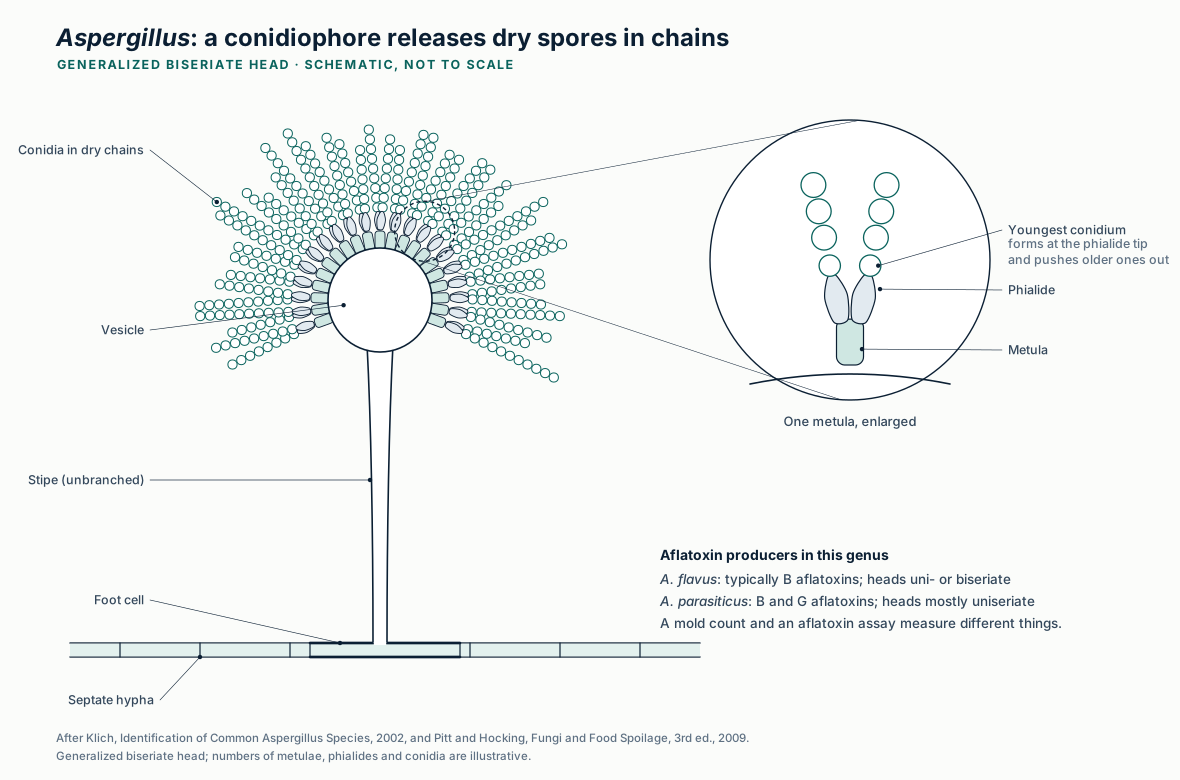
Aflatoxins come from Aspergillus molds such as A. flavus and A. parasiticus; the toxin needs its own assay, not a mold countSchematic
Line drawing of an Aspergillus conidiophore: a horizontal hypha divided by cross walls, a foot cell from which a long unbranched stalk rises, a swollen round vesicle at its tip covered in two layers of short cells, metulae and phialides, and radiating chains of round spores. An enlarged inset shows one metula, its phialides and a spore chain with the youngest spore next to the phialide.
Klich MA, Identification of Common Aspergillus Species, CBS 2002; Pitt JI, Hocking AD, Fungi and Food Spoilage, 3rd ed., Springer 2009. Not to scale. Generated illustration, EUTECNIQ. Full-size SVG
Show data: mycotoxin limits, µg/kg
Mycotoxin limits by framework
FrameworkToxinCommodityLimit, µg/kg
USP ⟨561⟩Aflatoxin B1Articles whose monograph calls for the test5
USP ⟨561⟩Sum of B1, B2, G1, G2Same20
EU 2023/915, 1.1.14–1.1.15Aflatoxin B1Dried Capsicum, pepper, nutmeg, turmeric, their mixtures; dried ginger5.0
EU 2023/915, 1.1.14–1.1.15Sum of four aflatoxinsSame10.0
FDA action levelAflatoxinsFoods20
EU 2023/915, 1.2.17Ochratoxin ADried spices except Capsicum, and mixtures15
EU 2023/915, 1.2.18Ochratoxin ACapsicum spp.20
EU 2023/915, 1.2.19.1Ochratoxin ALiquorice root, including in herbal infusions20
EU 2023/915, 1.2.19.2Ochratoxin ALiquorice extract for food80

Regulation (EU) 2023/915 of April 25, 2023, Annex I (EUR-Lex, read October 23, 2026); 40 CFR 180.151 (eCFR, current as of October 2026). The EU sets ethylene-oxide residue limits for the sum of ethylene oxide and 2-chloroethanol under Regulation (EC) No 396/2005 (Finnish Food Authority summary); values are not reproduced here.

Explanation, details and sources

Where a monograph calls for the test, USP ⟨561⟩ limits aflatoxin B1 to 5 ppb and the sum of B1, B2, G1 and G2 to 20 ppb. The EU sets 5.0 and 10.0 µg/kg for dried spices and ginger, and limits ochratoxin A in spices and liquorice.

Other botanical contaminants with published limits

Other botanical contaminants with published limits
ContaminantLimitApplies toSource
Pyrrolizidine alkaloids, lower-bound sum of 21 (plus 14 co-eluting)400 µg/kg; 200 µg/kg; 150 µg/kgEU food supplements with botanical preparations; dried herbal infusions; dried teaEU 2023/915, entries 2.4.10, 2.4.7, 2.4.4
Polycyclic aromatic hydrocarbonsBenzo(a)pyrene 10.0 µg/kg; sum of four 50.0 µg/kgEU food supplements containing botanicals and their preparationsEU 2023/915, entry 5.1.16
Lead, cadmium, mercury3.0, 1.0 and 0.10 mg/kgEU food supplements (cadmium 3.0 mg/kg if ≥ 80% dried seaweed)EU 2023/915, entries 3.1.28, 3.2.21, 3.3.2
Ethylene oxide; 2-chloroethanol7 ppm; 940 ppmU.S. tolerances when used as a postharvest fumigant: dried herbs and spices (except basil), licorice roots, dried peppermint and spearmint tops, sesame seed40 CFR 180.151
7 · Measurement uncertainty

A result just under the limit has up to a 50% chance of being over it; a stated guard band sets that risk

JCGM 106:2012, expression (9), upper limitpc = ΦTU − yu   u = U/k   acceptance limit AL = TL − w,  w = rU
With a guard band w = U, ILAC-G8 reports four statements, not twoSchematic, computed from the normal model
Schematic of ILAC-G8 decision zones with a guard band equal to the expanded uncertainty: four results with their 95% intervals and the probability that the true value exceeds the limitPassConditional passConditional failFailAL = TL − wTLTL + wMeasured concentration → · guard band w = U (k = 2), ILAC-G8 guarded acceptanceProbability that the true value exceedsTLAA: 0.07% · passBB: 16% · conditional passCC: 84% · conditional failDD: 99.93% · fail
Results A–D sit at TL − 1.6U, TL − 0.5U, TL + 0.5U and TL + 1.6U with k = 2. Curves show the distribution of plausible true values; bars show y ± U.ILAC-G8:09/2019, Sections 4.1–4.2 (binary and non-binary statements); JCGM 106:2012, Section 7.3.
Raising the guard band from 0 to U cuts the worst-case false-acceptance risk from 50% to 2.3%Calculated; normal model
Line chart of the largest probability of false acceptance against the guard band, for a normal distribution and k = 2: 50% with no guard band, 4.8% at 0.83U, 2.3% at U and 0.13% at 1.5U0.001%0.01%0.1%1%10%100%0 U0.5 U1 U1.5 U2 UGuard band w, as a multiple of the expanded uncertainty U (k = 2)Largest specific probability of false acceptance (log)1 − Φ(2r)w = 0, simple acceptance: 50%w = 0, simple acceptance50% computed · ILAC: < 50%ISO 14253-1:2017, w = 0.83U: 4.85%ISO 14253-1:2017, w = 0.83U4.85% computed · ILAC: < 5%ILAC-G8:2009 rule, w = U: 2.28%ILAC-G8:2009 rule, w = U2.28% computed · ILAC: < 2.5%3 sigma, w = 1.5U: 0.135%3 sigma, w = 1.5U0.135% computed · ILAC: < 0.16%ModelResult exactly at AL = TL − rUu = U/2, normal distributionLargest false-acceptprobability = 1 − Φ(2r)6 sigma, w = 3U: below 1 ppm (offscale).Assumes a one-sided limit; ILAC-G8Table 1 gives the bounds.
ILAC-G8:09/2019, Table 1 (decision rules, guard bands and specific risk; one-sided limit, normal distribution); JCGM 106:2012, Section 8 and the ISO 14253-1 example (w = U = 2u gives at most 2.3%).
Show data: guard band and largest false-acceptance probability
Guard band rules and false acceptance probability
Rule (ILAC-G8 Table 1)Guard band wILAC bound1 − Φ(2r), %
Simple acceptance0< 50% PFA50
ISO 14253-1:20170.83U< 5% PFA4.85
ILAC G8:2009 rule1U< 2.5% PFA2.28
3 sigma1.5U< 0.16% PFA0.135
6 sigma3U< 1 ppm PFA0.0000001

PFA: probability of false acceptance. Computed values assume a result exactly at the acceptance limit, k = 2 and a normal distribution.

Acceptance limit AL, same unit0.4
z = (TL − y)/u1.6
Probability the true value is within TL, %94.5
Probability it exceeds TL, %5.48
ILAC-G8 statementconditional pass
Rejected under the EU rule (y − U > TL)?no

Below the limit, inside the guard band.

Plausible true values around the resultCalculator; values you set
Lead, aflatoxin and hexane values are illustrative inputs; the limits are the published ones cited on this page.
Method, assumptions and limits
What it calculates
For one result against an upper limit: the acceptance limit under a chosen guard band, the probability that the true value conforms, the ILAC-G8 statement and the EU official-control rejection test.
Equations
u = U/k with k = 2. pc = Φ((TL − y)/u) (JCGM 106, expression 9). AL = TL − rU. Statement: pass if y ≤ AL; conditional pass if AL < y ≤ TL; conditional fail if TL < y ≤ TL + w; fail above. With w = 0: pass or fail. EU test: reject if y − U > TL.
Variables and units
TL, y and U in the same unit (µg/g, µg/kg or ppm). r from ILAC-G8 Table 1.
Assumptions
Normal distribution; U evaluated near the limit; results corrected for recovery where the method requires it; specific (single-result) risk.
What it does not establish
The size of U for a real method, which needs validation and uncertainty data, or global (population) risk.
References
ILAC-G8:09/2019; JCGM 106:2012; Regulation (EU) 2023/2782.
Verification
Reproduces JCGM 106 Example 1 (z = 1.40, pc = 0.92) after a shift of +6 units, and the ILAC-G8 Table 1 bounds; independent Python reference cases.
Explanation, details and sources

Every result carries an expanded uncertainty U, usually at about 95% coverage (k = 2). ISO/IEC 17025:2017 requires a laboratory that states conformity to document "the decision rule employed" and report it. ILAC-G8:09/2019 describes the rules.

Buyers and regulators often choose opposite rules. A buyer protecting its customers accepts a lot when the result is below TL − U. EU official control of mycotoxins rejects a lot when the result minus the expanded uncertainty is above the maximum level, "beyond reasonable doubt" (Regulation (EU) 2023/2782). Between those two lines, the decision depends on the rule agreed in advance.

Key terms

Twelve terms carry most of the arithmetic on a COA, across limits that span seven orders of magnitude

Every limit in this course on one scale: 1 ppm = 1 mg/kg = 1 µg/g; 1 ppb = 1 µg/kg; 0.5% = 5,000 ppmLimits cited on this page
Log ruler of mass fractions from 1 ppb to 1% with every limit taught on this page: mycotoxins, PAHs and pesticides in the ppb range, elements around 1 ppm, solvents from 2 ppm to 0.5%1 ppb10 ppb100 ppb1 ppm10 ppm100 ppm1,000 ppm1%Aflatoxin B1, EU spices: 5 µg/kg5 µg/kgAflatoxin B1, EU spicesBenzo(a)pyrene, EU supplements: 10 µg/kg10 µg/kgBenzo(a)pyrene, EUsupplementsAflatoxins (sum), USP: 20 µg/kg, ⟨561⟩20 µg/kg, <561>Aflatoxins (sum), USPPesticide limits, median: 0.1 mg/kg, ⟨561⟩ Table 40.1 mg/kg, <561> Table 4Pesticide limits, medianPyrrolizidine alkaloids, EU supplements: 400 µg/kg400 µg/kgPyrrolizidine alkaloids,EU supplementsEthylene oxide, U.S. dried spices: 7 ppm7 ppmEthylene oxide, U.S.dried spicesLead, USP component limit: 0.5 µg/g, ⟨2232⟩Lead, USPcomponent limit0.5 µg/g, <2232>Benzene, Class 1: 2 ppm, ICH Q3CBenzene, Class 12 ppm, ICH Q3CLead, EU supplements: 3.0 mg/kgLead, EUsupplements3.0 mg/kgLead, USP botanicals: 5 µg/g, ⟨561⟩Lead, USPbotanicals5 µg/g, <561>Hexane, Class 2: 290 ppm, Option 1Hexane, Class 2290 ppm, Option 1Methanol, Class 2: 3,000 ppm, Option 1Methanol, Class 23,000 ppm, Option 1Class 3 solvents: 0.5%, Option 1Class 3 solvents0.5%, Option 1Organic trace contaminants (mycotoxins, PAHs, pesticides, alkaloids)Elements and residual solventsEvery limit on this page as a mass fraction, from 5 ppb to 0.5%Limits on this page, lowest to highest1 ppb10 ppb100 ppb1 ppm10 ppm100 ppm1,000 ppm10,000 ppmAflatoxin B1, EU spices5 µg/kgBenzo(a)pyrene, EU supplements10 µg/kgAflatoxins (sum), USP20 µg/kg, <561>Pesticide limits, median0.1 mg/kg, <561> Table 4Pyrrolizidine alkaloids, EU supplements400 µg/kgLead, USP component limit0.5 µg/g, <2232>Benzene, Class 12 ppm, ICH Q3CLead, EU supplements3.0 mg/kgLead, USP botanicals5 µg/g, <561>Ethylene oxide, U.S. dried spices7 ppmHexane, Class 2290 ppm, Option 1Methanol, Class 23,000 ppm, Option 1Class 3 solvents0.5%, Option 1
Mass fractions on a log scale. Each value is cited in its section above; the ruler compares magnitudes, not legal force.
Show the 12 key terms
Certificate of analysis (COA)
A lot-specific report of tests, methods, limits and results, issued and approved by the testing party.
Permitted daily exposure (PDE)
The maximum acceptable daily intake of an impurity from a product, in µg/day for elements (Q3D) or mg/day for solvents (Q3C).
Modifying factors F1–F5
Divisors applied to a NOAEL for species, human variability, study length, severity and the lack of a NOEL.
Option 1, 2a, 2b, 3 (Q3D)
Ways to turn a PDE into concentration limits: a common limit at 10 g/day, at the real intake, per component, or on the finished product.
Control threshold
30% of the PDE; below it, Q3D expects no further elemental controls if variability is acceptable.
Summation option
USP ⟨2232⟩ route that adds each component's contribution per serving and multiplies by servings per day.
Class 1, 2, 3 solvents
ICH Q3C groups: avoid, limit by PDE, or accept up to 50 mg/day.
Acceptable daily intake (ADI)
The FAO-WHO published intake value for a pesticide, in mg per kg body weight per day; USP ⟨561⟩ uses it as A.
Tolerance
The EPA's maximum residue level for a pesticide in or on a food commodity, set in 40 CFR Part 180.
Expanded uncertainty (U)
The half-width of an interval expected to hold about 95% of plausible values (k = 2).
Guard band (w)
The distance between the tolerance limit and the acceptance limit, often a multiple of U.
Decision rule
The stated rule for how uncertainty is used when declaring a result conforming or not (ISO/IEC 17025:2017).
Check your understanding

Five questions to test the arithmetic and the scope rules

A COA for an ashwagandha extract reports "lead complies with ICH Q3D". What should a reviewer ask?

Q3D "does not apply to herbal products", and a supplement's elemental limits are in USP ⟨2232⟩ or the monograph. Ask for the numerical lead result, the method (e.g., ICP-MS per ⟨233⟩), the limit used and its basis (daily intake, component limit at 10 g, or summation).

An ingredient contains 2 µg/g lead and is used at 2 g per day. Does it meet USP ⟨2232⟩?

It fails the individual component limit (0.5 µg/g), but that is one of three options. Its daily contribution is 4 µg, below the 5 µg PDE, so it can pass the summation option if the other components add less than 1 µg/day. It would still exceed the Proposition 65 MADL of 0.5 µg/day.

Why can a product pass Q3C Option 2 when two of its components fail Option 1?

Option 1 assumes 10 g of every component per day. In the ICH example, 5.0 g of product contains 3.64 mg of acetonitrile, below the 4.1 mg/day PDE, although the drug substance and one excipient hold 800 ppm against a 410 ppm Option 1 limit.

For an unlisted pesticide with an ADI of 0.01 mg/kg bw and a 3 g/day dose, what is the ⟨561⟩ limit, and what share of the ADI does it allow?

0.01 × 60 / (100 × 0.003) = 2 mg/kg. At 3 g/day that is 6 µg/day, which is 1% of the 600 µg/day ADI for 60 kg. In the U.S., EPA tolerances govern a food-labeled botanical instead.

A lab reports 0.48 µg/g lead with U = 0.10 µg/g (k = 2) against 0.5 µg/g. Is the lot conforming?

It depends on the agreed rule. With simple acceptance it passes. The probability that the true value exceeds 0.5 is 1 − Φ(0.4) ≈ 34%. With w = U the acceptance limit is 0.40, so the ILAC statement is "conditional pass".

Next: microbiology of botanicals

Course 7 covers the microbial lines of the COA: counts, specified organisms, spore formers and kill steps.