
EUTECNIQ Sciences

See every page on one mapArrow keys move through results · Enter opens · Esc closes

Academy · Course 4 Peer-reviewed science Calculators

Genomes explain why plants that share a name can make different compounds, so a specification must test the chemistry as well as the species

This course covers how many plant species are known, how genome size and ploidy are measured, what the chloroplast genome can and cannot tell apart, and how biosynthetic genes decide a plant's chemistry. Each topic ends at a decision a botanical specification has to make.

Level
Intermediate
Reading time
About 30 minutes
Builds on
Botanical identity
Tools
2 calculators, 1 treemap, 1 heat map
342,953accepted vascular plant species in the World Checklist, April 2021
798land-plant species with a genome assembly, January 2021
160.45Gbp in one fork-fern genome (1C), the largest measured
10clustered genes behind noscapine in the high-noscapine opium-poppy variety HN1
At a glance

Medicinal-plant genome assemblies differ about 18-fold in size, from 0.56 Gb in Catharanthus roseus to 9.87 Gb in Ginkgo

Six sequenced medicinal plants, area proportional to assembled genome size (Gb)Genome papers
Assembly sizes from the genome papers cited in the sequenced-genomes section of this course. Artemisia annua is shown per haplotype. Assembly size is not the same measurement as a flow-cytometry C-value.
Data table: assembly sizes
Assembled genome sizes
SpeciesGroupGbNote
Ginkgo bilobaGymnosperm9.87Nearly complete assembly, 27,832 genes (2021)
Camellia sinensis var. assamicaFlowering plants3.0280.9% repeats
Panax ginsengFlowering plants2.98Tetraploid assembly, 59,352 annotated genes
Papaver somniferumFlowering plants2.7211 chromosomes; 15-gene alkaloid cluster
Artemisia annuaFlowering plants1.5Per haplotype; about 50,000 genes per haplotype
Catharanthus roseusFlowering plants0.56178 pseudochromosomes, contig N50 24.7 Mb
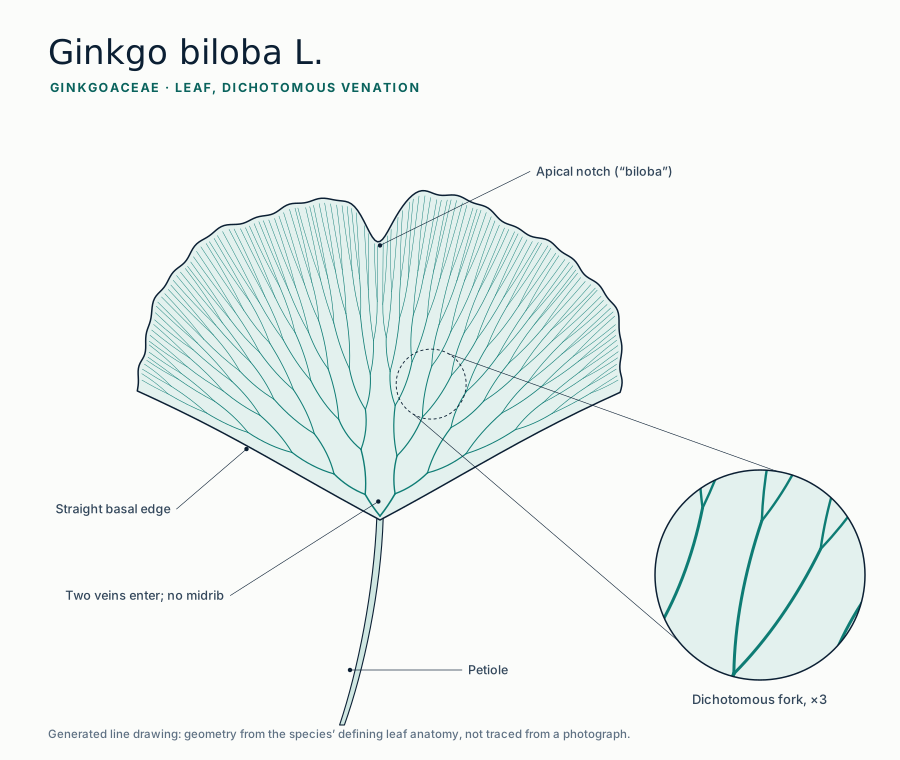
Ginkgo, the 9.87 Gb end of that range, is a gymnosperm whose fan-shaped leaf has forking veins and no midribGenerated illustration
Line drawing of a ginkgo leaf: a fan-shaped blade notched at the apex, a long petiole, and veins that fork in twos from the base to the margin, with no midrib. A circular inset magnifies three times a region where veins fork.
Leaf morphology: Raven PH et al., Biology of Plants, 8th ed., 2013. Geometry generated from the species’ defining leaf features, not traced. Generated illustration, EUTECNIQ. Full-size SVG

You will learn

  1. How many vascular plant species are accepted, and how few have a measured genome size or an assembly.
  2. What 1C, 2C and 1Cx mean, and how flow cytometry turns a peak ratio into picograms and megabases.
  3. How polyploidy changes chemistry, using Acorus and β-asarone as the worked case.
  4. Why the four-part chloroplast genome carries the standard DNA barcodes, and where they stop resolving species.
  5. What a medicinal-plant genome paper reports, and how much sequencing an assembly needs.
  6. How the artemisinin pathway and the noscapine gene cluster tie genes to a specification.
1 · Species

Botanists accept 342,953 vascular plant species, and fewer than 1,000 land plants had a genome assembly in 2021

From names to genomes, each layer of knowledge is one to three orders of magnitude thinnerKew data, peer-reviewed
Log scale: 342,953 accepted vascular plant species, 12,273 species with a measured genome size, 798 land-plant species with a genome assembly1001,00010,000100,0001,000,000Count, log scalePlant names in the World ChecklistWCVP, April 2021Plant names in the World Checklist: 1,383,297 (WCVP, April 2021)1,383,297Accepted vascular plant speciesWCVP, April 2021Accepted vascular plant species: 342,953 (WCVP, April 2021)342,953Species with a C-value in the Kew databaserelease 7.1, April 2019; land plants and algaeSpecies with a C-value in the Kew database: 12,273 (release 7.1, April 2019; land plants and algae)12,273Angiosperms among themrelease 7.1Angiosperms among them: 10,770 (release 7.1)10,770Land-plant species with a genome assemblyJanuary 2021 (Marks et al. 2021)Land-plant species with a genome assembly: 798 (January 2021 (Marks et al. 2021))798
Govaerts R, et al. Sci Data. 2021;8:215; Kew Plant DNA C-values database, release 7.1 (April 2019), landing page accessed October 23, 2026; Pellicer J, Leitch IJ. New Phytol. 2020;226:301–305; Marks RA, et al. Nat Plants. 2021;7:1571–1578. The groups differ (vascular plants, land plants and algae, land plants).
Data table: names, species, C-values and assemblies
Counts as published
QuantityCountDate and source
Plant names in WCVP1,383,297April 16, 2021; Govaerts 2021
Accepted vascular plant species342,953April 16, 2021; Govaerts 2021
Species with a C-value (all groups)12,273Release 7.1, April 2019
Angiosperms with a C-value10,770Release 7.1
Land-plant species with a genome assembly798January 2021; Marks 2021
Explanation, details and sources

The World Checklist of Vascular Plants, which feeds Kew's Plants of the World Online, listed 342,953 accepted species among 1,383,297 names in April 2021. Genome data cover a small fraction: Marks et al. (2021) counted 798 land-plant species with assemblies, about 0.16% of roughly 350,000 land plants.

Treat any species count as dated: WCVP is "continuously updated" (Govaerts et al. 2021), so cite the version. For product work the useful number is smaller: how many candidate species have a measured genome size, a reference sequence or a published pathway. For most, none exists.

2 · Genome size

Plant genomes range from 0.061 to 160 Gbp, so every size must state whether it is 1C, 2C or 1Cx

1C, 2C and 1Cx in a diploid and a tetraploidSchematic
C-value terms: in a diploid, 2C holds two monoploid sets and 1C equals 1Cx; in a tetraploid, 2C holds four sets, 1C holds two and 1Cx is one setDiploid somatic nucleus2n = 2x: two sets; DNA content 2CIts gameten = x: 1C = 1CxTetraploid somatic nucleus2n = 4x: four sets; DNA content 2CIts gameten = 2x: 1C = 2Cx; 1Cx is one setmeiosismeiosisHoloploid genome size (C-value) counts the whole complement; monoploid genome size (Cx) counts one set. Flow cytometry measures 2C in G1 nuclei.
Terms: Greilhuber J, et al. Ann Bot. 2005;95:255–260. Chromosome sets drawn as bars; numbers of chromosomes are not to scale.
Sequenced medicinal plants sit between 0.38 and 10 Gbp, inside a range of 0.061 to 160 GbpPeer-reviewed
Log-scale genome sizes from 0.061 Gbp in Genlisea tuberosa to 160.45 Gbp in Tmesipteris oblanceolata, with eight sequenced medicinal plants between 0.38 and 9.9 Gbp0.1110100Haploid genome size (Gbp), log scaleGenlisea tuberosaGenlisea tuberosa: 0.061 Gbp (flow cytometry); smallest angiosperm known (Fleischmann 2014)0.061smallest angiosperm known (Fleischmann2014)Glycyrrhiza uralensisGlycyrrhiza uralensis: 0.379 Gbp (assembly length); draft assembly (Mochida 2017)0.379draft assembly (Mochida 2017)Acorus americanus (2x)Acorus americanus (2x): 0.43–0.465 Gbp (flow cytometry); from 2C 0.88–0.95 pg (Sokoloff 2024)0.43–0.465from 2C 0.88–0.95 pg (Sokoloff 2024)Catharanthus roseusCatharanthus roseus: 0.5617 Gbp (assembly length); 8 pseudochromosomes (Xu 2023)0.56178 pseudochromosomes (Xu 2023)Artemisia annuaArtemisia annua: 1.5 Gbp (assembly length); per haplotype (Liao 2022)1.5per haplotype (Liao 2022)Papaver somniferumPapaver somniferum: 2.72 Gbp (assembly length); 11 chromosomes (Guo 2018)2.7211 chromosomes (Guo 2018)Panax ginsengPanax ginseng: 2.98 Gbp (assembly length); tetraploid (Kim 2018)2.98tetraploid (Kim 2018)Camellia sinensisCamellia sinensis: 3.02–3.1 Gbp (assembly length); two varieties (Xia 2017; Wei 2018)Camellia sinensis: 3.02–3.1 Gbp (assembly length); two varieties (Xia 2017; Wei 2018)3.02–3.1two varieties (Xia 2017; Wei 2018)Ginkgo bilobaGinkgo biloba: 9.87 Gbp (assembly length); nearly complete (Liu 2021)9.87nearly complete (Liu 2021)Paris japonicaParis japonica: 148.89 Gbp (flow cytometry); largest angiosperm (Pellicer 2010)148.89largest angiosperm (Pellicer 2010)Tmesipteris oblanceolataTmesipteris oblanceolata: 160.45 Gbp (flow cytometry); fork fern; largest eukaryote (Fernández 2024)160.45fork fern; largest eukaryote (Fernández 2024)flow cytometry, 1Cgenome assembly lengthNote
Fleischmann A, et al. Ann Bot. 2014;114:1651–1663; Pellicer J, Fay MF, Leitch IJ. Bot J Linn Soc. 2010;164:10–15 (1C = 152.23 pg); Fernández P, et al. iScience. 2024;27:109889; assembly papers listed in section 5. Assembly length is not the same measurement as 1C by flow cytometry.
Data table: genome sizes in the chart
Haploid genome size in Gbp; FC = flow cytometry (1C), AS = assembly length
SpeciesGbpTypeSource
Genlisea tuberosa≈0.061FCFleischmann 2014
Glycyrrhiza uralensis≈0.379ASMochida 2017
Acorus americanus (2x)0.430–0.465FC2C 0.88–0.95 pg × 978/2; Sokoloff 2024
Catharanthus roseus0.5617ASXu 2023
Artemisia annua1.5ASLiao 2022
Papaver somniferum2.72ASGuo 2018
Panax ginseng2.98ASKim 2018
Camellia sinensis3.02; 3.1ASXia 2017 (var. assamica); Wei 2018 (var. sinensis)
Ginkgo biloba9.87ASLiu 2021
Paris japonica148.89FCPellicer 2010, as converted by Fernández 2024
Tmesipteris oblanceolata160.45FCFernández 2024
Flow cytometry with an internal standard2Csample = G1 peaksampleG1 peakstandard × 2Cstandard 1C = 2C/2 1Cx = 2C/p 1 pg = 978 Mbp
Peak ratio
2C of the sample
1C
1C in megabases
1Cx (one set)
1Cx in megabases
Against the Acorus ranges

Histogram of nuclei and the result on a 2C axisCalculation; histogram simulated
Standards and 2C values as listed by Charalambous et al. Plants. 2023;12:1469 (Doležel's set); Acorus ranges: Sokoloff DD, et al. Plants. 2024;13:1978. Peak shapes are simulated (3% coefficient of variation, small G2 peaks at twice the G1 position).
Method, assumptions and limits
What it calculates
The sample's 2C DNA content from the ratio of G1 peak positions, then 1C, 1Cx for the ploidy you enter, megabases, and whether 2C falls inside one of three published Acorus ranges.
Equations
2Csample = (mean fluorescence of sample ÷ mean fluorescence of standard) × 2Cstandard, the formula quoted by Al-Qurainy et al. (Plants 2021;10:1362); 1 pg = 978 Mbp (Doležel et al. 2003); 1Cx = 2C/p (Greilhuber et al. 2005).
Assumptions
Sample and standard nuclei stained together under the same conditions; fluorescence proportional to DNA content; G1 peaks identified correctly. The warning for peaks within 5% of each other is this tool's rule for overlapping peaks, not a published criterion.
What it does not establish
Ploidy. The tool divides by the ploidy you enter; inferring ploidy from DNA content needs reference values for known cytotypes, which is why the Acorus ranges are shown.
Verification
tests/numerics/ref/academy_genomes-and-species.py; tests/unit/acidn.test.js.
Explanation, details and sources

Greilhuber et al. (2005) separate the holoploid genome size (C-value, the whole chromosome complement) from the monoploid genome size (Cx, one chromosome set). In a diploid 1C equals 1Cx; in a tetraploid it does not. Flow cytometry measures the 2C content of nuclei against an internal standard, and 1 pg of DNA equals 978 Mbp (Doležel et al. 2003).

Worked examples. Paris japonica: 1C = 152.23 pg × 978 Mbp/pg ≈ 148,900 Mbp, the 148.89 Gbp quoted by Fernández et al. (2024). Acorus calamus against a tomato standard (2C = 1.96 pg): peaks at channels 260 and 400 give 2C = 0.65 × 1.96 = 1.27 pg, inside the published triploid range (calculator defaults).

Common misreading. Assembly length is not a flow-cytometry 1C value. Ginkgo's draft assembly was 10.61 Gb and the later, nearly complete one 9.87 Gb (Guan et al. 2016; Liu et al. 2021).

Why it matters for a program. Genome size sets the sequencing budget: at equal coverage, Ginkgo (9.87 Gb) needs about 6.6 times the reads of Artemisia annua (1.5 Gb per haplotype). It also tells a laboratory which flow-cytometry standard to run, and a shift in 2C can flag a different cytotype.

3 · Polyploidy and chemotype

Polyploidy is common in plants, and in Acorus the number of chromosome sets tracks β-asarone

The triploid A. calamus combines one set from the diploid and two from the tetraploid, and cannot set seedPeer-reviewed
The Acorus calamus group: diploid A. americanus and tetraploid A. verus, and their sterile triploid hybrid A. calamus, which spreads by rhizomeAcorus americanusdiploid, 2x; sets seedAcorus verustetraploid, 4x; sets seedAcorus calamustriploid, 3x; no seed, pollen largelysterilegamete: one set (x)gamete: two sets (2x)Spreads clonally by rhizome; both parental ITS ribotypes are kept in one plant (Sokoloff et al. 2024).
Sokoloff DD, et al. Plants. 2024;13:1978. POWO accepts Acorus americanus (Raf.) Raf., Acorus calamus L. and Acorus verus (L.) Raf. Chromosome sets schematic.
DNA content separates the three cytotypes, and β-asarone rises from not detected to 85–95% of the rhizome oilEMA, peer-reviewed, eCFR
Acorus cytotypes: 2C DNA content 0.88–0.95, 1.23–1.31 and 1.47–1.61 pg; beta-asarone not detected in the diploid, 9–19% of rhizome oil in the triploid and 85–95% in the tetraploidDiploid, A. americanusDiploid, A. americanus: 2C DNA (pg), flow cytometry 0.88–0.950.88–0.95not detected—Triploid, A. calamusTriploid, A. calamus: 2C DNA (pg), flow cytometry 1.23–1.311.23–1.31Triploid, A. calamus: β-asarone in rhizome oil (%) 9–199–19Triploid, A. calamus: β-asarone in dried rhizome (%) 0.3–0.30.3Tetraploid, A. verusTetraploid, A. verus: 2C DNA (pg), flow cytometry 1.47–1.611.47–1.61Tetraploid, A. verus: β-asarone in rhizome oil (%) 85–9585–95Tetraploid, A. verus: β-asarone in dried rhizome (%) 4.4–8.34.4–8.32C DNA (pg), flow cytometry0.81.21.6β-asarone in rhizome oil (%)050100β-asarone in dried rhizome (%)0510Two isomers, C₁₂H₁₆O₃OOOβ-asarone (Z)OOOα-asarone (E)21 CFR 189.110: food containing added calamus, oil of calamus or extract of calamus is deemed adulterated (order of May 9,1968, 33 FR 6967).EMA (2005): a temporary limit of about 115 µg/day of asarone from herbal medicinal products; “diploid varieties should always bepreferred.”
2C ranges: Sokoloff et al. 2024. β-asarone: EMA HMPC, Public statement on the use of herbal medicinal products containing asarone, EMEA/HMPC/139215/2005 (November 23, 2005), which names the cytotypes A. calamus var. americanus, var. calamus and var. angustatus. 21 CFR 189.110 (eCFR, current as of October 20, 2026). Structures: PubChem CID 5281758 and 636822.
Data table: Acorus cytotypes
As published; β-asarone values are ranges reported by EMA without per-row references
Cytotype2C DNA (pg)β-asarone, leaf oilβ-asarone, rhizome oilβ-asarone, dried rhizome
Diploid, A. americanus0.88–0.95not detectednot detected—
Triploid, A. calamus1.23–1.3150–65%9–19%0.3%
Tetraploid, A. verus1.47–1.61major component85–95%4.4–8.3%
Explanation, details and sources

Ploidy increase accompanies about 15% of angiosperm and 31% of fern speciation events (Wood et al. 2009), and whole-genome duplications occurred in the ancestors of all seed plants and of all angiosperms (Jiao et al. 2011). Sweet flag shows what this means for a product: its three cytotypes differ in DNA content and in β-asarone, and calamus may not be added to U.S. food (21 CFR 189.110).

Polyploid lines are frequent: Wood et al. (2009) estimate a standing incidence of polyploid species within genera of 35%. Any species a supplier offers may therefore exist in several cytotypes, and chemistry can differ between them, as Acorus shows.

For a specification, the species name alone does not fix β-asarone. A flow-cytometry ploidy check or an ITS barcode identifies the cytotype (Sokoloff et al. 2024), and a quantitative β-asarone assay confirms the chemistry. Databases can disagree: NCBI files the diploid's chloroplast genome under Acorus calamus var. americanus (NC_010093), while POWO accepts Acorus americanus.

4 · The chloroplast genome

The chloroplast genome is small and conserved, which makes it easy to barcode and slow to separate close relatives

In Panax ginseng, all seven candidate barcode loci tested by CBOL sit in the large single-copy regionNCBI RefSeq
Linear map of the Panax ginseng chloroplast genome, 156,318 bp: large single copy 86,106 bp, inverted repeats of 26,071 bp and small single copy 18,070 bp; all seven CBOL candidate barcode loci lie in the large single copyLSC: 1–86,106 (86,106 bp)LSC 86,106 bpIRb: 86,107–112,177 (26,071 bp)IRb 26,071 bpSSC: 112,178–130,247 (18,070 bp)SSC 18,070 bpIRa: 130,248–156,318 (26,071 bp)IRa 26,071 bp0 kb20 kb40 kb60 kb80 kb100 kb120 kb140 kbtrnH–psbA: 81–484trnH–psbAmatK: 2,079–3,590matKpsbK–psbI: 8,771–9,178psbK–psbIatpF–atpH: 14,217–14,592atpF–atpHrpoC1: 22,186–25,011rpoC1rpoB: 25,017–28,232rpoBrbcL: 57,353–58,789rbcLThe seven candidate loci compared by CBOL (2009), positions in NC_006290ycf2: 88,328–94,660ycf2rrn16: 101,937–103,427rrn16rrn23: 105,835–108,643rrn23ndhF: 112,183–114,408ndhFycf1: 126,137–131,896ycf1rrn23: 133,782–136,590rrn23rrn16: 138,998–140,488rrn16ycf2: 147,765–154,097ycf2The inverted repeats carry both rRNA operons (rrn16, rrn23), so each copy is identical; the seven barcode candidates all lie in the large single-copy region.
NCBI RefSeq NC_006290.1 (Panax ginseng chloroplast, 156,318 bp), gene coordinates from the record; partition found as the longest inverted repeat by src/modules/acidn/compute/plastome_stats.py. Loci: CBOL Plant Working Group 2009.
Seventeen chloroplast genomes share the four-part layout, except licorice, which has no inverted repeatNCBI RefSeq
Chloroplast genome partitions of 17 species from RefSeq: totals 127.9 to 159.6 kb; the licorice plastome has no inverted repeat, and Ginkgo and Hypericum have shorter repeatsPlastome length and partition (kb), computed from NCBI RefSeq0255075100125150Ginkgo bilobaGinkgo biloba (NC_016986.1): 156,988 bp; LSC 108,172 bpGinkgo biloba (NC_016986.1): 156,988 bp; IR 13,027 bpGinkgo biloba (NC_016986.1): 156,988 bp; SSC 22,762 bpGinkgo biloba (NC_016986.1): 156,988 bp; IR 13,027 bp157.0Acorus calamusAcorus calamus (NC_007407.1): 153,821 bp; LSC 83,493 bpAcorus calamus (NC_007407.1): 153,821 bp; IR 26,025 bpAcorus calamus (NC_007407.1): 153,821 bp; SSC 18,278 bpAcorus calamus (NC_007407.1): 153,821 bp; IR 26,025 bp153.8Curcuma longaCurcuma longa (NC_042886.1): 159,550 bp; LSC 92,604 bpCurcuma longa (NC_042886.1): 159,550 bp; IR 24,202 bpCurcuma longa (NC_042886.1): 159,550 bp; SSC 18,542 bpCurcuma longa (NC_042886.1): 159,550 bp; IR 24,202 bp159.6Papaver somniferumPapaver somniferum (NC_029434.1): 152,931 bp; LSC 83,029 bpPapaver somniferum (NC_029434.1): 152,931 bp; IR 25,991 bpPapaver somniferum (NC_029434.1): 152,931 bp; SSC 17,920 bpPapaver somniferum (NC_029434.1): 152,931 bp; IR 25,991 bp152.9Glycyrrhiza glabraGlycyrrhiza glabra (NC_024038.1): 127,943 bp; no inverted repeat 127,943 bp127.9Hypericum perforatumHypericum perforatum (NC_083133.1): 139,725 bp; LSC 95,109 bpHypericum perforatum (NC_083133.1): 139,725 bp; IR 16,766 bpHypericum perforatum (NC_083133.1): 139,725 bp; SSC 11,084 bpHypericum perforatum (NC_083133.1): 139,725 bp; IR 16,766 bp139.7Arabidopsis thalianaArabidopsis thaliana (NC_000932.1): 154,478 bp; LSC 84,170 bpArabidopsis thaliana (NC_000932.1): 154,478 bp; IR 26,264 bpArabidopsis thaliana (NC_000932.1): 154,478 bp; SSC 17,780 bpArabidopsis thaliana (NC_000932.1): 154,478 bp; IR 26,264 bp154.5Camellia sinensisCamellia sinensis (NC_020019.1): 157,103 bp; LSC 86,645 bpCamellia sinensis (NC_020019.1): 157,103 bp; IR 26,091 bpCamellia sinensis (NC_020019.1): 157,103 bp; SSC 18,276 bpCamellia sinensis (NC_020019.1): 157,103 bp; IR 26,091 bp157.1Catharanthus roseusCatharanthus roseus (NC_021423.1): 154,950 bp; LSC 85,765 bpCatharanthus roseus (NC_021423.1): 154,950 bp; IR 25,594 bpCatharanthus roseus (NC_021423.1): 154,950 bp; SSC 17,997 bpCatharanthus roseus (NC_021423.1): 154,950 bp; IR 25,594 bp154.9Withania somniferaWithania somnifera (NC_047245.1): 155,365 bp; LSC 86,260 bpWithania somnifera (NC_047245.1): 155,365 bp; IR 25,390 bpWithania somnifera (NC_047245.1): 155,365 bp; SSC 18,325 bpWithania somnifera (NC_047245.1): 155,365 bp; IR 25,390 bp155.4Nicotiana tabacumNicotiana tabacum (NC_001879.2): 155,943 bp; LSC 86,686 bpNicotiana tabacum (NC_001879.2): 155,943 bp; IR 25,343 bpNicotiana tabacum (NC_001879.2): 155,943 bp; SSC 18,571 bpNicotiana tabacum (NC_001879.2): 155,943 bp; IR 25,343 bp155.9Artemisia annuaArtemisia annua (NC_034683.1): 150,952 bp; LSC 82,772 bpArtemisia annua (NC_034683.1): 150,952 bp; IR 24,956 bpArtemisia annua (NC_034683.1): 150,952 bp; SSC 18,268 bpArtemisia annua (NC_034683.1): 150,952 bp; IR 24,956 bp151.0Panax ginsengPanax ginseng (NC_006290.1): 156,318 bp; LSC 86,106 bpPanax ginseng (NC_006290.1): 156,318 bp; IR 26,071 bpPanax ginseng (NC_006290.1): 156,318 bp; SSC 18,070 bpPanax ginseng (NC_006290.1): 156,318 bp; IR 26,071 bp156.3Panax quinquefoliusPanax quinquefolius (NC_027456.1): 156,088 bp; LSC 86,095 bpPanax quinquefolius (NC_027456.1): 156,088 bp; IR 26,000 bpPanax quinquefolius (NC_027456.1): 156,088 bp; SSC 17,993 bpPanax quinquefolius (NC_027456.1): 156,088 bp; IR 26,000 bp156.1Panax notoginsengPanax notoginseng (NC_026447.1): 156,387 bp; LSC 86,111 bpPanax notoginseng (NC_026447.1): 156,387 bp; IR 25,861 bpPanax notoginseng (NC_026447.1): 156,387 bp; SSC 18,554 bpPanax notoginseng (NC_026447.1): 156,387 bp; IR 25,861 bp156.4Panax japonicusPanax japonicus (NC_028703.1): 156,188 bp; LSC 86,199 bpPanax japonicus (NC_028703.1): 156,188 bp; IR 25,988 bpPanax japonicus (NC_028703.1): 156,188 bp; SSC 18,013 bpPanax japonicus (NC_028703.1): 156,188 bp; IR 25,988 bp156.2Eleutherococcus senticosusEleutherococcus senticosus (NC_016430.1): 156,768 bp; LSC 86,755 bpEleutherococcus senticosus (NC_016430.1): 156,768 bp; IR 25,930 bpEleutherococcus senticosus (NC_016430.1): 156,768 bp; SSC 18,153 bpEleutherococcus senticosus (NC_016430.1): 156,768 bp; IR 25,930 bp156.8large single copyinverted repeat (×2)small single copyno inverted repeat
RefSeq accessions in the data table; partitions computed as above and checked against the records' own repeat annotations where present (Papaver, Withania, Hypericum, Acorus americanus). Order: gymnosperm, monocots, then eudicots.
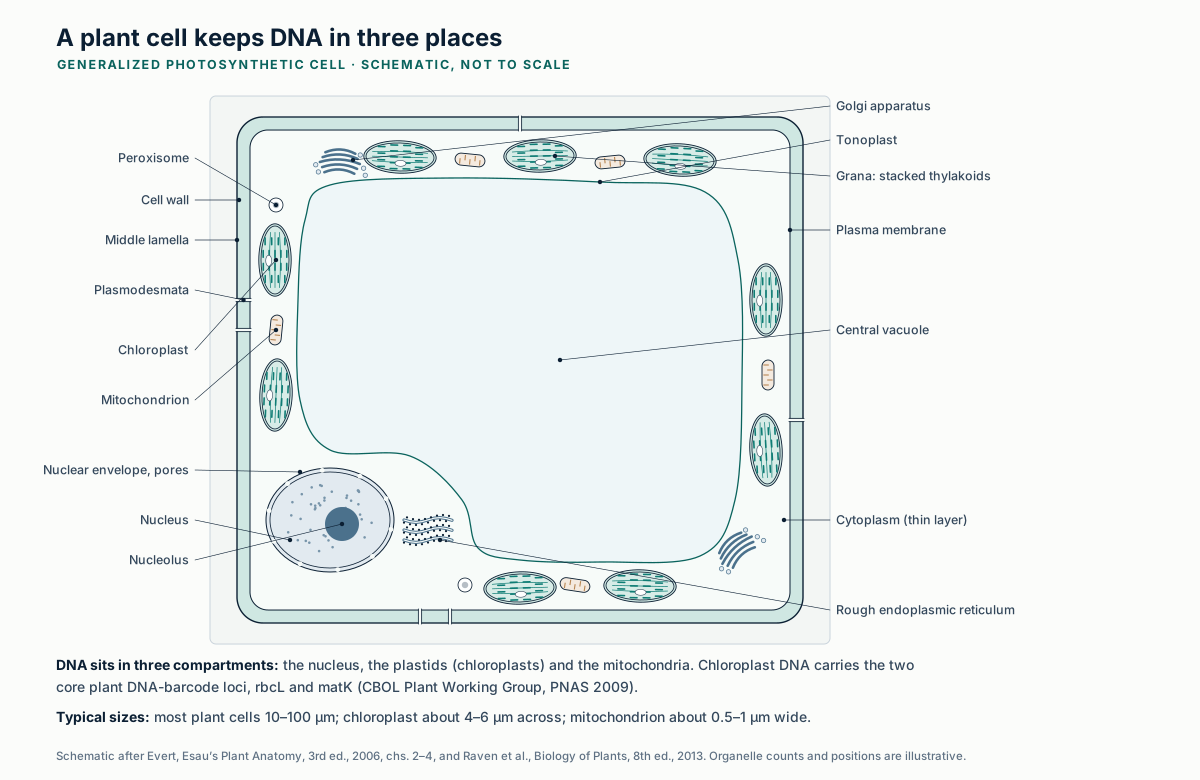
A plant cell keeps DNA in its nucleus, its plastids and its mitochondria; the core barcodes rbcL and matK come from the plastidSchematic
Schematic of a mature plant cell: a rigid cell wall with a middle lamella shared with neighbors and plasmodesmata crossing it; the plasma membrane; a large central vacuole bounded by the tonoplast; and a thin layer of cytoplasm holding the nucleus with its nucleolus, rough endoplasmic reticulum, Golgi stacks, chloroplasts with stacked thylakoids, mitochondria with folded inner membranes and peroxisomes. Notes give typical sizes and the three places a plant cell keeps DNA.
Evert RF, Esau’s Plant Anatomy, 3rd ed., Wiley 2006, chs. 2–4; Raven PH et al., Biology of Plants, 8th ed., 2013; CBOL Plant Working Group, PNAS 2009;106:12794–12797. Schematic, not to scale. Generated illustration, EUTECNIQ. Full-size SVG
Data table: chloroplast genome partitions
Lengths in bp; GC in %; computed from the RefSeq records
SpeciesRefSeqLengthLSCSSCIR (each)GC, wholeGC, IR
Ginkgo bilobaNC_016986.1156,988108,17222,76213,02739.647.9
Acorus calamusNC_007407.1153,82183,49318,27826,02538.642.6
Curcuma longaNC_042886.1159,55092,60418,54224,20236.342.8
Papaver somniferumNC_029434.1152,93183,02917,92025,99138.943.1
Glycyrrhiza glabraNC_024038.1127,943———34.2—
Hypericum perforatumNC_083133.1139,72595,10911,08416,76637.443.8
Arabidopsis thalianaNC_000932.1154,47884,17017,78026,26436.342.3
Camellia sinensisNC_020019.1157,10386,64518,27626,09137.342.9
Catharanthus roseusNC_021423.1154,95085,76517,99725,59438.143.3
Withania somniferaNC_047245.1155,36586,26018,32525,39037.643.0
Nicotiana tabacumNC_001879.2155,94386,68618,57125,34337.843.2
Artemisia annuaNC_034683.1150,95282,77218,26824,95637.543.1
Panax ginsengNC_006290.1156,31886,10618,07026,07138.143.1
Panax quinquefoliusNC_027456.1156,08886,09517,99326,00038.143.1
Panax notoginsengNC_026447.1156,38786,11118,55425,86138.143.2
Panax japonicusNC_028703.1156,18886,19918,01325,98838.143.1
Eleutherococcus senticosusNC_016430.1156,76886,75518,15325,93038.043.1
P. ginseng and P. quinquefolius differ at a single site in each core barcode geneComputed from RefSeq
Heat map of uncorrected p-distances: matK above the diagonal, rbcL below; Panax ginseng and P. quinquefolius differ at one site in each gene, Eleutherococcus differs from the Panax species by 1.3 to 1.5 percentP. ginsengP. quinquefoliusP. notoginsengP. japonicusE. senticosusPanax ginsengPanax ginsengmatK, Panax ginseng vs Panax quinquefolius: 1 differences in 1512 aligned sites (0.07%)0.07matK, Panax ginseng vs Panax notoginseng: 5 differences in 1512 aligned sites (0.33%)0.33matK, Panax ginseng vs Panax japonicus: 8 differences in 1512 aligned sites (0.53%)0.53matK, Panax ginseng vs Eleutherococcus senticosus: 19 differences in 1512 aligned sites (1.26%)1.26Panax quinquefoliusrbcL, Panax quinquefolius vs Panax ginseng: 1 differences in 1437 aligned sites (0.07%)0.07Panax quinquefoliusmatK, Panax quinquefolius vs Panax notoginseng: 6 differences in 1512 aligned sites (0.40%)0.40matK, Panax quinquefolius vs Panax japonicus: 9 differences in 1512 aligned sites (0.60%)0.60matK, Panax quinquefolius vs Eleutherococcus senticosus: 20 differences in 1512 aligned sites (1.32%)1.32Panax notoginsengrbcL, Panax notoginseng vs Panax ginseng: 7 differences in 1437 aligned sites (0.49%)0.49rbcL, Panax notoginseng vs Panax quinquefolius: 6 differences in 1437 aligned sites (0.42%)0.42Panax notoginsengmatK, Panax notoginseng vs Panax japonicus: 9 differences in 1512 aligned sites (0.60%)0.60matK, Panax notoginseng vs Eleutherococcus senticosus: 22 differences in 1512 aligned sites (1.46%)1.46Panax japonicusrbcL, Panax japonicus vs Panax ginseng: 8 differences in 1437 aligned sites (0.56%)0.56rbcL, Panax japonicus vs Panax quinquefolius: 7 differences in 1437 aligned sites (0.49%)0.49rbcL, Panax japonicus vs Panax notoginseng: 5 differences in 1437 aligned sites (0.35%)0.35Panax japonicusmatK, Panax japonicus vs Eleutherococcus senticosus: 23 differences in 1512 aligned sites (1.52%)1.52Eleutherococcus senticosusrbcL, Eleutherococcus senticosus vs Panax ginseng: 19 differences in 1428 aligned sites (1.33%)1.33rbcL, Eleutherococcus senticosus vs Panax quinquefolius: 19 differences in 1428 aligned sites (1.33%)1.33rbcL, Eleutherococcus senticosus vs Panax notoginseng: 20 differences in 1428 aligned sites (1.40%)1.40rbcL, Eleutherococcus senticosus vs Panax japonicus: 21 differences in 1428 aligned sites (1.47%)1.47Eleutherococcus senticosusAbove the diagonal: matKBelow the diagonal: rbcL0.00%1.75%uncorrected p-distance, % of aligned sites (7 bins)
rbcL and matK coding sequences from RefSeq NC_006290.1, NC_027456.1, NC_026447.1, NC_028703.1 and NC_016430.1; global alignment and uncorrected p-distance (gaps excluded), the distance CBOL used. One record per species, so variation within a species is not shown. A seven-species comparison found 1,128 SNPs in 72 of 79 protein-coding genes (Nguyen et al. J Ginseng Res. 2020;44:135–144).
Data table: pairwise p-distances
Differences and aligned sites per pair
GenePairAligned sitesDifferencesp-distance (%)
rbcLP. ginseng vs P. quinquefolius1,43710.07
rbcLP. ginseng vs P. notoginseng1,43770.49
rbcLP. ginseng vs P. japonicus1,43780.56
rbcLP. ginseng vs E. senticosus1,428191.33
rbcLP. quinquefolius vs P. notoginseng1,43760.42
rbcLP. quinquefolius vs P. japonicus1,43770.49
rbcLP. quinquefolius vs E. senticosus1,428191.33
rbcLP. notoginseng vs P. japonicus1,43750.35
rbcLP. notoginseng vs E. senticosus1,428201.40
rbcLP. japonicus vs E. senticosus1,428211.47
matKP. ginseng vs P. quinquefolius1,51210.07
matKP. ginseng vs P. notoginseng1,51250.33
matKP. ginseng vs P. japonicus1,51280.53
matKP. ginseng vs E. senticosus1,512191.26
matKP. quinquefolius vs P. notoginseng1,51260.40
matKP. quinquefolius vs P. japonicus1,51290.60
matKP. quinquefolius vs E. senticosus1,512201.32
matKP. notoginseng vs P. japonicus1,51290.60
matKP. notoginseng vs E. senticosus1,512221.46
matKP. japonicus vs E. senticosus1,512231.52
Explanation, details and sources

Land-plant chloroplast genomes are single circular molecules with two inverted repeats (IR) separating a large and a small single-copy region (LSC, SSC). They carry 120–130 genes and range from 107 kb to 218 kb, independent of nuclear genome size (Daniell et al. 2016). Some legumes have lost one inverted repeat.

Reading the heat map. One base in 1,437 rbcL sites and one in 1,512 matK sites separate the two ginseng records. A barcode call between them therefore rests on a single position, which is why identity standards add chemical markers such as ginsenoside Rf and pseudoginsenoside F11 (Course 3), and why nuclear ITS2 is often added for close relatives.

5 · Genome projects

Medicinal-plant genomes are large and repetitive, and their numbers change between assemblies

Ten assemblies of seven medicinal plants, with length and protein-coding genes as reportedPeer-reviewed
Ten published medicinal-plant genome assemblies: length from 0.38 to 10.6 Gb and protein-coding gene counts from 27,832 to 63,226; Ginkgo's count fell from 41,840 to 27,832 when the assembly was redoneAssembly length (Gb)Protein-coding genes0246810020,00040,00060,000Glycyrrhiza uralensis2017Glycyrrhiza uralensis (Mochida 2017): 0.379 Gb0.379Glycyrrhiza uralensis (Mochida 2017): 34,445 genes34,445Catharanthus roseus2023Catharanthus roseus (Xu 2023): 0.5617 Gb0.5617—Artemisia annua2018—Artemisia annua (Shen 2018): 63,226 genes63,226Artemisia annua2022Artemisia annua (Liao 2022, per haplotype): 1.5 Gb1.5Artemisia annua (Liao 2022, per haplotype): 50,000 genes (about, per haplotype)≈50,000Papaver somniferum2018Papaver somniferum (Guo 2018): 2.72 Gb2.72—Panax ginseng2018Panax ginseng (Kim 2018): 2.98 Gb2.98Panax ginseng (Kim 2018): 59,352 genes59,352Camellia sinensis var. assamica2017Camellia sinensis var. assamica (Xia 2017): 3.02 Gb3.02—Camellia sinensis var. sinensis2018Camellia sinensis var. sinensis (Wei 2018): 3.1 Gb3.1Camellia sinensis var. sinensis (Wei 2018): 33,932 genes33,932Ginkgo biloba2016Ginkgo biloba (Guan 2016, draft): 10.61 Gb10.61Ginkgo biloba (Guan 2016, draft): 41,840 genes41,840Ginkgo biloba2021Ginkgo biloba (Liu 2021): 9.87 Gb9.87Ginkgo biloba (Liu 2021): 27,832 genes27,832Year
Mochida K, et al. Plant J. 2017;89:181–194; Xu Z, et al. Plant Commun. 2023;4:100661; Shen Q, et al. Mol Plant. 2018;11:776–788; Liao B, et al. Mol Plant. 2022;15:1310–1328; Guo L, et al. Science. 2018;362:343–347; Kim NH, et al. Plant Biotechnol J. 2018;16:1904–1917; Xia EH, et al. Mol Plant. 2017;10:866–877; Wei C, et al. PNAS. 2018;115:E4151–E4158; Guan R, et al. GigaScience. 2016;5:49; Liu H, et al. Nat Plants. 2021;7:748–756. A dash means the value is not stated in the source's abstract and is not shown.
Data table: genome assemblies
Values as stated in each paper's abstract
SpeciesYearAssembly (Gb)Protein-coding genesNote
Glycyrrhiza uralensis2017≈0.37934,445draft
Catharanthus roseus20230.5617—8 pseudochromosomes; contig N50 24.7 Mb
Artemisia annua2018—63,226highly heterozygous
Artemisia annua20221.5≈50,000 per haplotypetwo haplotype-resolved strains
Papaver somniferum20182.72—11 chromosomes; 15-gene alkaloid cluster
Panax ginseng20182.9859,352tetraploid
Camellia sinensis var. assamica20173.02—80.9% repeats
Camellia sinensis var. sinensis20183.133,932at least 64% repeats
Ginkgo biloba201610.6141,840draft
Ginkgo biloba20219.8727,832nearly complete; scaffold N50 775 Mb
Coverage and the Poisson (Lander–Waterman) expectationc = N·Lp·G fraction of a haplotype not covered = e−c reads needed = ctarget·p·GL
Sequence produced
Coverage of one genome copy
Coverage per haplotype c
Fraction of a haplotype not covered
Bases not covered, per haplotype
Reads needed for the target
Sequence needed for the target
Each added unit of coverage cuts the uncovered fraction by a factor of eCalculation
Lander ES, Waterman MS. Genomics. 1988;2:231–239 (random, independent read placement). Genome sizes from the assembly papers in the table above.
Method, assumptions and limits
What it calculates
Sequence produced, coverage per haplotype, the expected uncovered fraction and bases, and the reads and gigabases needed for a target coverage.
Assumptions
Reads land uniformly at random and independently; each of p haplotypes receives an equal share. The genome size you enter is one haplotype (monoploid).
What it does not establish
An assembly. Repeats longer than the reads, heterozygosity, GC bias and duplicate reads all leave gaps the Poisson model does not predict; the tea and Ginkgo papers above describe genomes dominated by repeats.
Verification
The Python reference checks e−c against a simulation that places reads at random on a one-megabase genome (tests/numerics/ref/academy_genomes-and-species.py).
Explanation, details and sources

Repeats make up at least 64% of the tea genome (Wei et al. 2018); Artemisia annua is highly heterozygous (Shen et al. 2018). Ginkgo's gene count fell from 41,840 to 27,832 when a nearly complete assembly replaced the draft (Liu et al. 2021). Cite a genome by its assembly and year, not by species alone.

What a genome paper can give a specification.

  • Gene copy number linked to a marker: artemisinin content correlated with the number of amorpha-4,11-diene synthase genes, confirmed by resequencing 36 plants (Liao et al. 2022).
  • Where a compound is made: ginsenosides are produced largely in shoots and moved to the roots (Kim et al. 2018).
  • Reference sequences for species-specific DNA primers, which Parveen et al. (2016) recommend over universal primers for processed material.

Worked example (calculator defaults). Artemisia annua at 1.5 Gb per haplotype, two haplotypes, 400 million reads of 150 bp: 60 Gb of sequence, 20× per haplotype, and an expected uncovered fraction of e−20 ≈ 2 × 10⁻⁹. Reaching 30× per haplotype needs 600 million reads (90 Gb). The real limit is the repeats, not the arithmetic.

6 · Genes behind compounds

Biosynthetic genes decide which compounds a plant can make, and where

Four characterized enzymes and one non-enzymatic step lead from FPP to artemisininPeer-reviewed
Artemisinin pathway in the glandular trichome of Artemisia annua: FPP to amorpha-4,11-diene by ADS, three oxidations by CYP71AV1 to artemisinic acid, reduction by DBR2 to dihydroartemisinic aldehyde, ALDH1 to dihydroartemisinic acid, then non-enzymatic conversion to artemisininOPOOHOPOOHOHFarnesyl diphosphate (FPP)C15​H28​O7​P2​ · 382.33 g/molAmorpha-4,11-dieneC15​H24​ · 204.36 g/molOHArtemisinic alcoholC15​H24​O · 220.36 g/molOArtemisinic aldehydeC15​H22​O · 218.34 g/molOOHArtemisinic acidC15​H22​O2​ · 234.34 g/molODihydroartemisinic aldehydeC15​H24​O · 220.36 g/molOOHDihydroartemisinic acidC15​H24​O2​ · 236.35 g/molOOOOOArtemisininC15​H22​O5​ · 282.34 g/molADSCYP71AV1CYP71AV1CYP71AV1,ALDH1DBR2ALDH1non-enzymaticO₂, lightAlso the precursor for semi-synthesis: 25 g/L in engineered yeast (Paddon 2013)Location: ADS, CYP71AV1 and DBR2 are expressed only in the apical cells of glandular secretory trichomes (Olsson 2009). Final steps are non-enzymatic in vivo(Czechowski 2016).
Mercke P, et al. Arch Biochem Biophys. 2000;381:173–180 (ADS); Teoh KH, et al. FEBS Lett. 2006;580:1411–1416 and Ro DK, et al. Nature. 2006;440:940–943 (CYP71AV1); Zhang Y, et al. J Biol Chem. 2008;283:21501–21508 (DBR2); Teoh KH, et al. Botany. 2009;87:635–642 (ALDH1); Olsson ME, et al. Phytochemistry. 2009;70:1123–1128; Czechowski T, et al. PNAS. 2016;113:15150–15155; Paddon CJ, et al. Nature. 2013;496:528–532. Structures from PubChem isomeric SMILES; formula and mass computed with RDKit.
Text version of the artemisinin pathway

Amorpha-4,11-diene synthase (ADS) cyclizes farnesyl diphosphate. CYP71AV1 oxidizes amorpha-4,11-diene through artemisinic alcohol and aldehyde to artemisinic acid. DBR2 reduces the Δ11(13) double bond of artemisinic aldehyde; an aldehyde dehydrogenase (ALDH1) gives dihydroartemisinic acid, which converts to artemisinin without enzymes. Engineered yeast reached 25 g/L of artemisinic acid, converted chemically to artemisinin.

Ten clustered genes convert (S)-scoulerine to noscapine and are inherited as a blockPeer-reviewed
The noscapine gene cluster of opium poppy: ten genes in five enzyme classes convert (S)-scoulerine to noscapine; they are expressed only in the high-noscapine variety HN1ONOOHOH(S)-Scoulerine, CID 439654C19​H21​NO4​ · 327.38 g/molNOOOOOOONoscapine, CID 275196C22​H23​NO7​ · 413.43 g/molTen genes, five enzyme classes (order not shown)Cytochrome P450CYP719A21 · CYP82Y1 · CYP82X1 · CYP82X2O-methyltransferasePsMT1 · PsMT2 · PsMT3CarboxylesterasePsCXE1Short-chain dehydrogenase/reductasePsSDR1AcetyltransferasePsAT1Winzer et al. 2012: expressed only in variety HN1 and tightly linked; gene list per Li and Smolke 2016. Guo et al. 2018describe a 15-gene cluster with morphinan genes.
Winzer T, et al. Science. 2012;336:1704–1708; Li Y, Smolke CD. Nat Commun. 2016;7:12137; Guo L, et al. Science. 2018;362:343–347. Structures: PubChem CID 439654 and 275196. Shown for its genetics only.
Text version of the noscapine cluster

Winzer et al. found ten genes encoding five enzyme classes expressed only in the high-noscapine variety HN1, tightly linked in a mapping population and confirmed as a cluster by BAC sequencing. Li and Smolke list four cytochrome P450s (CYP719A21, CYP82Y1, CYP82X1, CYP82X2), three methyltransferases (PsMT1–3), a carboxylesterase (PsCXE1), a short-chain dehydrogenase/reductase (PsSDR1) and an acetyltransferase (PsAT1).

Explanation, details and sources

Artemisinin is made in the apical cells of glandular trichomes; the last steps run without enzymes. Opium poppy's noscapine genes sit together in one cluster, expressed only in a high-noscapine variety. Both cases explain why a marker assay belongs in a specification next to the species name.

Chemotypes also arise without polyploidy. Thyme has six chemotypes that show marked spatial segregation in nature (Thompson et al. 2003); their dominant monoterpenes are drawn on the discovery and characterization page.

Because clustered genes are inherited together, a compound can belong to a variety rather than to a species. A specification that names only the species cannot guarantee the marker; a quantitative assay, and where genetics is known a cytotype or chemotype check, can.

Key terms

Nine terms used in genome and chemotype work

Show the 9 key terms
C-value (1C)
DNA content of an unreplicated haploid chromosome complement.
Monoploid genome size (1Cx)
DNA content of one chromosome set.
Ploidy
The number of chromosome sets in a somatic nucleus.
Internal standard
Nuclei of known 2C stained together with the sample.
Inverted repeat
The duplicated region of the chloroplast genome holding the rRNA genes.
p-distance
Share of aligned sites that differ between two sequences.
Coverage
Average number of reads covering each base.
Gene cluster
Pathway genes lying together on a chromosome.
Chemotype
A chemically distinct form within one species.
Check your understanding

Five questions on genomes and chemotypes

A flow-cytometry run gives a sample peak at 260 and a tomato standard (2C = 1.96 pg) at 400. What is the 2C value, and which Acorus range does it fall in?

2C = 260/400 × 1.96 = 1.27 pg, inside the triploid A. calamus range of 1.23–1.31 pg (Sokoloff et al. 2024).

Why can rbcL and matK fail to separate Panax ginseng from Panax quinquefolius?

The two RefSeq chloroplast genomes differ at one site in each gene. Chloroplast genomes are highly conserved, so close relatives share most sites; CBOL left 28% of species resolved only to a group of congeners.

Is "Acorus calamus rhizome" enough to specify a material low in β-asarone?

No. β-asarone ranges from not detected in the diploid to 85–95% of rhizome oil in the tetraploid. The cytotype and a β-asarone assay must be specified; in U.S. food, calamus is not permitted at all (21 CFR 189.110).

A paper reports 41,840 genes for Ginkgo; another reports 27,832. Which is right?

The later, nearly complete assembly (Liu et al. 2021) states that its 27,832 genes supersede the earlier draft annotation. Cite the assembly and year.

At 20× coverage per haplotype, what fraction of a haplotype does the Poisson model leave uncovered?

e−20 ≈ 2 × 10⁻⁹. Real assemblies have far larger gaps because repeats and biases break the model's assumptions.

Next: the soil a plant grows in

Course 5 covers how soil, climate and harvest timing change metals and marker compounds.