

EUTECNIQ Sciences

See every page on one mapArrow keys move through results · Enter opens · Esc closes

Academy · Course 1 Published scholarship Map and timeline explorer

Every tradition recorded plant medicines; isolating and testing a compound turned a few records into drugs

This course follows written records of plant medicine from Mesopotamian clay tablets to a 44,691-record database, across eleven regions. It then traces how a handful of records became purified, characterized drugs, and why most did not.

Level
Introductory
Reading time
About 30 minutes
Builds on
No prior course; next is The untapped botanicals
Tools
1 map and timeline explorer, 1 network, 2 heat maps
879texts in the Ebers Papyrus, end of the 16th century BCE
1,892medicinal drugs in Li Shizhen's Bencao Gangmu, completed 1578
44,691recorded Native American plant uses in one ethnobotany database
170of 194 WHO Member States acknowledge traditional-medicine use (2019)
At a glance

Twelve plant records in this course led to isolated compounds, and three of those compounds led on to new drugs

From plant to isolated compound to derived drug (drag a node; hover for the dates)Historical record
Each link and date is cited in the sections below (Sertürner; Pelletier and Caventou; Withering and Smith; King; Leroux and Hoffmann; Sterne; Noble and Beer; Tu Youyou's group).
Data table: the links shown
Plant or parent compound, and what was isolated or derived from it
FromToDate or note
Opium poppyMorphineSertürner: reported 1805, full account 1817
Cinchona barkQuininePelletier and Caventou, 1820
Foxglove (Digitalis)DigoxinSmith, from Digitalis lanata, 1930
Calabar beanPhysostigmineFirst isolated 1864
Rauwolfia serpentinaReserpine–
Artemisia annuaArtemisininIsolated November 1972
Catharanthus roseusVinblastine and vincristineNoble and Beer, 1950s
CurareTubocurarineKing, 1935
Jaborandi leavesPilocarpine–
Mayapple (podophyllin)Podophyllotoxin–
Willow barkSalicinLeroux, 1829: about 30 g from 1.5 kg of bark
Galega officinalisGuanidineShown in 1918 to lower blood glucose
SalicinAcetylsalicylic acidHoffmann, August 10, 1897
PodophyllotoxinEtoposidePodophyllotoxin derivative; inhibits topoisomerase II
GuanidineMetforminSterne, 1957

You will learn

  1. Where and when the main medical records of eleven regions were written, with disputed dates shown as ranges.
  2. Why most historical remedies cannot be reconstructed from the text alone.
  3. How morphine, quinine, aspirin, artemisinin and other drugs moved from a record to a characterized molecule.
  4. How to read Newman and Cragg's statistics on natural-product drugs without overreading them.
  5. Which access-and-benefit-sharing rules now govern traditional knowledge.
Atlas

Medical records survive from sixteen places on five continents, and the oldest dated writing is younger than the knowledge it records

Sixteen places, numbered, shaded by the date of the oldest written record cited herePublished scholarship
World map of sixteen numbered places whose medical records or plant medicines this course covers, from Mesopotamia and Egypt to China, Japan, Africa and the Americas, shaded by the date of the oldest written record cited, with a key1 · Mesopotamia: Nippur tablet, c. 2200 BCE; Nineveh encyclopaedia, 50 tablets. Oldest dated written record cited here: 2200 BCE12 · Egypt: Ebers Papyrus, end of the 16th century BCE: 879 texts. Oldest dated written record cited here: 1550 BCE23 · Greece: Hippocratic Corpus, some 60 texts; Theophrastus. Oldest dated written record cited here: 425 BCE34 · Rome: Dioscorides, c. 77 CE: nearly 600 plants. Oldest dated written record cited here: 77 CE45 · Persia: Ibn Sīnā's Canon, begun c. 1012 (scholarship only). Oldest dated written record cited here: 854 CE56 · India: Charaka and Sushruta; Rauwolfia → reserpine, 1952. Oldest dated written record cited here: 200 BCE67 · China: 365 medicinals (Eastern Han) to 1,892 (Bencao Gangmu). Oldest dated written record cited here: 25 CE78 · Japan: Ishinpō, 984; 148 Kampo formulas reimbursed. Oldest dated written record cited here: 562 CE89 · Europe: Willow, foxglove, poppy: first alkaloid isolated 1805–1817. Oldest dated written record cited here: 1763910 · West Africa: Calabar bean → physostigmine, 1864. Oldest dated written record cited here: 18461011 · Madagascar: Periwinkle → vinblastine and vincristine, 1950s. Oldest dated written record cited here: 19501112 · Southern Africa: Pelargonium and Hoodia: benefit-sharing disputes. Oldest dated written record cited here: 19951213 · North America: 44,691 recorded plant uses; mayapple → etoposide. Oldest dated written record cited here: 18201314 · Andes: Cinchona bark, c. 1630 → quinine, 1820. Oldest dated written record cited here: 16301415 · South America: Curare → tubocurarine, 1935. Oldest dated written record cited here: 15001516 · Brazil: Jaborandi → pilocarpine, 1875. Oldest dated written record cited here: 187316Shading: date of the oldest dated written record cited on this pageBefore 1000 BCE1000 BCE to 499 CE500 to 17991800 or later1MesopotamiaNippur tablet, c. 2200 BCE;Nineveh encyclopaedia, 50 tablets5PersiaIbn Sīnā's Canon, begun c. 1012(scholarship only)9EuropeWillow, foxglove, poppy: firstalkaloid isolated 1805–181713North America44,691 recorded plant uses;mayapple → etoposide2EgyptEbers Papyrus, end of the 16thcentury BCE: 879 texts6IndiaCharaka and Sushruta; Rauwolfia →reserpine, 195210West AfricaCalabar bean → physostigmine,186414AndesCinchona bark, c. 1630 → quinine,18203GreeceHippocratic Corpus, some 60 texts;Theophrastus7China365 medicinals (Eastern Han) to1,892 (Bencao Gangmu)11MadagascarPeriwinkle → vinblastine andvincristine, 1950s15South AmericaCurare → tubocurarine, 19354RomeDioscorides, c. 77 CE: nearly 600plants8JapanIshinpō, 984; 148 Kampo formulasreimbursed12Southern AfricaPelargonium and Hoodia:benefit-sharing disputes16BrazilJaborandi → pilocarpine, 1875Two maps, the Old World and the Americas, with sixteen numbered places shaded by the date of the oldest written record cited, and a key1 · Mesopotamia: Nippur tablet, c. 2200 BCE; Nineveh encyclopaedia, 50 tablets. Oldest dated written record cited here: 2200 BCE12 · Egypt: Ebers Papyrus, end of the 16th century BCE: 879 texts. Oldest dated written record cited here: 1550 BCE23 · Greece: Hippocratic Corpus, some 60 texts; Theophrastus. Oldest dated written record cited here: 425 BCE34 · Rome: Dioscorides, c. 77 CE: nearly 600 plants. Oldest dated written record cited here: 77 CE45 · Persia: Ibn Sīnā's Canon, begun c. 1012 (scholarship only). Oldest dated written record cited here: 854 CE56 · India: Charaka and Sushruta; Rauwolfia → reserpine, 1952. Oldest dated written record cited here: 200 BCE67 · China: 365 medicinals (Eastern Han) to 1,892 (Bencao Gangmu). Oldest dated written record cited here: 25 CE78 · Japan: Ishinpō, 984; 148 Kampo formulas reimbursed. Oldest dated written record cited here: 562 CE89 · Europe: Willow, foxglove, poppy: first alkaloid isolated 1805–1817. Oldest dated written record cited here: 1763910 · West Africa: Calabar bean → physostigmine, 1864. Oldest dated written record cited here: 18461011 · Madagascar: Periwinkle → vinblastine and vincristine, 1950s. Oldest dated written record cited here: 19501112 · Southern Africa: Pelargonium and Hoodia: benefit-sharing disputes. Oldest dated written record cited here: 19951213 · North America: 44,691 recorded plant uses; mayapple → etoposide. Oldest dated written record cited here: 18201314 · Andes: Cinchona bark, c. 1630 → quinine, 1820. Oldest dated written record cited here: 16301415 · South America: Curare → tubocurarine, 1935. Oldest dated written record cited here: 15001516 · Brazil: Jaborandi → pilocarpine, 1875. Oldest dated written record cited here: 187316Shading: oldest dated written record citedBefore 1000 BCE1000 BCE to 499 CE500 to 17991800 or later1MesopotamiaNippur tablet, c. 2200 BCE; Nineveh encyclopaedia, 50tablets2EgyptEbers Papyrus, end of the 16th century BCE: 879 texts3GreeceHippocratic Corpus, some 60 texts; Theophrastus4RomeDioscorides, c. 77 CE: nearly 600 plants5PersiaIbn Sīnā's Canon, begun c. 1012 (scholarship only)6IndiaCharaka and Sushruta; Rauwolfia → reserpine, 19527China365 medicinals (Eastern Han) to 1,892 (Bencao Gangmu)8JapanIshinpō, 984; 148 Kampo formulas reimbursed9EuropeWillow, foxglove, poppy: first alkaloid isolated 1805–181710West AfricaCalabar bean → physostigmine, 186411MadagascarPeriwinkle → vinblastine and vincristine, 1950s12Southern AfricaPelargonium and Hoodia: benefit-sharing disputes13North America44,691 recorded plant uses; mayapple → etoposide14AndesCinchona bark, c. 1630 → quinine, 182015South AmericaCurare → tubocurarine, 193516BrazilJaborandi → pilocarpine, 1875
Positions approximate; a map of recorded traditions, not of sources of any material. Land outlines: Natural Earth 1:110m via world-atlas (public domain), no borders. Dates and counts: sources in each section below. Select a region in the explorer to highlight it.
Text version of the atlas key
  1. Mesopotamia: medical tablet from Nippur with prescriptions, c. 2200 BCE; Nineveh Medical Encyclopaedia, 7th century BCE, 50 tablets.
  2. Egypt: Ebers Papyrus, end of the 16th century BCE, 879 texts.
  3. Greece: Hippocratic Corpus, some 60 texts; Theophrastus (c. 371–287 BCE).
  4. Rome: Dioscorides, De materia medica, about 77 CE, nearly 600 plants.
  5. Persia: Ibn Sīnā's Canon of Medicine, begun about 1012; scholarship only.
  6. India: Charaka and Sushruta compendia; Rauwolfia research leading to reserpine, 1952.
  7. China: from 365 medicinals (Eastern Han) to 1,892 (Bencao Gangmu, 1578–1596).
  8. Japan: Ishinpō, 984; 148 Kampo formulas reimbursed today.
  9. Europe: willow, foxglove and poppy; morphine isolated 1805–1817.
  10. West Africa: Calabar bean; physostigmine isolated 1864.
  11. Madagascar: periwinkle; vinblastine and vincristine, 1950s.
  12. Southern Africa: Pelargonium and Hoodia benefit-sharing cases.
  13. North America: 44,691 recorded plant uses; mayapple and etoposide.
  14. Andes: cinchona bark, c. 1630; quinine, 1820.
  15. South America: curare; tubocurarine, 1935.
  16. Brazil: jaborandi; pilocarpine, 1875.
Explanation, details and sources

Shading gives the date of the oldest written record cited in this course. Oral knowledge is older than its first written record, which in Africa and the Americas was often made by outside observers.

Timeline

Written records span four millennia, while isolated plant drugs cluster in the last two centuries

65 dated steps in twelve lanes; the scale widens 7.5 times after 1500 CEPublished scholarship
Timeline from 2500 BCE to 2030 CE in twelve lanes, Mesopotamia to international law: written records dominate before 1500; isolations, approvals and access-and-benefit-sharing law cluster after 1800. The scale changes at 1500 CE.Historical recordIsolation or structureClinical use or approvalLaw, policy or agreementBar: date range (dashed if approximate)MesopotamiaEgyptGreece and RomePersiaIndiaChinaJapanEuropeAfricaNorth AmericaSouth AmericaInternational lawc. 2200 BCE · Mesopotamia: Clay medical tablet with prescriptions from Nippur, dated c. 2200 BCE by the museum (CBS 14221).Nippur tablet8th–7th century BCE · Mesopotamia: BAM 1, a large three-column tablet that Geller calls an apothecary's handbook of plant drugs and their uses.7th century BCE · Mesopotamia: Nineveh Medical Encyclopaedia in the library of Ashurbanipal: 12 sections from head to foot, 50 tablets, more than 10,000 lines.Nineveh encyclopaediaend of the 16th century BCE · Egypt: Ebers Papyrus: 879 texts in 110 columns on nine areas of medicine; 70–80% of its ingredients are still unidentified.Ebers Papyruslate 5th–4th century BCE · Greece and Rome: Hippocratic Corpus: some 60 texts by several authors, mostly late 5th and 4th century BCE.Hippocratic Corpusc. 371–287 BCE · Greece and Rome: Theophrastus, Aristotle's pupil: Inquiry into Plants (9 books) and Growth of Plants (6 books).c. 77 CE · Greece and Rome: Dioscorides, De materia medica, about 77 CE: five books, nearly 600 plants, about 1,000 simple drugs.Dioscorides23–79 · Greece and Rome: Pliny the Elder (23–79 CE): Natural History in 37 books.23–79 · Greece and Rome: Pliny the Elder (23–79 CE): Natural History in 37 books.c. 129–216 · Greece and Rome: Galen of Pergamum (129–c. 216): dominant in European medicine until the mid-17th century.Galenearly 6th century · Greece and Rome: Vienna Dioscurides, made for Juliana Anicia early in the 6th century; Memory of the World, 1997.c. 854/865–925 · Persia: al-Rāzī (Rhazes, c. 854/865–925): al-Ḥāwī, used in European curricula into the 14th century.al-Rāzīc. 1012 · Persia: Ibn Sīnā begins the Canon of Medicine about 1012; Book II covers simple drugs.Canon12th century · Persia: Gerard of Cremona (1114–1187) translates the Canon into Latin in Toledo.2nd c. BCE–2nd c. CE · India: Charaka lived between the 2nd century BCE and the 2nd century CE; the Charaka-samhita's present form dates from about the 1st century CE.Charakadate disputed · India: Sushruta-samhita, on surgery and pharmacology: dated c. 6th century BCE by Britannica, about two millennia ago by the Suśruta Project.Sushruta (date disputed)1931 · India: Sen and Bose report Rauwolfia serpentina root for insanity and high blood pressure.1932 · India: Siddiqui and Siddiqui publish the ajmaline series of Rauwolfia alkaloids.1949 · India: Vakil's British Heart Journal paper on Rauwolfia in hypertension.1952 · India: Reserpine isolated in pure crystalline form by Müller, Schlittler and Bein at CIBA.reserpineEastern Han, 25–220 CE · China: Shennong Bencao Jing, compiled in the Eastern Han (25–220 CE): 365 medicinals in three grades.Shennong, 365c. 317–420 CE · China: Ge Hong's Handbook of Prescriptions for Emergencies first records qinghao for periodic fevers.Ge Hong420–589 CE · China: Tao Hongjing annotates the classic and adds 365 entries: 730 medicinals.659 CE · China: Xin Xiu Bencao (659), commissioned by the Tang government: 850 medicinals; China's earliest national pharmacopoeia.8501108 · China: Zheng Lei Bencao (1108): 1,746 medicinals; the only bencao text from the Song or earlier to survive intact.1,7461578–1596 · China: Bencao Gangmu by Li Shizhen: 1,892 drugs, 11,096 prescriptions; completed 1578, printed 1593 (UNESCO) or 1596 (Zhao et al.).1578–1596 · China: Bencao Gangmu by Li Shizhen: 1,892 drugs, 11,096 prescriptions; completed 1578, printed 1593 (UNESCO) or 1596 (Zhao et al.).Bencao Gangmu, 1,8921971 · China: Sample 191, the neutral portion of an ether extract of qinghao, is fully effective in rodent malaria (October 4, 1971).1972 · China: Artemisinin isolated in November 1972; the extract was first tested in 30 patients from August to October 1972.artemisinin1986 · China: Artemisinin receives new-drug approval in China; dihydroartemisinin follows in 1992.2009 · China: FDA approves Coartem (artemether–lumefantrine), April 7, 2009.562 CE · Japan: Chinese medical books on herbal drugs and acupuncture arrive from Wu.562984 CE · Japan: Tamba Yasuyori presents the Ishinpō, the oldest extant medical book in Japan, to the emperor.Ishinpō1967 · Japan: Kampo formulas first covered by National Health Insurance; coverage expanded from 1976.1987 · Japan: 148 Kampo formulas covered by National Health Insurance by 1987, the number still listed.148 formulas1763 · Europe: Edward Stone reports willow bark against agues (fevers) to the Royal Society.willow1785 · Europe: William Withering publishes An Account of the Foxglove.1805–1817 · Europe: Sertürner isolates morphine, the first alkaloid isolated from any plant (reported 1805; full account 1817).1805–1817 · Europe: Sertürner isolates morphine, the first alkaloid isolated from any plant (reported 1805; full account 1817).morphine1829 · Europe: Leroux purifies about 30 g of salicin from 1.5 kg of willow bark.1897 · Europe: Bayer chemists make pure acetylsalicylic acid (aspirin), August 1897.aspirin1918 · Europe: Guanidine, abundant in goat's rue (Galega officinalis), is shown to lower blood glucose.1930 · Europe: Sydney Smith isolates digoxin from woolly foxglove (Digitalis lanata).digoxin1957 · Europe: Jean Sterne reports metformin for diabetes; U.S. approval follows on March 3, 1995.2001 · Europe: FDA approves galantamine, a snowdrop alkaloid earlier used in Eastern Europe, February 28, 2001.1846–1863 · Africa: Missionaries in Old Calabar document the ordeal bean (1846); Christison tests it (1855); Argyll Robertson shows it constricts the pupil (1863).1846–1863 · Africa: Missionaries in Old Calabar document the ordeal bean (1846); Christison tests it (1855); Argyll Robertson shows it constricts the pupil (1863).Calabar bean1864 · Africa: Physostigmine isolated from the Calabar bean; its structure was known by 1923.1950s · Africa: Testing a reputed antidiabetic use of Madagascar periwinkle, Noble and Beer find anticancer alkaloids: vinblastine and vincristine.vinca alkaloids1995 · Africa: CSIR patents P57 from Hoodia; a licence goes to Phytopharm six years later.2003 · Africa: Benefit-sharing agreement gives the San a 6% share of CSIR's financial benefits from its partners.San agreement2003 and 2005 · Africa: Patents on Pelargonium sidoides and P. reniforme extracts granted 2003 and 2005 with no benefit-sharing agreement, per the African Centre for Biosafety.1820 · North America: Mayapple enters the first U.S. Pharmacopoeia (1820) as a cathartic.USP1971 · North America: Wani and colleagues report the isolation and structure of taxol from Taxus brevifolia.1977–1998 · North America: Moerman's ethnobotany database: 4,869 items (1977), 17,634 medicinal items (1986), 44,691 uses by 291 groups (1998 book).1977–1998 · North America: Moerman's ethnobotany database: 4,869 items (1977), 17,634 medicinal items (1986), 44,691 uses by 291 groups (1998 book).1983 · North America: FDA approves etoposide (VePesid), a semi-synthetic derivative of mayapple podophyllotoxin, November 10, 1983.etoposide1992 · North America: FDA approves Taxol (paclitaxel), December 29, 1992.16th century · South America: Explorers describe South American arrow poisons (curares).curare reportsc. 1630 · South America: Jesuit missionaries use cinchona bark against fevers; a legend credits earlier Indigenous use.Jesuits' bark1820 · South America: Pelletier and Caventou isolate and name quinine; purified quinine replaces the bark.quinine1873 · South America: Symphronio Coutinho takes jaborandi leaves to Europe.1875 · South America: Hardy and Gerrard independently discover pilocarpine; Weber introduces it as an eye drug in 1876.pilocarpine1935 · South America: King isolates tubocurarine from curare.tubocurarineafter 1943 · South America: Neuromuscular blockers become established as muscle relaxants in surgical anaesthesia after 1943.1992–1993 · International law: Convention on Biological Diversity opens for signature (June 5, 1992) and enters into force (December 29, 1993). The United States signed but is not a Party.CBD2010 · International law: Nagoya Protocol on access and benefit-sharing adopted, October 29, 2010.2014 · International law: Nagoya Protocol enters into force, October 12, 2014; 143 Parties as of October 2026, not including the United States.Nagoya2019 · International law: WHO reports that 170 Member States acknowledge use of traditional and complementary medicine.2024 · International law: WIPO treaty adopted May 24, 2024: patent applicants must disclose the origin of genetic resources and associated traditional knowledge.2500 BCE1500 BCE500 BCE5001500160017001800190020004,000 years: 2500 BCE to 1500 CE530 years: 1500 to 2030 (scale 7.5× wider)Timeline by era from 2500 BCE to today: records first, isolations and law after 1800Before 1000 BCEc. 2200 BCE · MesopotamiaNippur tabletend of the 16th century BCE · EgyptEbers Papyrus1000 BCE to 500 CE7th century BCE · MesopotamiaNineveh encyclopaediadate disputed · IndiaSushruta (date disputed)late 5th–4th century BCE · Greece and RomeHippocratic Corpus2nd c. BCE–2nd c. CE · IndiaCharakaEastern Han, 25–220 CE · ChinaShennong, 365c. 77 CE · Greece and RomeDioscoridesc. 129–216 · Greece and RomeGalenc. 317–420 CE · ChinaGe Hong500 to 1500562 CE · Japan562659 CE · China850c. 854/865–925 · PersiaAl-Rāzī984 CE · JapanIshinpōc. 1012 · PersiaCanon1108 · China1,7461500 to 180016th century · South AmericaCurare reports1578–1596 · ChinaBencao Gangmu, 1,892c. 1630 · South AmericaJesuits' bark1763 · EuropeWillow1800 to 19501805–1817 · EuropeMorphine1820 · North AmericaUSP1820 · South AmericaQuinine1846–1863 · AfricaCalabar bean1875 · South AmericaPilocarpine1897 · EuropeAspirin1930 · EuropeDigoxin1935 · South AmericaTubocurarine1950 to today1950s · AfricaVinca alkaloids1952 · IndiaReserpine1972 · ChinaArtemisinin1983 · North AmericaEtoposide1987 · Japan148 formulas1992–1993 · International lawCBD2003 · AfricaSan agreement2014 · International lawNagoya
Every mark carries its date, place and source in a tooltip and in the table below. Ranges are drawn where the sources give a period or disagree.
Explorer: filter the dated steps by region, era and kindPublished scholarship

Showing all 65 dated steps.

WhenRegionKindWhat happenedSource
c. 2200 BCEMesopotamiaHistorical recordClay medical tablet with prescriptions from Nippur, dated c. 2200 BCE by the museum (CBS 14221).Penn Museum, CBS 14221
end of the 16th century BCEEgyptHistorical recordEbers Papyrus: 879 texts in 110 columns on nine areas of medicine; 70–80% of its ingredients are still unidentified.Leipzig University Library
8th–7th century BCEMesopotamiaHistorical recordBAM 1, a large three-column tablet that Geller calls an apothecary's handbook of plant drugs and their uses.Geller 2020
7th century BCEMesopotamiaHistorical recordNineveh Medical Encyclopaedia in the library of Ashurbanipal: 12 sections from head to foot, 50 tablets, more than 10,000 lines.British Museum; Simko 2021
date disputedIndiaHistorical recordSushruta-samhita, on surgery and pharmacology: dated c. 6th century BCE by Britannica, about two millennia ago by the Suśruta Project.Britannica; Suśruta Project
late 5th–4th century BCEGreece and RomeHistorical recordHippocratic Corpus: some 60 texts by several authors, mostly late 5th and 4th century BCE.Totelin 2015
c. 371–287 BCEGreece and RomeHistorical recordTheophrastus, Aristotle's pupil: Inquiry into Plants (9 books) and Growth of Plants (6 books).Britannica
2nd c. BCE–2nd c. CEIndiaHistorical recordCharaka lived between the 2nd century BCE and the 2nd century CE; the Charaka-samhita's present form dates from about the 1st century CE.Britannica
23–79Greece and RomeHistorical recordPliny the Elder (23–79 CE): Natural History in 37 books.Britannica
Eastern Han, 25–220 CEChinaHistorical recordShennong Bencao Jing, compiled in the Eastern Han (25–220 CE): 365 medicinals in three grades.Zhao et al. 2018
c. 77 CEGreece and RomeHistorical recordDioscorides, De materia medica, about 77 CE: five books, nearly 600 plants, about 1,000 simple drugs.Britannica
c. 129–216Greece and RomeHistorical recordGalen of Pergamum (129–c. 216): dominant in European medicine until the mid-17th century.Britannica
c. 317–420 CEChinaHistorical recordGe Hong's Handbook of Prescriptions for Emergencies first records qinghao for periodic fevers.Tu 2015
420–589 CEChinaHistorical recordTao Hongjing annotates the classic and adds 365 entries: 730 medicinals.Zhao et al. 2018
early 6th centuryGreece and RomeHistorical recordVienna Dioscurides, made for Juliana Anicia early in the 6th century; Memory of the World, 1997.Austrian Commission for UNESCO
562 CEJapanHistorical recordChinese medical books on herbal drugs and acupuncture arrive from Wu.Kobayashi et al. 2010
659 CEChinaHistorical recordXin Xiu Bencao (659), commissioned by the Tang government: 850 medicinals; China's earliest national pharmacopoeia.Zhao et al. 2018
c. 854/865–925PersiaHistorical recordal-Rāzī (Rhazes, c. 854/865–925): al-Ḥāwī, used in European curricula into the 14th century.Edriss et al. 2017; Compier 2012
984 CEJapanHistorical recordTamba Yasuyori presents the Ishinpō, the oldest extant medical book in Japan, to the emperor.Kobayashi et al. 2010
c. 1012PersiaHistorical recordIbn Sīnā begins the Canon of Medicine about 1012; Book II covers simple drugs.Nasser et al. 2009
1108ChinaHistorical recordZheng Lei Bencao (1108): 1,746 medicinals; the only bencao text from the Song or earlier to survive intact.Zhao et al. 2018
12th centuryPersiaHistorical recordGerard of Cremona (1114–1187) translates the Canon into Latin in Toledo.Arráez-Aybar et al. 2015
16th centurySouth AmericaHistorical recordExplorers describe South American arrow poisons (curares).Bowman 2006
1578–1596ChinaHistorical recordBencao Gangmu by Li Shizhen: 1,892 drugs, 11,096 prescriptions; completed 1578, printed 1593 (UNESCO) or 1596 (Zhao et al.).UNESCO MoW; Zhao et al. 2018
c. 1630South AmericaHistorical recordJesuit missionaries use cinchona bark against fevers; a legend credits earlier Indigenous use.Achan et al. 2011
1763EuropeHistorical recordEdward Stone reports willow bark against agues (fevers) to the Royal Society.Stone 1763; Wood 2015
1785EuropeHistorical recordWilliam Withering publishes An Account of the Foxglove.Khandelwal et al. 2024
1805–1817EuropeIsolation or structureSertürner isolates morphine, the first alkaloid isolated from any plant (reported 1805; full account 1817).Krishnamurti and Rao 2016
1820North AmericaHistorical recordMayapple enters the first U.S. Pharmacopoeia (1820) as a cathartic.Singh et al. 2022
1820South AmericaIsolation or structurePelletier and Caventou isolate and name quinine; purified quinine replaces the bark.Achan et al. 2011
1829EuropeIsolation or structureLeroux purifies about 30 g of salicin from 1.5 kg of willow bark.Wood 2015
1846–1863AfricaHistorical recordMissionaries in Old Calabar document the ordeal bean (1846); Christison tests it (1855); Argyll Robertson shows it constricts the pupil (1863).Proudfoot 2006
1864AfricaIsolation or structurePhysostigmine isolated from the Calabar bean; its structure was known by 1923.Ramsay and Tipton 2017
1873South AmericaHistorical recordSymphronio Coutinho takes jaborandi leaves to Europe.Holmstedt et al. 1979
1875South AmericaIsolation or structureHardy and Gerrard independently discover pilocarpine; Weber introduces it as an eye drug in 1876.Holmstedt et al. 1979
1897EuropeClinical use or approvalBayer chemists make pure acetylsalicylic acid (aspirin), August 1897.Wood 2015
1918EuropeIsolation or structureGuanidine, abundant in goat's rue (Galega officinalis), is shown to lower blood glucose.Bailey 2017
1930EuropeIsolation or structureSydney Smith isolates digoxin from woolly foxglove (Digitalis lanata).Smith 1930
1931IndiaClinical use or approvalSen and Bose report Rauwolfia serpentina root for insanity and high blood pressure.Roy 2018
1932IndiaIsolation or structureSiddiqui and Siddiqui publish the ajmaline series of Rauwolfia alkaloids.Roy 2018
1935South AmericaIsolation or structureKing isolates tubocurarine from curare.King 1935
after 1943South AmericaClinical use or approvalNeuromuscular blockers become established as muscle relaxants in surgical anaesthesia after 1943.Bowman 2006
1949IndiaClinical use or approvalVakil's British Heart Journal paper on Rauwolfia in hypertension.Roy 2018
1950sAfricaIsolation or structureTesting a reputed antidiabetic use of Madagascar periwinkle, Noble and Beer find anticancer alkaloids: vinblastine and vincristine.Noble 1990; Talib et al. 2022
1952IndiaIsolation or structureReserpine isolated in pure crystalline form by Müller, Schlittler and Bein at CIBA.Roy 2018
1957EuropeClinical use or approvalJean Sterne reports metformin for diabetes; U.S. approval follows on March 3, 1995.Bailey 2017; Drugs@FDA, NDA 020357
1967JapanLaw, policy or agreementKampo formulas first covered by National Health Insurance; coverage expanded from 1976.Kwon et al. 2026
1971ChinaIsolation or structureSample 191, the neutral portion of an ether extract of qinghao, is fully effective in rodent malaria (October 4, 1971).Tu 2015
1971North AmericaIsolation or structureWani and colleagues report the isolation and structure of taxol from Taxus brevifolia.Wani et al. 1971
1972ChinaIsolation or structureArtemisinin isolated in November 1972; the extract was first tested in 30 patients from August to October 1972.Tu 2015
1977–1998North AmericaHistorical recordMoerman's ethnobotany database: 4,869 items (1977), 17,634 medicinal items (1986), 44,691 uses by 291 groups (1998 book).BRIT, Native American Ethnobotany Database
1983North AmericaClinical use or approvalFDA approves etoposide (VePesid), a semi-synthetic derivative of mayapple podophyllotoxin, November 10, 1983.Drugs@FDA, NDA 018768
1986ChinaClinical use or approvalArtemisinin receives new-drug approval in China; dihydroartemisinin follows in 1992.Tu 2015
1987JapanLaw, policy or agreement148 Kampo formulas covered by National Health Insurance by 1987, the number still listed.Kwon et al. 2026; Uneda et al. 2024
1992North AmericaClinical use or approvalFDA approves Taxol (paclitaxel), December 29, 1992.Drugs@FDA, NDA 020262
1992–1993International lawLaw, policy or agreementConvention on Biological Diversity opens for signature (June 5, 1992) and enters into force (December 29, 1993). The United States signed but is not a Party.CBD Secretariat
1995AfricaLaw, policy or agreementCSIR patents P57 from Hoodia; a licence goes to Phytopharm six years later.Reihling 2008
2001EuropeClinical use or approvalFDA approves galantamine, a snowdrop alkaloid earlier used in Eastern Europe, February 28, 2001.Heinrich and Teoh 2004; Drugs@FDA, NDA 021169
2003AfricaLaw, policy or agreementBenefit-sharing agreement gives the San a 6% share of CSIR's financial benefits from its partners.Reihling 2008
2003 and 2005AfricaLaw, policy or agreementPatents on Pelargonium sidoides and P. reniforme extracts granted 2003 and 2005 with no benefit-sharing agreement, per the African Centre for Biosafety.Reihling 2008
2009ChinaClinical use or approvalFDA approves Coartem (artemether–lumefantrine), April 7, 2009.Drugs@FDA, NDA 022268
2010International lawLaw, policy or agreementNagoya Protocol on access and benefit-sharing adopted, October 29, 2010.CBD Secretariat
2014International lawLaw, policy or agreementNagoya Protocol enters into force, October 12, 2014; 143 Parties as of October 2026, not including the United States.CBD Secretariat
2019International lawLaw, policy or agreementWHO reports that 170 Member States acknowledge use of traditional and complementary medicine.WHO 2019
2024International lawLaw, policy or agreementWIPO treaty adopted May 24, 2024: patent applicants must disclose the origin of genetic resources and associated traditional knowledge.WIPO
Rows are sorted by date; a dated range matches every era it overlaps. Full references are listed at the foot of the page.
Explanation, details and sources

Twelve lanes run from 2500 BCE to 2030, with the axis stretched after 1500 CE. The explorer filters the same 65 dated steps by region, era and kind, and highlights the region on the atlas.

Mesopotamia and Egypt

Clay tablets and papyri recorded hundreds of prescriptions, yet most of their ingredients cannot be identified today

Three Mesopotamian records, and the Ebers Papyrus by area of medicine and by type of textVerified fact
Mesopotamian medical records from about 2200 to the 7th century BCE, and the contents of the Ebers Papyrus: internal medicine has 329 of its 877 numbered prescriptions, and 776 texts are abridged prescriptionsMesopotamia: three recordsc. 2200 BCE · NippurMedical tablet CBS 14221Clay, 15.4 × 9.3 cm, inscribed withprescriptions. Penn Museum dating; itscatalogue labels range from EarlyDynastic IIIB to Ur III.CBS 14221 drawn to scale: 15.4 × 9.3 cmto scale8th–7th century BCEBAM 1, an apothecary's handbookA large three-column tablet of plant drugs and theiruses. A single prescription of the period could list asmany as 90 drugs.7th century BCE · NinevehNineveh Medical EncyclopaediaLibrary of Ashurbanipal: 12 sectionsfrom head to foot on 50 tablets of atleast 250 lines, more than 10,000 linesin all.Egypt: Ebers Papyrus, numbered prescriptions by area (Eb 1–877)Internal medicineInternal medicine: prescriptions Eb 7–335, 329 texts329Skin disordersSkin disorders: prescriptions Eb 432–602, 171 texts171Eye disordersEye disorders: prescriptions Eb 336–431, 96 texts96Diseases of the extremitiesDiseases of the extremities: prescriptions Eb 603–696, 94 texts94Head, tongue, teeth, nose, ears, cosmeticsHead, tongue, teeth, nose, ears, cosmetics: prescriptions Eb 697–782, 86 texts86GynaecologyGynaecology: prescriptions Eb 783–853, 71 texts71UlcersUlcers: prescriptions Eb 857–877, 21 texts21Spells before treatmentSpells before treatment: prescriptions Eb 1–6, 6 texts6Cardiovascular systemCardiovascular system: prescriptions Eb 854–856, 3 texts3The same texts by type (878 classified)Abridged prescriptions: 776Teaching texts: 44Prescriptions with remnants of teaching text: 28Prescriptions with added magic: 11Magic texts with medical use: 10Prognoses: 4Compilations of teaching texts: 4Magic text without medical use: 1776 abridged prescriptions (88%)Other 102: 44 teaching texts · 28 prescriptions with remnants of teaching text · 11 prescriptions with addedmagic · 10 magic texts with medical use · 4 prognoses · 4 compilations of teaching texts · 1 magic textwithout medical use70–80% of the ingredients have not been identified, so most remedies cannot be reconstructedtoday.Mesopotamian medical records and the contents of the Ebers PapyrusMesopotamia: three recordsc. 2200 BCE · NippurMedical tablet CBS 14221Clay, 15.4 × 9.3 cm, inscribed withprescriptions. Penn Museum dating; itscatalogue labels range from Early Dynastic IIIBto Ur III.CBS 14221 drawn to scale: 15.4 × 9.3 cmto scale8th–7th century BCEBAM 1, an apothecary's handbookA large three-column tablet of plant drugs and their uses. Asingle prescription of the period could list as many as 90drugs.7th century BCE · NinevehNineveh Medical EncyclopaediaLibrary of Ashurbanipal: 12 sections from headto foot on 50 tablets of at least 250 lines, morethan 10,000 lines in all.Egypt: Ebers Papyrus, numbered prescriptions byareaInternal medicineInternal medicine: Eb 7–335329Skin disordersSkin disorders: Eb 432–602171Eye disordersEye disorders: Eb 336–43196Diseases of theextremitiesDiseases of the extremities: Eb 603–69694Head, tongue, teeth,nose, ears, cosmeticsHead, tongue, teeth, nose, ears, cosmetics: Eb 697–78286GynaecologyGynaecology: Eb 783–85371UlcersUlcers: Eb 857–87721Spells before treatmentSpells before treatment: Eb 1–66Cardiovascular systemCardiovascular system: Eb 854–8563The same texts by type (878 classified)Abridged prescriptions: 776Teaching texts: 44Prescriptions with remnants of teaching text: 28Prescriptions with added magic: 11Magic texts with medical use: 10Prognoses: 4Compilations of teaching texts: 4Magic text without medical use: 1776 abridged prescriptions (88%)Other 102: 44 teaching texts · 28 prescriptions with remnantsof teaching text · 11 prescriptions with added magic · 10magic texts with medical use · 4 prognoses · 4 compilationsof teaching texts · 1 magic text without medical use70–80% of the ingredients have not been identified.
Penn Museum, object CBS 14221; Geller MJ, Le Journal des Médecines Cunéiformes 2020;35:1–33; British Museum research project on the Nineveh Medical Encyclopaedia and Simko K, British Museum blog, November 30, 2021; Leipzig University Library, Papyrus Ebers (permanent exhibition page, accessed October 23, 2026); Dias DA, et al. Metabolites 2012;2:303–336 for the 2900 BCE date. The library's own counts differ slightly: 879 texts in all, prescriptions numbered 1–877, 878 classified by type.
Show data: Ebers Papyrus contents
Area of medicineNumbered prescriptionsCount
Spells to be chanted before treatmentEb 1–66
Internal medicineEb 7–335329
Eye disordersEb 336–43196
Skin disordersEb 432–602171
Diseases of the extremitiesEb 603–69694
Miscellaneous: head, tongue, teeth, nose, ears, cosmeticsEb 697–78286
GynaecologyEb 783–85371
Information about the cardiovascular systemEb 854–8563
UlcersEb 857–87721
Type of textCount
Abridged prescriptions776
Teaching texts44
Prescriptions with remnants of the teaching text28
Prescriptions with additional magic11
Magic texts with medical applications10
Prognoses4
Compilations of teaching texts4
Magic text without medical application1

Counts are the library's numbered ranges and categories. Leipzig University Library, Papyrus Ebers. The scroll's date (end of the 16th century BCE) rests on the calendar on its reverse and radiocarbon dating performed in 2014.

Explanation, details and sources

Mesopotamian healers wrote prescriptions on clay by about 2200 BCE, and the Nineveh encyclopaedia of the 7th century BCE ran to more than 10,000 lines. The Ebers Papyrus holds 879 texts, and the library that owns it notes that 70–80% of their ingredients have not been identified.

Check dates against the holding institution. A widely cited 2012 review dates the Ebers Papyrus to 2900 BCE; the library dates it to the end of the 16th century BCE from the calendar on its reverse and radiocarbon dating.

China and Japan

Chinese materia medica grew five-fold over fifteen centuries, and Japan reimburses 148 Kampo formulas today

Medicinals recorded in five major Chinese bencao, and six steps of Kampo in JapanPublished scholarship
Chinese materia medica grew from 365 medicinals in the Eastern Han Shennong Bencao Jing to 1,892 in the Bencao Gangmu; Japan received Chinese medical books in 562 and now reimburses 148 Kampo formulasChina: medicinals recorded in five major bencao, 1st to 16th century05001,0001,5002,0000 CE400 CE800 CE12001600Medicinals recordedShennong Bencao Jing (Eastern Han): 365 medicinalsShennong Bencao Jing (Eastern Han): 365 medicinals365 · Shennong Bencao JingEastern Han, 25–220 CEBencao Jing Jizhu (Tao Hongjing) (420–589): 730 medicinalsBencao Jing Jizhu (Tao Hongjing) (420–589): 730 medicinals730 · Bencao Jing Jizhu (Tao Hongjing)420–589Xin Xiu Bencao (659): 850 medicinals850 · Xin Xiu Bencao659Zheng Lei Bencao (1108): 1,746 medicinals1,746 · Zheng Lei Bencao1108Bencao Gangmu (Li Shizhen) (1578–1596): 1,892 medicinalsBencao Gangmu (Li Shizhen) (1578–1596): 1,892 medicinals1,892 · Bencao Gangmu (Li Shizhen)completed 1578; printed 1593–1596×5.2 from the first to the lastJapan: from imported texts to 148 reimbursed Kampo formulas600800100012001400160018002000562 · Chinese medical books arrive from Wu562: Chinese medical books arrive from Wu894 · Exchange with China stops894: Exchange with China stops984 · Ishinpō, oldest extant Japanese medical book984: Ishinpō, oldest extant Japanese medical book1967 · Kampo first covered by health insurance1967: Kampo first covered by health insurance1976 · Coverage expanded1976: Coverage expanded1987 · 148 formulas covered1987: 148 formulas coveredChinese materia medica from 365 to 1,892 medicinals, and Kampo in JapanChina: medicinals in five major bencao05001,0001,5002,0000 CE400 CE800 CE12001600Medicinals recordedShennong Bencao Jing (Eastern Han): 365 medicinalsShennong Bencao Jing (Eastern Han): 365 medicinals365 · Shennong Bencao JingBencao Jing Jizhu (Tao Hongjing) (420–589): 730 medicinalsBencao Jing Jizhu (Tao Hongjing) (420–589): 730 medicinals730 · Bencao Jing JizhuXin Xiu Bencao (659): 850 medicinals850 · Xin Xiu BencaoZheng Lei Bencao (1108): 1,746 medicinals1,746 · Zheng Lei BencaoBencao Gangmu (Li Shizhen) (1578–1596): 1,892 medicinalsBencao Gangmu (Li Shizhen) (1578–1596): 1,892 medicinals1,892 · Bencao GangmuJapan562 · Chinese medical books arrive from Wu894 · Exchange with China stops984 · Ishinpō, oldest extant Japanese medical book1967 · Kampo first covered by health insurance1976 · Coverage expanded1987 · 148 formulas covered
Zhao Z, Guo P, Brand E. Chin Med 2018;13:18; UNESCO Memory of the World, Ben Cao Gang Mu (inscribed 2011); Kobayashi A, et al. Evid Based Complement Alternat Med 2010;7:359; Kwon CY, et al. Integr Med Res 2026;15:101290; Uneda K, et al. PLoS One 2024;19:e0296450. Ranges mark entries dated to a period. UNESCO dates the oldest surviving printed copy to 1593; Zhao et al. give first publication as 1596.
Show data: Chinese bencao and Kampo milestones
WorkDateMedicinalsNote
Shennong Bencao JingEastern Han, 25–220 CE365Earliest extant bencao; three grades
Bencao Jing Jizhu (Tao Hongjing)420–589730Adds 365 entries
Xin Xiu Bencao659850Described as China's earliest national pharmacopoeia
Zheng Lei Bencao11081,746Described as the only Song or earlier bencao to survive intact
Bencao Gangmu (Li Shizhen)Completed 1578; printed 1593–15961,89211,096 prescriptions; 1,109 illustrations in the 1593 printing

Japan: medical books on herbal drugs and acupuncture arrived from Wu in 562; exchange with China stopped in 894; Tamba Yasuyori presented the Ishinpō, the oldest extant medical book in Japan, to the emperor in 984. Kampo formulas were first covered by national health insurance in 1967, coverage expanded from 1976, and 148 formulas were covered by 1987, the number still listed.

Explanation, details and sources

Each major bencao (materia medica, a catalogue of medicinal substances) preserved and extended its predecessors, from 365 medicinals in the Eastern Han to 1,892 in Li Shizhen's Bencao Gangmu. Japan received Chinese medical books in 562, and its national health insurance has covered Kampo formulas since 1967.

Worked example

Artemisinin came from screening more than 2,000 prescriptions and changing one extraction step

The record supplied a candidate and a clue. Identity, chemistry and trials supplied the medicine: of at least six Artemisia species, only A. annua contains meaningful artemisinin.
From 2,000 prescriptions to one molecule: screening, a low-temperature extraction, isolation and approvalsPublished scholarship
Worked example, artemisinin: from more than 2,000 prescriptions to one herb, a low-temperature ether extraction, sample 191, silica-gel isolation of artemisinin in 1972 and approvals from 1986 to 20091 · Screening, 1969–1971>2,000 prescriptions gathered in three months, 1969>2,000prescriptions gathered in threemonths, 1969640 kept in a brochure circulated April 1969640kept in a brochure circulated April 1969>100 herbs tested as water or ethanol extracts, May 1969 to June 1971: few promising results>100herbs tested as water or ethanolextracts, May 1969 to June 1971: fewpromising results1 herb, qinghao (1971); Ge Hong's text points to a lower extraction temperature1herb, qinghao (1971); Ge Hong's textpoints to a lower extractiontemperature2 · Extraction and isolation, 1971–1973QinghaoArtemisia annua; of atleast six Artemisiaspecies, only this onehas meaningfulartemisininTIEthyl ether, atreduced temperatureSeptember 197112Alkaline washremoves acidsAcidic portion outSample 191: the neutralportionOct 4, 1971: 100%effective in rodentmalaria; monkeys, Dec1971 to Jan 19723Silica gelAug–Nov 1972OOOOOArtemisininC15​H22​O5​ · 282.34 g/molFormula set April 27, 1973X-ray structure published 19773 · Clinical use and recognitionAug–Oct 1972Extract tested in 30patients: 21 in Hainan,9 in BeijingSep–Oct 1973First clinical trial ofartemisinin1986New-drug approval inChina1992Dihydroartemisininapproved in China2009FDA approvesCoartem, anartemethercombination2015Nobel Prize: one half toTu YouyouWorked example: how artemisinin was found1 · Screening, 1969–1971>2,000prescriptions gathered in three months, 1969640kept in a brochure circulated April 1969>100herbs tested as water or ethanol extracts, May1969 to June 1971: few promising results1herb, qinghao (1971); Ge Hong's text points to alower extraction temperature2 · Extraction and isolation, 1971–1973Qinghao, Artemisia annuaOf at least six Artemisia species, only this one hasmeaningful artemisininEthyl ether at reduced temperatureSeptember 1971Alkaline wash removes the acidic portionSample 191: the neutral portionOct 4, 1971: 100% effective in rodent malaria; monkeys,Dec 1971 to Jan 1972Silica gel separationCompound isolated, November 1972OOOOOArtemisininC15​H22​O5​ · 282.34 g/molFormula set April 27, 1973; X-ray structure published 19773 · Clinical use and recognitionAug–Oct 1972Extract tested in 30 patients: 21 in Hainan, 9in BeijingSep–Oct 1973First clinical trial of artemisinin1986New-drug approval in China1992Dihydroartemisinin approved in China2009FDA approves Coartem, an artemethercombination2015Nobel Prize: one half to Tu Youyou
Tu Y. Artemisinin: a gift from traditional Chinese medicine to the world. Nobel Lecture, December 7, 2015 (Les Prix Nobel 2015); Nobel Prize in Physiology or Medicine 2015 (nobelprize.org); Drugs@FDA, NDA 022268 (Coartem, approved April 7, 2009). Equipment symbols are schematic, not to scale; they show the sequence the lecture describes, not its apparatus. Structure: PubChem CID 68827.
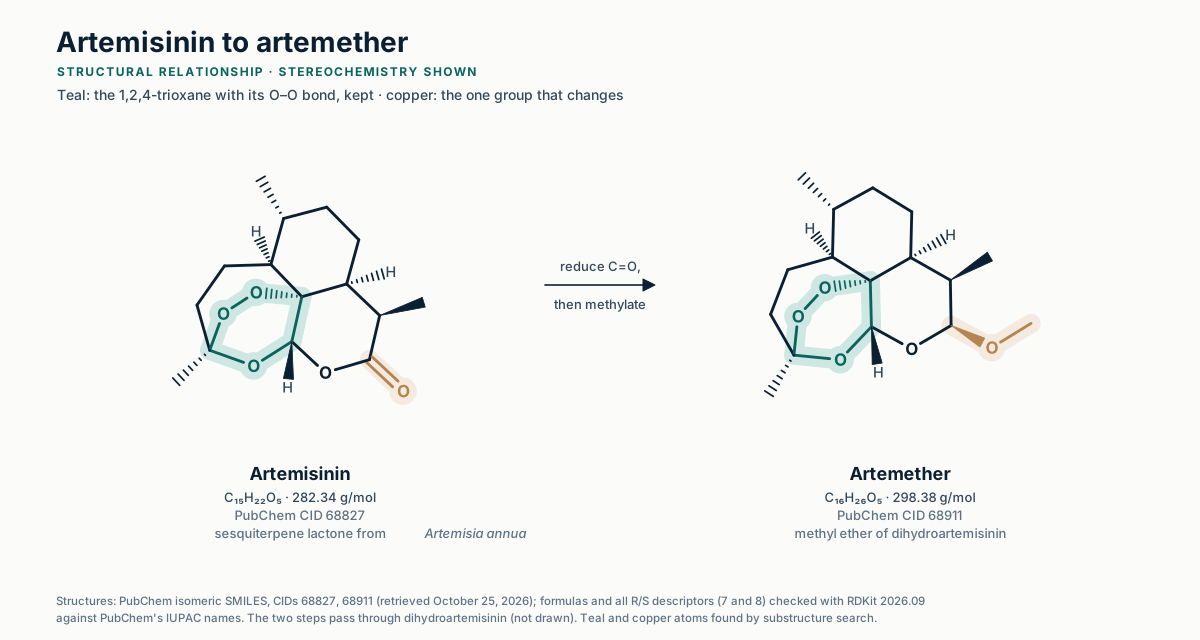
Artemether keeps artemisinin's peroxide-bearing trioxane ring; only the lactone carbonyl becomes a methyl etherReference structures
Skeletal formulas of artemisinin and its derivative artemether with stereochemistry shown by wedge and hash bonds. The 1,2,4-trioxane ring with its peroxide oxygen–oxygen bond, common to both, is drawn in teal; the only change, the lactone carbonyl of artemisinin becoming a methyl ether (acetal) in artemether, is drawn in copper.
Structures: PubChem isomeric SMILES, CIDs 68827, 68911 (retrieved Oct 25, 2026); RDKit 2026.09 2D depiction; all R/S descriptors checked against PubChem's IUPAC names. Generated illustration, EUTECNIQ. Full-size SVG
Text version of the worked example
  1. 1969: Tu Youyou gathered over 2,000 herbal, animal and mineral prescriptions in three months and kept 640 in a brochure circulated in April 1969.
  2. May 1969 to June 1971: water and ethanol extracts of over 100 herbs were tested in rodent malaria, with few promising results.
  3. 1971: the team focused on qinghao. Ge Hong's handbook (East Jin dynasty, about 317–420) first records qinghao for periodic fevers; it led to a lower extraction temperature.
  4. September 1971: extraction with ethyl ether at reduced temperature; an alkaline wash removed the acidic portion.
  5. October 4, 1971: sample 191, the neutral portion, was fully effective in rodent malaria; monkey tests followed from December 1971 to January 1972.
  6. August to October 1972: the extract was tested in 30 patients, 21 in Hainan and 9 in Beijing. Silica-gel separation followed, and artemisinin was isolated in November 1972.
  7. April 27, 1973: the formula C15H22O5 was established; the X-ray stereostructure was published in 1977.
  8. Approvals: artemisinin in China in 1986, dihydroartemisinin in 1992; FDA approved Coartem (artemether–lumefantrine) in 2009. In 2015 Tu Youyou received one half of the Nobel Prize in Physiology or Medicine "for her discoveries concerning a novel therapy against Malaria".
Explanation, details and sources

Tu Youyou's team tested extracts of over 100 herbs with few promising results. A 4th-century handbook by Ge Hong led them to extract qinghao with ether at a lower temperature, and sample 191 was fully effective in rodent malaria in October 1971.

India and Persia

Indian and Persian medical texts are well studied, but their dates and plant names still need care

Two authorities date the Indian compendia differently; sarpagandha led to reserpine in 1952Published scholarship
India: authorities date the Charaka and Sushruta compendia differently; Rauwolfia serpentina led from Indian clinical reports in 1931 to reserpine, isolated in 1952Dating the classical compendia: authorities differCharakaBritannica: lived between the 2nd c. BCE and the 2nd c. CEBritannica: lived between the 2nd c. BCE and the 2nd c. CEBritannica: present text from about the 1st c. CEBritannica: present text from about the 1st c. CESushrutaBritannica: flourished c. 6th c. BCEBritannica: flourished c. 6th c. BCESuśruta Project: composed about two millennia agoSuśruta Project: composed about two millennia ago600 BCE400 BCE200 BCE1 CE200 CESarpagandha (Rauwolfia serpentina) to reserpine1931Sen and Bose report Rauwolfia rootfor insanity and high blood pressure1932Siddiqui and Siddiqui publish theajmaline series of alkaloids1949Vakil's British Heart Journal paper onRauwolfia in hypertension1952Müller, Schlittler and Bein at CIBAisolate reserpine in pure crystallineform1957Lasker awards for reserpine andchlorpromazine in psychiatry, and forVakilONOONHOOOOOOReserpineC33​H40​N2​O9​ · 608.69 g/molIndia: dating the compendia, and Rauwolfia to reserpineDating the compendia: authorities differCharakaBritannica: lived between the 2nd c. BCE and the 2nd c.CEBritannica: lived between the 2nd c. BCE and the 2nd c. CEBritannica: present text from about the 1st c. CEBritannica: present text from about the 1st c. CESushrutaBritannica: flourished c. 6th c. BCEBritannica: flourished c. 6th c. BCESuśruta Project: composed about two millennia agoSuśruta Project: composed about two millennia ago600 BCE400 BCE200 BCE1 CE200 CESarpagandha to reserpine1931Sen and Bose report Rauwolfia root for insanity andhigh blood pressure1932Siddiqui and Siddiqui publish the ajmaline series ofalkaloids1949Vakil's British Heart Journal paper on Rauwolfia inhypertension1952Müller, Schlittler and Bein at CIBA isolate reserpine inpure crystalline form1957Lasker awards for reserpine and chlorpromazine inpsychiatry, and for VakilONOONHOOOOOOReserpineC33​H40​N2​O9​ · 608.69 g/mol
Encyclopaedia Britannica, "Charaka" (updated June 22, 2026) and "Sushruta"; The Suśruta Project (Wujastyk et al.); Roy P. Global pharma and local science: the untold tale of reserpine. Indian J Psychiatry 2018;60:S277. Structure: PubChem CID 5770.
Text version: dates and the reserpine story

Charaka: Britannica says he lived between the 2nd century BCE and the 2nd century CE, and estimates the Charaka-samhita in its present form at about the 1st century CE. Sushruta: Britannica says he flourished c. 6th century BCE; the Suśruta Project describes the Suśruta-samhita as composed in Sanskrit about two millennia ago.

Sarpagandha to reserpine: Sen and Bose reported Rauwolfia root for insanity and high blood pressure in 1931; Siddiqui and Siddiqui published the ajmaline series of alkaloids in 1932; Vakil's 1949 British Heart Journal paper brought Rauwolfia in hypertension to Western attention; Müller, Schlittler and Bein at CIBA isolated reserpine in pure crystalline form in 1952; the 1957 Lasker awards recognized reserpine and chlorpromazine in psychiatry, and Vakil.

Explanation, details and sources

Britannica places Charaka between the 2nd century BCE and the 2nd century CE and Sushruta in about the 6th century BCE; the Suśruta Project dates that text to about two millennia ago. In the 20th century, Indian clinicians and chemists studied sarpagandha (Rauwolfia serpentina) before CIBA chemists isolated reserpine in 1952.

Persian physicians such as al-Rāzī and Ibn Sīnā, whose Canon of Medicine devotes Book II to simple drugs, are covered as scholarship on the heritage page. U.S. sanctions (31 CFR 560.201) prohibit importing goods of Iranian origin; this course concerns texts only.

Greece and Rome

Greek and Roman texts set Europe's materia medica for about 1,400 years

From the Hippocratic Corpus to European universities, through Persian scholarship and Latin translationPublished scholarship
Transmission of Greek and Roman plant-drug knowledge: Hippocratic Corpus, Theophrastus, Dioscorides, Galen and the Vienna Dioscurides; then Persian scholarship, Latin translation in Toledo and university teaching to the 17th centuryGreek and Roman authorslate 5th–4th c. BCEHippocratic CorpusSome 60 texts by severalauthors; 'pharmakon'usually meant a purgativec. 371–287 BCETheophrastusAristotle's pupil; Inquiryinto Plants in nine booksc. 77 CEDioscoridesDe materia medica: fivebooks, nearly 600 plants,about 1,000 simple drugs129–c. 216Galen of PergamumDominant in Europeanmedicine until themid-17th centuryearly 6th c.Vienna DioscuridesIllustrated copy made forJuliana Anicia; restored in1406Persian scholarship and Latin Europec. 854/865–925al-Rāzī (Rhazes)al-Ḥāwī, used in Europeancurricula into the 14th centuryc. 1012Ibn Sīnā's CanonBook II covers simple drugs;Persian scholarship, see theheritage page12th centuryGerard of CremonaTranslates the Canon into Latin inToledoto the 17th c.European universitiesSalerno, Montpellier, Bologna andParis teach from the Articella;Arabic Canon printed in Rome,1593Galen's authority was similarly long-lived in the Byzantine world and the Muslim Middle East.Dioscorides' Greek text served as the primary text of pharmacology until the end of the 15th century.Transmission of Greek and Roman plant-drug knowledge to Persian scholarship and Latin EuropeGreek and Roman authorslate 5th–4th c. BCEHippocratic CorpusSome 60 texts by several authors; 'pharmakon' usuallymeant a purgativec. 371–287 BCETheophrastusAristotle's pupil; Inquiry into Plants in nine booksc. 77 CEDioscoridesDe materia medica: five books, nearly 600 plants, about1,000 simple drugs129–c. 216Galen of PergamumDominant in European medicine until the mid-17th centuryearly 6th c.Vienna DioscuridesIllustrated copy made for Juliana Anicia; restored in 1406Persian scholarship and Latin Europec. 854/865–925al-Rāzī (Rhazes)al-Ḥāwī, used in European curricula into the 14th centuryc. 1012Ibn Sīnā's CanonBook II covers simple drugs; Persian scholarship, see theheritage page12th centuryGerard of CremonaTranslates the Canon into Latin in Toledoto the 17th c.European universitiesSalerno, Montpellier, Bologna and Paris teach from theArticella; Arabic Canon printed in Rome, 1593Dioscorides' text was the primary text of pharmacology untilthe end of the 15th century; Galen's authority was long-livedin the Byzantine world and the Muslim Middle East.
Totelin L. J Ethnopharmacol 2015;167:30–37; Encyclopaedia Britannica, "Theophrastus", "Pedanius Dioscorides", "Pliny the Elder", "Galen"; Austrian Commission for UNESCO, Vienna Dioscurides Manuscript (Memory of the World, 1997). Persian and Latin steps: sources on the heritage page.
Text version of the transmission
  1. Hippocratic Corpus, late 5th and 4th century BCE: some 60 texts by several authors; pharmakon usually meant a purgative.
  2. Theophrastus (c. 371–287 BCE), Aristotle's pupil: Inquiry into Plants in nine books and Growth of Plants in six.
  3. Dioscorides, De materia medica, about 77 CE: five books, nearly 600 plants, about 1,000 simple drugs. Pliny the Elder (23–79 CE) wrote the Natural History in 37 books.
  4. Galen of Pergamum (129–c. 216): dominant in European medicine until the mid-17th century; his authority was similarly long-lived in the Byzantine world and the Muslim Middle East.
  5. Vienna Dioscurides, early 6th century: an illustrated copy made for Juliana Anicia, restored in 1406, inscribed in the Memory of the World Register in 1997.
  6. al-Rāzī (c. 854/865–925) and Ibn Sīnā, whose Canon was begun about 1012; Gerard of Cremona translated the Canon into Latin in Toledo in the 12th century; the Articella was taught at Salerno, Montpellier, Bologna and Paris up to the 17th century, and an Arabic Canon was printed in Rome in 1593.
Explanation, details and sources

The Hippocratic Corpus, some 60 texts by several authors, mostly used pharmakon for a purgative. Dioscorides' De materia medica (about 77 CE) described nearly 600 plants and served as the primary text of pharmacology until the end of the 15th century.

Africa

In Africa, an ordeal poison became an eye drug, and a reputed diabetes remedy led to cancer drugs

Physostigmine and vinblastine, and two Southern African benefit-sharing casesPublished scholarship
Africa: the Calabar ordeal bean gave physostigmine; testing a folk antidiabetic use of Madagascar periwinkle found the anticancer vinca alkaloids; Pelargonium and Hoodia show why benefit-sharing law followedWest Africa · Calabar beanPhysostigma venenosumNNOONHPhysostigmineC15​H21​N3​O2​ · 275.35 g/mol1846Missionaries in Old Calabar documentthe ordeal bean1855Christison tests a bean on himself1861Balfour names the plant Physostigmavenenosum1863Argyll Robertson: the extract constrictsthe pupil1864Physostigmine isolated; later used forglaucoma and myasthenia gravisMadagascar · periwinkleCatharanthus roseusNNHNNOOOHOOOOOOHVinblastineC46​H58​N4​O9​ · 810.99 g/molFolkLeaf extracts reputed to help indiabetes1950sNoble and Beer test the claim and findvinblastine and vincristineTodayBoth are used against cancers; theantidiabetic claim was not what wasfoundSouthern Africa · two benefit-sharing casesPelargonium sidoidesSouthern African traditional medicine, sold in Europeas Stevens' Cure and later Umckaloabo. By 2008: 18clinical studies, mainly in acute bronchitis. Patents onP. sidoides and P. reniforme extracts (2003, 2005)had no benefit-sharing agreement, per the AfricanCentre for Biosafety.Hoodia gordoniiAlso used by the Khoisan. CSIR patented P57 in 1995and licensed it six years later. A 2003 agreementgives the San 6% of CSIR's financial benefits. A15-day trial of a purified extract found no effect onenergy intake or body weight.Nagoya ProtocolSouth Africa and Namibia have been Parties sinceOctober 12, 2014, the day it entered into force. TheUnited States is not a Party.Africa: physostigmine, the vinca alkaloids and two benefit-sharing casesWest Africa · Calabar bean (Physostigma venenosum)NNOONHPhysostigmineC15​H21​N3​O2​ · 275.35 g/mol1846Missionaries in Old Calabar document the ordealbean1855Christison tests a bean on himself1861Balfour names the plant Physostigma venenosum1863Argyll Robertson: the extract constricts the pupil1864Physostigmine isolated; later used for glaucoma andmyasthenia gravisMadagascar · periwinkle (Catharanthus roseus)NNHNNOOOHOOOOOOHVinblastineC46​H58​N4​O9​ · 810.99 g/molFolkLeaf extracts reputed to help in diabetes1950sNoble and Beer test the claim and find vinblastineand vincristineTodayBoth are used against cancers; the antidiabetic claimwas not what was foundSouthern Africa · two benefit-sharing casesPelargonium sidoidesSouthern African traditional medicine, sold in Europe asStevens' Cure and later Umckaloabo. By 2008: 18 clinicalstudies, mainly in acute bronchitis. Patents on P. sidoidesand P. reniforme extracts (2003, 2005) had nobenefit-sharing agreement, per the African Centre forBiosafety.Hoodia gordoniiAlso used by the Khoisan. CSIR patented P57 in 1995 andlicensed it six years later. A 2003 agreement gives theSan 6% of CSIR's financial benefits. A 15-day trial of apurified extract found no effect on energy intake or bodyweight.Nagoya ProtocolSouth Africa and Namibia have been Parties sinceOctober 12, 2014, the day it entered into force. The UnitedStates is not a Party.
Proudfoot A. Toxicol Rev 2006;25:99–138; Ramsay RR, Tipton KF. Molecules 2017;22:1192; Noble RL. Biochem Cell Biol 1990;68:1344–1351; Talib WH, et al. Molecules 2022;27:4818; POWO, Catharanthus roseus (native to eastern and southern Madagascar); Brendler T, van Wyk BE. J Ethnopharmacol 2008;119:420–433; Reihling HCW. J Ethnobiol Ethnomed 2008;4:9; the Hoodia trial and Nagoya status as on the botanical atlas. Structures: PubChem CIDs 5983, 13342.
Text version of the African cases
  • Calabar bean (Physostigma venenosum): missionaries who arrived in Old Calabar in 1846 documented the ordeal bean; Christison tested a bean on himself in 1855; Balfour named the plant about six years later; Argyll Robertson showed in 1863 that the extract constricts the pupil. Physostigmine was isolated in 1864, its structure was known by 1923, and it has been used for glaucoma and myasthenia gravis.
  • Madagascar periwinkle (Catharanthus roseus): leaf extracts were reputed to help in diabetes. Testing that claim, Noble and Beer found the anticancer alkaloids vinblastine and vincristine in the 1950s.
  • Pelargonium sidoides: a Southern African traditional medicine sold in Europe as Stevens' Cure and later Umckaloabo, with 18 clinical studies by 2008, mainly in acute bronchitis. Patents on extracts of P. sidoides and P. reniforme were granted in 2003 and 2005 without a benefit-sharing agreement, according to the African Centre for Biosafety.
  • Hoodia gordonii: also used by the Khoisan. CSIR patented P57 in 1995 and licensed it six years later; a 2003 agreement gives the San a 6% share of CSIR's financial benefits from its partners. A 15-day trial of a purified extract found no effect on energy intake or body weight.
Explanation, details and sources

Missionaries documented the Calabar ordeal bean in 1846; physostigmine was isolated from it in 1864. Testing a folk antidiabetic use of Madagascar periwinkle led Noble and Beer to vinblastine and vincristine in the 1950s. The Pelargonium and Hoodia cases show why benefit-sharing law followed.

The Americas

South American plants gave quinine, tubocurarine and pilocarpine, and a 44,691-record database documents North American plant uses

Three South American drugs: quinine, tubocurarine and pilocarpinePublished scholarship
South America: cinchona bark gave quinine, curare gave tubocurarine and jaborandi gave pilocarpine, each isolated in the 19th or 20th centuryAndes · cinchona barkONNOHQuinineC20​H24​N2​O2​ · 324.42 g/molc. 1630Jesuit missionaries use the bark againstfevers; a legend credits earlierIndigenous use1820Pelletier and Caventou isolate quinine,which replaces the barkThe first successful use of a chemical compoundagainst an infectious disease (Achan et al. 2011)South America · curare arrow poisonsNOOHON+OHOOTubocurarineC37​H41​N2​O6​+ · 609.74 g/mol1500sExplorers describe curares1935King isolates tubocurarine1943+Neuromuscular blockers become musclerelaxants in surgeryClaude Bernard located its site of action, thenerve–muscle junction, in the mid-19th centuryBrazil · jaborandi leavesOONNPilocarpineC11​H16​N2​O2​ · 208.26 g/mol1873Coutinho takes the leaves to Europe1875Hardy and Gerrard isolate pilocarpine1876Weber introduces it as an eye drugIndigenous use of the leaves could not be pinneddown, and 'jaborandi' also names other plantsSouth America: quinine, tubocurarine and pilocarpineAndes · cinchona barkONNOHQuinineC20​H24​N2​O2​ · 324.42 g/molc. 1630Jesuit missionaries use the bark against fevers; alegend credits earlier Indigenous use1820Pelletier and Caventou isolate quinine, whichreplaces the barkThe first successful use of a chemical compound against aninfectious disease (Achan et al. 2011)South America · curare arrow poisonsNOOHON+OHOOTubocurarineC37​H41​N2​O6​+ · 609.74 g/mol1500sExplorers describe curares1935King isolates tubocurarine1943+Neuromuscular blockers become muscle relaxants insurgeryClaude Bernard located its site of action, the nerve–musclejunction, in the mid-19th centuryBrazil · jaborandi leavesOONNPilocarpineC11​H16​N2​O2​ · 208.26 g/mol1873Coutinho takes the leaves to Europe1875Hardy and Gerrard isolate pilocarpine1876Weber introduces it as an eye drugIndigenous use of the leaves could not be pinned down, and'jaborandi' also names other plants
Achan J, et al. Malar J 2011;10:144; Bowman WC. Br J Pharmacol 2006;147(Suppl 1):S277–S286; King H. J Chem Soc 1935:1381; Holmstedt B, Wassén SH, Schultes RE. J Ethnopharmacol 1979;1:3–21. Structures: PubChem CIDs 3034034, 6000, 5910.
Text version of the South American cases
  • Cinchona bark: Jesuit missionaries in South America used it against fevers about 1630, and a legend credits earlier Indigenous use. Pelletier and Caventou isolated and named quinine in 1820, and purified quinine replaced the bark. Achan and colleagues describe quinine as the first successful use of a chemical compound against an infectious disease.
  • Curare: explorers described South American arrow poisons in the 16th century; Claude Bernard located their site of action in the mid-19th century; King isolated tubocurarine in 1935; neuromuscular blockers became established as muscle relaxants in surgery after 1943.
  • Jaborandi (Pilocarpus): Symphronio Coutinho took the leaves to Europe in 1873; Hardy and Gerrard independently discovered pilocarpine in 1875; Weber introduced it as a pupil-constricting eye drug in 1876.
All 44,691 records by use, and the share of drug, food and other records for the twelve groups with the most recordsVerified fact
Native American Ethnobotany Database: 44,691 records, of which 24,945 are drug uses; among the twelve groups with the most records, the drug share ranges from 30% to 95% of each group's recordsA · All 44,691 records by useDrugDrug: 24,945 records (55.8%)24,945FoodFood: 11,078 records (24.8%)11,078OtherOther: 5,494 records (12.3%)5,494FiberFiber: 2,567 records (5.7%)2,567DyeDye: 607 records (1.4%)6071977: 4,869 items · 1986: 17,634 medicinal items1998 book and today: 44,691 records, 291 groups,4,029 species, 243 plant familiesShares describe the published record. The database lists‘Navajo’ (30% drug records) and ‘Navajo, Ramah’ (74%)separately, from different sources.B · Share of each group's records by use, twelve groups with the most recordsDrugFoodOtherFiberDyeCherokee (3,313)Cherokee · Drug: 2,715 of 3,313 records (81.9%)82%Cherokee · Food: 309 of 3,313 records (9.3%)9%Cherokee · Other: 153 of 3,313 records (4.6%)5%Cherokee · Fiber: 108 of 3,313 records (3.3%)3%Cherokee · Dye: 28 of 3,313 records (0.8%)1%Iroquois (2,994)Iroquois · Drug: 2,505 of 2,994 records (83.7%)84%Iroquois · Food: 424 of 2,994 records (14.2%)14%Iroquois · Other: 45 of 2,994 records (1.5%)2%Iroquois · Fiber: 14 of 2,994 records (0.5%)0%Iroquois · Dye: 6 of 2,994 records (0.2%)0%Thompson (1,979)Thompson · Drug: 1,067 of 1,979 records (53.9%)54%Thompson · Food: 493 of 1,979 records (24.9%)25%Thompson · Other: 258 of 1,979 records (13.0%)13%Thompson · Fiber: 144 of 1,979 records (7.3%)7%Thompson · Dye: 17 of 1,979 records (0.9%)1%Navajo, Ramah (1,382)Navajo, Ramah · Drug: 1,027 of 1,382 records (74.3%)74%Navajo, Ramah · Food: 166 of 1,382 records (12.0%)12%Navajo, Ramah · Other: 124 of 1,382 records (9.0%)9%Navajo, Ramah · Fiber: 45 of 1,382 records (3.3%)3%Navajo, Ramah · Dye: 20 of 1,382 records (1.4%)1%Paiute (1,187)Paiute · Drug: 871 of 1,187 records (73.4%)73%Paiute · Food: 217 of 1,187 records (18.3%)18%Paiute · Other: 69 of 1,187 records (5.8%)6%Paiute · Fiber: 29 of 1,187 records (2.4%)2%Paiute · Dye: 1 of 1,187 records (0.1%)0%Okanagan-Colville (975)Okanagan-Colville · Drug: 520 of 975 records (53.3%)53%Okanagan-Colville · Food: 185 of 975 records (19.0%)19%Okanagan-Colville · Other: 189 of 975 records (19.4%)19%Okanagan-Colville · Fiber: 72 of 975 records (7.4%)7%Okanagan-Colville · Dye: 9 of 975 records (0.9%)1%Navajo (973)Navajo · Drug: 293 of 973 records (30.1%)30%Navajo · Food: 322 of 973 records (33.1%)33%Navajo · Other: 244 of 973 records (25.1%)25%Navajo · Fiber: 52 of 973 records (5.3%)5%Navajo · Dye: 62 of 973 records (6.4%)6%Blackfoot (964)Blackfoot · Drug: 546 of 964 records (56.6%)57%Blackfoot · Food: 161 of 964 records (16.7%)17%Blackfoot · Other: 209 of 964 records (21.7%)22%Blackfoot · Fiber: 25 of 964 records (2.6%)3%Blackfoot · Dye: 23 of 964 records (2.4%)2%Seminole (827)Seminole · Drug: 643 of 827 records (77.8%)78%Seminole · Food: 61 of 827 records (7.4%)7%Seminole · Other: 106 of 827 records (12.8%)13%Seminole · Fiber: 14 of 827 records (1.7%)2%Seminole · Dye: 3 of 827 records (0.4%)0%Shoshoni (815)Shoshoni · Drug: 777 of 815 records (95.3%)95%Shoshoni · Food: 13 of 815 records (1.6%)2%Shoshoni · Other: 11 of 815 records (1.3%)1%Shoshoni · Fiber: 9 of 815 records (1.1%)1%Shoshoni · Dye: 5 of 815 records (0.6%)1%Ojibwa (814)Ojibwa · Drug: 437 of 814 records (53.7%)54%Ojibwa · Food: 190 of 814 records (23.3%)23%Ojibwa · Other: 88 of 814 records (10.8%)11%Ojibwa · Fiber: 76 of 814 records (9.3%)9%Ojibwa · Dye: 23 of 814 records (2.8%)3%Hopi (807)Hopi · Drug: 263 of 807 records (32.6%)33%Hopi · Food: 238 of 807 records (29.5%)29%Hopi · Other: 229 of 807 records (28.4%)28%Hopi · Fiber: 44 of 807 records (5.5%)5%Hopi · Dye: 33 of 807 records (4.1%)4%0%100%Share of recordsNative American Ethnobotany Database by use and by groupA · All 44,691 records by useDrugDrug: 24,94524,945FoodFood: 11,07811,078OtherOther: 5,4945,494FiberFiber: 2,5672,567DyeDye: 607607B · Share of each group's records by useDrugFoodOtherFiberDyeCherokeeCherokee · Drug: 8282Cherokee · Food: 99Cherokee · Other: 55Cherokee · Fiber: 33Cherokee · Dye: 11IroquoisIroquois · Drug: 8484Iroquois · Food: 1414Iroquois · Other: 22Iroquois · Fiber: 00Iroquois · Dye: 00ThompsonThompson · Drug: 5454Thompson · Food: 2525Thompson · Other: 1313Thompson · Fiber: 77Thompson · Dye: 11Navajo, RamahNavajo, Ramah · Drug: 7474Navajo, Ramah · Food: 1212Navajo, Ramah · Other: 99Navajo, Ramah · Fiber: 33Navajo, Ramah · Dye: 11PaiutePaiute · Drug: 7373Paiute · Food: 1818Paiute · Other: 66Paiute · Fiber: 22Paiute · Dye: 00Okanagan-ColvilleOkanagan-Colville · Drug: 5353Okanagan-Colville · Food: 1919Okanagan-Colville · Other: 1919Okanagan-Colville · Fiber: 77Okanagan-Colville · Dye: 11NavajoNavajo · Drug: 3030Navajo · Food: 3333Navajo · Other: 2525Navajo · Fiber: 55Navajo · Dye: 66BlackfootBlackfoot · Drug: 5757Blackfoot · Food: 1717Blackfoot · Other: 2222Blackfoot · Fiber: 33Blackfoot · Dye: 22SeminoleSeminole · Drug: 7878Seminole · Food: 77Seminole · Other: 1313Seminole · Fiber: 22Seminole · Dye: 00ShoshoniShoshoni · Drug: 9595Shoshoni · Food: 22Shoshoni · Other: 11Shoshoni · Fiber: 11Shoshoni · Dye: 11OjibwaOjibwa · Drug: 5454Ojibwa · Food: 2323Ojibwa · Other: 1111Ojibwa · Fiber: 99Ojibwa · Dye: 33HopiHopi · Drug: 3333Hopi · Food: 2929Hopi · Other: 2828Hopi · Fiber: 55Hopi · Dye: 440%100%
Botanical Research Institute of Texas, Native American Ethnobotany Database (D. E. Moerman), filtered searches by group and use category, queried October 23, 2026; database history page for the 1977, 1986 and 1998 counts. Counts measure the published record: which ethnographers worked where, and what they asked.
Show data: database records by use and by group
Group, as named in the databaseRecordsDrugFoodOtherFiberDye
Cherokee3,3132,715 (82%)30915310828
Iroquois2,9942,505 (84%)42445146
Thompson1,9791,067 (54%)49325814417
Navajo, Ramah1,3821,027 (74%)1661244520
Paiute1,187871 (73%)21769291
Okanagan-Colville975520 (53%)185189729
Navajo973293 (30%)3222445262
Blackfoot964546 (57%)1612092523
Seminole827643 (78%)61106143
Shoshoni815777 (95%)131195
Ojibwa814437 (54%)190887623
Hopi807263 (33%)2382294433
All 291 groups44,69124,94511,0785,4942,567607

Mayapple (Podophyllum peltatum): 39 records from Iroquois (13), Cherokee (12), Meskwaki (5), Delaware, Oklahoma (3), Menominee (3), Delaware (2) and Chippewa (1); 25 drug, 11 food and 3 other records. Earlier editions: 4,869 items (1977) and 17,634 medicinal items from 123 groups (1986).

Explanation, details and sources

Quinine was isolated from cinchona bark in 1820, tubocurarine from curare in 1935 and pilocarpine from jaborandi in 1875. For jaborandi, scholars could not pin down any particular Indigenous use, and the name covers other plants.

Daniel Moerman's Native American Ethnobotany Database holds 44,691 records of plant uses by 291 groups, 24,945 of them drug uses. Its 39 mayapple records come from seven groups, and two record the root as poisonous; mayapple's podophyllotoxin is the starting point for etoposide.

From record to molecule

Chemists either used the isolated compound as found or changed it into a new molecule
Two routes from plant to medicine, with structures from PubChemPublished scholarship
Two routes from plant to medicine with PubChem structures: morphine, digoxin and galantamine were isolated and used as found; salicin, podophyllotoxin and artemisinin were chemically modified into aspirin, etoposide and artemetherA · Isolated and used as foundOpium poppy, Papaver somniferumNOHOOHMorphineC17​H19​NO3​ · 285.34 g/molIsolated 1805–1817 by Sertürner: the firstalkaloid isolated from any plantWoolly foxglove, Digitalis lanataOOOOHOOOHOOOOHOHOHOHDigoxinC41​H64​O14​ · 780.95 g/molIsolated 1930 by Sydney Smith; Withering's 1785 account ofthe foxglove came firstSnowdrop, GalanthusNOOOHGalantamineC17​H21​NO3​ · 287.36 g/molCaucasian observations, then Bulgarian use;FDA approval for Alzheimer's disease, 2001B · Chemically modified into a new moleculeWillow barkOHOOOHOHOHOHSalicinC13​H18​O7​ · 286.28 g/molOOOOHAspirinC9​H8​O4​ · 180.16 g/molSalicin purified 1829; pure acetylsalicylicacid made at Bayer, 1897Mayapple, Podophyllum peltatumOOOOOOOOHPodophyllotoxinC22​H22​O8​ · 414.41 g/molOOOOOOOOOOHOOHOHEtoposideC29​H32​O13​ · 588.56 g/molSemi-synthetic; FDA 1983. The target changes from tubulinto topoisomerase IIQinghao, Artemisia annuaOOOOOArtemisininC15​H22​O5​ · 282.34 g/molOOOOOArtemetherC16​H26​O5​ · 298.38 g/molDerivative in Coartem(artemether–lumefantrine), FDA 2009Two routes from plant to medicine, with structuresA · Isolated and used as foundOpium poppy, Papaver somniferumNOHOOHMorphineC17​H19​NO3​ · 285.34 g/molIsolated 1805–1817 by Sertürner: the first alkaloid isolatedfrom any plantWoolly foxglove, Digitalis lanataOOOOHOOOHOOOOHOHOHOHDigoxinC41​H64​O14​ · 780.95 g/molIsolated 1930 by Sydney Smith; Withering's 1785 account ofthe foxglove came firstSnowdrop, GalanthusNOOOHGalantamineC17​H21​NO3​ · 287.36 g/molCaucasian observations, then Bulgarian use; FDA approvalfor Alzheimer's disease, 2001B · Chemically modifiedWillow barkOHOOOHOHOHOHSalicinC13​H18​O7​ · 286.28 g/molOOOOHAspirinC9​H8​O4​ · 180.16 g/molSalicin purified 1829; pure acetylsalicylic acid made at Bayer,1897Mayapple, Podophyllum peltatumOOOOOOOOHPodophyllotoxinC22​H22​O8​ · 414.41 g/molOOOOOOOOOOHOOHOHEtoposideC29​H32​O13​ · 588.56 g/molSemi-synthetic; FDA 1983. The target changes from tubulinto topoisomerase IIQinghao, Artemisia annuaOOOOOArtemisininC15​H22​O5​ · 282.34 g/molOOOOOArtemetherC16​H26​O5​ · 298.38 g/molDerivative in Coartem (artemether–lumefantrine), FDA 2009
Krishnamurti C, Rao SSCC. Indian J Anaesth 2016;60:861–862; Smith S. J Chem Soc 1930:508–510; Khandelwal R, et al. Cureus 2024;16:e56755; Heinrich M, Teoh HL. J Ethnopharmacol 2004;92:147–162; Wood JN. Phil Trans R Soc B 2015;370:20140317; Singh A, et al. Indian Dermatol Online J 2022;13:167–171; Drugs@FDA NDAs 021169, 018768, 022268. Structures: PubChem CIDs 5288826, 2724385, 9651, 439503, 2244, 10607, 36462, 68827, 68911; formula and mass computed by RDKit.
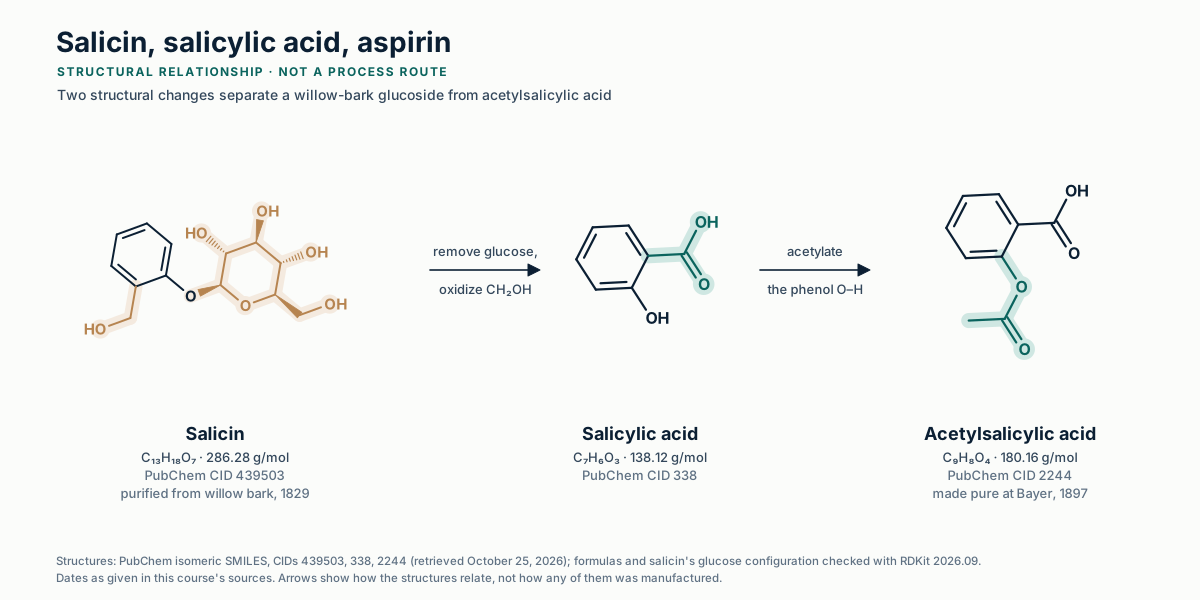
Removing glucose, oxidizing one carbon and acetylating one phenol separate willow-bark salicin from aspirinReference structures
Skeletal formulas of salicin, the β-D-glucoside of salicyl alcohol from willow bark; salicylic acid; and acetylsalicylic acid. Copper marks the glucose and the CH2OH carbon that change in the first step; teal marks the carboxylic acid that results and the acetyl ester added in the second step. Arrows show structural relationships, not a manufacturing route.
Structures: PubChem isomeric SMILES, CIDs 439503, 338, 2244 (retrieved Oct 25, 2026); RDKit 2026.09 2D depiction; dates as cited in this section. Arrows show structural relationships, not a manufacturing route. Generated illustration, EUTECNIQ. Full-size SVG
Text version of the two routes
  • Isolated and used as found: morphine from opium poppy (Sertürner, reported 1805, full account 1817), described as the first alkaloid isolated from any plant; digoxin from woolly foxglove, Digitalis lanata (Sydney Smith, 1930), after Withering's 1785 account of the foxglove; galantamine from snowdrop, developed from Caucasian observations and Bulgarian use and approved by FDA for Alzheimer's disease on February 28, 2001.
  • Chemically modified: salicin purified from willow bark (1829), then pure acetylsalicylic acid made at Bayer (1897); podophyllotoxin from mayapple, modified into etoposide (FDA, November 10, 1983), which inhibits topoisomerase II where podophyllotoxin binds tubulin; artemisinin modified into artemether, the partner of lumefantrine in Coartem (FDA, April 7, 2009).
Δt = tisolated − tfirst report
From first dated report to isolated compound took 2 to about 1,650 yearsPublished scholarship
Years from the first dated report of a plant's use, in the sources cited, to isolation of its active compound and to first clinical use or approval: from 2 years for pilocarpine to about 1,550 to 1,650 years for artemisininActive compound isolatedFirst clinical use or approvalrange where the first report is dated only to a periodPilocarpine · jaborandi1873: leaves taken to EuropePilocarpine: isolated 1875, 2 years after the first dated reportPilocarpine: eye drug (Weber) 1876, 3 years after the first dated reportisolated 1875 (+2 y) · eye drug (Weber) 1876 (+3 y)Physostigmine · Calabar bean1846: ordeal use documentedPhysostigmine: isolated 1864, 18 years after the first dated reportisolated 1864 (+18 y)Reserpine · Rauwolfia1931: Indian clinical reportReserpine: isolated 1952, 21 years after the first dated reportisolated 1952 (+21 y)Salicin, then aspirin · willow bark1763: Stone's reportSalicin, then aspirin: isolated 1829, 66 years after the first dated reportSalicin, then aspirin: aspirin made at Bayer 1897, 134 years after the first dated reportisolated 1829 (+66 y) · aspirin made at Bayer 1897 (+134 y)Digoxin · foxglove1785: Withering's accountDigoxin: isolated 1930, 145 years after the first dated reportisolated 1930 (+145 y)Etoposide · mayapple1820: first U.S. PharmacopoeiaEtoposide: FDA approval 1983, 163 years after the first dated reportFDA approval 1983 (+163 y)Quinine · cinchona barkc. 1630: Jesuits' useQuinine: isolated 1820, 190 years after the first dated reportisolated 1820 (+190 y)Tubocurarine · curare1500s: explorers' reportsTubocurarine: isolated 1935, 336–435 years after the first dated reportTubocurarine: surgical use (after) 1943, 344–443 years after the first dated reportisolated 1935 (+336–435 y) · surgical use (after) 1943 (+344–443 y)Artemisinin · qinghaoc. 317–420: Ge Hong's handbookArtemisinin: isolated 1972, 1552–1655 years after the first dated reportArtemisinin: approval in China 1986, 1566–1669 years after the first dated reportisolated 1972 (+1552–1655 y) · approval in China 1986 (+1566–1669 y)1310301003001,000Years after the first dated report (log scale)Years from the first dated report to isolation and to first clinical usePilocarpine · jaborandiFirst report 1873: leaves taken to EuropeIsolated 1875: +2 yearsEye drug (Weber) 1876: +3 yearsPhysostigmine · Calabar beanFirst report 1846: ordeal use documentedIsolated 1864: +18 yearsReserpine · RauwolfiaFirst report 1931: Indian clinical reportIsolated 1952: +21 yearsSalicin, then aspirin · willow barkFirst report 1763: Stone's reportIsolated 1829: +66 yearsAspirin made at Bayer 1897: +134 yearsDigoxin · foxgloveFirst report 1785: Withering's accountIsolated 1930: +145 yearsEtoposide · mayappleFirst report 1820: first U.S. PharmacopoeiaFDA approval 1983: +163 yearsQuinine · cinchona barkFirst report c. 1630: Jesuits' useIsolated 1820: +190 yearsTubocurarine · curareFirst report 1500s: explorers' reportsIsolated 1935: +336–435 yearsSurgical use (after) 1943: +344–443 yearsArtemisinin · qinghaoFirst report c. 317–420: Ge Hong's handbookIsolated 1972: +1552–1655 yearsApproval in China 1986: +1566–1669 years
Years from the sources in each section. Lags are simple differences computed for this course.
Show data: lag from first dated report
DrugFirst dated reportIsolatedLag (years)First clinical use or approvalLag (years)
Pilocarpine (jaborandi)1873, leaves taken to Europe187521876, eye drug3
Physostigmine (Calabar bean)1846, ordeal use documented186418not dated here–
Reserpine (Rauwolfia)1931, Indian clinical report195221not dated here–
Salicin, then aspirin (willow)1763, Stone's report1829661897, aspirin134
Digoxin (foxglove)1785, Withering's account1930145not dated here–
Etoposide (mayapple)1820, first U.S. Pharmacopoeianot dated here–1983, FDA approval163
Quinine (cinchona)c. 1630, Jesuits' use1820190not dated here–
Tubocurarine (curare)16th century, explorers' reports1935336–435after 1943, surgical use344–443
Artemisinin (qinghao)c. 317–420, Ge Hong's handbook19721,552–1,6551986, approval in China1,566–1,669
Explanation, details and sources

Morphine, digoxin and galantamine are used much as they were isolated. Aspirin, etoposide and artemether are modified molecules, and etoposide acts on a different target from its parent podophyllotoxin.

Δt is the lag in years; tfirst report is the first dated report of the plant's use in the sources cited, which is never the first use. A range appears where that report is dated only to a period.

Natural products in modern drugs

Natural products and their derivatives remain a large share of new drugs, especially for cancer

Anticancer small molecules by period, and all 1,881 new drugs by origin categoryPublished scholarship
Newman and Cragg 2020: among anticancer small molecules, 53.3% were natural products or derivatives in 1946–1980 and 64.9% were natural products, derivatives or natural-pharmacophore synthetics in 1981–2019; across all 1,881 drugs approved 1981–2019, unaltered natural products were 3.8%, botanicals 0.8% and derivatives 18.9%A · Anticancer small molecules, by period (counts from the review's abstract)1946–198075 moleculesN or ND: 40 (53.3%)40 · 53.3%Other: 35 (46.7%)35 · 46.7%1981–2019185 moleculesN*: 62 (33.5%)62 · 33.5%S* or S*/NM: 58 (31.4%)58 · 31.4%Other: 65 (35.1%)65 · 35.1%N, ND or N*: natural product or derivativeS*, S*/NM: synthetic with a natural-product pharmacophoreOther origins120 of 185 = 64.9%B · All 1,881 new drugs approved worldwide, January 1981 to September 2019 (shares)N: unaltered natural product: 3.8%NB: botanical defined mixture: 0.8%ND: natural-product derivative: 18.9%18.9%All other categories: 76.5%76.5%1,881 drugsN: unaltered natural product · 3.8%NB: botanical defined mixture · 0.8%ND: natural-product derivative · 18.9%All other categories · 76.5%Newman and Cragg 2020: natural-product shares of new drugsA · Anticancer small molecules1946–1980 · 75 moleculesN or ND: 40 (53.3%)40 · 53.3%Other: 35 (46.7%)35 · 46.7%N or ND: 40 (53.3%)Other: 35 (46.7%)1981–2019 · 185 moleculesN*: 62 (33.5%)62 · 33.5%S* or S*/NM: 58 (31.4%)58 · 31.4%Other: 65 (35.1%)65 · 35.1%N*: 62 (33.5%)S* or S*/NM: 58 (31.4%)Other: 65 (35.1%)B · All 1,881 drugs, 1981–2019N: unaltered natural product: 3.8%NB: botanical defined mixture: 0.8%ND: natural-product derivative: 18.9%All other categories: 76.5%76.5%N: unaltered natural product: 3.8%NB: botanical defined mixture: 0.8%ND: natural-product derivative: 18.9%All other categories: 76.5%
Newman DJ, Cragg GM. Natural products as sources of new drugs over the nearly four decades from 01/1981 to 09/2019. J Nat Prod 2020;83:770–803. Panel A: counts stated in the abstract. Panel B: shares as reproduced from the review's Figure 1 (also on the evidence page); the review counts only the first approval of each drug.
Show data: Newman and Cragg 2020
SetCategoryCountShare
Anticancer small molecules, 1946–1980 (75)N or ND4053.3%
Anticancer small molecules, 1981–2019 (185)N* (natural product or derivative)6233.5%
Anticancer small molecules, 1981–2019 (185)S* and S*/NM (synthetic, natural-product pharmacophore)5831.4%
Anticancer small molecules, 1981–2019 (185)N*, S* and S*/NM together12064.9%
All new drugs, 1981–2019 (1,881)N, unaltered natural product–3.8%
All new drugs, 1981–2019 (1,881)NB, botanical defined mixture–0.8%
All new drugs, 1981–2019 (1,881)ND, natural-product derivative–18.9%

The 31.4% share of S* and S*/NM is computed here from the abstract's counts (58 of 185). The NB share is as reproduced in Sarbadhikary P, George BP. Plants 2022;11:2293.

Explanation, details and sources

Newman and Cragg classify every drug approved worldwide by origin. Of 185 anticancer small molecules approved from 1981 to September 2019, 62 were natural products or derivatives and 58 were synthetics built on a natural-product pharmacophore (the part of a molecule that produces its action): 64.9% together.

Across all 1,881 approvals, unaltered natural products were 3.8% and botanical defined mixtures 0.8%. Many natural-product drugs come from microbes, so these shares do not measure what traditional plant knowledge contributed.

What history shows

A historical record is a hypothesis that must pass six gates before it becomes a medicine

Ten cases scored against four questions; only three pass all fourPublished scholarship
Ten cases scored against four questions: recorded traditional use, compound isolated, medicine from it, and whether the traditional use matched the medical use; only three of ten pass all four, and two are failures or harmsRecord of useSpecies and plantpart fixedCompound isolatedStructure andpharmacologySafety and clinicaltrialsApproved medicineEvery gate can end the path. The cases below show how often the tradition and the medicine part ways.Recordedtraditional useActivecompoundisolatedMedicine from itTraditional usematched themedical useNoteQinghao → artemisininQinghao → artemisinin · Recorded traditional use: yesQinghao → artemisinin · Active compound isolated: yesQinghao → artemisinin · Medicine from it: yesQinghao → artemisinin · Traditional use matched the medical use: yesPeriodic fevers in c. 317–420; antimalarialapproved 1986Cinchona → quinineCinchona → quinine · Recorded traditional use: yesCinchona → quinine · Active compound isolated: yesCinchona → quinine · Medicine from it: yesCinchona → quinine · Traditional use matched the medical use: yesBark used against fevers c. 1630; quinine 1820Willow → aspirinWillow → aspirin · Recorded traditional use: yesWillow → aspirin · Active compound isolated: yesWillow → aspirin · Medicine from it: yesWillow → aspirin · Traditional use matched the medical use: yesAgues (fevers) in 1763; salicin 1829; aspirin1897Calabar bean → physostigmineCalabar bean → physostigmine · Recorded traditional use: yesCalabar bean → physostigmine · Active compound isolated: yesCalabar bean → physostigmine · Medicine from it: yesCalabar bean → physostigmine · Traditional use matched the medical use: noRecorded as an ordeal poison; used for theeye and muscleJaborandi → pilocarpineJaborandi → pilocarpine · Recorded traditional use: partlyJaborandi → pilocarpine · Active compound isolated: yesJaborandi → pilocarpine · Medicine from it: yesIndigenous use could not be pinned downPeriwinkle → vinca alkaloidsPeriwinkle → vinca alkaloids · Recorded traditional use: yesPeriwinkle → vinca alkaloids · Active compound isolated: yesPeriwinkle → vinca alkaloids · Medicine from it: yesPeriwinkle → vinca alkaloids · Traditional use matched the medical use: noTested as antidiabetic; anticancer activityfound insteadGoat's rue → metforminGoat's rue → metformin · Recorded traditional use: yesGoat's rue → metformin · Active compound isolated: partlyGoat's rue → metformin · Medicine from it: yesGuanidine lowered glucose (1918); metforminis syntheticPacific yew → paclitaxelPacific yew → paclitaxel · Recorded traditional use: noPacific yew → paclitaxel · Active compound isolated: yesPacific yew → paclitaxel · Medicine from it: yesNo traditional lead: found by plant screeningHoodia → P57Hoodia → P57 · Recorded traditional use: yesHoodia → P57 · Active compound isolated: yesHoodia → P57 · Medicine from it: noHoodia → P57 · Traditional use matched the medical use: no15-day trial: no effect on energy intake orbody weightAristolochiaAristolochia · Recorded traditional use: yesAristolochia · Medicine from it: noDocumented harm: aristolochic acids areknown human carcinogensyesyespartlypartlynononot applicable or not assessedTen cases scored against four questionsFour questions for each case1 · Recorded traditional use2 · Active compound isolated3 · Medicine from it4 · Traditional use matched the medical useQinghao → artemisininQinghao → artemisinin · Recorded traditional use: yes1Qinghao → artemisinin · Active compound isolated: yes2Qinghao → artemisinin · Medicine from it: yes3Qinghao → artemisinin · Traditional use matched the medical use: yes4Periodic fevers in c. 317–420; antimalarialapproved 1986Cinchona → quinineCinchona → quinine · Recorded traditional use: yes1Cinchona → quinine · Active compound isolated: yes2Cinchona → quinine · Medicine from it: yes3Cinchona → quinine · Traditional use matched the medical use: yes4Bark used against fevers c. 1630; quinine1820Willow → aspirinWillow → aspirin · Recorded traditional use: yes1Willow → aspirin · Active compound isolated: yes2Willow → aspirin · Medicine from it: yes3Willow → aspirin · Traditional use matched the medical use: yes4Agues (fevers) in 1763; salicin 1829; aspirin1897Calabar bean → physostigmineCalabar bean → physostigmine · Recorded traditional use: yes1Calabar bean → physostigmine · Active compound isolated: yes2Calabar bean → physostigmine · Medicine from it: yes3Calabar bean → physostigmine · Traditional use matched the medical use: no4Recorded as an ordeal poison; used for theeye and muscleJaborandi → pilocarpineJaborandi → pilocarpine · Recorded traditional use: partly1Jaborandi → pilocarpine · Active compound isolated: yes2Jaborandi → pilocarpine · Medicine from it: yes34Indigenous use could not be pinned downPeriwinkle → vinca alkaloidsPeriwinkle → vinca alkaloids · Recorded traditional use: yes1Periwinkle → vinca alkaloids · Active compound isolated: yes2Periwinkle → vinca alkaloids · Medicine from it: yes3Periwinkle → vinca alkaloids · Traditional use matched the medical use: no4Tested as antidiabetic; anticancer activityfound insteadGoat's rue → metforminGoat's rue → metformin · Recorded traditional use: yes1Goat's rue → metformin · Active compound isolated: partly2Goat's rue → metformin · Medicine from it: yes34Guanidine lowered glucose (1918);metformin is syntheticPacific yew → paclitaxelPacific yew → paclitaxel · Recorded traditional use: no1Pacific yew → paclitaxel · Active compound isolated: yes2Pacific yew → paclitaxel · Medicine from it: yes34No traditional lead: found by plant screeningHoodia → P57Hoodia → P57 · Recorded traditional use: yes1Hoodia → P57 · Active compound isolated: yes2Hoodia → P57 · Medicine from it: no3Hoodia → P57 · Traditional use matched the medical use: no415-day trial: no effect on energy intake orbody weightAristolochiaAristolochia · Recorded traditional use: yes12Aristolochia · Medicine from it: no34Documented harm: aristolochic acids areknown human carcinogensyesyespartlypartlynononot applicable or not assessed
A qualitative symbol matrix: each mark restates a source cited in this course. Hoodia trial and Aristolochia: botanical atlas and heritage page (National Toxicology Program, Report on Carcinogens). Paclitaxel: Wani MC, et al. J Am Chem Soc 1971;93:2325–2327; Drugs@FDA NDA 020262. Metformin: Bailey CJ. Diabetologia 2017;60:1566–1576.
Text version of the ten cases
  • Passed all four (recorded use, compound isolated, medicine, matching use): qinghao to artemisinin, cinchona to quinine, willow to aspirin.
  • Medicine with a different use from the tradition: Calabar bean to physostigmine (recorded as an ordeal poison), periwinkle to vinca alkaloids (tested as antidiabetic, anticancer activity found).
  • Medicine without a clear traditional use: jaborandi to pilocarpine (Indigenous use could not be pinned down), Pacific yew to paclitaxel (found by plant screening).
  • Medicine from a related synthetic: goat's rue to metformin (guanidine lowered blood glucose in 1918; metformin is synthetic).
  • No medicine: Hoodia (a 15-day trial of a purified extract found no effect on energy intake or body weight) and Aristolochia (aristolochic acids are listed as known human carcinogens).
  • Centuries of use≠demonstrated safety
  • A traditional claim≠the activity later found
  • A historical plant name≠a verified species
Explanation, details and sources

Three of these ten cases pass all four questions. In the others the medicine came from a different activity, from screening, or not at all, and Aristolochia caused documented harm.

Traditional medicine today

170 WHO Member States report traditional-medicine use, and regulation of herbal medicines varies widely by region

Share of WHO Member States reporting each indicator as at 2018, by WHO regionVerified fact
WHO 2019: share of Member States reporting each traditional and complementary medicine (T&CM) indicator as at 2018, by WHO region; Europe regulates herbal medicines in 85% of states but has a T&CM policy in 21%, Africa the reverse patternAfrica (47)Americas (35)EasternMediterranean(21)Europe (53)South-East Asia(11)Western Pacific(27)All MemberStates (194)Population uses T&CMPopulation uses T&CM · Africa: 41 of 47 Member States (87%)87%Population uses T&CM · Americas: 28 of 35 Member States (80%)80%Population uses T&CM · Eastern Mediterranean: 19 of 21 Member States (90%)90%Population uses T&CM · Europe: 47 of 53 Member States (89%)89%Population uses T&CM · South-East Asia: 10 of 11 Member States (91%)91%Population uses T&CM · Western Pacific: 25 of 27 Member States (93%)93%Population uses T&CM · all 194 Member States: 88%88%National policy on T&CMNational policy on T&CM · Africa: 40 of 47 Member States (85%)85%National policy on T&CM · Americas: 11 of 35 Member States (31%)31%National policy on T&CM · Eastern Mediterranean: 9 of 21 Member States (43%)43%National policy on T&CM · Europe: 11 of 53 Member States (21%)21%National policy on T&CM · South-East Asia: 10 of 11 Member States (91%)91%National policy on T&CM · Western Pacific: 17 of 27 Member States (63%)63%National policy on T&CM · all 194 Member States: 51%51%Laws or regulations on T&CMLaws or regulations on T&CM · Africa: 39 of 47 Member States (83%)83%Laws or regulations on T&CM · Americas: 15 of 35 Member States (43%)43%Laws or regulations on T&CM · Eastern Mediterranean: 12 of 21 Member States (57%)57%Laws or regulations on T&CM · Europe: 21 of 53 Member States (40%)40%Laws or regulations on T&CM · South-East Asia: 9 of 11 Member States (82%)82%Laws or regulations on T&CM · Western Pacific: 13 of 27 Member States (48%)48%Laws or regulations on T&CM · all 194 Member States: 56%56%National programme on T&CMNational programme on T&CM · Africa: 34 of 47 Member States (72%)72%National programme on T&CM · Americas: 13 of 35 Member States (37%)37%National programme on T&CM · Eastern Mediterranean: 4 of 21 Member States (19%)19%National programme on T&CM · Europe: 7 of 53 Member States (13%)13%National programme on T&CM · South-East Asia: 10 of 11 Member States (91%)91%National programme on T&CM · Western Pacific: 11 of 27 Member States (41%)41%National programme on T&CM · all 194 Member States: 41%41%National office for T&CMNational office for T&CM · Africa: 39 of 47 Member States (83%)83%National office for T&CM · Americas: 17 of 35 Member States (49%)49%National office for T&CM · Eastern Mediterranean: 13 of 21 Member States (62%)62%National office for T&CM · Europe: 15 of 53 Member States (28%)28%National office for T&CM · South-East Asia: 10 of 11 Member States (91%)91%National office for T&CM · Western Pacific: 13 of 27 Member States (48%)48%National office for T&CM · all 194 Member States: 55%55%Expert committee on T&CMExpert committee on T&CM · Africa: 34 of 47 Member States (72%)72%Expert committee on T&CM · Americas: 12 of 35 Member States (34%)34%Expert committee on T&CM · Eastern Mediterranean: 11 of 21 Member States (52%)52%Expert committee on T&CM · Europe: 15 of 53 Member States (28%)28%Expert committee on T&CM · South-East Asia: 10 of 11 Member States (91%)91%Expert committee on T&CM · Western Pacific: 11 of 27 Member States (41%)41%Expert committee on T&CM · all 194 Member States: 48%48%National research instituteNational research institute · Africa: 29 of 47 Member States (62%)62%National research institute · Americas: 9 of 35 Member States (26%)26%National research institute · Eastern Mediterranean: 10 of 21 Member States (48%)48%National research institute · Europe: 11 of 53 Member States (21%)21%National research institute · South-East Asia: 7 of 11 Member States (64%)64%National research institute · Western Pacific: 9 of 27 Member States (33%)33%National research institute · all 194 Member States: 39%39%Regulation of herbal medicinesRegulation of herbal medicines · Africa: 20 of 47 Member States (43%)43%Regulation of herbal medicines · Americas: 18 of 35 Member States (51%)51%Regulation of herbal medicines · Eastern Mediterranean: 18 of 21 Member States (86%)86%Regulation of herbal medicines · Europe: 45 of 53 Member States (85%)85%Regulation of herbal medicines · South-East Asia: 10 of 11 Member States (91%)91%Regulation of herbal medicines · Western Pacific: 13 of 27 Member States (48%)48%Regulation of herbal medicines · all 194 Member States: 64%64%Registration of herbal medicinesRegistration of herbal medicines · Africa: 23 of 47 Member States (49%)49%Registration of herbal medicines · Americas: 19 of 35 Member States (54%)54%Registration of herbal medicines · Eastern Mediterranean: 17 of 21 Member States (81%)81%Registration of herbal medicines · Europe: 45 of 53 Member States (85%)85%Registration of herbal medicines · South-East Asia: 10 of 11 Member States (91%)91%Registration of herbal medicines · Western Pacific: 11 of 27 Member States (41%)41%Registration of herbal medicines · all 194 Member States: 64%64%0%100%of the region's Member States (number in brackets)WHO 2019: traditional medicine indicators by region (percent of Member States)AFRAMREMREURSEARWPRAllPopulation usesT&CMPopulation uses T&CM · AFR: 8787Population uses T&CM · AMR: 8080Population uses T&CM · EMR: 9090Population uses T&CM · EUR: 8989Population uses T&CM · SEAR: 9191Population uses T&CM · WPR: 9393Population uses T&CM · All: 8888National policy onT&CMNational policy on T&CM · AFR: 8585National policy on T&CM · AMR: 3131National policy on T&CM · EMR: 4343National policy on T&CM · EUR: 2121National policy on T&CM · SEAR: 9191National policy on T&CM · WPR: 6363National policy on T&CM · All: 5151Laws or regulationson T&CMLaws or regulations on T&CM · AFR: 8383Laws or regulations on T&CM · AMR: 4343Laws or regulations on T&CM · EMR: 5757Laws or regulations on T&CM · EUR: 4040Laws or regulations on T&CM · SEAR: 8282Laws or regulations on T&CM · WPR: 4848Laws or regulations on T&CM · All: 5656National programmeon T&CMNational programme on T&CM · AFR: 7272National programme on T&CM · AMR: 3737National programme on T&CM · EMR: 1919National programme on T&CM · EUR: 1313National programme on T&CM · SEAR: 9191National programme on T&CM · WPR: 4141National programme on T&CM · All: 4141National office forT&CMNational office for T&CM · AFR: 8383National office for T&CM · AMR: 4949National office for T&CM · EMR: 6262National office for T&CM · EUR: 2828National office for T&CM · SEAR: 9191National office for T&CM · WPR: 4848National office for T&CM · All: 5555Expert committee onT&CMExpert committee on T&CM · AFR: 7272Expert committee on T&CM · AMR: 3434Expert committee on T&CM · EMR: 5252Expert committee on T&CM · EUR: 2828Expert committee on T&CM · SEAR: 9191Expert committee on T&CM · WPR: 4141Expert committee on T&CM · All: 4848National researchinstituteNational research institute · AFR: 6262National research institute · AMR: 2626National research institute · EMR: 4848National research institute · EUR: 2121National research institute · SEAR: 6464National research institute · WPR: 3333National research institute · All: 3939Regulation of herbalmedicinesRegulation of herbal medicines · AFR: 4343Regulation of herbal medicines · AMR: 5151Regulation of herbal medicines · EMR: 8686Regulation of herbal medicines · EUR: 8585Regulation of herbal medicines · SEAR: 9191Regulation of herbal medicines · WPR: 4848Regulation of herbal medicines · All: 6464Registration ofherbal medicinesRegistration of herbal medicines · AFR: 4949Registration of herbal medicines · AMR: 5454Registration of herbal medicines · EMR: 8181Registration of herbal medicines · EUR: 8585Registration of herbal medicines · SEAR: 9191Registration of herbal medicines · WPR: 4141Registration of herbal medicines · All: 64640%100%AFR Africa (47) · AMR Americas (35) · EMR EasternMediterranean (21) · EUR Europe (53) · SEAR South-East Asia(11) · WPR Western Pacific (27) · All 194
World Health Organization. WHO global report on traditional and complementary medicine 2019. Geneva: WHO; 2019. Tables 5.1–5.6. Regional shares are the report's counts divided by the number of Member States in each region; the last column is the report's global percentage.
Show data: Member States with each indicator as at 2018
IndicatorAfrica (47)Americas (35)Eastern Mediterranean (21)Europe (53)South-East Asia (11)Western Pacific (27)All (194)
Population uses T&CM41 (87%)28 (80%)19 (90%)47 (89%)10 (91%)25 (93%)88%
National policy on T&CM40 (85%)11 (31%)9 (43%)11 (21%)10 (91%)17 (63%)51%
Laws or regulations on T&CM39 (83%)15 (43%)12 (57%)21 (40%)9 (82%)13 (48%)56%
National programme on T&CM34 (72%)13 (37%)4 (19%)7 (13%)10 (91%)11 (41%)41%
National office for T&CM39 (83%)17 (49%)13 (62%)15 (28%)10 (91%)13 (48%)55%
Expert committee on T&CM34 (72%)12 (34%)11 (52%)15 (28%)10 (91%)11 (41%)48%
National research institute29 (62%)9 (26%)10 (48%)11 (21%)7 (64%)9 (33%)39%
Regulation of herbal medicines20 (43%)18 (51%)18 (86%)45 (85%)10 (91%)13 (48%)64%
Registration of herbal medicines23 (49%)19 (54%)17 (81%)45 (85%)10 (91%)11 (41%)64%
Explanation, details and sources

WHO's 2019 global report, with information from 179 Member States, found that 88% acknowledge use of traditional and complementary medicine (T&CM). The European Region regulates herbal medicines in 85% of its states but has a national T&CM policy in 21%; the African Region shows the reverse.

Access and benefit-sharing

This course follows the same rules: it cites recorded scholarship by name and gives no preparation or dosing instructions for any traditional remedy.

Access and benefit-sharing, 1992 to 2026: treaties above the axis, Southern African cases belowTreaty law Published scholarship
Access and benefit-sharing from 1992 to 2026: the Convention on Biological Diversity, the Hoodia and Pelargonium cases, the Nagoya Protocol and the 2024 WIPO treaty19901995200020052010201520202025Treaties and lawSouthern African casesJune 5, 1992CBD opens for signature at RioJune 4, 1993United States signs; it never becomes a PartyDec 29, 1993CBD enters into forceOct 29, 2010Nagoya Protocol adoptedOct 12, 2014Nagoya Protocol in forceMay 24, 2024WIPO treaty: patents must disclose originOct 2026143 Parties to the Nagoya Protocol1995CSIR patents P57 from Hoodia2001Licence to Phytopharm2003San benefit-sharing agreement: 6%2003 and 2005Pelargonium extract patents, no agreementAccess and benefit-sharing, 1992 to 2026June 5, 1992CBD opens for signature at RioJune 4, 1993United States signs; it never becomes a PartyDec 29, 1993CBD enters into force1995CSIR patents P57 from Hoodia2001Licence to Phytopharm2003San benefit-sharing agreement: 6%2003 and 2005Pelargonium extract patents, no agreementOct 29, 2010Nagoya Protocol adoptedOct 12, 2014Nagoya Protocol in forceMay 24, 2024WIPO treaty: patents must disclose originOct 2026143 Parties to the Nagoya Protocol
CBD Secretariat, history of the Convention and list of Parties to the Nagoya Protocol (accessed October 23, 2026); WIPO, Treaty on Intellectual Property, Genetic Resources and Associated Traditional Knowledge (adopted May 24, 2024); Reihling HCW 2008 for the Hoodia and Pelargonium patents. Not legal advice; see Legal status.
Text version of the timeline
  • June 5, 1992: the Convention on Biological Diversity opens for signature at Rio. June 4, 1993: the United States signs; it has not become a Party. December 29, 1993: the Convention enters into force.
  • 1995: CSIR patents P57 from Hoodia; 2001: licence to Phytopharm; 2003: benefit-sharing agreement with the San. 2003 and 2005: patents on Pelargonium extracts, with no benefit-sharing agreement according to the African Centre for Biosafety.
  • October 29, 2010: the Nagoya Protocol is adopted; October 12, 2014: it enters into force; October 2026: 143 Parties.
  • May 24, 2024: WIPO adopts a treaty requiring patent applicants to disclose the country of origin of genetic resources, or the Indigenous Peoples or local community that provided associated traditional knowledge, when a claimed invention is based on them.
Explanation, details and sources

The Convention on Biological Diversity entered into force in 1993 and its Nagoya Protocol in 2014; the Protocol has 143 Parties as of October 2026. The United States signed the Convention but is a Party to neither, and provider countries' access laws can still apply to material collected there.

Key terms

Eleven terms used in this course

Show the 11 key terms
Materia medica
A text listing medicinal substances, their sources and uses; bencao in Chinese.
Hippocratic Corpus
About 60 Greek medical texts by several authors, mostly 5th–4th century BCE.
Kampo
Japanese medicine adapted from Chinese sources; 148 formulas are reimbursed.
Ethnobotany
The study of how people use plants, from interviews, observation and texts.
Alkaloid
A basic, nitrogen-containing plant compound, such as morphine or quinine.
Isolation
Obtaining one compound in pure form from an extract.
Semi-synthetic derivative
A natural product changed chemically, as etoposide from podophyllotoxin.
N, NB and ND
Newman and Cragg's codes for natural product, botanical mixture and derivative.
T&CM
Traditional and complementary medicine, WHO's term.
Access and benefit-sharing
Using genetic resources or traditional knowledge with consent, and sharing the benefits.
Nagoya Protocol
The 2010 benefit-sharing agreement under the Convention on Biological Diversity.
Check your understanding

Five questions on reading the historical record

Why can most remedies in the Ebers Papyrus not be reconstructed today?

The text survives, but the holding library notes that 70–80% of its ingredients have not been identified. Without the species and plant part, a prescription cannot be prepared or tested.

Ge Hong's handbook did not contain artemisinin. What did it contribute?

A candidate plant and a clue about method. It led Tu Youyou's team to a lower extraction temperature. Species identity, isolation, structure work and trials produced the medicine.

What does the periwinkle story show about traditional claims?

The reputed antidiabetic use was the reason for testing, but the result was anticancer alkaloids. A traditional claim is a hypothesis; testing can reveal a different activity or none.

Why do two Navajo entries in the ethnobotany database show 30% and 74% drug records?

The database counts published records, and the two entries come from different sources. Shares reflect what each source studied and asked, as well as what each community used.

Does the 64.9% figure for anticancer drugs show that traditional plant knowledge produced most cancer drugs?

No. It counts natural products, derivatives and synthetics built on a natural pharmacophore, many from microbes and from screening, such as paclitaxel. It says nothing about traditional use.

Next: the botanicals regulation has left untested

Course 2 follows the funnel from all plant species to the few with full evidence, and the barriers in between.