

A botanical is identified by its name, its plant part and its chemistry, and each needs its own test
This course follows the identity question from the label to the laboratory: whether a lot is the plant, and the part, that its specification names. It covers accepted names, microscopy, HPTLC fingerprints and DNA barcodes, and shows what each method can and cannot see.
Related: targeted and non-targeted chemical analysis · analytical characterization
No identity method answers every question, so an identity file combines anatomy, chemistry and DNA
Text version: basis for each column
- Plant part: read from morphology and tissues; organ chemistry differs (Acorus leaf versus rhizome oil); DNA is the same in every organ.
- Species within a genus: the core barcode left 28% of CBOL species matched only to a group of congeners; metabarcoding could not resolve Echinacea species; related species can mimic parts of a chemical pattern.
- Synthetic dye: HPTLC with white-light detection found dyes in 8 of 37 St. John's wort samples; HPTLC-MS and densitometry confirmed them.
- Marker spiking: ginkgo extracts spiked with flavonol aglycones pass a post-hydrolysis assay; an assay before and after hydrolysis exposes them.
- Other plants: TLC and HPLC-MS "do not yield any information on other plant ingredients" (Raclariu 2017), and HPTLC "does not offer information on the other species within the product" (Raclariu 2018); metabarcoding does.
- Dilution: needs a quantitative assay; similarity coefficients cannot see it (section 6).
- Extracts: chemistry applies; DNA is degraded or absent in many extracts.
You will learn
- What 21 CFR 111.75(a)(1)(i) requires, and how often FDA cites firms for skipping it.
- Why an accepted Latin name with its author, and the plant part, belong in every identity specification.
- Which microscopic features (crystals, starch, stomata, hairs) identify a powdered herb.
- How an HPTLC plate is run and read: RF, resolution, system suitability and fingerprint comparison.
- What DNA barcodes resolve, and why they fail on many extracts.
- Which method detects which kind of adulteration.
Every dietary-ingredient lot needs an identity test before use, and FDA keeps citing firms that skip it
src/modules/acidn/compute/fda_483_identity.py.Data table: Part 111 observations by fiscal year
| Fiscal year | § 111.75(a)(1)(i) | All Part 111 | Share (%) | § 111.70(b) | § 111.75(a)(2)(ii)(A) | § 111.75(a)(2) | § 111.70(e) | § 111.75(c) | § 111.75(h) |
|---|---|---|---|---|---|---|---|---|---|
| FY2010 | 11 | 631 | 1.7 | 9 | 6 | 9 | 9 | 16 | 2 |
| FY2011 | 27 | 1,328 | 2.0 | 30 | 29 | 5 | 34 | 31 | 2 |
| FY2012 | 67 | 1,964 | 3.4 | 64 | 43 | 13 | 67 | 75 | 9 |
| FY2013 | 75 | 2,211 | 3.4 | 90 | 66 | 17 | 74 | 94 | 9 |
| FY2014 | 56 | 1,549 | 3.6 | 88 | 40 | 16 | 63 | 58 | 3 |
| FY2015 | 46 | 1,294 | 3.6 | 62 | 23 | 11 | 58 | 42 | 7 |
| FY2016 | 50 | 1,625 | 3.1 | 82 | 38 | 17 | 74 | 63 | 5 |
| FY2017 | 45 | 1,842 | 2.4 | 94 | 50 | 13 | 104 | 81 | 3 |
| FY2018 | 54 | 1,640 | 3.3 | 88 | 36 | 11 | 89 | 58 | 6 |
| FY2019 | 36 | 1,444 | 2.5 | 94 | 41 | 7 | 92 | 50 | 4 |
| FY2020 | 24 | 871 | 2.8 | 62 | 22 | 7 | 57 | 23 | 6 |
| FY2021 | 15 | 704 | 2.1 | 61 | 13 | 7 | 62 | 20 | 14 |
| FY2022 | 22 | 1,218 | 1.8 | 115 | 25 | 10 | 117 | 38 | 25 |
| FY2023 | 15 | 1,173 | 1.3 | 106 | 18 | 11 | 104 | 24 | 19 |
| FY2024 | 39 | 1,583 | 2.5 | 184 | 29 | 25 | 144 | 40 | 22 |
| FY2025 | 66 | 1,938 | 3.4 | 177 | 45 | 28 | 188 | 63 | 20 |
Explanation, details and sources
A manufacturer must "conduct at least one appropriate test or examination to verify the identity of any component that is a dietary ingredient" before using it (21 CFR 111.75(a)(1)(i)). The only exemption is an FDA-granted petition showing "no material diminution of assurance, compared to the assurance provided by 100 percent identity testing" (§ 111.75(a)(1)(ii)). A supplier's certificate cannot replace this test.
Raw counts follow inspection volume: all Part 111 observations fell to 871 in FY2020 and 704 in FY2021, then recovered to 1,938 in FY2025. The heat map divides by that total, so a rising cell means a larger share of what inspectors wrote, not simply more inspections.
A common name can point to several plants, while an accepted name with its author points to one
Text version of the two name cases
Ginseng. POWO accepts Panax ginseng C.A.Mey. and Panax quinquefolius L. (Araliaceae); the Hong Kong standard writes P. quinquefolium. Eleutherococcus senticosus (Rupr. & Maxim.) Maxim. is also accepted in Araliaceae; MeSH lists "Siberian ginseng" as an entry term. Since May 13, 2002, a food "purports to be or is represented as ginseng" lawfully only if it is "derived from a plant classified within the genus Panax" (21 U.S.C. 343(u)).
Fang ji. The European Medicines Agency's position paper states that "the name Fang ji can be used to describe the roots of Aristolochia fangchi, Stephania tetrandra or Cocculus species". In Belgium, a manufacturing error replaced Stephania tetrandra with Aristolochia fangchi in slimming pills used in 1990–1992; among 39 patients with end-stage nephropathy who underwent prophylactic surgery, 18 had urothelial carcinoma.
Data table: names in the World Checklist of Vascular Plants
| Category | Count |
|---|---|
| All plant names | 1,383,297 |
| Names at species level | 996,093 |
| Synonyms | 925,561 |
| Accepted vascular plant species | 342,953 |
Explanation, details and sources
Trade names drift; botanical names are governed by the nomenclature code and reconciled in checklists such as Kew's Plants of the World Online (POWO) and the World Flora Online. A specification starts by resolving every supplier name to one accepted name.
Worked example. A supplier offers "Siberian ginseng root powder". POWO resolves the plant to Eleutherococcus senticosus (Rupr. & Maxim.) Maxim., so a U.S. label cannot call it ginseng (21 U.S.C. 343(u)). Its identity test is not a ginsenoside test: the Hong Kong standard asks for isofraxidin, liriodendrin and syringin zones, and its powder description lists fibres and does not mention starch (sections 4 and 5).
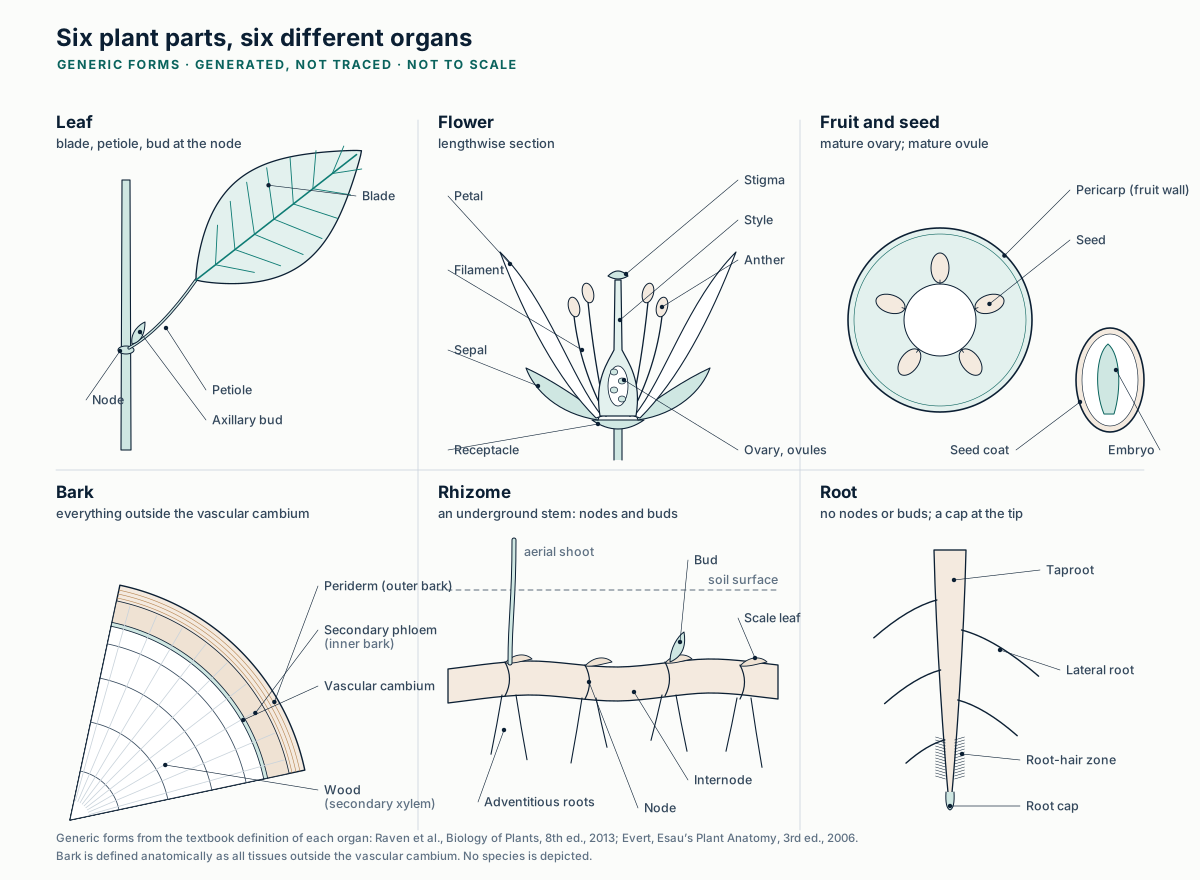
The label must name the plant part, because organs of one plant differ in chemistry
Explanation, details and sources
Under 21 CFR 101.4(h), a botanical's common name follows Herbs of Commerce (1992) and is followed by the part of the plant, in English, and the Latin binomial when needed. A supplement that fails to name the part is misbranded (21 U.S.C. 343(s)(2)(C)). In Acorus, β-asarone is 50–65% of the leaf oil but 9–19% of the rhizome oil of the triploid (EMEA/HMPC/139215/2005; see Course 4).
For a specification, name the accepted species with its author, the part, and the form (whole, cut, powder or extract). The form decides which identity methods still work (section 7).
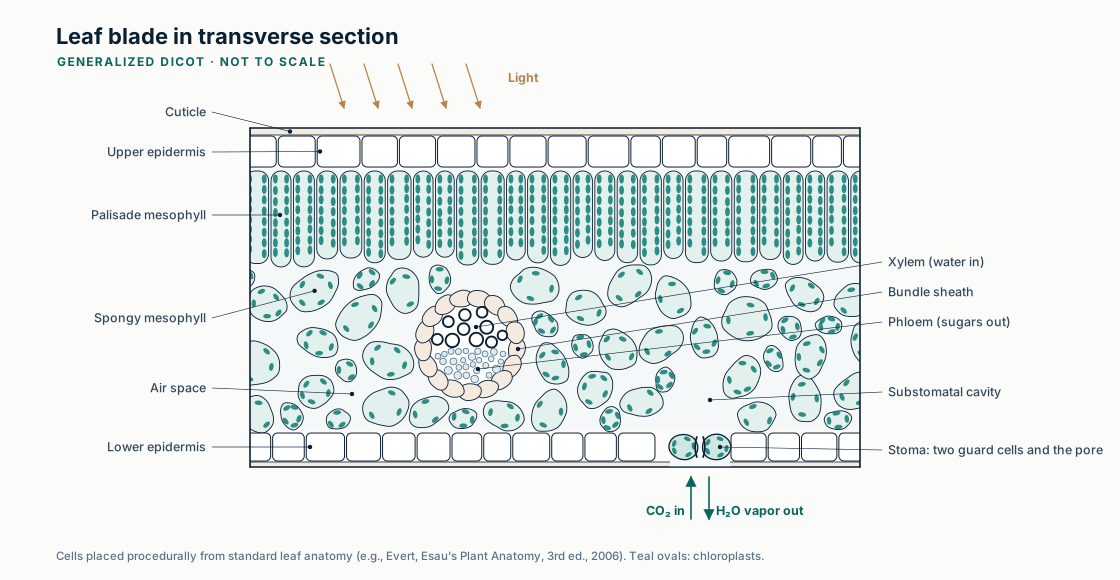
Microscopy reads the plant's anatomy in a powder, and that evidence is lost at extraction
Text version of the feature plate
- Druse: a cluster of calcium oxalate crystals. Raphides: bundles of needles inside a specialized cell. Prism: a single block-shaped crystal. Styloid: a long prism. Crystal sand: many fine grains in one cell.
- Starch grain: concentric lamellae around a hilum; under a polarizing microscope a black cross appears.
- Stomata: anomocytic, no distinct subsidiary cells; anisocytic, three subsidiary cells of unequal size; diacytic, a pair of polar subsidiary cells perpendicular to the pore; paracytic, lateral subsidiary cells parallel to the pore.
- Glandular secretory trichome of Artemisia annua: the enzymes of artemisinin synthesis are expressed only in the apical cells; the subapical cavity stores the product.
Data table: powder features in the Hong Kong standards
| Feature | Panax ginseng | Panax quinquefolius | Eleutherococcus senticosus |
|---|---|---|---|
| Calcium oxalate clusters | 19–173 | 8–91 | 10–74 |
| Vessels | 19–100 (reticulate, scalariform) | described (reticulate, scalariform, annular, spiral) | 18–109 (bordered-pitted) |
| Simple starch granules | described (compound granules of 2–11 units) | 2–28 (compound granules of 2–9) | not described |
| Fibres | not described | not described | phloem 9–47; xylem 8–37 |
| Canals | resin canals, yellow secretion | resin canals, yellow oil droplets | secretory canals |
Explanation, details and sources
USP general chapter ⟨563⟩, Identification of Articles of Botanical Origin, codifies macroscopic and microscopic assessment. Calcium oxalate occurs in five forms (raphides, druses, prisms, styloids and crystal sand), and crystal shape is constant within a species. Starch grains show a hilum and, under a polarizing microscope, a black cross.
Microscopy needs a trained analyst and an authenticated reference, and it says little once material is extracted. Read the chart as a pattern: the two Panax monographs describe no fibres, so a "ginseng" powder full of fibres calls for further tests.
An HPTLC test compares a sequence of zones with a reference run on the same plate
Method, assumptions and limits
- What it calculates
- RF and hRF of two zones, their difference, the retention factor k implied by each RF, the resolution of the pair and the offset of zone 1 from a reference RF.
- Equations
- RF = b/a and hRF = 100 RF (IUPAC, Pure Appl Chem 1993;65:819, p. 845). R = 1/(1 + k) in column chromatography, and "ideally" RF equals R, so k = (1 − RF)/RF (p. 843). Peak resolution Rs = 2(tR2 − tR1)/(wb1 + wb2) (p. 847), evaluated here with zone positions and widths read on the developed plate.
- Variables and units
- Positions in mm from the lower edge of the plate; widths in mm along the development direction.
- Valid range
- Zones must lie between the application position and the front, and the front at least 10 mm above the application.
- What it does not establish
- Identity. A pharmacopoeial test compares zone sequence, colour and intensity with a reference on the same plate under the stated conditions; a matching RF alone proves nothing.
- Verification
- Independent Python reference:
tests/numerics/ref/academy_plant-identity.py; unit tests:tests/unit/acidn.test.js.
Text version of the TLC criteria
Radix Ginseng: zones corresponding to ginsenosides Rb1, Rc, Rf and Rg1, "but no spots or bands corresponding to pseudoginsenoside F11". Radix Panacis Quinquefolii: zones corresponding to ginsenosides Rb1, Rc, Rg1 and 24(R)-pseudoginsenoside F11. Eleutherococcus: zones corresponding to isofraxidin, liriodendrin (eleutheroside E) and syringin (eleutheroside B). Both isomers are C42H72O14.
Explanation, details and sources
USP general chapter ⟨203⟩ standardizes high-performance thin-layer chromatography (HPTLC) for botanical identification. A fingerprint is "a sequence of separated zones with a certain color and intensity", read against a botanical reference material and a system suitability test (SST) on track 1.
b: distance from the application position to the zone centre; a: distance to the solvent front; z: zone positions; w: zone widths, all in mm. In a four-laboratory trial, RF values of SST markers were reproducible within a confidence interval of 0.040 (Do et al. 2021).
Worked example (calculator defaults). With the application line at 8 mm and the front at 70 mm, the solvent travels a = 62 mm. A zone centred at 30 mm has RF = 22/62 = 0.355 (hRF 35.5); a neighbour at 33.5 mm has RF = 0.411. With zone widths of 3.0 and 3.2 mm, Rs = 7.0/6.2 = 1.13.
Common misreadings.
- Comparing RF values between plates or laboratories without an SST. Even with one, RF values of SST markers varied within a confidence interval of 0.04 between four laboratories.
- Treating one matching zone as identity. The test is the whole sequence of zones, colours and intensities against the reference.
- Reading an absent zone as proof of absence. A zone below the detection limit of the chosen derivatization does not appear.
Similarity coefficients compare the shape of two fingerprints, so they cannot see dilution
Densitograms are compared with the correlation coefficient r and the congruence (cosine) coefficient; values near 1 mean similar patterns. Both ignore overall scale. Try each preset.
Method, assumptions and limits
- What it calculates
- The Pearson correlation and the congruence (cosine) coefficient between a reference and a sample densitogram, the ratio of their total areas and the ratio of the marker zone.
- Assumptions
- Zones at fixed positions with equal Gaussian shape; no baseline drift; densitograms on the same plate and scale. Every intensity is invented for teaching.
- What it does not establish
- A pass or fail. Acceptance limits for similarity are set per method and validated; none is applied here.
- Verification
tests/numerics/ref/academy_plant-identity.pyrecomputes both coefficients with numpy and scipy.stats.pearsonr.
A similarity coefficient answers "same pattern?", not "same amount?". Pair it with a quantitative assay of named markers, and inspect the zone-by-zone ratios before accepting a high coefficient.
DNA barcodes name the species of raw material, but not the plant part, the chemistry or most extracts
Data table: species discrimination by barcode
| Study and sample | Locus or combination | Discrimination (%) |
|---|---|---|
| CBOL 2009, 907 samples, 550 species | rpoC1 | 38 |
| rpoB | 40 | |
| atpF–atpH | 50 | |
| matK | 57 | |
| rbcL | 58 | |
| trnH–psbA | 58 | |
| psbK–psbI | 64 | |
| CBOL 2009, 397 samples with all seven loci | rbcL | 61 |
| matK | 66 | |
| rbcL + matK | 72 | |
| All seven loci | 73 | |
| China Plant BOL 2011, 6,286 individuals, 1,757 species | rbcL + matK | 49.7 |
| ITS + any plastid marker | 69.9–79.1 | |
| Chen et al. 2010, more than 6,600 samples, 4,800 species | ITS2 | 92.7 |
Text version of the processing matrix
Macroscopy needs whole or cut material. Microscopy works on powders but not extracts. DNA barcoding works on raw material; Parveen et al. do "not recommend the use of universal primers for DNA barcoding of processed plant material as a sole means of species identification". Metabarcoding detected the labelled species in 34 of 38 Echinacea products and found other species too. Chemical fingerprints apply to all forms but can be imitated.
Explanation, details and sources
The Consortium for the Barcode of Life plant working group recommended rbcL + matK as the core land-plant barcode (CBOL 2009); later studies added the nuclear ITS2 region. Every organ carries the same genome, so a barcode cannot tell root from leaf.
Limits that matter for a purchase decision.
- A barcode is only as good as the reference sequence it matches; protocols for DNA-based identification still need standardizing before regulators accept them as routine (Raclariu et al. 2018).
- Universal primers are not recommended as the sole identification of processed material (Parveen et al. 2016).
- DNA says nothing about the marker content the specification controls.
Market surveys find substitution, dilution and spiking that any single test would miss
Data table: authenticity surveys
| Product | Study | Method | Flagged / tested | Share (%) |
|---|---|---|---|---|
| Grape seed extract | Villani 2015 | HPLC-UV-MS | 9 / 21 | 42.9 |
| St. John's wort | Frommenwiler 2016 | HPTLC | 14 / 37 | 37.8 |
| Ginkgo leaf products | Wohlmuth 2014 | HPLC | 3 / 8 | 37.5 |
| Black cohosh products | Jiang 2006 | HPLC-PDA, LC-MS | 4 / 11 | 36.4 |
| St. John's wort products | Raclariu 2017 | DNA metabarcoding | species not detected in 32% of 78 | 32 |
| Turmeric (48 publications) | Gafner 2025 | scoping review | 2,235 samples | 20.0 |
| Echinacea products | Raclariu 2018 | DNA metabarcoding | 4 / 38 | 10.5 |
Explanation, details and sources
The ABC–AHP–NCNPR Botanical Adulterants Prevention Program documents how ingredients are faked and how each scheme is detected; its review lists bilberry, ginkgo, grape seed, St. John's wort and turmeric among ingredients at risk (Gafner et al. 2023).
An identity file therefore combines methods by material form: anatomy plus a chemical fingerprint for raw herbs and powders, a fingerprint plus a quantitative assay for extracts, and metabarcoding when a blend may hide other plants.
Nine terms used in identity specifications
Show the 9 key terms
- Accepted name
- The name a checklist such as POWO uses for a species; other names are synonyms.
- Author citation
- The botanist who published the name, e.g. "L." for Linnaeus.
- Plant part
- The organ used (root, leaf, flower); required on U.S. supplement labels.
- Druse
- A spherical cluster of calcium oxalate crystals.
- RF
- Zone travel divided by solvent-front travel, both from the application line.
- SST
- System suitability test: a reference mixture that shows the plate ran correctly.
- Botanical reference material
- Authenticated plant material run beside the sample.
- DNA barcode
- A short standard DNA region compared with a reference library.
- Metabarcoding
- Sequencing many barcode copies at once to list the species in a mixture.
Five questions on choosing an identity test
A supplier's certificate says "identity: conforms". Is that enough under Part 111?
No. § 111.75(a)(1)(i) requires the manufacturer to conduct at least one appropriate identity test or examination on each dietary ingredient, unless FDA has granted a petition. Certificates can support other components under § 111.75(a)(2), not this test.
A lot of "ginseng" powder shows ginsenoside F11 on the HPTLC plate. What does the Hong Kong standard say?
Radix Ginseng (Panax ginseng) must show no zone for pseudoginsenoside F11, so the lot fails as P. ginseng. F11 is required for P. quinquefolius, which suggests American ginseng or a mixture.
Why can a DNA barcode not confirm that a product is made from root rather than leaf?
All organs of a plant carry the same genome. The part is read from anatomy (macroscopy, microscopy) or from organ-specific chemistry.
A sample's densitogram has r = 1.00 against the reference. Can it still be adulterated?
Yes. Dilution with an inert filler scales every zone equally and leaves r and the congruence coefficient unchanged. A quantitative assay is needed.
Which method would reveal a second, undeclared plant in a capsule blend?
DNA metabarcoding. Raclariu et al. found that TLC and HPLC-MS confirmed target compounds but gave no information on other plant ingredients.
Next: genomes, species and chemotypes
Why closely related plants make different compounds, and how genome size and ploidy are measured.