

The platform · proposed
The Large Botanical Model: scientific AI for botanical ingredients.
A family of specialized, physics-informed models on one shared botanical data layer. It is designed to return testable predictions with their uncertainty, choose the experiments worth running, and assemble traceable evidence for safety, regulatory, process and formulation decisions. It is not a chatbot, and it is not one giant model.
In developmentNo Large Botanical Model has been trained. What exists: computed research on published data and illustrative simulators, one benchmark, and a rules-based NDI demonstration. The register below shows the status of each part.
01 · The architecture
Data in, predictions with uncertainty out, experiments back in.
Choose an application to see which inputs, models, outputs, experiments and decisions it uses, what evidence it must earn, and what exists today.
02 · Seven kinds of data
Seven kinds of scientific data, kept with their source and rights.
Each record keeps its source, its license or ownership, the method that produced it and its uncertainty. Customer data stay the customer’s and are not used to train shared models unless the customer agrees in writing.
| Data class | What it covers | Where it would come from | Status today |
|---|---|---|---|
| Chemical and molecular | Structures, conformers, properties, solubility, thermodynamics, stability, interactions | PubChem, published measurements (for example NIST ThermoML), computed | Computed for 3 molecules; screen of 13 |
| Botanical | Species, cultivar, chemotype, origin, cultivation, harvest, processing, natural variability | Taxonomic checklists, literature, supplier records | Planned |
| Analytical | HPLC, LC-MS, GC-MS, spectroscopy, fingerprints, purity, identity, contaminants, batch consistency | Partner laboratories; published datasets | Published data reanalyzed (ginkgo PCA) |
| Extraction and manufacturing | Solvents, mass transfer, thermal behavior, kinetics, yield, selectivity, equipment, scale-up, mass and energy balances, exergy | Partner pilot runs; literature; computation | Illustrative simulator and 2D CFD |
| Formulation and delivery | SNEDDS and SEDDS, dispersions, emulsions, encapsulation, complexation, precipitation, stability, dissolution, bioaccessibility | Partner laboratories; literature | Published designs reanalyzed |
| Biological and safety | Toxicology, ADME, PK/PD, PBPK, dose–response, transporters, interactions, human clinical evidence | Literature; CRO studies where required | PK calibrated on published human data |
| Regulatory | Identity, manufacturing history, safety substantiation, intended use, jurisdiction, NDI and NDIN records | Statute, regulations, FDA guidance and public NDIN records | Rules run in the NDI demonstration |
03 · How the pieces combine
Specialized models on a shared data layer, not one model for everything.
Botanical data are scarce, mixed in kind and expensive to measure. A single large transformer trained on them would have little to learn from and would not respect mass balances or give calibrated uncertainty. The proposed design combines five kinds of component.
Representation
Molecular representations
Molecular graphs, descriptors and surface-charge (σ) profiles that let models compare compounds across plants.
Structure
Knowledge graph
Species, plant part, compound, lot, process, study and regulatory record as linked entities, so a question can follow the links.
Learning
Specialized machine learning
Narrow models for one property or decision each, trained only where enough rights-cleared data exist, and judged on held-out data.
Physics
First-principles simulation
COSMO-type solvation, molecular dynamics, mass transfer, CFD and PBPK, which hold where data are thin.
Decision
Uncertainty-aware optimization
Bayesian inference, multi-fidelity methods and active learning choose the next experiment by the information it adds.
Methods: Gilmer et al., Neural message passing for quantum chemistry, ICML 2017; Hogan et al., Knowledge graphs, ACM Computing Surveys 2021;54(4):71; Klamt, J Phys Chem 1995;99:2224 (COSMO-RS); Kennedy and O’Hagan, J R Stat Soc B 2001;63:425 (Bayesian calibration of computer models); Peherstorfer, Willcox and Gunzburger, SIAM Review 2018;60:550 (multifidelity methods); Jones, Schonlau and Welch, J Global Optim 1998;13:455 (expected improvement).
04 · One benchmark, with its uncertainty
With 15 runs, the model’s worst-case error was half that of the classic method.
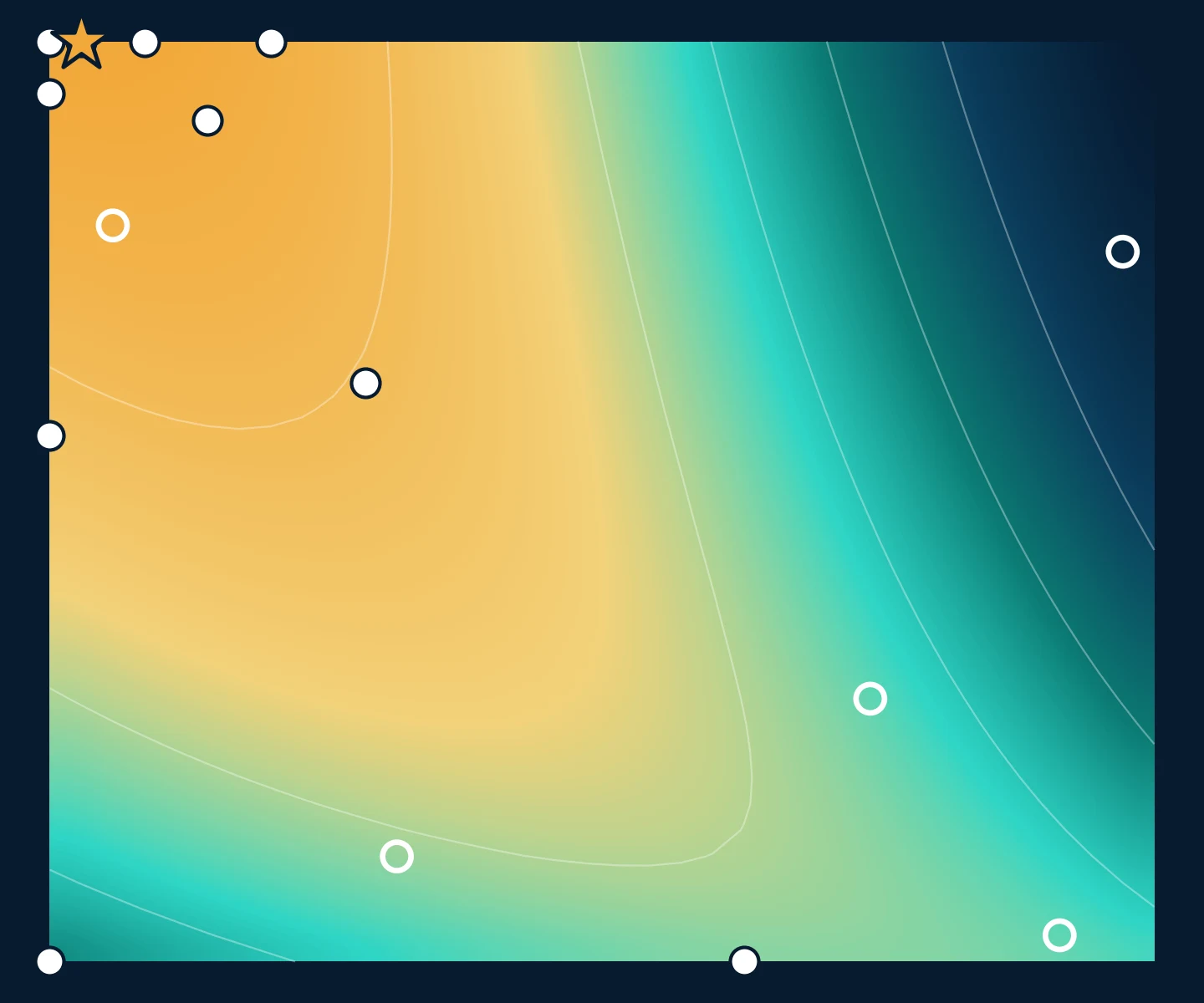
A computed benchmark on the illustrative extraction simulator behind FIG 047: 1,296 settings, 50 random repeats, the same 15-run budget for each method. It tests the method, not a real process, and no laboratory data are involved.

| Method, 15 runs | Typical error (RMSE) | Worst error | Found the best setting | 95% band coverage |
|---|---|---|---|---|
| 5 space-filling + 10 by expected improvement, Gaussian process | 1.4 points | 6.4 | 50 of 50 | 91% |
| 15 space-filling, Gaussian process | 1.0 | 7.4 | 50 of 50 | 98% |
| 15 space-filling, quadratic response surface (classic) | 2.3 | 13.7 | Within 0.02 points | None given |
All three methods found the best setting, so the gain is a more accurate map and a usable uncertainty, not finding the peak. EUTECNIQ computation, November 15, 2026 (scikit-learn Gaussian process, Matérn 5/2 kernel); scripts kept for review. Recovery points are percentage points of intact recovery. Box and Wilson, J R Stat Soc B 1951;13:1 (response surfaces); Rasmussen and Williams, Gaussian Processes for Machine Learning, MIT Press 2006.
05 · Platform maturity register
What exists, what is being built, and what has not been proven.
A drawn architecture is not an operating platform. This register is updated at each stage gate; a level is marked only when the evidence for it exists.
| Component | Existing research or tool | Under development | Trained and benchmarked | Validated on independent experimental data | Used by customers | Regulatory support capability | Evidence today and next gate |
|---|---|---|---|---|---|---|---|
| Scientific research library | Reached | Not yet | Not yet | Not yet | Not yet | Not yet | 60 figures with data and scripts, each labeled by evidence type Next gate: Kept current; every new figure labeled |
| Molecular modeling tools | Reached | Not yet | Not yet | Not yet | Not yet | Not yet | Open-source conformers and force fields; COSMO-SAC screen of 13 molecules; MD set-up Next gate: Benchmark against measured solubility (Phase 2) |
| Extraction and process models | Reached | Not yet | Partly | Not yet | Not yet | Not yet | Surrogate benchmarked on an illustrative simulator (50 repeats); Pareto and Monte Carlo design space; 2D CFD calculation Next gate: Fit to partner-measured extraction runs (Phase 3) |
| Exposure models (PK) | Reached | Not yet | Partly | Not yet | Not yet | Not yet | Bayesian PK for curcumin, quercetin and berberine calibrated on published human data Next gate: Test on held-out published datasets (Phase 2) |
| Pareto solvent screen | Reached | Not yet | Not yet | Not yet | Not yet | Not yet | Live interactive screen on published NIST ThermoML measurements Next gate: Extend to new botanical actives as data allow |
| NDI regulatory intelligence workflow | Reached | Partly | Not yet | Not yet | Not yet | Partly | Rules-based demonstration on this site: seven screening questions, FDA Appendix A table, safety calculations Next gate: Test against public FDA response letters; first paid feasibility work (Phase 1) |
| Botanical knowledge graph and data pipelines | Not yet | Not yet | Not yet | Not yet | Not yet | Not yet | Schema and provenance rules designed; not built Next gate: First release with source provenance (Phase 1) |
| Specialized predictive models | Not yet | Not yet | Not yet | Not yet | Not yet | Not yet | None trained on EUTECNIQ data Next gate: Each must beat a stated baseline on held-out data (Phase 2) |
| Larger multimodal botanical models | Not yet | Not yet | Not yet | Not yet | Not yet | Not yet | Future research objective Next gate: Only when data quality, validation, cost and demand justify it (Phase 4) |
| Owned ingredients and licensing | Not yet | Not yet | Not yet | Not yet | Not yet | Not yet | Future objective Next gate: After validated client work and an IP assessment (Phase 5) |
Reached Partly: on an illustrative simulator, published data or rules only Not yet
Register as of November 19, 2026. No component has been validated against independent experimental data or used by a customer. Regulatory support capability means a working, cited workflow, not a filed notification.
06 · The roadmap
Five phases, each with a gate to pass and a reason to stop.
Evidence comes before infrastructure: data rights, models, external validation and paying customers first; a laboratory only after demand and technical milestones are proven.
Phase 1
Months 0–6
Scientific data infrastructure and the first product
The botanical knowledge graph and source-data pipelines with recorded provenance and rights; the existing computational models connected to them; one focused regulatory-intelligence use case.
Phase 2
Months 4–12
Specialized predictive models
Narrow models for selected molecular properties, safety-gap identification, extraction conditions and formulation-relevant properties, each benchmarked before use.
Phase 3
Months 9–18
Commercial pilots with partners
The platform used on real client problems with qualified CROs and analytical laboratories, compared with the conventional workflow on documented metrics.
Phase 4
After month 18, if justified
Larger multimodal botanical models
Shared representations and larger models across data types, built only when dataset quality, validation evidence, computing economics and customer demand justify them.
Phase 5
When capabilities are validated
Proprietary ingredient development and licensing
Validated capabilities applied to selected EUTECNIQ-owned botanical ingredient programs, commercialized by license, qualified manufacturing partners or supply.
Phases overlap. Timing is the earliest proposed and may slip; each phase is funded only when the previous gate is met.
07 · Benchmarks to earn
No benefit is claimed until it is measured.
EUTECNIQ does not claim shorter studies, higher success rates, FDA acceptance, better bioavailability or lower cost. These are the studies designed to establish whether the platform delivers any of them.
Regulatory
Gap detection on public letters
Share of the identity and safety deficiencies cited in public FDA responses to notifications that the gap analysis flags in advance.
Prediction
Error against blinded measurements
Solubility, extraction recovery and droplet size predicted before partner laboratories measure them; error and interval coverage reported.
Experiments
Runs to an operating window
Experiments needed to locate a specified window, against a classic design of experiments on the same problem.
Time and cost
Candidate to decision
Elapsed time and cost from intake to a documented pathway decision, logged against the client’s conventional baseline.
08 · Where it fits
One platform, three ways it would earn.
Business 1
Enterprise platform
Subscriptions, research modules and API access for ingredient makers, brands, CROs and CDMOs. A future product.
Business 2 · first
Regulatory and development solutions
Model-assisted NDI assessment, dossier support, ingredient qualification and development programs, with partner laboratories and CROs.
Business 3
Owned ingredients and IP
EUTECNIQ-funded ingredient programs, licensed or supplied through qualified partners.
The Large Botanical Model is the core; each business uses it and, with permission, improves it.
EUTECNIQ Atlas, the free public guide on this site, is a separate program with its own governance. It is not the Large Botanical Model and makes no predictions. Information only; not an offer of securities.
Health information notice. These statements have not been evaluated by the Food and Drug Administration. Nothing on this site is intended to diagnose, treat, cure or prevent any disease, and nothing here is medical advice.
Read the full notice
The information is for general education only. It does not replace advice, diagnosis or treatment from a qualified health professional, or any medication a clinician has prescribed. Do not start, stop or change any medicine, supplement or herbal product because of something you read here. Talk to your doctor or pharmacist first, especially if you are pregnant or breastfeeding, have a medical condition, take any medicines, are preparing for surgery, or are caring for a child. Research findings, traditional uses and safety data are reported as their sources state them; they are not recommendations or claims about any product. If you think you may have a medical emergency, call your doctor or 911 at once.
EUTECNIQ Sciences sells no supplements or health products today and receives nothing from any product or ingredient mentioned on this site; any commercial interest it later has in an ingredient will be stated on that ingredient’s page.