

Technologies · Scientific Intelligence · Computational research
From molecule to manufacturable ingredient, in five figures
One curcumin program, followed through the five decisions that turn a molecule into an ingredient: what its surface is like, which solvent dissolves it, which extraction settings recover it reliably, how a lipid system could deliver it and what reaches the blood. Each figure says what kind of figure it is, what was calculated and where the chain breaks.
Calculations and published dataCalculated from published measurements with open-source quantum chemistry and statistics. EUTECNIQ has not yet measured these compounds; the experiments that would test each result are listed.
On this page
- 5
- signature figures, one decision each
- 2
- links between figures carried by a physical model
- 2
- links with no model yet, shown as gaps
- 0
- EUTECNIQ laboratory measurements so far
The chain
Two links are carried by physics; two are still gaps

- 01Moleculeσ-profile of curcumin
- σ-profiles are the input to the solubility model
- 02Solventsolubility in four water–cosolvent systems
- solubility caps how much the solvent can carry
- 03Extraction windowprobability of meeting the recovery specification
- Gap: no model links extract to formulation
- 04Deliveryself-emulsifying lipid system (published berberine data)
- Gap: no model links composition to exposure
- 05Bodycurcumin exposure fitted to a published human study
Calculated scientific output Drawn from model data by reproducible code. Nothing in it is hand-placed.
Mechanistic scientific illustration A drawing of a physical or biological mechanism as described in the cited literature. It shows how something works, not a result.
Interactive explanatory visualization Controls select among precomputed model results or recompute a documented equation. Nothing is estimated by hand.
Figure 1 · Molecule
93% of curcumin's computed surface is non-hydrogen-bonding, and measured in water it is about 26,000 times less soluble than in ethanol
Calculated scientific outputComputedMeasured, published
Scientific challenge
Before any solvent is bought, the question is which liquids can hold the molecule at all. Trial and error over dozens of solvents and mixtures is slow and wastes material.
Visual mechanism
A density-functional calculation places curcumin in a perfect conductor and records the screening charge σ on every patch of its surface. The second surface map is colored by σ, and the σ-profile chart is that surface's histogram. A solvent dissolves curcumin well when its own σ-profile can pair with these patches.
Calculated result
Of 426.7 Ų of cavity surface, 397.6 Ų (93.2%) sits on atoms the COSMO-SAC 2010 scheme treats as non-hydrogen-bonding; 19.9 Ų is hydroxyl-type and 9.2 Ų other hydrogen-bonding. For water the hydroxyl-type share is 52%; for ethanol, 16%.
Engineering decision
Screen water–alcohol and water–glycol mixtures rather than water alone, and use these σ-profiles as the input to the solubility model in Figure 2. Measured at 25 °C, the mole-fraction solubility is 10−7.53 in water and 10−3.11 in ethanol.
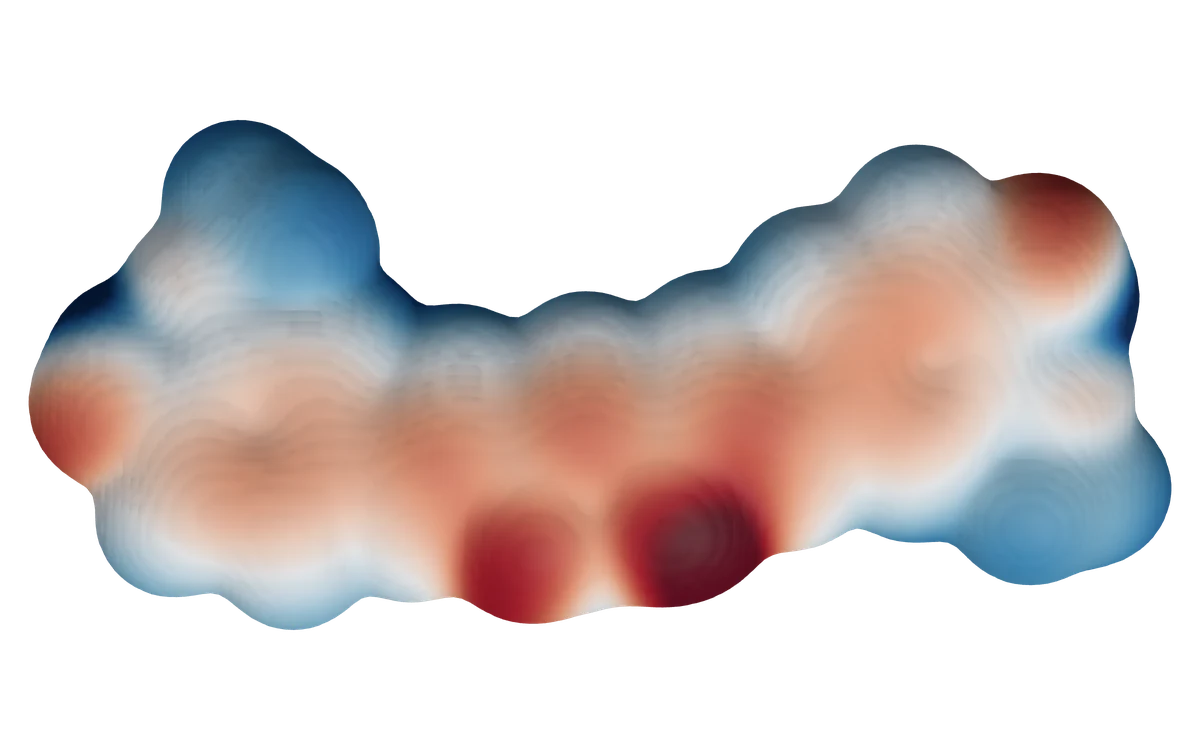
Electrostatic potential
−30+30 kcal mol⁻¹
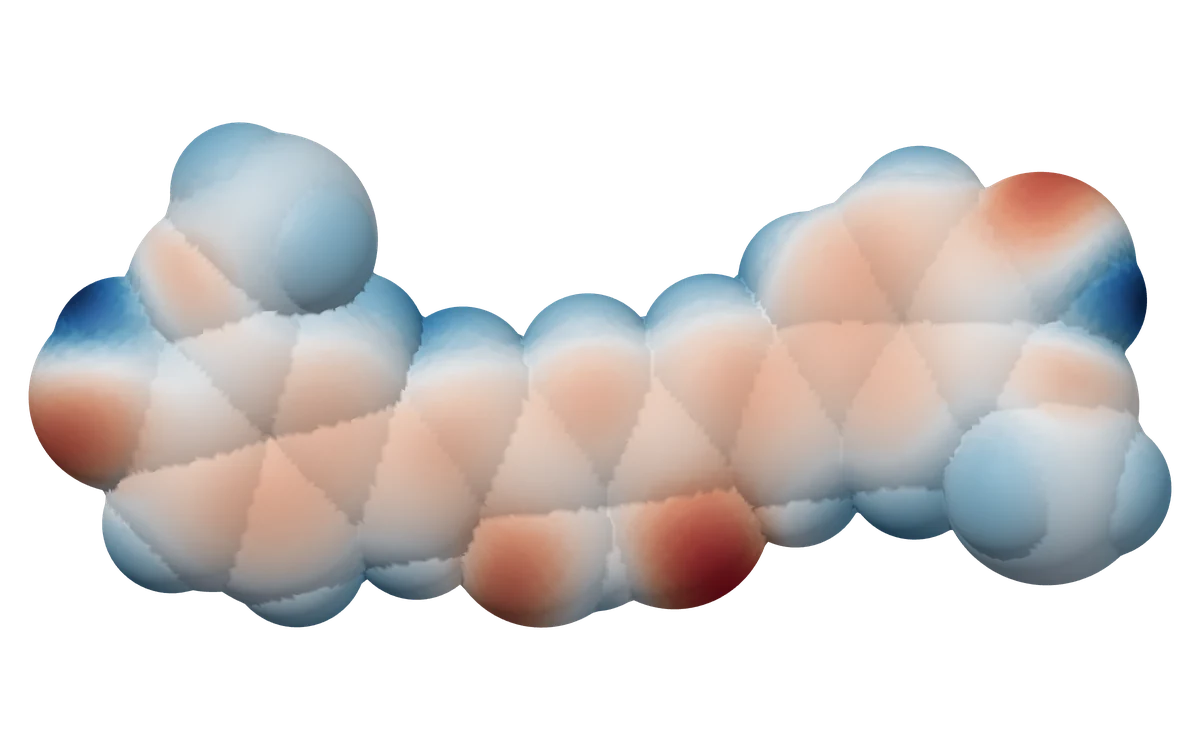
Screening charge σ on the cavity
+15−15 × 10⁻³ e Å⁻²
Evidence and limitations
- Computed Geometry, potential and σ are single-conformer gas-phase and conductor calculations. Curcumin has keto–enol and diketo forms and several conformers; the workstation shows five of them.
- Measured Water and ethanol solubilities are published measurements (Shen et al. 2019), not EUTECNIQ measurements.
- A σ-profile describes surface polarity, not solubility by itself; the melting properties of the solid also decide solubility and enter in Figure 2.
Figure 2 · Solvent
Measured at 25 °C, solubility falls only threefold from pure ethanol to 50% ethanol, then about 1,900-fold from 30% ethanol to water
Interactive explanatory visualizationCalculated scientific outputCalibratedMeasured, published
Scientific challenge
Extraction solvents are water mixtures for cost and safety, and solubility changes steeply with the water fraction. The model must be checked against measurements before it guides a process.
Visual mechanism
COSMO-SAC turns the σ-profiles of curcumin and each solvent into an activity coefficient. Combined with the melting point (456.15 K) and one fitted enthalpy of fusion, that gives the mole-fraction solubility at every composition and temperature.
Calculated result
Against 396 mixture measurements in four systems, 5–45 °C, the root-mean-square error is 1.19 log₁₀ units. The model is not fitted to these mixture data; the dashed line removes each system's mean error and is a correction, not a test.
Engineering decision
Choose an ethanol fraction and temperature here; that point carries into Figure 3 as the saturation limit of the extraction solvent. The value passed on is the corrected line.
Evidence and limitations
- Calibrated One parameter, the enthalpy of fusion, was fitted to pure-solvent data (error 0.70 log₁₀ units there). Everything else is predicted from the σ-profiles.
- An error of 1.19 log₁₀ units is a factor of about 15 at a single point. The model ranks solvents and shapes curves; it does not replace a measurement at the chosen operating point.
- Solubility here is for the pure compound. Turmeric extracts contain other curcuminoids and matrix compounds that can change it.
Figure 3 · Extraction and the robust window
In the model, milling from 0.5 to 0.25 mm raises the share of operating conditions with at least 90% probability of meeting specification from 8% to 34%
Mechanistic scientific illustrationInteractive explanatory visualizationPredictedScenario kinetics
Scientific challenge
A process window that works at the average parameter value can still fail often. The specification here is at least 80% of the rhizome's curcumin in solution at the end of the hold, and the question is how often each setting meets it.
Visual mechanism
Curcumin diffuses out of milled particles into a well-stirred liquid of limited volume (Crank 1975, eq. 6.30). Recovery is capped by how much curcumin the liquid can hold at saturation, which comes from Figure 2.
Calculated result
Each map cell is the share of 600 Monte Carlo draws meeting specification, varying the enthalpy of fusion, the solubility-model error and the diffusivity. At 8 kg solvent per kg rhizome and a 60-minute hold, 34% of the map reaches at least 90% probability with 0.25 mm particles and 8% with 0.5 mm.
Engineering decision
Pick a point inside the 90% contour with margin, then read what limits it: if diffusion alone would fail, mill finer or hold longer; if diffusion succeeds but the solvent saturates, raise ethanol, temperature or solvent ratio.
- Jacket. Holds the liquid at temperature T for the whole hold; heat-up time is not modeled.
- Liquid. Ethanol–water at mass fraction w, assumed well stirred so its concentration is uniform.
- Solvent-to-rhizome ratio S. Sets the liquid volume. At saturation the liquid holds at most S × csat of curcumin per kilogram of rhizome.
- Particles. Milled rhizome treated as uniform spheres of diameter dp, starting at 3.14% curcumin (mean of pure turmeric powders, Tayyem et al. 2006).
- Inside a particle. Curcumin diffuses outward with an effective diffusivity D; at the surface it is in equilibrium with the liquid (partition coefficient 1).
Probability of meeting specification
Recovery over time at the ringed point
Evidence and limitations
- Scenario No diffusivity has been measured for turmeric; the range is a scenario, so the map shows how settings rank, not validated yields.
- Degradation of curcumin during the hold and co-extracted impurities are not included. Both would shrink the window.
- Next experiments, in order: solubility at the chosen fraction and temperature (shake-flask, HPLC); extraction kinetics on milled rhizome of the specified size; curcumin assay of the incoming lot instead of the literature mean; degradation and impurity profiles.
Figure 4 · Delivery
A self-emulsifying lipid system helps only while the active stays dissolved; a published berberine system crystallized at 22 mg g⁻¹ but not at 20
Mechanistic scientific illustrationPublished mechanismMeasured, published
Scientific challenge
An active that dissolves poorly in gut fluid is absorbed poorly. A lipid pre-concentrate can carry it in solution, but dispersion and digestion change the solvent around it at every step.
Visual mechanism
The pre-concentrate disperses into fine droplets; lipase digests the glycerides; bile salts and digestion products form mixed micelles and vesicles. If these colloids hold less than the dose, the active becomes supersaturated and can precipitate before it is absorbed (Pouton 2006; Porter et al. 2007).
Calculated result
The published optimum, Capmul MCM 55% : Kolliphor RH 40 22.5% : 1,2-propanediol 22.5%, falls within the composition ranges of a Type IIIA formulation in the Lipid Formulation Classification System. Measured droplet sizes were 48–55 nm at 14–20 mg g⁻¹.
Engineering decision
Set the load below the crystallization limit with margin, test dispersion and digestion before any animal or human work, and do not expect a lymphatic route from a medium-chain lipid.
-
1 · Pre-concentrate
Oil, surfactant and cosolvent in one clear phase with the active dissolved. No water.
-
2 · Dispersion
In gut fluid, droplets form; the cosolvent leaves for the water and can take solvent capacity with it.
-
3 · Digestion
Lipase cuts glycerides into fatty acids and monoglycerides, which join bile salts in mixed micelles and vesicles.
-
4 · Supersaturation risk
If the colloids now hold less than the dose, the excess is supersaturated and can crystallize or precipitate.
-
5 · Absorption
Dissolved active crosses the gut wall. Medium-chain lipid products go mainly to portal blood; long-chain products can route some very lipophilic actives into lymph.
| Drug load | Droplet size, PDI | Crystallization |
|---|
Evidence and limitations
- Published All composition and droplet data are from Chen et al. 2024, not EUTECNIQ. The same study reported 163% relative bioavailability in rats; no model on this page links these compositions to that number.
- Droplet size alone does not show whether a dispersion is a thermodynamically stable microemulsion or a kinetically stable nanoemulsion; the study reports size and polydispersity, not phase behavior.
- Gap No measured formulation data exist for curcumin in this program. The planned design is a simplex-lattice mixture design of oil, surfactant and cosurfactant, measuring droplet size, polydispersity and stability on dilution.
- In standardized digestion tests, drugs crystallized from medium-chain and surfactant-only formulations only when the calculated maximum supersaturation ratio exceeded 3 (Williams et al. 2013).
Figure 5 · Body
Fitted to a published human study, unconjugated curcumin is 0.28% of total plasma curcumin exposure (90% interval 0.11–0.66%)
Mechanistic scientific illustrationInteractive explanatory visualizationFittedMeasured, published
Scientific challenge
A delivery system is judged by what reaches the blood, and for curcumin most of what reaches the blood is conjugated. Total and unconjugated curcumin are different analytes and must not be pooled.
Visual mechanism
After absorption, curcumin passes the gut wall and the liver, where it is conjugated to glucuronides and sulfates (Anand et al. 2007; Vareed et al. 2008), before reaching the circulation that a blood sample sees.
Calculated result
A one-compartment model with first-order absorption, fitted by Bayesian sampling to the published medians and ranges after 576 mg curcumin in a micellar solubilizate (n = 9), gives the bands at right and the 0.28% share.
Engineering decision
Specify the analyte (unconjugated, conjugated, total) and the assay before any formulation claim, and treat a higher total as different from a higher unconjugated exposure.
-
Gut lumen
Dose released and dissolved, or not.
-
Gut wall
Uptake by enterocytes; first conjugation.
-
Portal vein
Carries absorbed material to the liver.
-
Liver
Further conjugation on first pass.
-
Circulation, sampled
Plasma assayed for unconjugated and total curcumin.
What the fitted model sees: one compartment, absorption rate ka, elimination rate ke. The organs above are lumped; this is not a physiologically based (PBPK) model.
Evidence and limitations
- Fitted The model is fitted to summary statistics (medians and ranges), not individual data, so its intervals describe the fit, not person-to-person variation.
- Gap This is a micellar curcumin product, not the lipid system in Figure 4, and no model here predicts exposure from composition. A PBPK model would need measured permeability, intestinal and hepatic conjugation kinetics and tissue partitioning; none are fitted here.
- Conjugates may have activities of their own; this figure concerns exposure only, not effect.
Sources
Every number above comes from these sources or from the workstation's published calculations
- Shen Y, Farajtabar A, Xu J, Wang J, Xia Y, Zhao H, Xu R. Thermodynamic solubility modeling, solvent effect and preferential solvation of curcumin in aqueous co-solvent mixtures of ethanol, n-propanol, isopropanol and propylene glycol. J Chem Thermodyn 2019;131:410–419. doi:10.1016/j.jct.2018.11.022 (data via NIST ThermoML; pure-solvent data via BigSolDB 2.0).
- Lin S-T, Sandler SI. A priori phase equilibrium prediction from a segment contribution solvation model. Ind Eng Chem Res 2002;41(5):899–913. doi:10.1021/ie001047w
- Hsieh C-M, Sandler SI, Lin S-T. Improvements of COSMO-SAC for vapor–liquid and liquid–liquid equilibrium predictions. Fluid Phase Equilib 2010;297(1):90–97. doi:10.1016/j.fluid.2010.06.011
- Bell IH, Mickoleit E, Hsieh C-M, et al. A benchmark open-source implementation of COSMO-SAC. J Chem Theory Comput 2020;16(4):2635–2646. doi:10.1021/acs.jctc.9b01016
- Crank J. The Mathematics of Diffusion. 2nd ed. Oxford: Clarendon Press; 1975 (eq. 6.30: sphere in a well-stirred solution of limited volume).
- Tayyem RF, Heath DD, Al-Delaimy WK, Rock CL. Curcumin content of turmeric and curry powders. Nutr Cancer 2006;55(2):126–131. doi:10.1207/s15327914nc5502_2
- Pouton CW. Formulation of poorly water-soluble drugs for oral administration: physicochemical and physiological issues and the lipid formulation classification system. Eur J Pharm Sci 2006;29(3–4):278–287. doi:10.1016/j.ejps.2006.04.016
- Porter CJH, Trevaskis NL, Charman WN. Lipids and lipid-based formulations: optimizing the oral delivery of lipophilic drugs. Nat Rev Drug Discov 2007;6(3):231–248. doi:10.1038/nrd2197
- Trevaskis NL, Charman WN, Porter CJH. Lipid-based delivery systems and intestinal lymphatic drug transport: a mechanistic update. Adv Drug Deliv Rev 2008;60(6):702–716. doi:10.1016/j.addr.2007.09.007
- Williams HD, Sassene P, Kleberg K, et al. Toward the establishment of standardized in vitro tests for lipid-based formulations, part 3. Pharm Res 2013;30(12):3059–3076. doi:10.1007/s11095-013-1038-z
- Chen X et al. Self-microemulsifying drug delivery system to enhance oral bioavailability of berberine hydrochloride in rats. Pharmaceutics 2024;16(9):1116. doi:10.3390/pharmaceutics16091116
- Anand P, Kunnumakkara AB, Newman RA, Aggarwal BB. Bioavailability of curcumin: problems and promises. Mol Pharm 2007;4(6):807–818. doi:10.1021/mp700113r
- Vareed SK, Kakarala M, Ruffin MT, et al. Pharmacokinetics of curcumin conjugate metabolites in healthy human subjects. Cancer Epidemiol Biomarkers Prev 2008;17(6):1411–1417. doi:10.1158/1055-9965.EPI-07-2693
- Kroon MAGM, van Laarhoven HWM, Swart EL, van Tellingen O, Kemper EM. A pharmacokinetic study and critical reappraisal of curcumin formulations enhancing bioavailability. iScience 2025;28(6):112575. doi:10.1016/j.isci.2025.112575. PMID 40487425.
Method details, input files and the full set of scenes are on the workstation and methods pages. This page reuses those published results; it adds no new fitting.
Health information notice. These statements have not been evaluated by the Food and Drug Administration. Nothing on this site is intended to diagnose, treat, cure or prevent any disease, and nothing here is medical advice.
Read the full notice
The information is for general education only. It does not replace advice, diagnosis or treatment from a qualified health professional, or any medication a clinician has prescribed. Do not start, stop or change any medicine, supplement or herbal product because of something you read here. Talk to your doctor or pharmacist first, especially if you are pregnant or breastfeeding, have a medical condition, take any medicines, are preparing for surgery, or are caring for a child. Research findings, traditional uses and safety data are reported as their sources state them; they are not recommendations or claims about any product. If you think you may have a medical emergency, call your doctor or 911 at once.
EUTECNIQ Sciences sells no supplements or health products today and receives nothing from any product or ingredient mentioned on this site; any commercial interest it later has in an ingredient will be stated on that ingredient’s page.