

Three ways into one Ingredient Engine
EUTECNIQ has one development model: the Ingredient Engine, an intake screen followed by eight stages. A program enters it one of three ways: Discover new botanicals, compounds and technologies; Develop an existing ingredient, delivery system or process; or Qualify & Supply ingredients from international manufacturers. Every program passes the intake screen first and the same four named decision gates later, and what each gate requires depends on the product category. The overview below shows the gates and the stage map; the fifteen detailed steps, filed under the eight stages, open on request, and each names the question it answers, the standards that apply, the record it leaves and who would do the work.
FDA CDER, “What is a Botanical Drug?” (updated September 3, 2026); FDA authors, Ther Innov Regul Sci 2025; 21 CFR 190.6; Meigs et al., ALTEX 2018;35:275–305, Table 3.
Status. EUTECNIQ is a company in formation (what exists today): no laboratory, hired staff, customers, data, patents or results. Every EUTECNIQ step on this page is a proposal; standards, costs and base rates are from the cited sources.
Three ways in, one intake screen, four named gates
The tracks differ in where they enter the Engine, not in what they must prove. Every program first passes the intake screen (Stage 0), which names the intended use and checks that a lawful route exists whose evidence the product can pay for.
- Discover new botanicals, compounds and technologies. It enters at Stage 1 with a new candidate (steps 1–2), and traditional use is one possible starting evidence for it, not a requirement for every program. What changes for Discover at each gate
- Develop an existing ingredient, delivery system or process. It enters at Stage 3 or Stage 5 (step 5 or 6) with an ingredient that already has a specification. What changes for Develop at each gate
- Qualify & Supply ingredients from international manufacturers. It enters at Stage 2, supplier qualification and identity (step 3). What changes for Qualify & Supply at each gate
Every track names its intended use first, because the use decides the category, the safety evidence worth producing and the document that closes the work.
What every track must show at each gate
| Gate | Closes | Every track must show | Documented output |
|---|---|---|---|
| Identity gate | Stage 4 (steps 7–8); draws on steps 3 and 5 | The identity method works on real lots, the content can be held within a defined range from lot to lot, and every specification has a scientifically valid method. | Specification and COA package: the specification with a reason for each limit, validated methods and lot certificates of analysis |
| Safety gate | Stage 6 (steps 9, 10 and 12); draws on steps 6 and 11 | Safety studies are chosen for each ingredient from its known hazards, prior human use, intended intake and regulatory route, and an intake limit is set from a NOAEL or benchmark dose. No hazard is known at the intended exposure, and the estimated daily intake does not exceed the acceptable intake. | Safety and exposure assessment: estimated daily intake, the safety calculation and an intake limit, with study reports where studies were run |
| Route gate | Stage 8 (steps 13–14 and 15), before any public step; first screened at Stage 0 | A lawful route exists for the intended use, and the evidence it needs can be produced at an acceptable cost. Counsel reviews the conclusion where the question is legal. | The route’s premarket document, where it has one, drafted for the client or its counsel to sign and submit (see the category table) |
| Scale gate | Stage 7 (transfer and supply terms); draws on step 4 for commercial imports | Lots made at commercial scale meet the specification, imported lots clear entry, and the terms of transfer or supply are written. A change in process or composition returns to the route gate. | Transfer package or supply agreement: a process development and transfer package, or supply and quality agreements with a specification exhibit and change control |
What changes by track
| Step | Discover: new botanicals, compounds and technologies | Develop: an existing ingredient, delivery system or process | Qualify & Supply: ingredients from international manufacturers |
|---|---|---|---|
| Start | Steps 1–2. A candidate botanical, compound or technology and its starting evidence: documented traditional use, the scientific literature or a compound already described. The actives are then traced by bioactivity-guided fractionation and dereplication. | An ingredient, delivery system or process that already exists and has a specification. Work starts from that specification and a measured limitation; application and delivery work is done only where a measured limitation justifies it. | Supplier qualification (step 3): questionnaire, mutual NDA, desk review of process, specifications, certificates of analysis and FDA import alerts and refusals, then an on-site audit and development samples. Development work starts only if species, plant part and process are disclosed and no critical audit finding is open. |
| Identity gate | Markers are drawn from the actives found at step 2, then a process and a specification are built for a new ingredient (step 5). | The changed ingredient is specified again and compared with the current one in a comparability package. A change in process or composition can change regulatory status, so it also reopens the route gate. | Identity is confirmed on several lots with orthogonal methods, and independent results are compared with the supplier’s certificates. A certificate is relied on for other specifications only after that confirmation (21 CFR 111.75(a)(2)). |
| Safety gate | Studies are chosen from the hazards found and the prior human use documented at step 1, and run at partner GLP laboratories where they are needed. | The existing safety case is checked again: a new format can change exposure and the safety case (step 11). For a nanoscale form, FDA states that data on the conventional form alone are unlikely to address its safety. | A safety evidence summary with its gaps, from the safety literature, exposure and interaction review. Development proceeds only if no hazard is known at the intended exposure. |
| Route gate | If a strong therapeutic signal appears, the drug path is weighed (step 15). The first lawful use fixes supplement or drug status (21 U.S.C. 321(ff)(3)(B)), so the intended category named at the start is confirmed here before any public step. | The current route conclusion is reopened. A new solvent or concentration step can change composition enough to raise the question whether an extract is a new dietary ingredient. | The intended U.S. use and claims are fixed: new-dietary-ingredient status for supplement use, GRAS status at the use level for food use, and importer roles under FSVP and prior notice. Other target markets are checked separately. |
| Scale gate | The process moves from laboratory to pilot (step 5) and into a transfer package. A drug candidate goes to a spin-off, licensee or buyer with a partnering file (step 15). | The changed process or format is transferred to the site that will make it, with a transfer protocol and acceptance criteria. Process validation stays with that site. | Importer roles are agreed; prior notice, customs entry, receipt testing and release follow. A supply agreement then sets the specification exhibit, change notification and audit rights, renewed on measured performance. |
What changes by category
The gates are shared; the rules behind them follow the product category, which intended use and claims decide. Detail and status: regulatory routes, NDI notifications, GRAS, cosmetics and global ingredients.
| Gate | Dietary supplement | Conventional food | Cosmetic | Drug |
|---|---|---|---|---|
| Identity gate | A specification for each component, and an identity test of every dietary ingredient before use (21 CFR 111.70(b), 111.75(a)(1)) | 21 CFR Part 117, with a supply-chain program where a supplier controls a hazard (§ 117.405) | No cosmetic GMP rule has been proposed; FDA has draft guidance only | Drug CGMP, 21 CFR Parts 210 and 211 |
| Safety gate | No test battery is prescribed for a new dietary ingredient; FDA’s NDI guidance divides a NOAEL by a safety factor, and an EDI/ADI of 1 or less supports safety | GRAS needs the same quantity and quality of evidence as a food additive (21 CFR 170.30(b)); FDA’s Redbook table recommends the tests | “Neither the law nor FDA regulations require specific tests”; qualified experts judge the safety substantiation | Nonclinical studies sized to each clinical trial (ICH M3(R2)), under good laboratory practice (21 CFR Part 58) |
| Route gate | NDI notification at least 75 days before marketing, unless the food-supply exception applies (21 CFR 190.6); not an approval | A GRAS conclusion, kept or notified, or a food additive petition that FDA decides by regulation (21 CFR 170.30, 171.1); mandatory GRAS notices proposed August 11, 2026 | Safety substantiation records, facility registration and product listing under MoCRA (FD&C Act §§ 607–608); no FDA approval except for color additives | An IND before clinical studies (21 CFR Part 312), then an NDA and FDA approval before marketing; partner-led |
| Scale gate | For an imported botanical: food facility registration, prior notice and FSVP (21 CFR 1.225 et seq.; 1.276–1.285; 1.500–1.514); the buyer still tests identity on receipt | As for supplements: food facility registration, prior notice and FSVP for an imported botanical | Facility registration under MoCRA, renewed every two years | Manufacture under Parts 210 and 211 by pharmaceutical partners; EUTECNIQ’s proposed role is characterization and partnering, not drug manufacture |
Track starts and gate criteria are EUTECNIQ proposals, restating the step table below and the global-ingredient pathway. Category rules: 21 CFR 111.70, 111.75, 117.405, 170.30, 171.1, 190.6, Parts 58, 210, 211 and 312, and 1.225 et seq., 1.276–1.285 and 1.500–1.514 (eCFR, current to October 21, 2026); FD&C Act §§ 607–608; ICH M3(R2); FDA Redbook summary table (2006); FDA, “FDA Authority Over Cosmetics” (November 18, 2025); FDA NDI guidance (October 2026); 91 FR 51834 (proposed rule, August 11, 2026). Summaries as of October 31, 2026; not legal advice.
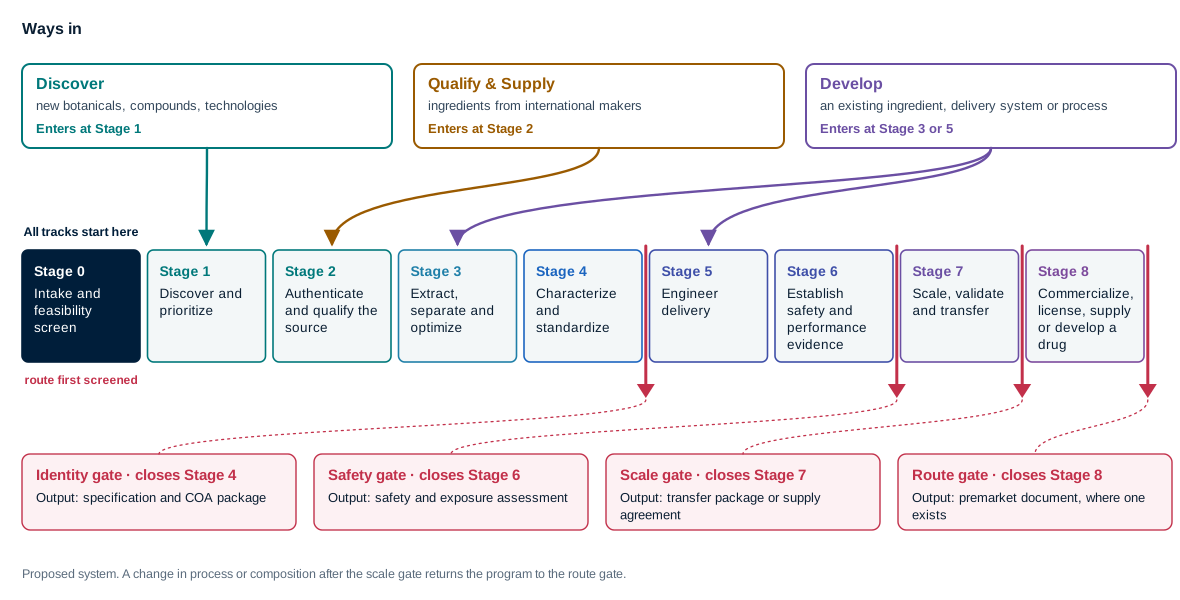
Fifteen detailed steps, filed under the eight Engine stages
Each Engine stage holds one or more detailed steps. Discover enters at Stage 1 (steps 1–2), Qualify & Supply at Stage 2 (step 3) and Develop at Stage 3 or 5 (step 5 or 6). Lawful import (step 4) sits in Stage 2 because samples already need prior notice, and is completed for commercial supply before the scale gate. The channel (supplement, food, cosmetic or drug) is named at the intake screen and confirmed at the route gate, because the first lawful use fixes it. Every stage ends in a written decision to progress, repeat or stop; the four named gates are the decisions that close a block of stages.
The step-by-step table and the detail for each step follow, closed by default: open the fifteen-step detail for the methods, standards, records and stop conditions behind each step.
Text version of the figure
- Ways in: Discover (new botanicals, compounds and technologies) enters at Stage 1, Qualify & Supply (ingredients from international manufacturers) at Stage 2, and Develop (an existing ingredient, delivery system or process) at Stage 3 or 5 with its specification. All pass the Stage 0 intake screen first.
- Stage 0 · Intake and feasibility screen: intended use named; lawful route and evidence cost screened (route gate, first pass).
- Stage 1 · Discover and prioritize: 1 find candidates; 2 identify the actives.
- Stage 2 · Authenticate and qualify the source: 3 qualify suppliers; 4 import legally (samples, then commercial lots).
- Stage 3 · Extract, separate and optimize: 5 make the ingredient.
- Stage 4 · Characterize and standardize: 7 validate methods; 8 screen for unknowns. Identity gate: identity on real lots, content held to a specification, validated methods.
- Stage 5 · Engineer delivery: 6 formulate; 11 choose the final format.
- Stage 6 · Establish safety and performance evidence: 9 safety and efficacy studies (partner-led), 10 set a safe dose, 12 test combinations. Safety gate: no known hazard at the intended exposure; EDI/ADI ≤ 1.
- Stage 7 · Scale, validate and transfer: transfer package; commercial import completed (step 4). Scale gate: commercial lots meet the specification, entry is cleared and the terms are written.
- Stage 8 · Commercialize, license, supply or pursue drug development: 13 third-party validation (partner-led), 14 choose markets, 15 drug path if warranted (partner-led). Route gate, confirmed before any public step. Then launch, license or stop.
Reference
The intake screen and all eight Engine stages on one sheet
The question each stage answers, when a program proceeds past its gate, the record it leaves and the change that sends it back to the feasibility screen, as on the Ingredient Engine page. All entries are proposed.
| Stage | Question | Proceeds when | Produces | Re-screen if |
|---|---|---|---|---|
| 0 · Intake and the regulatory and economic feasibility screen | Is there a lawful route for the intended use, and can its evidence be produced at a cost the product can carry? | A lawful route exists for the intended use, and its evidence can be produced at an acceptable cost. | A dated screen record that every later gate reads and amends | No; a change here does not re-run the screen by itself |
| 1 · Discover and prioritize | Which candidates deserve laboratory time, and on what evidence? | The candidate has documented starting evidence, a category hypothesis and a source that can be qualified. | Candidate dossier, active-constituent map, draft target product profile | No; a change here does not re-run the screen by itself |
| 2 · Authenticate and qualify the source | Is the material what the supplier says it is, and can it be supplied consistently and lawfully? | Two orthogonal methods agree with an authenticated reference, adulterant screens are negative, and several documented lots are available. | Identity passport, supplier qualification file, import file | A new species, plant part, origin or supplier |
| 3 · Extract, separate and optimize | Which process gets the actives out at a defined composition, with an acceptable residue and cost? | The process gives the target composition repeatably at laboratory scale, the mass balance closes and the residue fits the category. | Process description, laboratory design space, closed mass balance | A new solvent, concentration or purification step |
| 4 · Characterize and standardize | What is in the material, how much does it vary, and can every specification be measured reliably? | Every attribute has a fit-for-purpose method, composition falls in a range that can be justified, and contaminants are below the proposed limits. | Specification with reasons for each limit, validated methods, certificate-of-analysis format | No; a change here does not re-run the screen by itself |
| 5 · Engineer delivery | Which barrier limits the active, and which carrier addresses it in the intended format? | The prototype meets its physical and chemical stability targets, and a stated mechanism links the carrier to the identified barrier. | Formulation prototype, delivery technology dossier | A new carrier, particle size or dosage form |
| 6 · Establish safety and performance evidence | Is the ingredient safe at the intended intake, and does the product do what its design is meant to do? | No hazard is known at the intended exposure, EDI/ADI is 1 or less, and the performance target set at stage 5 is met by the kind of evidence the intended claim needs. | Safety and exposure assessment, study reports, stability data | A new population, dose or claim |
| 7 · Scale, validate and transfer | Does a larger process make on-specification material with its critical parameters known, and can another site repeat it? | Consecutive pilot batches meet the specification under a written control strategy, and every release attribute has a validated method. | Process development and transfer package, control strategy | A change of process, scale or site |
| 8 · Commercialize, license, supply or pursue drug development | Which route turns the evidence into value: a client program, a license, supply or a partnered drug program? | A customer or partner commits, ownership and data terms are agreed before work starts, and counsel has reviewed freedom to operate. | IP and commercialization assessment, supply and quality agreements, or a partnering file | New claims, a new market or a drug use |
The fifteen-step detail Select to show or hide the step table and one section per step group: candidates, suppliers and import, methods, safety, dose, format, combinations, markets and the drug path
Step by step
Each row is one detailed step: the Engine stage it belongs to, the question it answers, the methods and named standards, the record it would leave, the condition that stops a weak candidate, and who would do the work. Stop conditions are proposed internal criteria unless a rule is cited.
| Step | Question | Methods and standards | Record | Stop if | Who |
|---|---|---|---|---|---|
| 1 · Find candidatesStage 1 | Which candidates are worth testing, on what starting evidence? | Historical and traditional-system texts, ethnobotanical surveys with local communities, and literature and database review | Candidate dossier with sources and access status | No documented starting evidence, the species is threatened without a sustainable source, or access terms cannot be agreed | In house, with field researchers in the provider country |
| 2 · Identify the activesStage 1 | Which constituents carry the effect? | Bioactivity-guided fractionation, dereplication, molecular networking, LC-HRMS and NMR | Active-constituent map and draft markers | Activity disappears on fractionation or traces to a known toxicant | In house; NMR at partner laboratories in Phase I |
| 3 · Qualify suppliersStage 2 | Can a supplier deliver the right material, consistently and lawfully? | Capacity and cGMP audit, certificate-of-analysis verification and specifications per 21 CFR 111.70. USP <561>, <563>, <565>, ICH Q3C and Q3D as benchmarks | Supplier qualification file and approved specifications | Lots fail identity or contaminant limits, or the supplier cannot be audited | In house, with in-country auditors |
| 4 · Import legallyStage 2 | Can the material enter the United States lawfully? | FDA Prior Notice, Foreign Supplier Verification Program, USDA APHIS permits, CITES, and provider-country access and benefit-sharing (Nagoya Protocol) | Import file: permits, prior notices, FSVP records, access agreements | A required permit or access agreement is missing | In house, with customs brokers |
| 5 · Make the ingredientStage 3 | Can the actives be extracted, purified and held to a defined content? | Extraction, purification and standardization; EMA extract types (standardized, quantified, other) | Process description and ingredient specification | Content cannot be held within a defined range lot to lot | In house (laboratory, then pilot) |
| 6 · FormulateStage 5 | Does the ingredient work in a stable product? | Prototype formulation, compatibility and stability studies | Prototype formula and stability data | The actives degrade or separate within the intended shelf life | In house |
| 7 · Validate methodsStage 4 | Can every specification be measured reliably? | ICH Q2(R2) as the validation framework, AOAC and USP methods where they exist, and 21 CFR 111.75(h)(1) | Validated methods with validation reports | A specification has no scientifically valid method | In house |
| 8 · Screen for unknownsStage 4 | Is anything present that the specification does not name? | Non-targeted LC-HRMS and spectral-library screening for adulterants and unknowns | Non-targeted screening report | An adulterant or unexplained major constituent appears | In house |
| 9 · Safety and efficacy studiesStage 6 | Is it safe at the intended intake, and does it do what is claimed? | Selected for each ingredient from its known hazards, prior human use, intended intake and regulatory route: in vitro screens, GLP studies (21 CFR Part 58) to OECD 408, 471, 487, 473/474, 414, 416/443 and 451/453, and limited human studies | Study reports; NDI notification if required | Genotoxicity, a low NOAEL relative to intake, or no effect in humans | Partner GLP laboratories and CROs; in vitro screens in house |
| 10 · Set a safe doseStage 6 | What daily intake does the evidence support? | NOAEL or benchmark dose with safety factors, EDI/ADI, margin of exposure, TTC, and FDA 2005 HED scaling for drugs. An LD50 ranks acute hazard and does not set a human intake | Safety calculation and intake limit | EDI/ADI is greater than 1 at the intended dose | In house, on partner data |
| 11 · Choose the final formatStage 5 | Which delivery format gives the needed exposure? | Lipid systems, nanoemulsions, phospholipid complexes, cyclodextrins, solid dispersions, ion pairing; human PK where justified | Delivery dossier with exposure data | No format raises exposure, or the format changes the safety case | In house; human PK with CROs |
| 12 · Test combinationsStage 6 | Do combinations add, multiply or cancel effects, or interact with drugs? | Loewe additivity, Bliss independence, combination index, isobolograms; CYP and transporter interaction screens | Combination and interaction report | Antagonism, or a clinically relevant drug interaction | In house in vitro; clinical studies with CROs |
| 13 · Third-party validationStage 8 | Will an independent body confirm the claims made? | Third-party testing and certification, USDA organic (7 CFR Part 205) and non-GMO programs | Certificates and audit reports | A claim cannot be certified or substantiated | Certifiers and accredited laboratories |
| 14 · Choose marketsStage 8 | Where does the ingredient fit, under which rule? | Supplements (21 CFR Part 111), foods and beverages (Part 117, GRAS), cosmetics (MoCRA) and new dosage forms | Market-access assessment | The intended use falls outside every lawful channel | In house, with customers and counsel |
| 15 · Drug path, if warrantedStage 8 | Should a therapeutic signal become a drug program? | 21 U.S.C. 321(ff)(3)(B), IND (21 CFR 312), FDA Botanical Drug Development Guidance (2016) | Channel decision and partnering file | No partner, or the supplement channel is already the chosen first use | Spin-off, licensee, buyer or CDMO and CRO partners |
Rules as cited in the stage sections below; eCFR current to October 21, 2026. Phase I is the proposed laboratory core on the facilities roadmap.
Candidates and their actives
A Discover candidate can start from documented human use (historical and traditional-system texts, ethnobotanical surveys of local people), from the scientific literature, or from a compound or technology already described. Traditional use is not clinical proof. The Develop and Qualify & Supply tracks skip Stage 1 (steps 1 and 2). Kew counted 25,791 documented medicinal plant species in 2020; of 5,411 assessed for extinction risk, 723 (13%) were threatened, so sourcing is screened from the start.
The actives are then traced by fractionating an extract and testing each fraction, with dereplication to drop known compounds early. Detail: discovery and characterization and targeted and non-targeted analysis.
| Method | What it answers | Limit |
|---|---|---|
| Bioactivity-guided fractionation | Which fraction keeps the activity, step by step | Activity spread across several constituents can be lost on separation |
| Dereplication | Whether an active fraction holds an already-known compound | Only as good as the reference spectra and databases |
| Molecular networking (GNPS) | Which constituents are structurally related, from MS/MS spectral similarity | Similar spectra suggest, but do not prove, related structures |
| LC-HRMS | Accurate mass and fragments for each constituent | Isomers can share a formula; identity needs a standard or NMR |
| NMR | Full structure of an isolated constituent | Needs milligram amounts of a purified compound |
Royal Botanic Gardens, Kew. State of the World's Plants and Fungi 2020, doi:10.34885/172; Wang M, et al. Nat Biotechnol 2016;34:828–837 (GNPS). Related: botanical atlas, heritage.
Suppliers and import
A supplier's certificate of analysis does not establish identity: a supplement manufacturer must verify the identity of every dietary ingredient by at least one test or examination before use. USP chapters and ICH limits written for medicines would serve as benchmarks for specifications, not as legal requirements for supplements. Import adds FDA, USDA and treaty duties, and access to the plant falls under the provider country's law. Buyer duties: FSVP for buyers.
| Requirement | Rule or benchmark | Record |
|---|---|---|
| Identity, purity, strength, composition and contaminant limits for each component | 21 CFR 111.70(b)(1)–(3) Regulation | Component specification |
| At least one identity test or examination of every dietary ingredient before use | 21 CFR 111.75(a)(1)(i) Regulation | Lot identity record |
| Scientifically valid test methods | 21 CFR 111.75(h)(1) Regulation | Method file |
| Botanical tests and identification | USP <561> Articles of Botanical Origin; <563> Identification of Articles of Botanical Origin; <565> Botanical Extracts Benchmark | Specification references |
| Elemental impurities | ICH Q3D(R2) oral PDE: lead 5, cadmium 5, inorganic arsenic 15, inorganic mercury 30 µg/day Benchmark | Contaminant limits |
| Residual solvents | ICH Q3C(R9): benzene 2 ppm (Class 1); hexane 290 ppm and methanol 3,000 ppm (Class 2, Option 1) Benchmark | Solvent limits |
| Advance notice of imported food | FDA Prior Notice, 21 CFR 1.276–1.285 Regulation | Prior Notice confirmations |
| Foreign supplier verification by the importer | 21 CFR Part 1, Subpart L; § 1.511 for dietary supplements Regulation | FSVP file |
| Plant material entry and protected species | USDA APHIS permits; CITES permits for listed species Regulation | Permits |
| Access and benefit-sharing | Nagoya Protocol (adopted October 29, 2010; in force October 12, 2014): prior informed consent and mutually agreed terms. The United States is not a Party; the provider country's law applies at the point of access Treaty | Access permit and benefit-sharing agreement |
eCFR Title 21, Parts 1 and 111 (current to October 21, 2026); USP Herbal Medicines Compendium, general chapters list; ICH Q3D(R2) (2022), Q3C(R9) (2024); Convention on Biological Diversity, “About the Nagoya Protocol”. Related: quality standards, CFR atlas, contaminants.
Ingredient, formulation and methods
Extraction yield and purity are different measures, and the extract type decides how the content is controlled. The European Medicines Agency's herbal committee distinguishes three types. Formulation then has to keep the actives intact through shelf life, and every specification needs a validated method. Detail: extraction, purification and standardization, emulsions and colloids, method development.
| Extract type | Definition (quoted) | What is controlled |
|---|---|---|
| Standardized | “adjusted within an acceptable tolerance to a given content of constituents with known therapeutic activity” | Content of the active constituents |
| Quantified | “adjusted to a defined range of constituents (active markers)” | A range of marker constituents |
| Other | “essentially defined by their production process (state of the herbal drug to be extracted, solvent, extraction conditions) and their specifications” | The process and the specification |
EMA/HMPC/186645/2008, Reflection paper on the level of purification of extracts to be considered as herbal preparations (adopted September 16, 2010), section 6.
Methods would be validated with ICH Q2(R2), which FDA issued as final guidance in March 2024 for registration applications; for supplements the legal test is a scientifically valid method (21 CFR 111.75(h)(1)). A targeted method finds only what it looks for, so non-targeted screening would look for adulterants and unknowns. Separately, a widely cited 2013 DNA-barcoding survey of herbal products was retracted in 2024 after an investigation found evidence of data fabrication. Detail: targeted and non-targeted analysis, instruments.
FDA, Q2(R2) Validation of Analytical Procedures, final guidance, March 2024; 21 CFR 111.75(h); BMC Medicine retraction notice, July 4, 2024.
Safety and efficacy studies
Part 58 (good laboratory practice) governs nonclinical studies supporting INDs, NDAs, food additive petitions and GRAS submissions; NDI notifications are not on its list, and FDA's 2026 NDI guidance does not mention GLP. EUTECNIQ would still commission definitive studies from GLP partner laboratories so the data could support a later drug or food filing. Detail: toxicology.
| OECD guideline | Detects | Duration and size, where cited | Role in an NDI notification |
|---|---|---|---|
| 471 Ames | Gene mutations in bacteria | — | Both FDA batteries |
| 487 or 473 | Chromosome damage in mammalian cells in vitro | — | Both batteries (FDA prefers the mouse lymphoma tk assay) |
| 474 | Chromosome damage in vivo (erythrocyte micronucleus) | — | Third study of the three-study battery |
| 408 | Target organs and a NOAEL after repeated dosing | 90 days of oral dosing | Basis for EDI/ADI and margin of safety |
| 414, 416, 443 | Developmental and reproductive effects | — | Reproductive study when labeled for pregnancy, lactation or young children |
| 451, 453 | Tumors after lifetime exposure | OECD 451: normally 24 months in rodents, at least 50 animals per sex per group | Not in the standard list. Recommended if a genetic toxicity test is positive (section VII.6), and routine in drug and food-additive programs |
21 CFR 58.1 and 58.3(e) (eCFR, current to October 21, 2026); FDA, NDI Notifications and Related Issues; Identity and Safety Information About the NDI, final guidance, October 2026, sections VII.1 and IX; OECD Test No. 451 (2018). A dash means the guideline's duration is not given here.
Human studies follow the animal data. A study designed to test whether a supplement can diagnose, cure, mitigate, treat or prevent a disease needs an IND under 21 CFR Part 312. A new ingredient then needs an NDI notification at least 75 days before marketing; FDA's answer is “acknowledged without objection” (see what FDA’s reply means). Detail: clinical research, NDI notifications, GRAS.
| Period | Acknowledged without objection |
|---|---|
| All substantive responses to December 2020 (1,078) | 36.5% |
| FY2018 (17 of 38) | 44.7% |
| FY2019 (19 of 40) | 47.5% |
| FY2022 (30 of 42) | 71% |
| FY2023 (27 of 44) | 61% |
FDA data obtained under FOIA, as reported by SupplySide Supplement Journal; counts differ by definition and are not FDA publications. FDA, Determining Whether Human Research Studies Can Be Conducted Without an IND, September 2013, section VI.D.1; 21 CFR 190.6.
From NOAEL to a safe dose
An LD50 ranks acute hazard; it does not set a daily intake, and the OECD deleted the classical LD50 test (TG 401) on December 17, 2002. A safe intake starts from a NOAEL. For drugs, FDA's 2005 guidance converts it by body surface area and divides by 10; for a new dietary ingredient, FDA's NDI guidance divides the mg/kg NOAEL by combined safety factors of about 100, 1,000 or 2,000. Detail: risk assessment.
| Reference point | Value or rule | Use |
|---|---|---|
| Combined safety factor, NDI | 100 for a chronic study, 1,000 from rodent and non-rodent 90-day studies, 2,000 from one rodent 90-day study | ADI = NOAEL ÷ factor; EDI/ADI ≤ 1 supports safety |
| Human equivalent dose, drugs | Rat mg/kg ÷ 6.2 (Km 6 vs 37 for humans); default safety factor 10 | First-in-human starting dose |
| Margin of exposure | ≥ 10,000 from a BMDL10 in animals: low concern for a genotoxic carcinogen | Impurities that are genotoxic and carcinogenic |
| Threshold of toxicological concern | 0.0025 (DNA-reactive), 1.5 (Cramer III), 9 (II), 30 (I) µg/kg bw per day | Screening of minor constituents without toxicity data |
FDA NDI guidance (October 2026), section IX.5–6; FDA (2005), Table 1; EFSA Scientific Committee, EFSA Journal 2012;10(3):2578; EFSA Scientific Committee, EFSA Journal 2019;17(6):5708; OECD, Test No. 401 publication page.
Delivery format and brain exposure
A delivery format can raise dissolution or absorption, but a stable nanoemulsion is a formulation result, not proof of bioavailability; only exposure measured in people shows that. Brain entry is limited further by efflux transporters on brain capillaries. A message that a product “crosses the blood–brain barrier to treat” a disease states a disease use, which makes it a drug. Detail: bioavailability design, ADME and PBPK.
| Approach | Principle | Evidence needed before a claim |
|---|---|---|
| Lipid-based systems | Keep a lipophilic compound dissolved through digestion; very lipophilic compounds may reach lymph | Human PK against the plain extract |
| Nanoemulsions | Small oil droplets raise the dispersed surface | Droplet size and stability, then human PK |
| Phospholipid complexes | Association with phospholipids changes solubility and membrane passage | Complex characterization, then human PK |
| Cyclodextrin inclusion complexes | A host molecule holds the compound in its cavity and raises apparent solubility | Complexation data, then human PK |
| Amorphous solid dispersions | A polymer holds the compound in a higher-energy, faster-dissolving form | Physical stability on storage, then human PK |
| Ion pairing and ion exchange | A counter-ion or resin changes charge, lipophilicity or release | Dissociation behavior, then human PK |
| Point | Evidence |
|---|---|
| CNS MPO score | Six properties (ClogP, ClogD7.4, MW, TPSA, HBD, most basic pKa), 0–6; 74% of 119 marketed CNS drugs scored ≥ 4, against 60% of Pfizer CNS candidates |
| Efflux at the barrier | P-gp and BCRP sit on the luminal membrane of brain capillary endothelium and pump substrates back into blood |
| Claim rule | Articles intended for the diagnosis, cure, mitigation, treatment or prevention of disease are drugs (21 U.S.C. 321(g)(1)); supplements may carry structure/function statements with the 21 CFR 101.93 disclaimer |
Wager TT, et al. ACS Chem Neurosci 2010;1:435–449; Porter CJH, Trevaskis NL, Charman WN. Nat Rev Drug Discov 2007;6:231–248 (lymphatic transport); Giacomini KM, et al. Nat Rev Drug Discov 2010;9:215–236; 21 U.S.C. 321(g)(1), 343(r)(6); 21 CFR 101.93. Related: delivery, dosage forms.
Combinations and interactions
“Synergy” is a measured result against a stated reference model, and the two common models can disagree: a combination can be synergistic under one and antagonistic under the other. Combinations with vitamins, minerals or other botanicals would be tested against both. Botanical–drug interactions belong in the same stage: 14 days of a St. John's wort extract (41 mg/day hyperforin) cut oral midazolam AUC by 79.4%. Detail: combination science; ingredient pairs: documented interactions in Supplements A–Z.
| Model | Expected effect without interaction | Read-out |
|---|---|---|
| Loewe additivity | Each agent behaves as a dilution of the other; dA/DA + dB/DB = 1 | Isobologram: points below the additive line indicate synergy |
| Combination index (Chou–Talalay) | CI = 1 additive | CI < 1 synergism; CI > 1 antagonism |
| Bliss independence | Agents act independently; expected fractional effect EA + EB − EA·EB (the product of the fractions left unaffected gives the same result) | Observed minus expected at each dose pair |
Tallarida RJ. J Pharmacol Exp Ther 2006;319:1–7; Chou T-C. Cancer Res 2010;70:440–446; Tang J, Wennerberg K, Aittokallio T. Front Pharmacol 2015;6:181; Mueller SC, et al. Eur J Clin Pharmacol 2006;62:29–36 (six parallel groups, 42 healthy men in total). D: dose of each agent alone giving the chosen effect; d: its dose in the mixture giving the same effect.
Certification and markets
Some label terms are defined by regulation and some only by private programs or by the seller. Each market has its own rule set, and the dosage form can move a product out of the supplement category. Detail: clean label and the applications pages.
| Term | Defined by | Rule |
|---|---|---|
| “100 percent organic”, “organic”, “made with organic” | USDA National Organic Program | 100%, at least 95% and at least 70% organic ingredients, excluding water and salt (7 CFR 205.301) |
| Bioengineered disclosure | USDA, 7 CFR Part 66 | Exempt if no ingredient intentionally contains a bioengineered substance, allowing up to 5% inadvertent presence per ingredient (§ 66.5(c)) |
| “Non-GMO” | Private programs | Not defined in Title 21 CFR |
| “Clean label” | The seller or retailer | The phrase appears in no section of Title 21 CFR (eCFR search, October 28, 2026) |
| Market | Main U.S. rule | Detail |
|---|---|---|
| Dietary supplements | “Intended for ingestion” (21 U.S.C. 321(ff)); manufacturing under 21 CFR Part 111 | Dietary supplements |
| Foods and beverages | 21 CFR Part 117; GRAS or food-additive status (mandatory GRAS notification proposed August 11, 2026) | Foods and beverages |
| Cosmetics | MoCRA: facility registration, product listing, serious adverse events reported within 15 business days | Cosmetics and personal care |
| New formats | FDA: sublingual products “are not dietary supplements and are not foods” (warning letter, February 5, 2019) | Dosage forms |
eCFR Title 7, Parts 66 and 205 (current to October 21, 2026); eCFR full-text search of Title 21 for “clean label” (0 results, October 28, 2026); 21 U.S.C. 321(ff); Federal Register, August 11, 2026 (91 FR 51834, proposed rule); FDA cosmetics registration and listing page; FDA warning letter to DK Vitamins, February 5, 2019.
Supplement or drug
An article that has been approved as a new drug, or investigated as one with substantial clinical investigations instituted and made public, is excluded from the supplement definition unless it was first marketed as a supplement or food. The first lawful use therefore decides the channel, which is why every track names its intended use at the start and the route gate confirms it before any public step. The drug path is long: FDA lists four botanical drugs approved under an NDA or BLA, from 2006 to 2023.
A naturally occurring constituent is not patent-eligible merely because it has been isolated (product-of-nature exception); markedly different compositions, processes, formulations and methods of use can be. Five-year new-chemical-entity exclusivity exists only for approved drugs, and supplements have no data exclusivity. A drug program would therefore go to a partner with drug development capacity.
| Option | What would transfer | What EUTECNIQ would keep |
|---|---|---|
| Spin-off | The candidate and its data, into a separately financed company | A stake and service work |
| License | Rights to patents on compositions, processes or uses | Ownership, with license income |
| Sale | The program outright | None after closing |
| Partnership with CDMOs and CROs | Manufacturing under drug GMP and clinical trial work | Program control |
Association for Molecular Pathology v. Myriad Genetics, 569 U.S. 576 (2013); Mayo v. Prometheus, 566 U.S. 66 (2012); FDA, Frequently Asked Questions on Patents and Exclusivity (“Exclusivity attaches upon approval of a drug product”). Options are proposals. Related: pharmaceutical partnerships, commercialization and licensing, legal status.
Where EUTECNIQ would work
EUTECNIQ would run steps 1 to 8 and the calculations of steps 10 to 12 in its own laboratory, and would place GLP studies, clinical trials, certification and any drug program with qualified partners. In the Qualify & Supply track, qualified external laboratories would run identity, contaminant and stability testing at first. Every gate decision and its record would stay in one file. None of this exists yet.
Related pages: Development pathway · How EUTECNIQ differs · Facilities and roadmap · Digital lab · Regulatory
Health information notice. These statements have not been evaluated by the Food and Drug Administration. Nothing on this site is intended to diagnose, treat, cure or prevent any disease, and nothing here is medical advice.
Read the full notice
The information is for general education only. It does not replace advice, diagnosis or treatment from a qualified health professional, or any medication a clinician has prescribed. Do not start, stop or change any medicine, supplement or herbal product because of something you read here. Talk to your doctor or pharmacist first, especially if you are pregnant or breastfeeding, have a medical condition, take any medicines, are preparing for surgery, or are caring for a child. Research findings, traditional uses and safety data are reported as their sources state them; they are not recommendations or claims about any product. If you think you may have a medical emergency, call your doctor or 911 at once.
EUTECNIQ Sciences sells no supplements or health products today and receives nothing from any product or ingredient mentioned on this site; any commercial interest it later has in an ingredient will be stated on that ingredient’s page.