Platform · Services Proposed servicesStandards and rules named
Answers about an ingredient, from identity to a regulatory dossier
Is the material what the label says? Is it clean enough? What evidence does its market require? EUTECNIQ proposes to answer these questions for biotech, pharmaceutical, botanical, food and cosmetic companies. Services are the first revenue line: they would fund the early work and build the data and models behind EUTECNIQ’s own ingredients. The page leads with three defined packages, each ending in a decision the client can act on; the complete catalog of fourteen proposed services follows, each with its client, its deliverable, the standard it would follow and the rule that usually creates the need.
Status. EUTECNIQ is in formation. It has no laboratory, hired staff, clients, prices, turnaround times or accreditation, and it offers none of these services today. Partner work would go to qualified organizations under written agreements; none is signed.
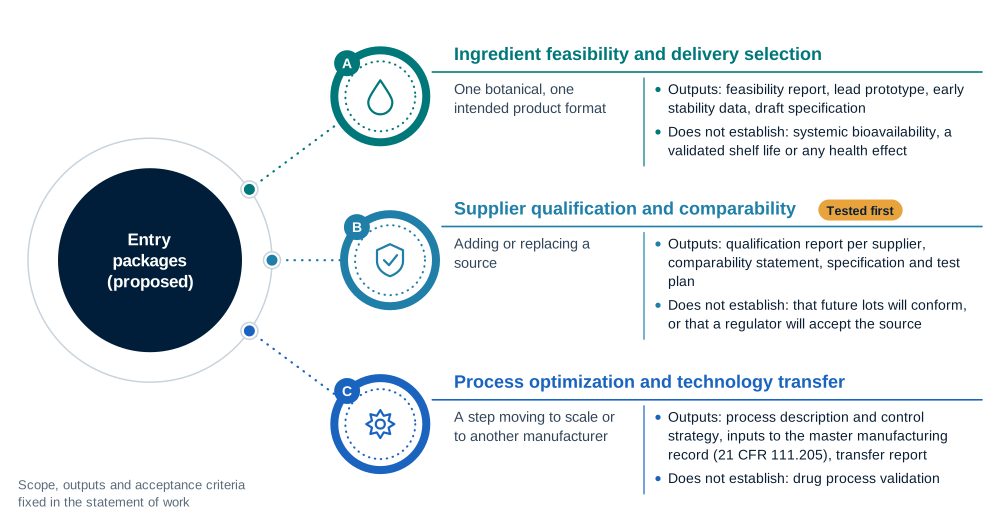
Three defined packages come first; Package B would be tested first
Each package has a fixed scope, written outputs and acceptance criteria agreed in the statement of work before work starts. Each also states what it would not establish. No prices are published; a package would be quoted after a technical review of the client’s material.
Tested first: Package B. Of the three entry packages, supplier qualification and comparability would be tested first. It answers the problem with the clearest published signal, needs the least equipment, and produces a result a client can check within weeks rather than years (the first test). An illustrative Package B report shows the format of its output.
A
Package A: Ingredient feasibility and delivery selection
For a brand or supplier with one botanical and one intended product format.
Scope
An identity and composition baseline by independent methods, then solubility, dispersibility and stability screening. A short list of delivery approaches, such as an emulsion, a spray-dried dispersion, encapsulation or complexation, tested in a designed experiment, with in vitro bioaccessibility where relevant.
Outputs
A feasibility report with a go, change or stop recommendation for each approach, a lead prototype, early stability data, a draft specification and a list of regulatory-category questions for the client’s counsel.
Acceptance criteria
The lead prototype meets the agreed target attributes at the agreed stability pulls, marker methods are shown fit for purpose, and every rejected approach has a documented reason.
Does not establish
Systemic bioavailability, a validated shelf life or any health effect.
B
Package B: Supplier qualification and comparability
Tested first
For a supplier, brand or importer adding or replacing a source.
Scope
One ingredient and up to three candidate suppliers, or an incumbent against an alternate. Specification review against 21 CFR 111.70(b), identity by HPTLC (USP <203>), microscopy and a chromatographic fingerprint, contaminant panels for the destination market at accredited partners, and lot-to-lot comparison.
Outputs
A qualification report for each supplier, a comparability statement, a recommended specification and test plan, a requalification schedule, and records that support an importer’s supplier verification.
Acceptance criteria
Comparability criteria and the number of lots fixed before testing; supplier certificate results confirmed within stated method uncertainty, the confirmation 21 CFR 111.75(a)(2)(ii) requires before a certificate can be relied on.
Does not establish
That future lots will conform, or that a regulator will accept the source.
C
Package C: Process optimization and technology transfer
For a client moving an extraction, drying, emulsification or blending step to scale or to another manufacturer.
Scope
A process map with a closed mass balance, critical parameters found by designed experiments and the scale-dependent parameters identified. A transfer protocol is agreed with the receiving site, which performs the confirmation runs.
Outputs
A process description and control strategy, inputs to the receiving site’s master manufacturing record (21 CFR 111.205), and a transfer report.
Acceptance criteria
Receiving-site batches meet the agreed specification for the agreed number of consecutive batches, the mass balance closes within the agreed tolerance, and deviations are investigated and documented.
Does not establish
Drug process validation. FDA’s process validation guidance does not cover dietary supplements.
Standards named: 21 CFR 111.70, 111.75, 111.205; USP <203>; FDA, Process Validation: General Principles and Practices (2011). Each package draws on lines of the complete catalog below.
Three entry packages: what each is for, what it delivers and what it does not establishSchematic · content from this page
Content from this section: Packages A, B and C as defined below. Proposed services; nothing is operating. Drawn by EUTECNIQ. Full-size SVG
Catalog Proposed
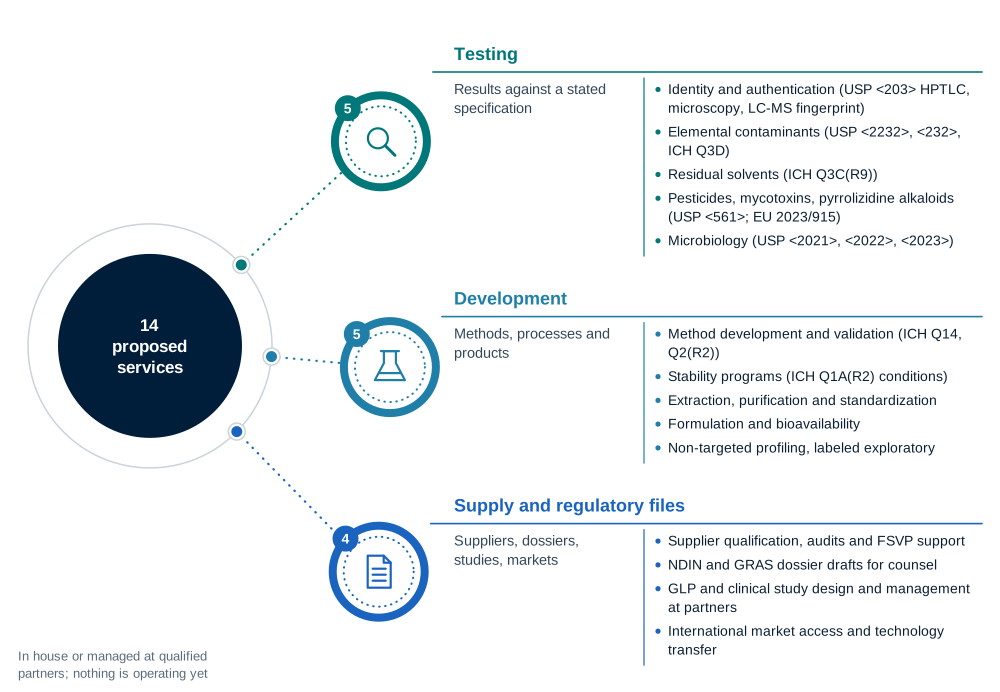
The complete catalog: fourteen proposed services
Each line is a service EUTECNIQ would offer, alone or as part of a package above, in house or managed at a qualified partner. The written outputs are the documents described on Scientific deliverables; engagement terms, IP and royalties are on Commercialization and licensing.
Proposed services with client types, deliverables, standards and regulatory drivers
Service
Typical client
Deliverable
Standard followed
Typical regulatory driver
Botanical identity and authentication
Supplement brand; ingredient supplier; pharmaceutical company
Identity report with orthogonal methods and reference material
USP <203> HPTLC; macroscopy and microscopy; LC-MS fingerprint; DNA where DNA survives processing
21 CFR 111.75(a)(1)(i) identity test for every dietary ingredient
Elemental contaminants
All client types
Results for lead, cadmium, arsenic and mercury against the client's specification
USP <2232> for finished supplements; USP <232> and ICH Q3D for drug products
21 CFR 111.70 specifications; drug-product limits
Residual solvents
Extract makers; pharmaceutical company
Solvent results by class
ICH Q3C(R9)
Drug-product limits; customer specification for extracts
Pesticides, mycotoxins, pyrrolizidine alkaloids
Ingredient supplier; importer; tea and food company
Residue and toxin results against the market's limits
Profile comparison between lots, sources or processes, labeled as exploratory
Method-specific; reported with its identification confidence
Comparability and adulteration questions
Supplier qualification, audits and FSVP support
Supplement brand; importer; food company
Supplier qualification package and audit report
21 CFR 111.75(a)(2); 21 CFR Part 1, Subpart L
Reliance on a supplier's certificate; FSVP for importers
NDIN and GRAS dossier preparation
Ingredient supplier; supplement brand; food company
Notification draft organized as FDA's guidance recommends, for counsel's review
FDA NDI final guidance (October 2026); 21 CFR Part 170 Subpart E
21 CFR 190.6; GRAS conclusions for food use
GLP and clinical study design and management
Ingredient supplier; supplement brand; biotech
Study design, partner selection, monitoring and an integrated report
21 CFR Part 58 and OECD test guidelines at partner GLP laboratories; 21 CFR 50 and 56 and ICH E6(R3) at partner CROs
Safety evidence for a notification; evidence for a claim
International market access and technology transfer
Ingredient supplier; supplement brand; pharmaceutical company
Market-access assessment; transfer dossier for the receiving site
The destination's rules; the receiving site's quality system
Foreign product classification; 21 CFR 111 or 117 at the receiving site
eCFR, 21 CFR 111.70, 111.75, 190.6, Parts 1 (Subpart L), 50, 56, 58 and 170, current to October 2026; USP-NF general chapters <203>, <232>, <561>, <2021>–<2023>, <2232>; ICH Q1A(R2), Q2(R2), Q3C(R9), Q3D(R2), Q14, E6(R3); Regulation (EU) 2023/915.
The fourteen proposed services, grouped by the question they answerSchematic · content from this page
Content from the catalog table in this section; the number in each badge counts its services. Drawn by EUTECNIQ. Full-size SVG
Clients Proposed
Who would buy which service
Drug developers need characterized material and methods before regulated studies. Brands and suppliers need identity, specifications and dossiers. Food and cosmetic companies need contaminant data and formulation work. The matrix is EUTECNIQ's planning assumption, not a survey.
Six client types, ten service families: where each would most likely startProposal
Planning assumption. Pharmaceutical work would stop where GLP, GCP and drug cGMP begin; see Pharmaceutical partnerships. Cosmetic safety substantiation under MoCRA: Cosmetics and MoCRA.EUTECNIQ management proposal.Text version of the client matrix
Biotech company: identity, methods, development, non-targeted profiling, studies at partners and technology transfer; contaminants and supplier work occasionally.
Pharmaceutical company: identity, contaminants, methods, development, profiling, supplier qualification, studies at partners and transfer; market access occasionally.
Botanical or supplement brand: identity, contaminants, development, supplier and FSVP work, dossiers, studies and market access; methods, profiling and transfer occasionally.
Ingredient supplier or importer: identity, contaminants, methods, development, supplier work, dossiers, market access and transfer; profiling and studies occasionally.
Food and beverage company: contaminants, development, supplier work and GRAS dossiers; identity, methods, studies, access and transfer occasionally.
Cosmetic company: contaminants and formulation development; identity, methods, supplier work, studies, access and transfer occasionally.
Context
Why the work is needed
Regulatory timelines, FDA response rates and study prices shape what a company needs before an ingredient reaches market.
75 daysminimum notice to FDA before a new dietary ingredient is marketed (21 CFR 190.6)
36.5%of 1,078 substantive FDA responses to NDI notifications, 1995 to 2020, were acknowledgments without objection
71%acknowledged among notifications filed 2010 to 2017 after a pre-NDI meeting with FDA
€105,600quoted EU price of a 90-day oral toxicity study in rats (OECD 408; range €87,200 to €161,200), quotes 2010 to 2018
21 CFR 190.6; FDA data as reported by J. Long, SupplySide Supplement Journal (December 18, 2020; June 28, 2018); Meigs et al., ALTEX 2018;35(3):275–305, Table 3.
Identity
Identity by orthogonal methods
Part 111 requires at least one appropriate test or examination to verify the identity of every dietary ingredient before use. No single method suits every material: microscopy needs intact tissue, DNA may not survive extraction, and a chromatographic fingerprint needs an authenticated reference. EUTECNIQ would combine methods whose failure modes differ.
A widely cited 2013 DNA-barcoding study of herbal products was retracted by BMC Medicine in July 2024; its figures should not be quoted. It is a reminder that a single method applied to extracts is a weak basis for an identity conclusion.
Identity methods, what each shows, its standard and its main limit
USP <203> HPTLC procedure for identification of articles of botanical origin
Depends on an authenticated reference and controlled conditions
HPLC or LC-MS fingerprint and markers
Marker identity, ratios and adulterant signals
Validated method (ICH Q2(R2) principles)
Markers can be added to a substitute material
DNA barcoding
Species of origin when DNA is intact
Reference sequences from vouchered specimens
DNA is often degraded or absent after extraction and heating
21 CFR 111.75(a)(1)(i); USP-NF <203> (2019); Retraction Note, BMC Medicine 2024, doi:10.1186/s12916-024-03504-x. Methods in depth: Botanical identity course.
Contaminants
Contaminant panels and their limits
Contaminant limits differ by product category and market, so the client's specification and destination decide which limit applies. USP <2232> limits elemental contaminants in finished dietary supplements and is not intended to set limits for dietary ingredients. ICH Q3D is written for drug products and excludes herbal products from its scope; its values are shown as a reference point.
Contaminant classes with example limits and their source
Class
Example limit
Source and scope
Elements, oral PDE
Cd 5, Pb 5, inorganic As 15, inorganic Hg 30 µg/day
200 µg/kg dried herbal infusions; 400 µg/kg for chamomile, peppermint and five others
Reg. (EU) 2023/915, sum of 21 PAs plus 14 co-eluting
Microbiology, dried botanicals
TAMC 105, TYMC 103 cfu/g; Salmonella and E. coli absent in 10 g
USP <2023>, Table 2
Microbiology, powdered extracts
TAMC 104, TYMC 103 cfu/g
USP <2023>, Table 2
ICH Q3D(R2) (2022); ICH Q3C(R9) (2024); USP-NF <2232> (2022), <232>, <2023>; USP stakeholder-forum presentation on <561> pesticide residues (2019); Commission Regulation (EU) 2023/915, Annex I. Detail: Contaminants, Microbiology, Certificate-of-analysis science.
Methods and development Proposed
Methods, stability and development
ICH Q2(R2) and Q14 were issued by FDA as final guidances for drugs in March 2024; EUTECNIQ would apply them to supplements and ingredients as good practice. Development work would end in a transfer package that another site can run, so the client is not tied to EUTECNIQ for routine testing or production.
Proposed development services, what the client would receive, and the related page
Service
The client would receive
What it would not establish
More
Method development and validation
Procedure, validation report, system-suitability criteria, transfer protocol
U.S. FDA, Q2(R2) Validation of Analytical Procedures and Q14 Analytical Procedure Development, final guidances, March 2024 (docket FDA-2022-D-1503).
Dossiers
NDIN and GRAS dossiers
About a third (36.5%) of FDA's substantive responses to new dietary ingredient notifications, 1995–2020, were acknowledgments without objection, and the rate varies widely by year. Notifications filed after a pre-NDI meeting fared better in FDA's own tracking, which is why EUTECNIQ's dossier service would start with gap analysis and a meeting request. EUTECNIQ would prepare the scientific dossier; the notifier and its counsel would sign and submit it.
FDA acknowledged 12.6% to 71% of NDI notifications without objection, depending on the yearFDA data, trade press
Fiscal years with a verified figure only. The pre-NDI figure covers 21 meetings FDA tracked from 2009 to 2016; FDA could not confirm the total number held.FDA data obtained by J. Long, SupplySide Supplement Journal: June 28, 2018 (pre-NDI meetings); December 18, 2020 (FY2017, FY2019, FY2020, cumulative); December 12, 2023 (FY2022, FY2023).
Facts that shape an NDIN or GRAS engagement
Fact
Value
Source
NDIN lead time
At least 75 days before marketing
21 CFR 190.6
FDA guidance on identity and safety information
Final, issued October 19, 2026
91 FR 66336 (Oct 20, 2026)
FDA paperwork estimate per NDIN
About 20 hours, excluding generating safety data
Federal Register, March 28, 2018
Mandatory GRAS notification
Proposed rule, August 11, 2026; comments due December 9, 2026
91 FR 51834; docket FDA-2025-N-3262
FDA estimate per GRAS notice
About 180 hours (170 to 190)
91 FR 51834
GRAS and supplements
GRAS applies to food use; a supplement ingredient follows the dietary-ingredient and NDI rules instead
A manufacturer may rely on a supplier's certificate only after qualifying the supplier, and importers carry their own verification duties. EUTECNIQ would build the qualification file, audit sites with or for the client, and confirm certificates by its own testing at a defined frequency.
Rules behind supplier and import work and what EUTECNIQ would deliver for each
Rule
What it requires
Proposed deliverable
21 CFR 111.75(a)(2)
Qualifying a supplier before relying on its certificate of analysis for other component specifications
Supplier qualification package with confirmatory test results
21 CFR 1.511
Modified FSVP for importers who, or whose customers, must set Part 111 specifications
FSVP file support for the importer
21 CFR 1.276–1.285
Prior notice to FDA of imported food shipments
Document checklist for the importer's broker
CITES; Nagoya Protocol
Permits for listed species; provider-country access and benefit-sharing law at the point of access (the U.S. is not a Party to Nagoya)
Sourcing-legality review in the supplier file
eCFR, 21 CFR 111.75 and Part 1, Subparts I and L, current to October 2026; CITES Secretariat; Convention on Biological Diversity. Buyer guide: FSVP for buyers.
Studies at partners Proposed
GLP and clinical studies at partners
EUTECNIQ would design toxicology and human studies, select and audit the partner, monitor the work and integrate the reports; it would not run GLP or clinical studies itself. 21 CFR Part 58 names food and color additives, drugs, devices and biologics, not dietary supplements, but EUTECNIQ would specify GLP for pivotal studies so one report can serve several dossiers. Human studies would run at partner CROs under IRB review and informed consent.
A 90-day rat study was quoted near €106,000; multigeneration reproduction and carcinogenicity studies about three to seven times as muchPublished price survey
Quotes from EU contract research organizations collected 2010 to 2018; they are likely below 2026 prices.Meigs L, Smirnova L, Rovida C, Leist M, Hartung T. ALTEX 2018;35(3):275–305, Table 3; doi:10.14573/altex.1807041.
The same ingredient can be a supplement in the United States, a traditional herbal medicinal product in the EU and a natural health product in Canada, each with different evidence rules. A market-access assessment would state the likely category, the evidence each market expects and the claims it allows, for review by local counsel.
Selected market pathways for botanical products
Market
Pathway
Key condition
United States
Dietary supplement (DSHEA 1994)
NDIN for ingredients not marketed before October 15, 1994; no disease claims
European Union
Traditional herbal medicinal product, Directive 2004/24/EC
At least 30 years of medicinal use, including 15 years in the EU
Canada
Natural Health Products Regulations (2004)
Product license (NPN); claims supported by evidence, which may include traditional evidence
Confidentiality would come before any sample or data moves, and ownership of results would be written into the agreement before work starts. The client would be told which work goes to which partner.
Eight steps from inquiry to report, with four data rules that hold throughoutProposal
EUTECNIQ management proposal; ownership terms consistent with Commercialization and licensing. Every agreement would be negotiated and reviewed by counsel.Text version of the engagement steps
Inquiry: a non-confidential description of the question.
Mutual NDA: signed before any confidential data or sample moves.
Scoping: feasibility, applicable standards, and which work would go to a named partner.
Agreement: scope, deliverables, acceptance criteria, IP and data terms.
Samples in: receipt, sample identifier, chain of custody, storage conditions.
Work to protocol: approved methods, recorded deviations and partner work under contract.
Review and release: technical review, then quality review and signature.
Report and data: report, raw data and methods; samples returned, kept or destroyed as agreed.
Throughout: the client owns the project-specific results it pays for, and EUTECNIQ keeps its background IP. Client data stays in a segregated project space and never enters EUTECNIQ's proprietary dataset or model training without written consent. Partners sign equivalent confidentiality terms.
Conflicts and confidentiality Proposed
Conflicts and confidentiality
A laboratory that also develops its own ingredients has a built-in conflict of interest. ISO/IEC 17025:2017 asks a laboratory to identify risks to its impartiality on an ongoing basis, to show how it removes or minimizes them, and to manage client information through legally enforceable commitments. EUTECNIQ would build both services and development on that frame and would plan to seek accreditation for a defined list of tests.
Two zones under one quality system: what may cross, what never crosses, and what must be declaredProposal
ISO/IEC 17025:2017 clauses 4.1 and 4.2 as summarized in PJLA checklist LF-56 (Rev. 1.1, December 2020); EUTECNIQ management proposal.
Proposed conflict and confidentiality rules, and the ISO/IEC 17025 clause each answers
Proposed rule
How it would work
Clause it answers
Impartiality register
Each new engagement checked against EUTECNIQ's own programs; conflicts recorded with the action taken
4.1.4 and 4.1.5: identify risks to impartiality; show how they are removed or minimized
Disclose or decline
A competing internal program is disclosed before the client signs, or the work is declined
4.1.5
Access control
Client projects open only to the named team; development staff have no default access
4.2.1: management of all information through legally enforceable commitments
Consent before reuse
Client data used for EUTECNIQ's dataset or models only with written consent, as the consent defines
4.2.1: the customer is told in advance what would become public
Partners and personnel
Partners, contractors and staff bound by the same confidentiality terms
4.2.4
ISO, ISO/IEC 17025:2017 General requirements for the competence of testing and calibration laboratories (edition 3, November 2017; reviewed and confirmed 2023): requirements for "competence, impartiality, and consistent operation" of testing and calibration laboratories. Accreditation would cover only listed tests. Quality plan: Quality system.
EUTECNIQ Proposed
Where EUTECNIQ would work
Services would start with identity, contaminant, method and dossier work in the Phase I laboratory, with GLP toxicology, human studies and overflow testing at qualified partners. Consulting would cover study design, supplier audits and market access. None of this exists yet.
Health information notice.These statements have not been evaluated by the Food and Drug Administration. Nothing on this site is intended to diagnose, treat, cure or prevent any disease, and nothing here is medical advice.
Read the full notice
The information is for general education only. It does not replace advice, diagnosis or treatment from a qualified health professional, or any medication a clinician has prescribed. Do not start, stop or change any medicine, supplement or herbal product because of something you read here. Talk to your doctor or pharmacist first, especially if you are pregnant or breastfeeding, have a medical condition, take any medicines, are preparing for surgery, or are caring for a child. Research findings, traditional uses and safety data are reported as their sources state them; they are not recommendations or claims about any product. If you think you may have a medical emergency, call your doctor or 911 at once.
EUTECNIQ Sciences sells no supplements or health products today and receives nothing from any product or ingredient mentioned on this site; any commercial interest it later has in an ingredient will be stated on that ingredient’s page.
Ready to start a development project?
Tell us about an ingredient you want to specify, verify or license. Questions? Email [email protected]