

Technologies · Scientific Intelligence · Computational research
From molecule to performance
One workspace that carries curcumin, quercetin and berberine from computed electronic structure to solubility, extraction, formulation, exposure and an extraction design space. A scene passes its result on only where a physical model connects it to the next; where none does, the workspace shows the gap.
CalculationsEverything here was computed from published data with open-source quantum chemistry and statistics. EUTECNIQ has not yet measured these compounds; the experiments that would test each result are listed.
In this release
- 26
- COSMO-type surfaces from density-functional calculations
- 1.19
- log-unit error on 396 mixture solubilities not used in the fit
- 6
- scenes, three of them linked by physical models
- 0
- EUTECNIQ laboratory measurements so far
Findings
What the connected calculations show
- Density-functional calculations produced COSMO-type surfaces, σ-profiles and electrostatic charges for 8 solute structures and 18 solvents. Before use, the pipeline reproduced a published ORCA ethanol surface to within 0.1% in area and 0.9% in the second σ-moment.
- With one fitted parameter, the enthalpy of fusion (46.8 kJ mol⁻¹; 95% interval 45–48), COSMO-SAC reproduces curcumin solubility in 15 pure solvents with an RMSE of 0.70 log units. In 396 mixtures of ethanol, n-propanol, isopropanol and propylene glycol with water, none used in the fit, the RMSE is 1.19, with the model up to 100-fold low at 10–40% cosolvent. The same activity model overstates the non-ideality of alcohol–water itself: it gives an infinite-dilution activity coefficient of 8.5 for ethanol in water against 3.77 measured (Straver and de Loos 2005), which shows that at least part of the mixture error lies in the activity model itself. Representing curcumin by its diketo tautomer instead lowers the mixture RMSE to 0.70 but raises the pure-solvent RMSE to 0.84; that tautomer lies 32.7 kJ mol⁻¹ higher in the conductor, so the better mixture agreement is not evidence for it, but it shows the mixture predictions are sensitive to how the solute is represented.
- For quercetin, with its measured melting data and nothing fitted, the error is 1.16 log units. Quercetin melts while decomposing, so its fusion data are themselves uncertain.
- Coupling solubility to the diffusion model changes the solvent decision. For 0.25 mm rhizome powder, 8 kg of solvent per kg and a 60-minute hold, the diffusion model alone gives at least a 90% chance of recovering 80% of the curcumin on 100% of the 5–45 °C, 30–100% ethanol grid; with the predicted solubility limit applied, 34% of the grid qualifies. At 45 °C the boundary sits at 40% ethanol. The kinetic inputs are scenarios, so the boundary is a hypothesis to test.
Workstation
Six scenes, one workspace
Choose a compound and step through the scenes. Inputs are on the left, the figure in the middle, and results with their evidence on the right. The line under the figure says what passes to the next scene, or that nothing does.
Loading
Connections
Which scenes are linked by a model
| Link | What would pass | Status | How |
|---|---|---|---|
| Molecule → Solvent | σ-profile of the computed structure | Model | COSMO-SAC 2010 (Hsieh et al. 2010) |
| Solvent → Extractor | solubility at the chosen solvent and temperature | Model | saturation cap on the diffusion model |
| Extractor → Formulation | extract composition | Gap | no model links extract to formulation behavior |
| Formulation → Body | release, dissolution, digestion | Gap | published formulation data are shown, not modeled |
| Body → Design space | exposure targets | Gap | the design space covers extraction only |
| Solvent + Extractor → Design space | solubility and kinetics with their uncertainty | Model | Monte Carlo probability of meeting the recovery specification |
Publication figures
Figures in journal format
Built to Nature's final-artwork specification: 183 mm wide, 5–7 pt sans-serif text, 8 pt panel letters, vector text in the PDF. Every plotted number comes from the scripts and files listed below.
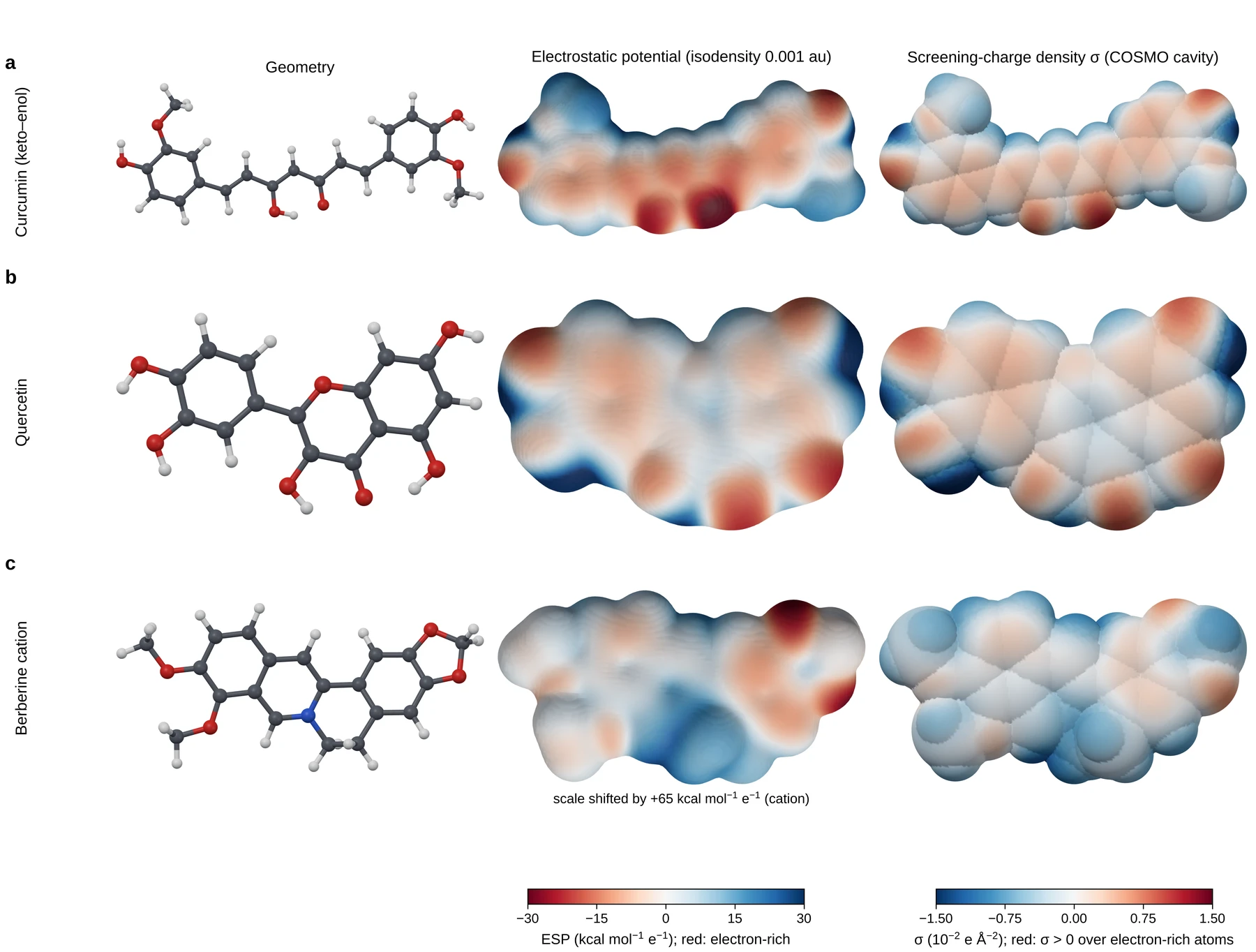
Fig. 1 | Computed electronic surfaces. Computed Rows: curcumin (keto–enol), quercetin and the berberine cation. Left: GFN2-xTB geometry. Middle: molecular electrostatic potential on the 0.001 e bohr⁻³ electron-density surface (BP86/def2-TZVP, gas phase); the cation's scale is centered on its median surface potential. Right: screening-charge density σ on the conductor cavity (C-PCM, ε → ∞, radii 1.2 × Bondi, BP86/def2-TZVP), averaged as in COSMO-SAC. Images are rendered from the computed meshes.
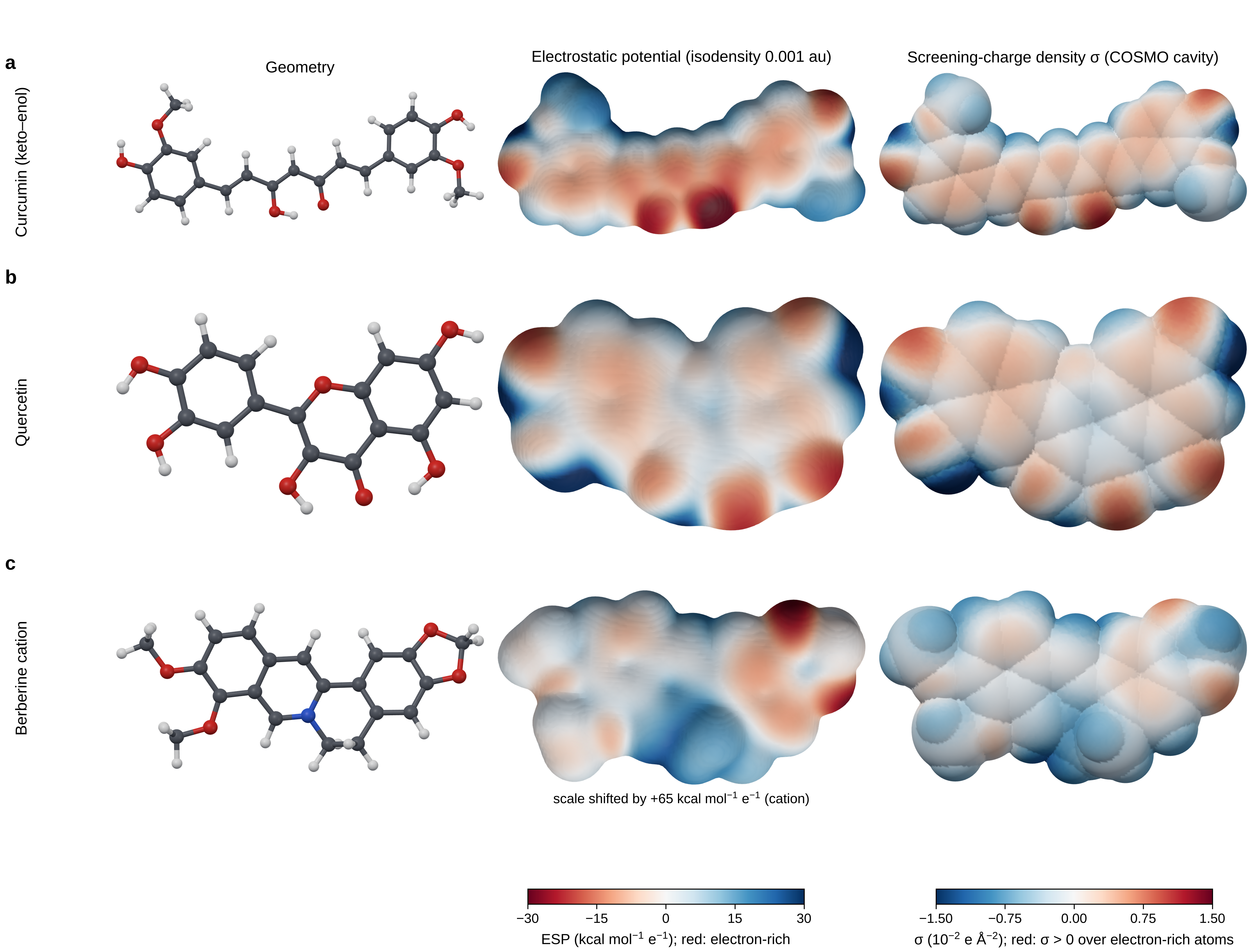
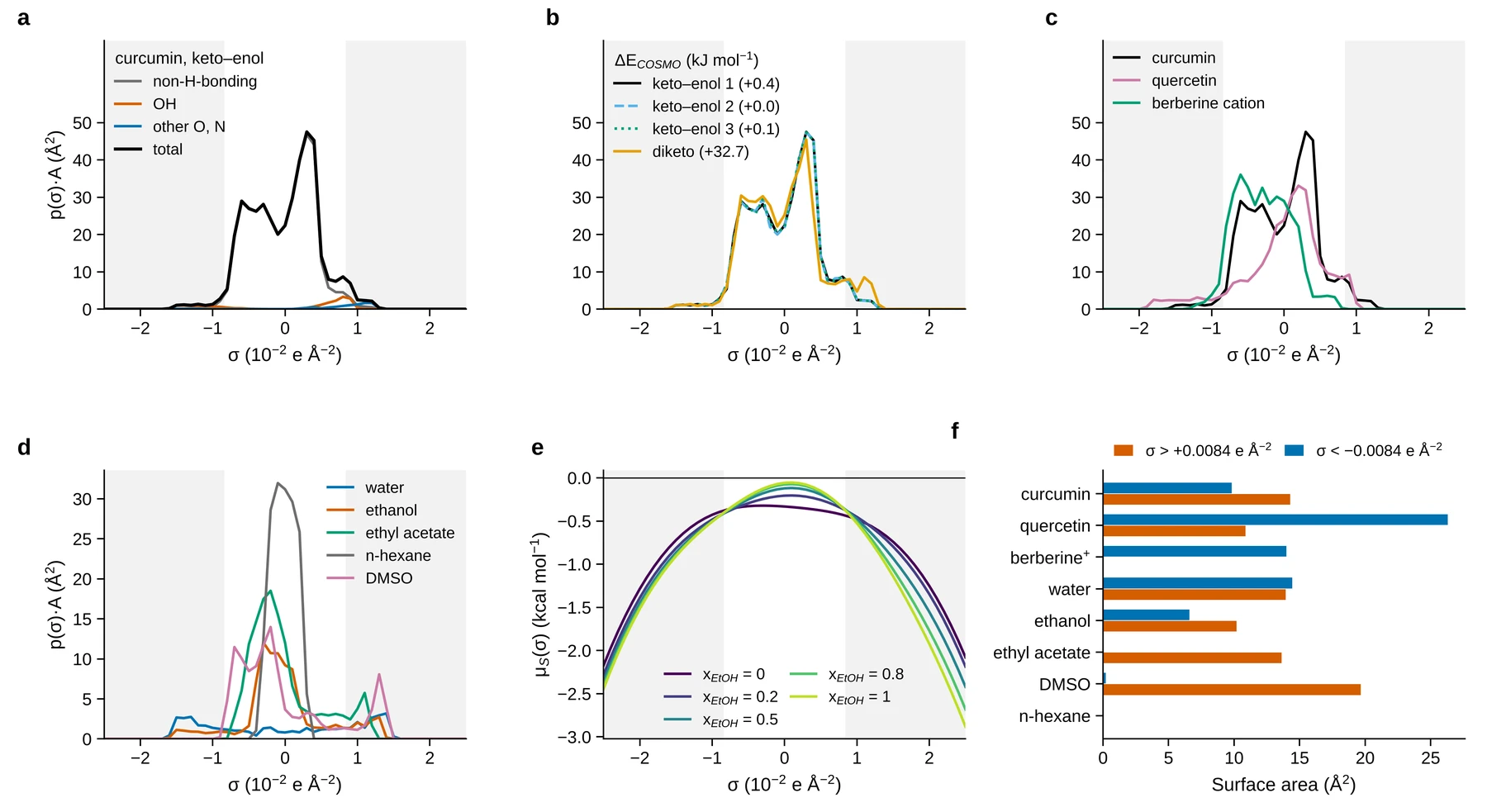
Fig. 2 | σ-profiles and σ-potentials. Computed a, Curcumin σ-profile split into non-hydrogen-bonding, hydroxyl and other hydrogen-bonding segments. b, Three keto–enol conformers and the diketo tautomer; legend values are C-PCM (ε = ∞) electronic energies relative to the lowest structure, at GFN2-xTB geometries, not free energies. c, The three solutes. d, Five solvents. e, σ-potentials of water–ethanol mixtures at 25 °C from the COSMO-SAC 2010 segment equations. f, Surface areas with σ beyond the COSMO-SAC hydrogen-bonding threshold of ±0.0084 e Å⁻² (gray bands in a–e); for the cation the negative-σ area reflects its charge, not hydrogen-bond donors.
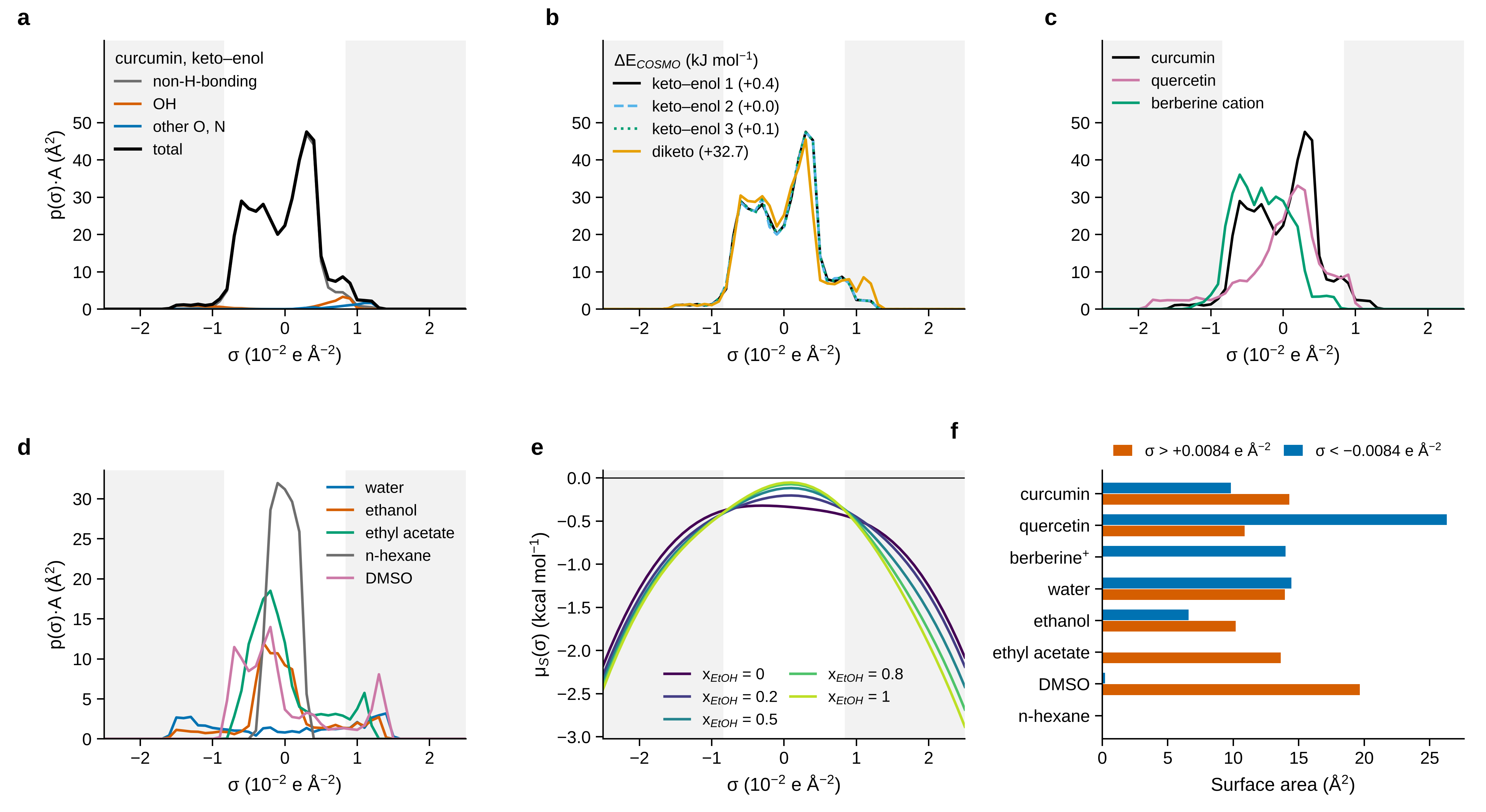
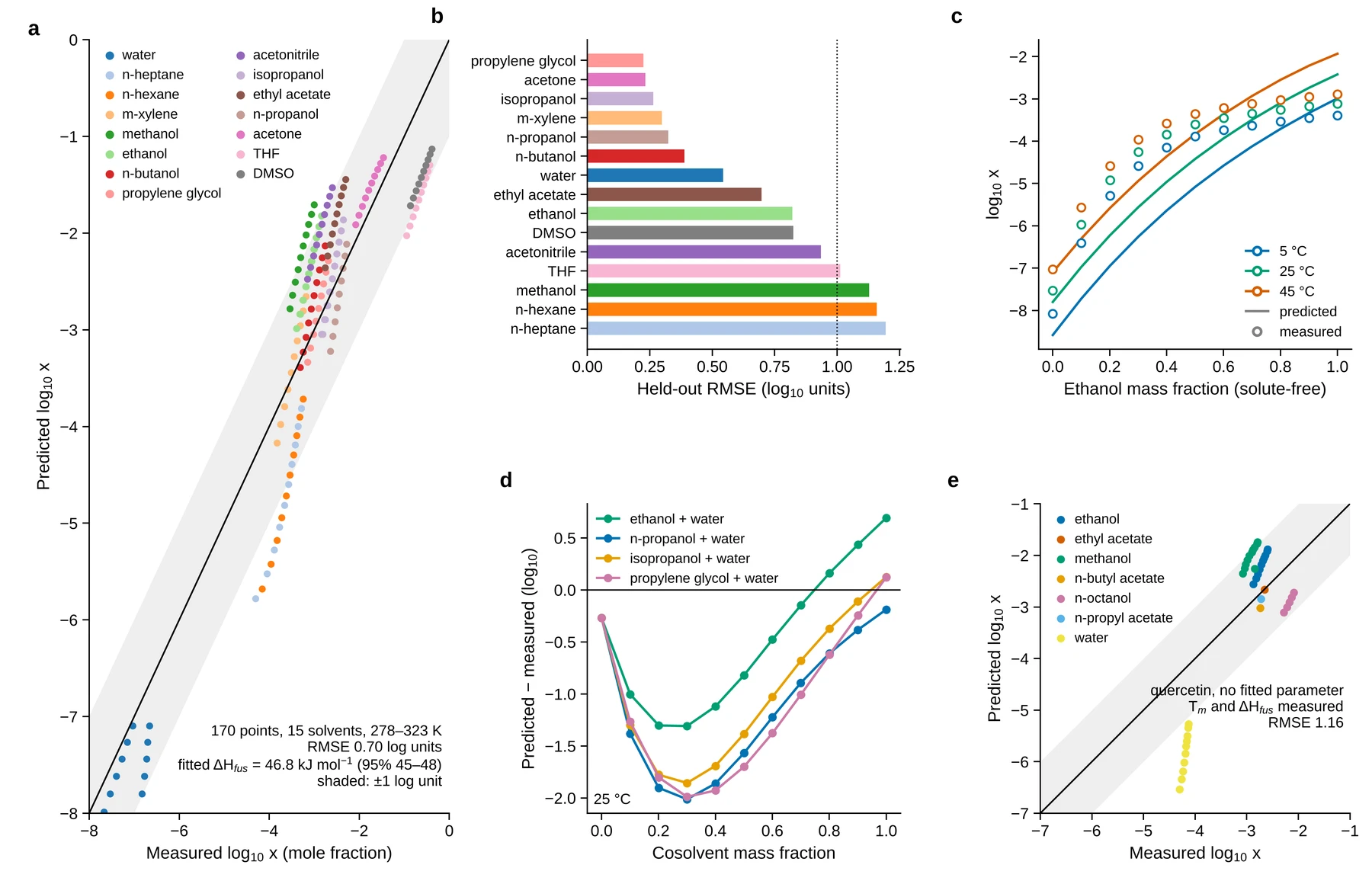
Fig. 3 | Solubility from computed σ-profiles against measurements. Calibrated a, Curcumin in 15 pure solvents at 278–323 K; one parameter, the enthalpy of fusion, fitted (46.8 kJ mol⁻¹). b, Leave-one-solvent-out error. c, Ethanol–water mixtures at three temperatures (Shen et al. 2019), not used in the fit. d, Residuals for four cosolvent–water systems at 25 °C. e, Quercetin with measured Tm and ΔHfus and no fitted parameter.
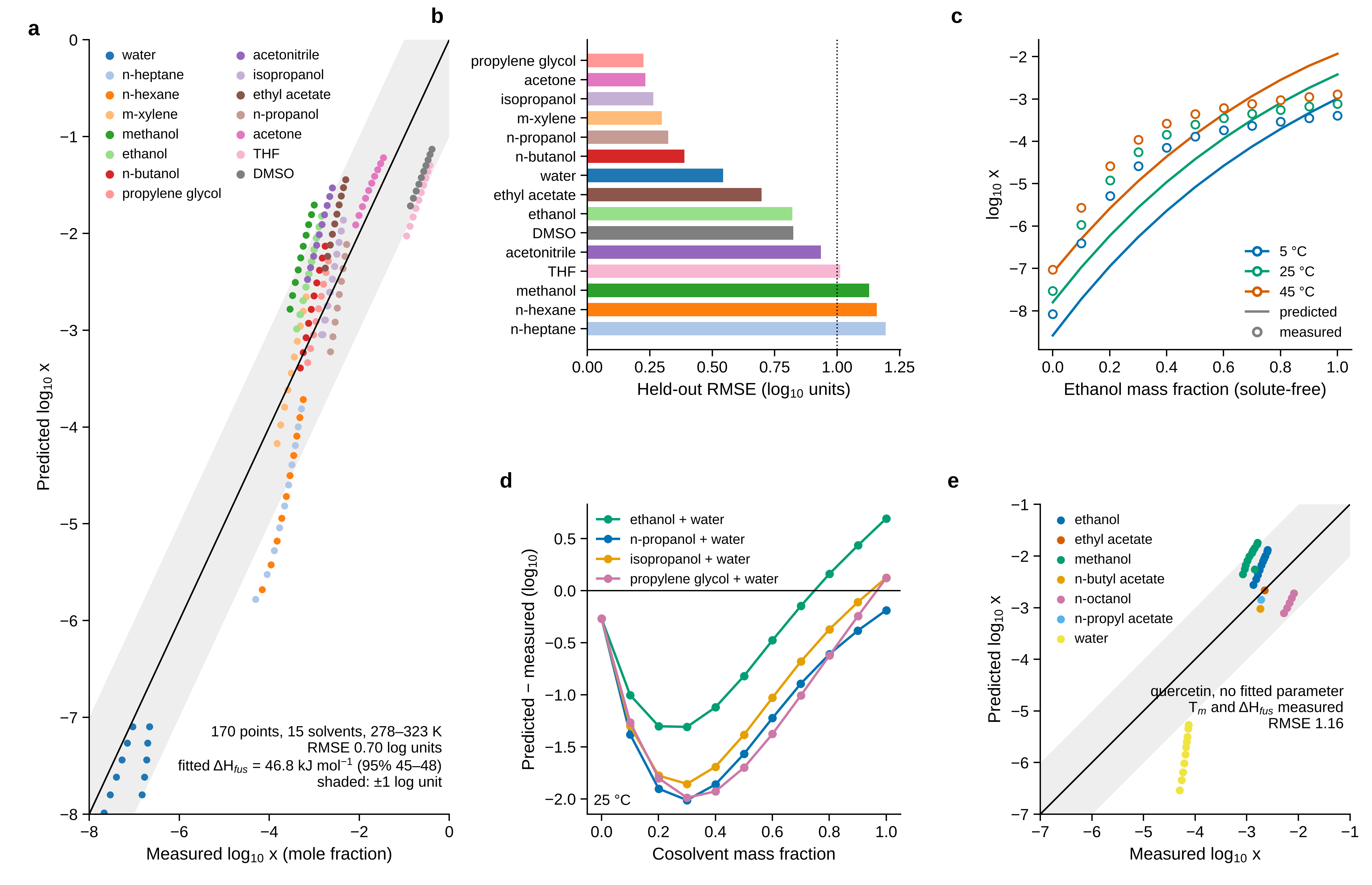
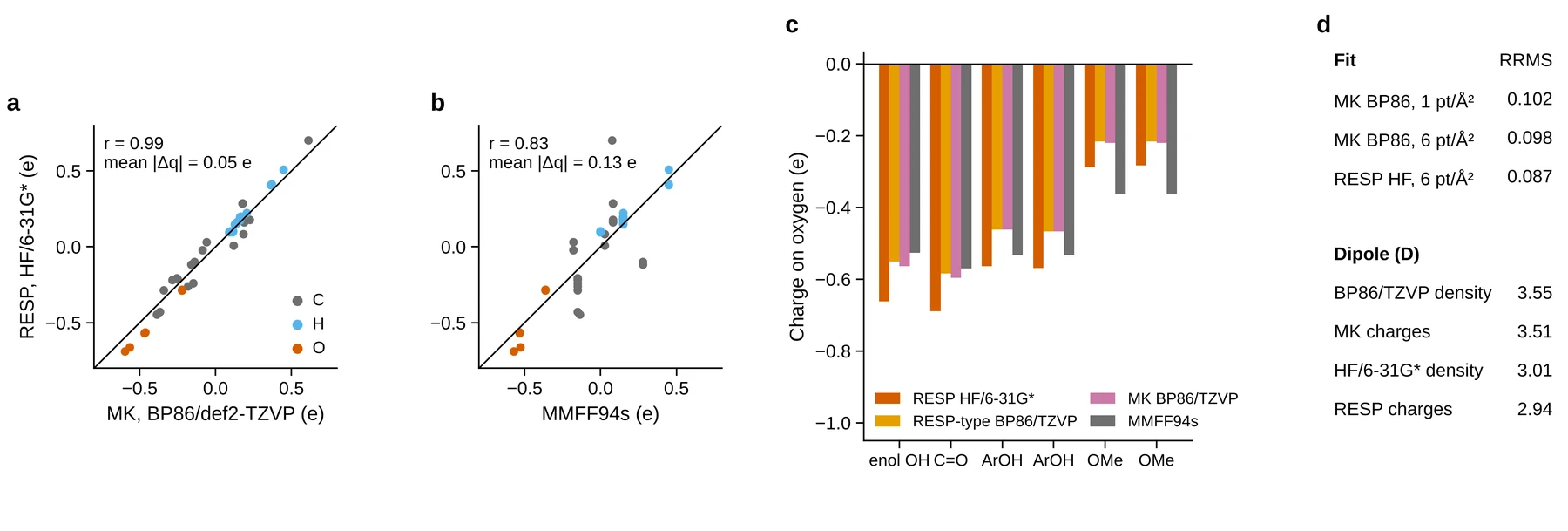
Fig. 4 | Electrostatic-potential-fitted charges of curcumin. Computed a, RESP charges (HF/6-31G*, two-stage restraint) against unrestrained Merz–Kollman charges from the BP86/def2-TZVP density. b, RESP against the MMFF94s charges used for conformer searches and molecular dynamics. c, Oxygen charges by method. d, Relative root-mean-square fit error and dipole moments.
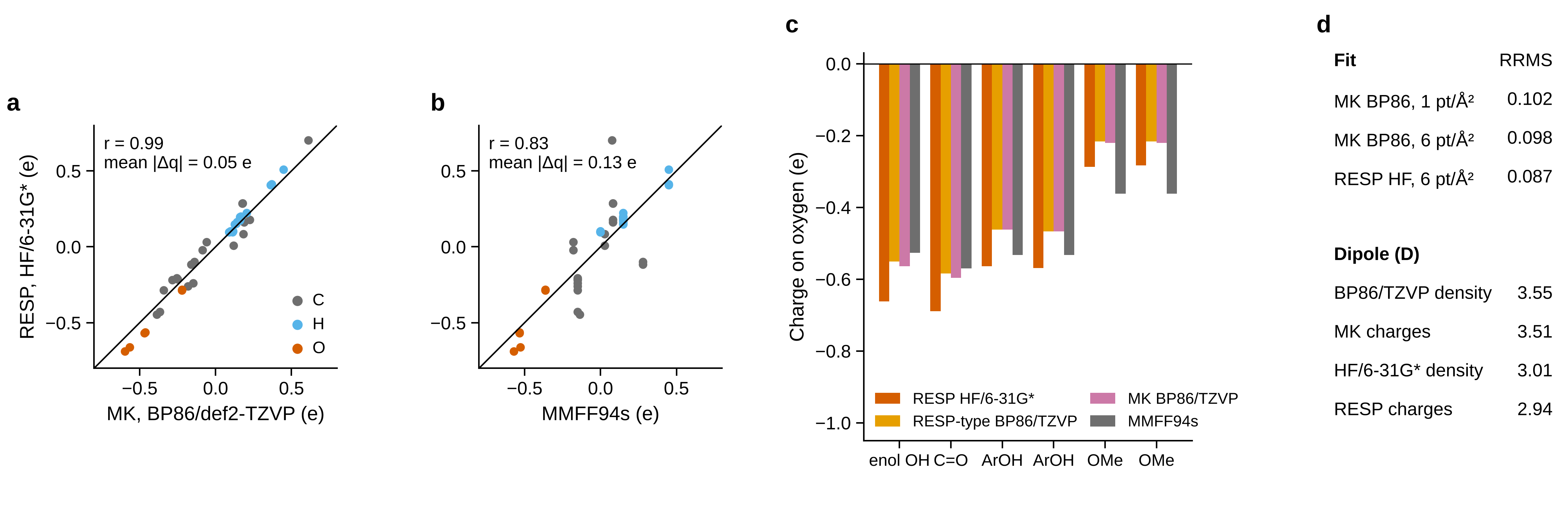
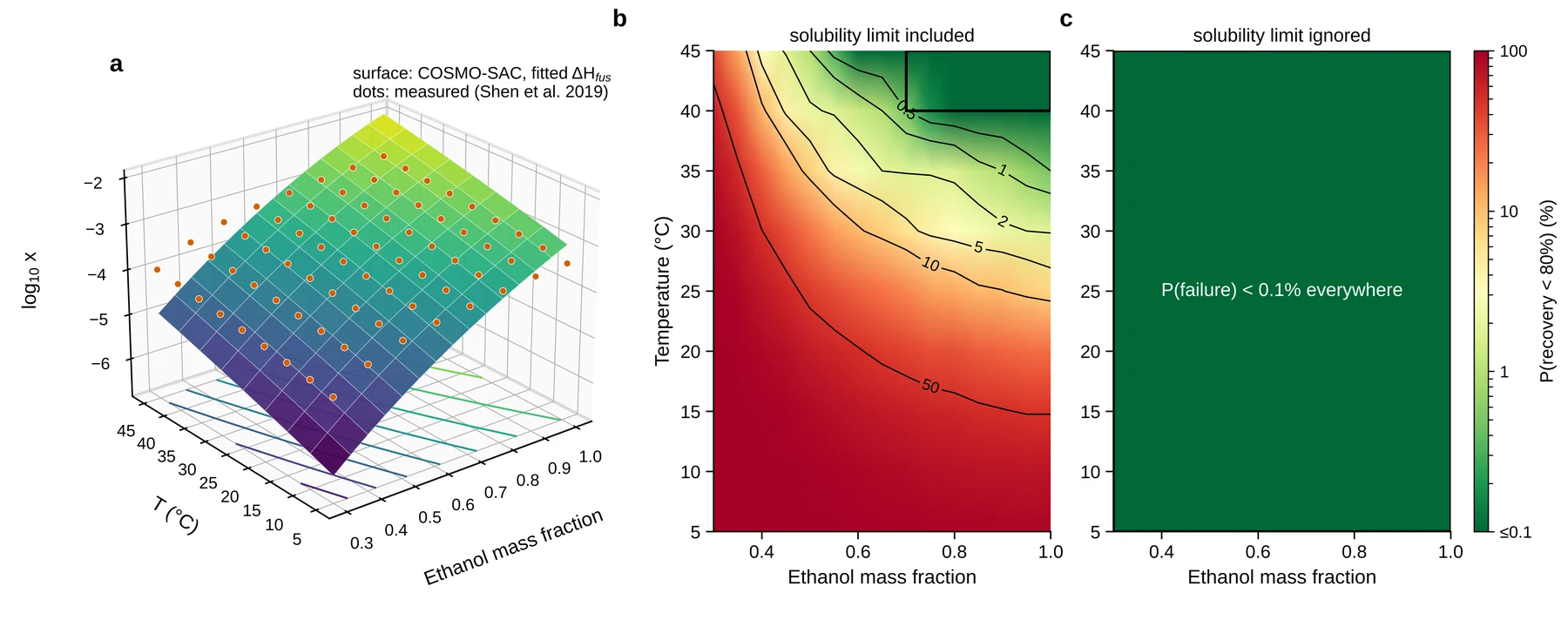
Fig. 5 | Solvent–temperature landscape and extraction design space. Predicted a, COSMO-SAC solubility of curcumin over ethanol fraction and temperature at the fitted enthalpy of fusion, uncorrected, with the measured points; the gap at low ethanol is the model error discussed in Fig. 3. b, Probability that less than 80% of the rhizome's curcumin is in solution after 60 min (0.25 mm particles, 8 kg solvent per kg); 600 Monte Carlo draws per point over enthalpy of fusion, solubility-model error and a scenario diffusivity. c, The same calculation with the solubility limit removed. Rectangles: largest windows with P(failure) ≤ 1%. Kinetic inputs are scenarios, so the maps are a method demonstration.
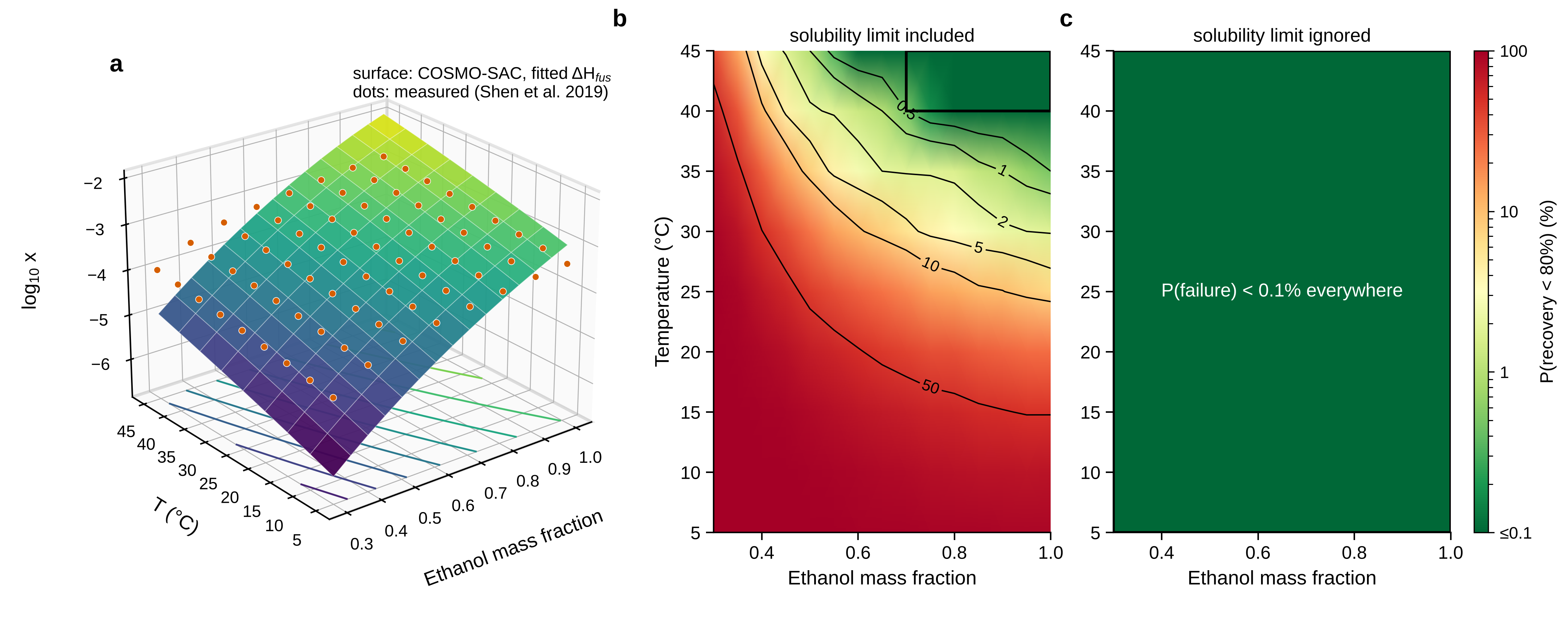
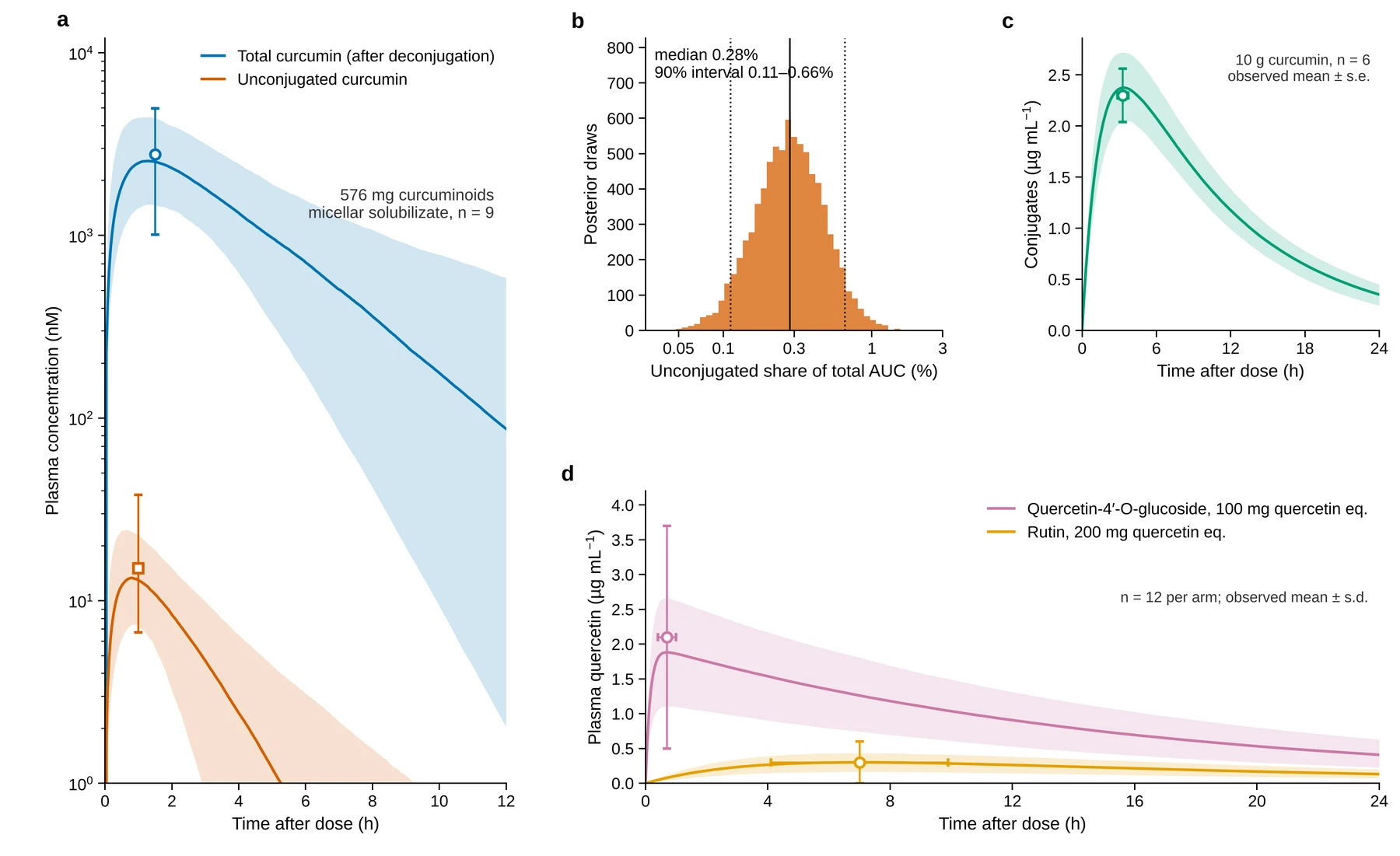
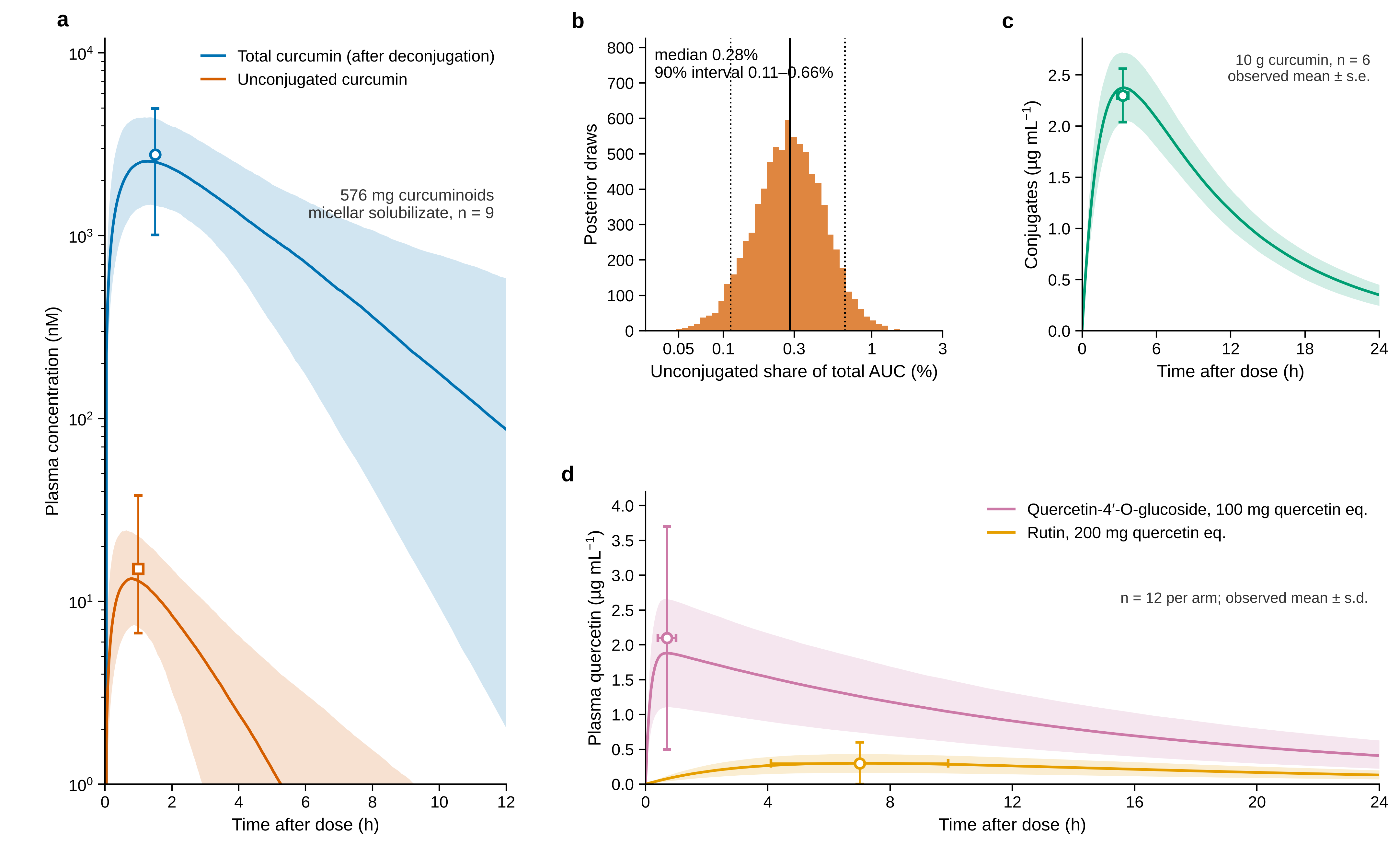
Fig. 6 | Calibrated exposure models. Calibrated a, Unconjugated and total curcumin after 576 mg in a micellar solubilizate, posterior median and 90% interval against the published medians (ranges). b, Unconjugated share of total AUC. c, Curcumin conjugates after 10 g. d, Quercetin after the 4′-O-glucoside and after rutin.
What would make this a result
Testable claims and the experiments that test them
The methods are established; what is proposed is their coupling, and the coupling makes predictions that a small set of experiments can confirm or refute.
- H1. For fine rhizome powder, the minimum ethanol fraction for ≥ 80% curcumin recovery at a fixed solvent ratio is set by solubility, not by diffusion: the coupled model predicts it within ±0.05 mass fraction. Test: 4 and 8 kg kg⁻¹, 40–90% ethanol, 25 and 45 °C, milled rhizome of measured particle size, HPLC assay of extract and marc.
- H2. One measured enthalpy of fusion for curcumin, replacing the calibrated value, will keep the mixture RMSE within 0.2 log units of the present value. Test: DSC of the same curcumin lot used for H1.
- H3. For quercetin, a measured solubility in one ethanol–water mixture identifies whether the error comes from the fusion data or from the activity model. Test: shake-flask solubility at 50% ethanol, 25 °C.
Methods and limits
How the numbers were produced
- Geometries: solute conformers are MMFF94s minima from Research Note 001 re-minimized with GFN2-xTB (tblite); the lowest distinct ones were carried forward. Solvent geometries were optimized at BP86-D3(BJ)/def2-SVP (PySCF 2.14.0, geomeTRIC). Re-optimizing curcumin conformer 1 at BP86-D3(BJ)/def2-SVP changes its predicted solubilities by 0.04 log units on average (largest 0.09); refitting ΔHfus on that geometry gives 46.5 kJ mol−1 and RMSE 0.69 (pure solvents) and 1.21 (mixtures), so the semi-empirical geometry is not what limits accuracy. Swapping in the other two keto–enol conformers (within 0.4 kJ mol⁻¹ of each other in the conductor) changes the predicted solubilities by at most 0.01 log units. The diketo tautomer lies 32.7 kJ mol⁻¹ higher; using it instead shifts predictions by 0.42 log units on average, with RMSE 0.84 (pure) and 0.70 (mixtures) after refitting ΔHfus (44.3 kJ mol⁻¹). These are electronic energies in the conductor, not free energies.
- COSMO-type surfaces: BP86/def2-TZVP with RI-J, conductor-like PCM with ε → ∞, Gaussian surface charges on 302 Lebedev points per atom, radii 1.2 × Bondi (H 1.1 Å before scaling). Files use the ORCA .cpcm layout; they were produced with PySCF, not ORCA, Turbomole or COSMOtherm, and carry no outlying-charge correction.
- Validation of the surface pipeline: ethanol at the geometry of the ORCA fixture in the NIST COSMO-SAC repository gives a cavity area of 92.64 Ų against 92.69 Ų and a dielectric energy of -5.35 against -5.34 kcal mol⁻¹. The independent σ-averaging code reproduces the fixture's profile to 3e-08 Ų.
- Activity coefficients: COSMO-SAC 2010 (Hsieh, Sandler and Lin 2010) with the constants of Bell et al. 2020, written independently. Those constants were fitted to DMol3 profiles; applied to these profiles they carry a model inconsistency that the measured comparisons expose rather than hide.
- Binary check of the activity model alone, infinite dilution in water at 25 °C (predicted against measured, Straver and de Loos, J. Chem. Eng. Data 2005, via NIST ThermoML): ethanol 8.5 against 3.77; propan-1-ol 23.6 against 13.3; acetone 9.9 against 7.7.
- Solid–liquid equilibrium: ideal-solubility term without the heat-capacity correction; the solid is assumed pure and unchanged. Curcumin Tm 456.15 K (HSDB); its enthalpy of fusion is calibrated because no measured value was found in an openly accessible source. Quercetin Tm and ΔHfus from Montenegro et al., Molecules 2025, 30, 199.
- Charges: Merz–Singh–Kollman points (1.4–2.0 × MSK radii), unrestrained ESP fits and two-stage RESP (Bayly et al. 1993) at HF/6-31G* and at BP86/def2-TZVP.
- Not covered: the berberine salt's solubility (an electrolyte problem), degradation during extraction, co-extracted impurities, and any link from formulation to absorption beyond published arms.
Files
COSMO files, σ-profiles, geometries and charges
| Structure | COSMO surface | σ-profile | Geometry | Charges |
|---|---|---|---|---|
| berberine conformer 1 | .cpcm | σ | .xyz | .csv |
| curcumin diketo 1 | .cpcm | σ | .xyz | .csv |
| curcumin keto–enol 1 | .cpcm | σ | .xyz | .csv |
| curcumin keto–enol 1 (BP86-D3 geometry) | .cpcm | σ | .xyz | – |
| curcumin keto–enol 2 | .cpcm | σ | .xyz | .csv |
| curcumin keto–enol 3 | .cpcm | σ | .xyz | .csv |
| quercetin conformer 1 | .cpcm | σ | .xyz | .csv |
| quercetin conformer 2 | .cpcm | σ | .xyz | .csv |
| DMSO | .cpcm | σ | .xyz | – |
| THF | .cpcm | σ | .xyz | – |
| acetone | .cpcm | σ | .xyz | – |
| acetonitrile | .cpcm | σ | .xyz | – |
| ethanol | .cpcm | σ | .xyz | .csv |
| ethyl acetate | .cpcm | σ | .xyz | – |
| isopropanol | .cpcm | σ | .xyz | – |
| m-xylene | .cpcm | σ | .xyz | – |
| methanol | .cpcm | σ | .xyz | – |
| n-butanol | .cpcm | σ | .xyz | – |
| n-butyl acetate | .cpcm | σ | .xyz | – |
| n-heptane | .cpcm | σ | .xyz | – |
| n-hexane | .cpcm | σ | .xyz | – |
| n-octanol | .cpcm | σ | .xyz | – |
| n-propanol | .cpcm | σ | .xyz | – |
| n-propyl acetate | .cpcm | σ | .xyz | – |
| propylene glycol | .cpcm | σ | .xyz | – |
| water | .cpcm | σ | .xyz | – |
Measured data: Shen et al., J. Chem. Thermodyn. 2019, 131, 410 (via NIST ThermoML); BigSolDB 2.0 (Krasnov et al., Zenodo); Tayyem et al., Nutr. Cancer 2006, 55, 126; Montenegro et al., Molecules 2025, 30, 199; pharmacokinetic sources as listed on the case-study pages.
Health information notice. These statements have not been evaluated by the Food and Drug Administration. Nothing on this site is intended to diagnose, treat, cure or prevent any disease, and nothing here is medical advice.
Read the full notice
The information is for general education only. It does not replace advice, diagnosis or treatment from a qualified health professional, or any medication a clinician has prescribed. Do not start, stop or change any medicine, supplement or herbal product because of something you read here. Talk to your doctor or pharmacist first, especially if you are pregnant or breastfeeding, have a medical condition, take any medicines, are preparing for surgery, or are caring for a child. Research findings, traditional uses and safety data are reported as their sources state them; they are not recommendations or claims about any product. If you think you may have a medical emergency, call your doctor or 911 at once.
EUTECNIQ Sciences sells no supplements or health products today and receives nothing from any product or ingredient mentioned on this site; any commercial interest it later has in an ingredient will be stated on that ingredient’s page.