

Computational research · Research Note 001
Molecular structure of curcumin, quercetin and berberine
Identity, conformer ensembles, torsional flexibility, descriptors and ionization: the structural inputs every later calculation depends on.
ComputedForce-field calculations with RDKit and OpenMM on structures from PubChem; pKa values from the cited literature. No quantum-chemical or experimental structure determination was performed.
Summary
What this note establishes
Before any property of a botanical active can be predicted, the molecule itself has to be pinned down: which tautomer, which charge state, which shapes it can take. This note fixes four chemical forms of curcumin, quercetin and berberine against PubChem identity, searches their conformations with the MMFF94s force field, scans their softest torsions, compares descriptors across tautomers and software, and maps ionization over the gastrointestinal pH range. The main result is practical: curcumin needs a conformer ensemble, not a single structure, and a 100-start search is not enough to find its lowest diketo minimum.
- Question
- Which chemical forms and shapes should represent each compound in solubility, formulation and exposure models?
- Approach
- ETKDGv3 embedding (1,500 starts for each curcumin tautomer, 400 for quercetin, 200 for berberine; fixed seed), MMFF94s minimization, energy- and RMSD-based uniqueness, Butina clustering at 1.0 Å, relaxed torsion scans in both directions, RDKit descriptors against PubChem, macroscopic speciation from published pKa values.
- Software
- RDKit 2026.09.1, OpenMM 8.6.1, Python 3.13; scripts and outputs listed on the methods page.
Results
Seven results, each with its figure
- Identity. The diketo curcumin, quercetin and berberine-cation structures reproduce the PubChem InChIKeys. The Z keto–enol tautomer of curcumin is modeled as a second form because crystal and solution studies place curcumin mainly in that form. FIG 001
- Geometry. The keto–enol minimum keeps the intramolecular O–H···O=C hydrogen bond (O···O 2.62 Å). Quercetin's B ring is twisted 46.6° from the chromone plane, and berberine's aromatic core is close to planar. FIG 002
- Diversity. Curcumin minima within 3 kcal/mol of the lowest differ by more than 2 Å RMSD; berberine's 200 starts collapse onto four minima that are two pairs of mirror images. FIG 003
- Convergence. The lowest diketo curcumin minimum (41.1756 kcal/mol) first appears at start 539 of 1,500; an earlier 100-start run found 41.6692. Every energy-degenerate pair of minima is superimposable after inversion, so unique-minimum counts include mirror images. FIG 004
- Flexibility. Along the lower envelope of the relaxed scans, the curcumin aryl–vinyl torsion costs about 1.3 kcal/mol and the quercetin B-ring twist about 3.1; turning berberine's C9 methoxy toward the C8–H side costs about 17. FIG 005
- Descriptors. Moving curcumin from the diketo to the keto–enol form adds a hydrogen-bond donor and raises Crippen cLogP by about 0.5; RDKit and PubChem differ by about 4 Ų in quercetin's polar surface area. FIG 006
- Ionization. Curcumin is about 97% neutral at pH 6.8 and berberine is a cation at every pH; quercetin's neutral fraction at pH 6.8 depends on which of seven published pKa values is used. FIG 007
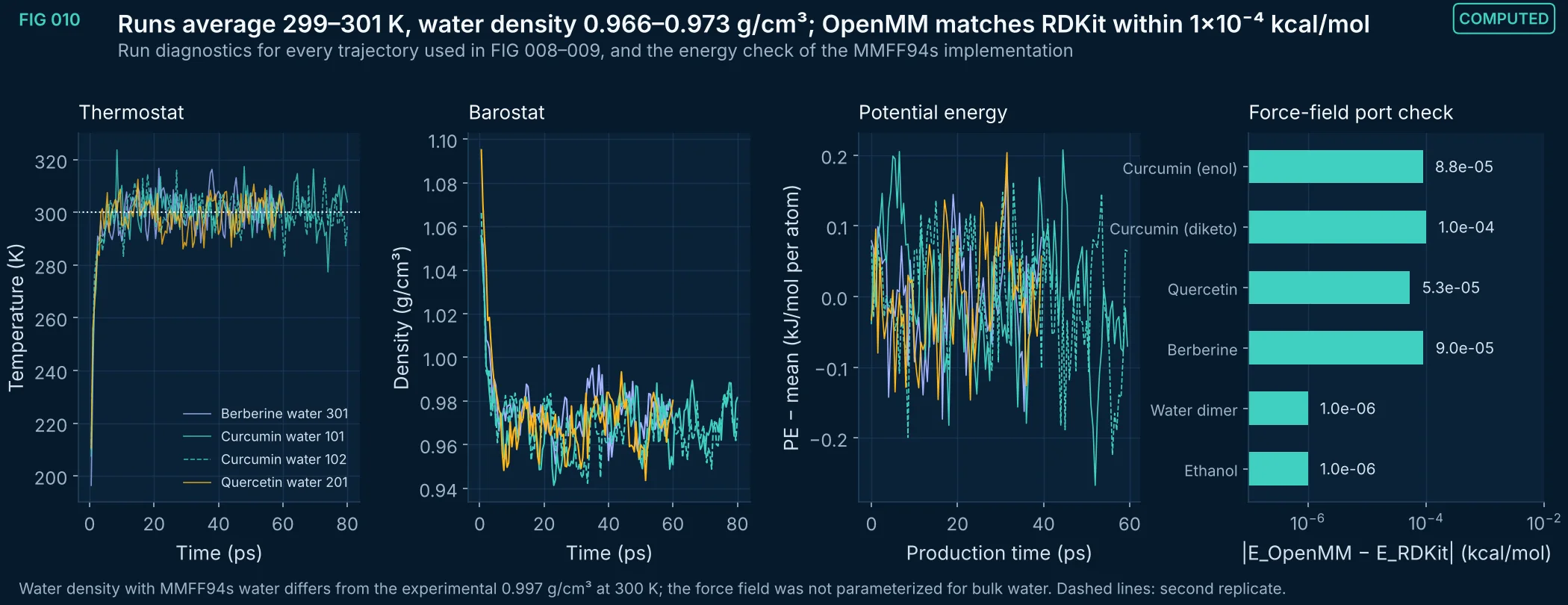
- Solvation. Explicit-solvent molecular dynamics with the same force field, implemented in OpenMM and checked against RDKit to 10⁻⁴ kcal/mol, gives first-shell hydration of each polar site and hydrogen-bond dynamics; curcumin's enol hydrogen bond stays intact in 88% of water frames. FIG 008, FIG 009, FIG 010
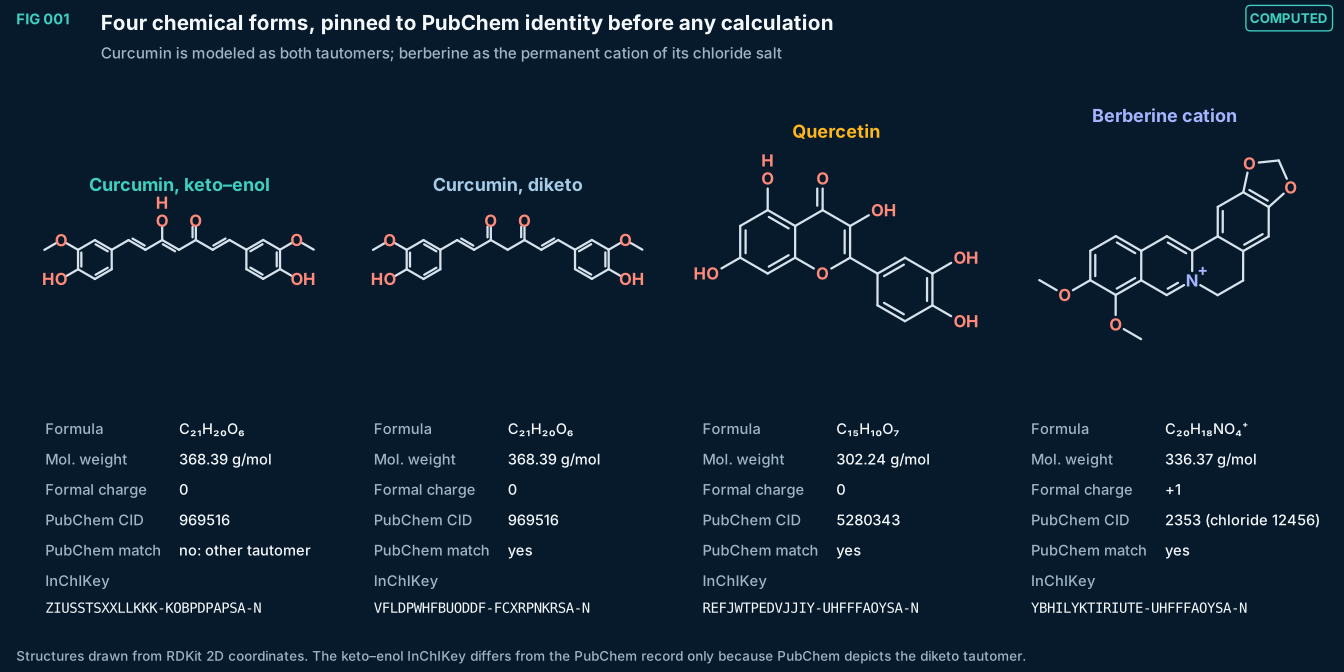
FIG 001Computed
Two-dimensional structures, formulas, molecular weights and InChIKeys of the four modeled forms. The curcumin diketo form, quercetin and the berberine cation reproduce the PubChem InChIKeys exactly; the Z keto–enol tautomer of curcumin is a deliberate second form, because crystal and solution studies place curcumin mainly in the enol form.
Method, sources and limits
- Method
- RDKit SMILES parsing, InChIKey generation and CoordGen 2D coordinates; values compared with PubChem PUG REST records retrieved November 5, 2026.
- Sources and code
- RDKit 2026.09.1 ETKDGv3 embedding (seed 20261105, no pruning) and MMFF94s minimization (maxIters 5000); scripts 01_molecular_structures/s01_compute.py and s01_export_minima.py. Structures from PubChem (CIDs 969516, 5280343, 2353).
- Supports
- Each calculation refers to a defined chemical form traceable to PubChem.
- Does not support
- Any statement about the composition of a commercial ingredient or extract.
- Limitations
- Identity checks confirm connectivity and tautomer, not purity or polymorph of any physical sample.
- Berberine is modeled without its chloride counter-ion except in the MD solvation boxes.
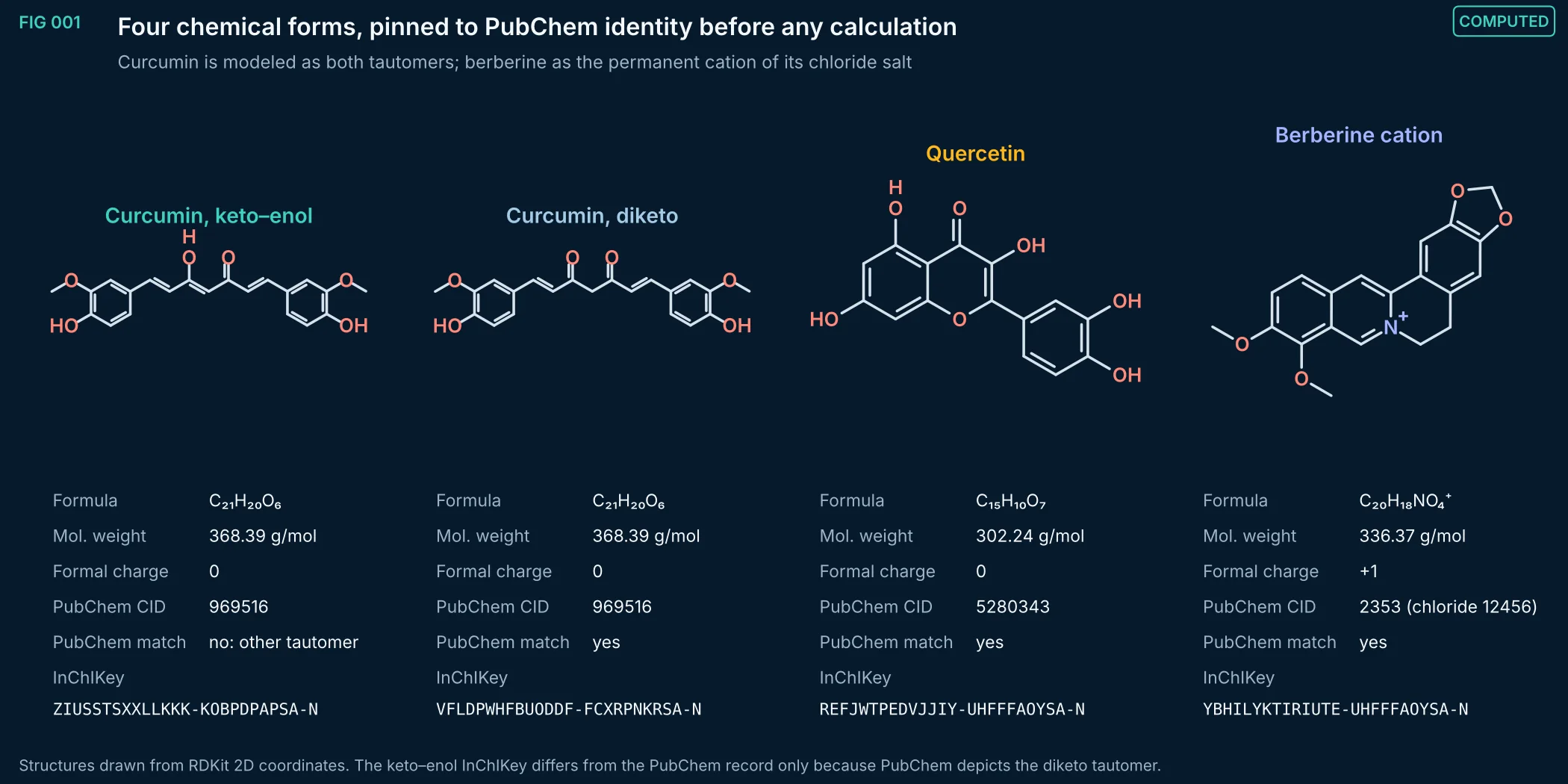
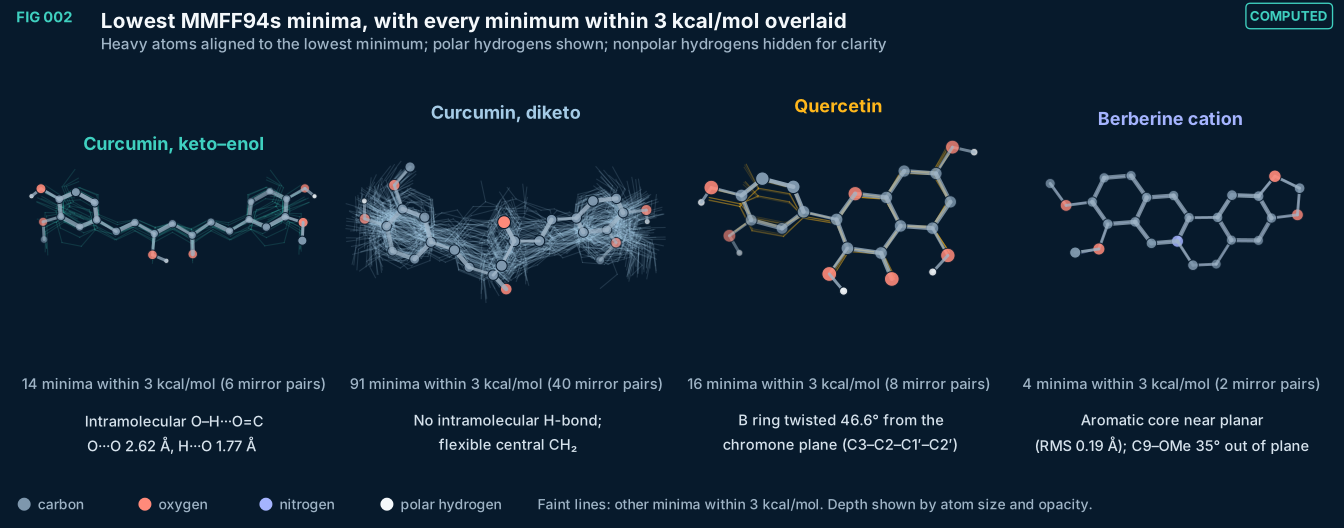
FIG 002Computed
Lowest-energy MMFF94s minimum of each form, projected on its principal axes, with all other unique minima within 3 kcal/mol overlaid as faint heavy-atom frames. The curcumin keto–enol minimum keeps the intramolecular O–H···O=C hydrogen bond; the diketo form has none. Quercetin's B ring is twisted relative to the chromone plane. Berberine's aromatic core is close to planar.
Method, sources and limits
- Method
- Unique minima (energy within 0.005 kcal/mol and heavy-atom RMSD below 0.15 Å treated as one) from 1,500 (curcumin), 400 (quercetin) or 200 (berberine) ETKDGv3 starts, MMFF94s-minimized; heavy-atom alignment to the lowest minimum; orthographic projection on principal axes.
- Sources and code
- RDKit 2026.09.1 ETKDGv3 embedding (seed 20261105, no pruning) and MMFF94s minimization (maxIters 5000); scripts 01_molecular_structures/s01_compute.py and s01_export_minima.py. Structures from PubChem (CIDs 969516, 5280343, 2353).
- Supports
- The geometric starting points used for solvation MD and descriptor calculations.
- Does not support
- Solution-phase conformer populations, tautomer ratios or crystal structures.
- Limitations
- Gas-phase force-field minima; solvent, counter-ion and crystal packing are absent.
- MMFF94s energies are not comparable between the two curcumin tautomers (different atom typing).
- A 3 kcal/mol window is a modeling convention, not a population at 300 K.
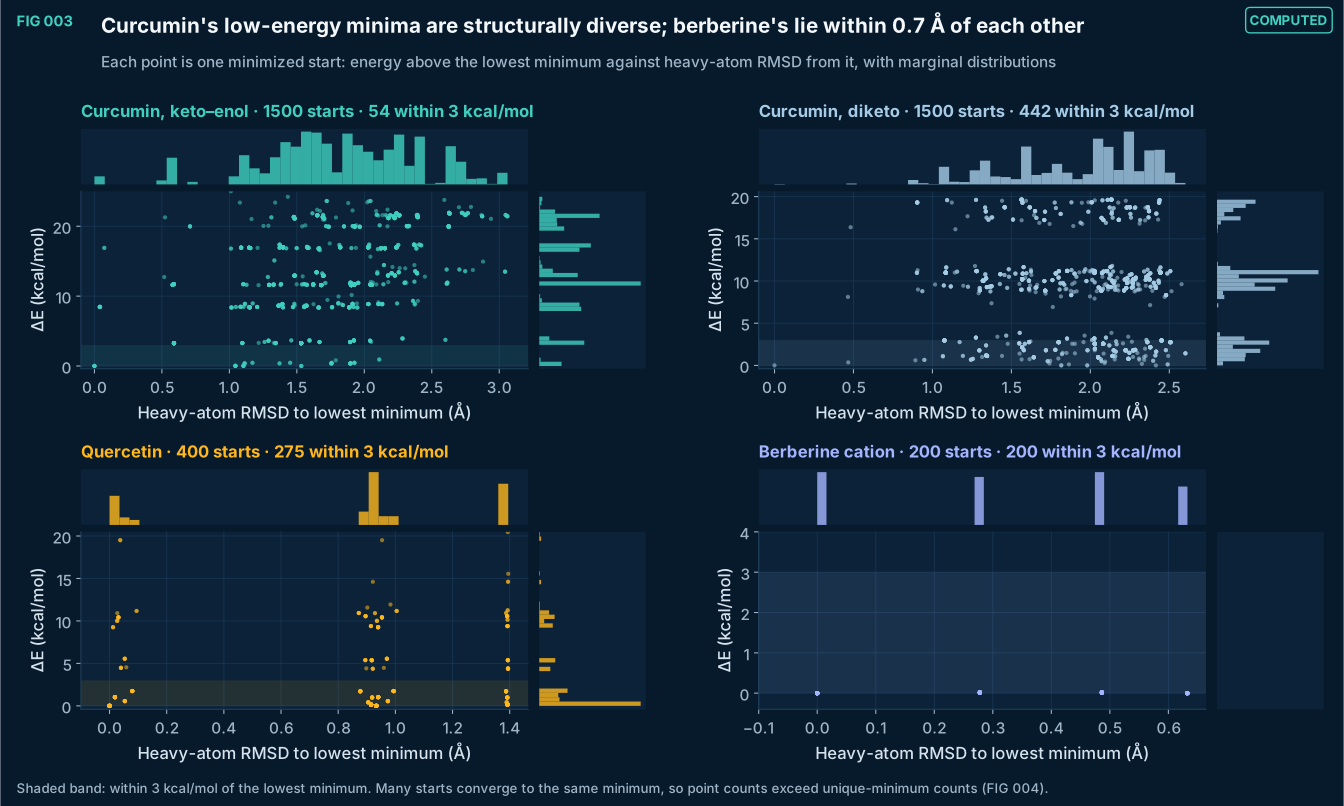
FIG 003Computed
Energy above the lowest MMFF94s minimum against heavy-atom RMSD to that minimum for every minimized start, with marginal histograms. Curcumin minima within 3 kcal/mol span RMSD values above 2 Å, so a single structure misrepresents it; berberine's 200 starts collapse onto four minima of essentially equal energy, all within 0.7 Å RMSD, two of them mirror images of the other two.
Method, sources and limits
- Method
- Same ensembles as FIG 002; symmetry-aware best RMSD (RDKit GetBestRMS) over heavy atoms.
- Sources and code
- RDKit 2026.09.1 ETKDGv3 embedding (seed 20261105, no pruning) and MMFF94s minimization (maxIters 5000); scripts 01_molecular_structures/s01_compute.py and s01_export_minima.py. Structures from PubChem (CIDs 969516, 5280343, 2353).
- Supports
- The need to carry conformer ensembles, not single structures, for curcumin into later calculations.
- Does not support
- Boltzmann populations in solution.
- Limitations
- Gas-phase MMFF94s energies.
- RMSD does not detect mirror-image conformers as identical (see FIG 004 notes).
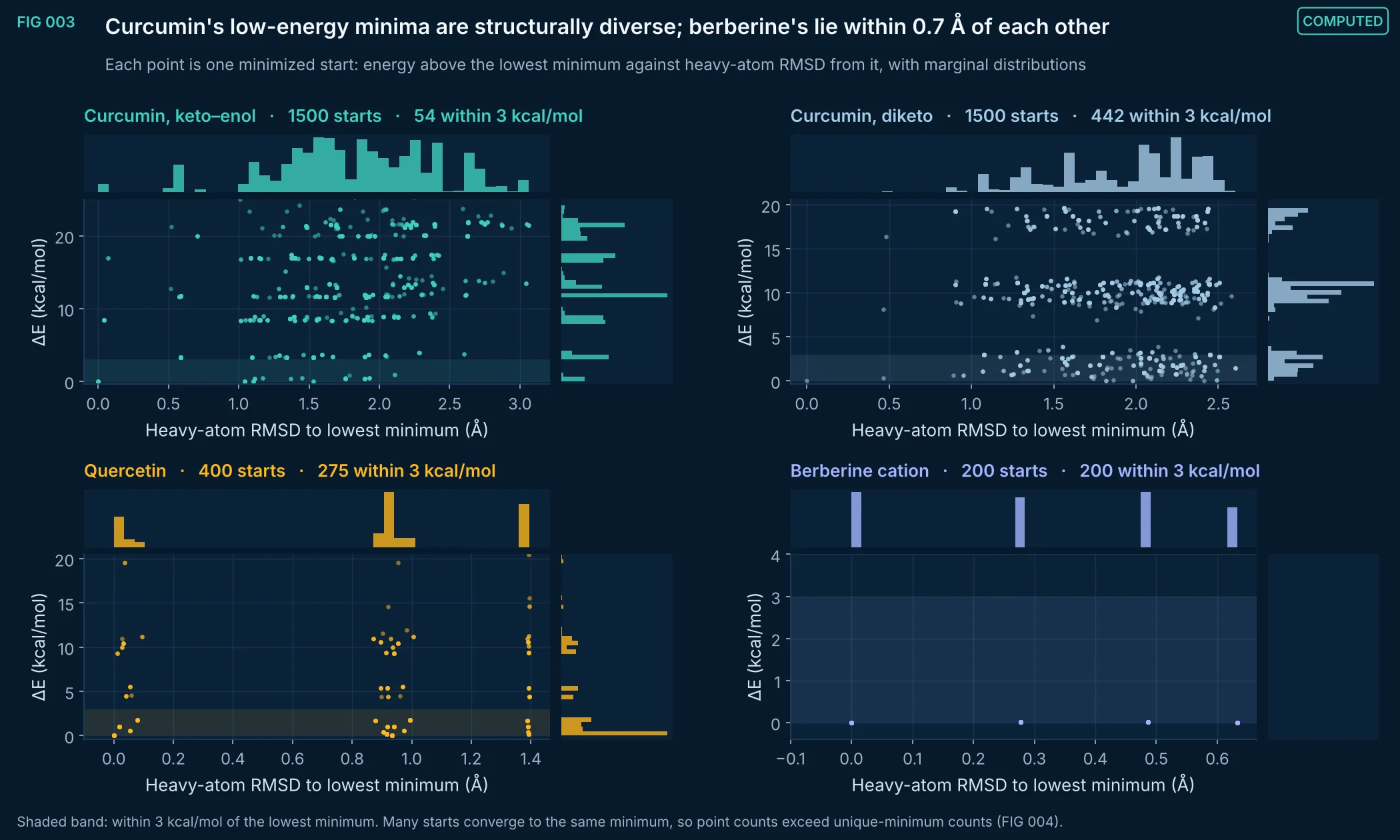
FIG 004Computed
Convergence of the conformer search. The curcumin diketo search reached its lowest minimum at start 539 of 1,500; the 100-start pilot's lowest diketo energy (41.6692 kcal/mol) is 0.49 kcal/mol above this run's (41.1756). Quercetin and berberine reach their minima within the first few starts and match the pilot to four decimals.
Method, sources and limits
- Method
- Running minimum over embedding order; energy-distinct minima (0.005 kcal/mol tolerance) within 3 kcal/mol of the running minimum; unique minima within 6 kcal/mol clustered with Butina at 1.0 Å heavy-atom RMSD.
- Sources and code
- RDKit 2026.09.1 ETKDGv3 embedding (seed 20261105, no pruning) and MMFF94s minimization (maxIters 5000); scripts 01_molecular_structures/s01_compute.py and s01_export_minima.py. Structures from PubChem (CIDs 969516, 5280343, 2353). Earlier 100-start run (version 0 of this calculation): conformer table kept in 00_provenance/.
- Supports
- That 100 starts were too few for curcumin and that 1,500 starts reached a stable minimum.
- Does not support
- Global-minimum certainty; QM or solution energetics.
- Limitations
- Embedding is stochastic and version-dependent; the 100-start run used a different RDKit build, so its individual starts are not reproducible.
- Unique-minimum counts include mirror-image (conformationally enantiomeric) pairs: Curcumin, keto–enol 14, Curcumin, diketo 46, Quercetin 14, Berberine cation 2 energy-degenerate pairs, each superimposable after inversion (RMSD below 0.001 Å).
- No search guarantees the global minimum.
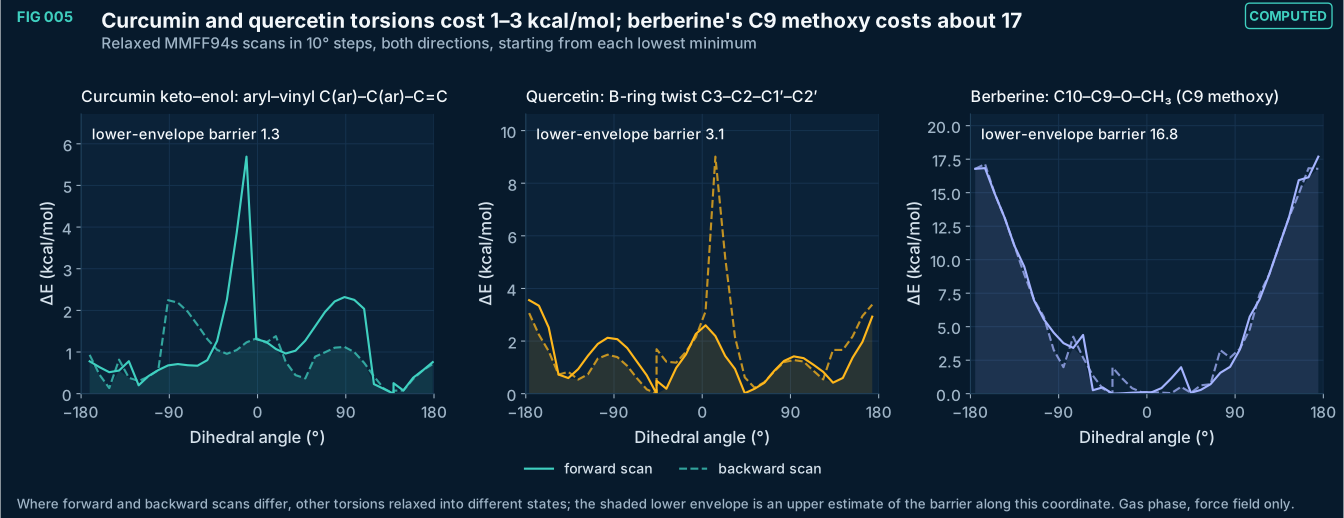
FIG 005Computed
Relaxed torsion scans (MMFF94s, 10° steps, restrained dihedral, all other coordinates minimized) in both directions from the lowest minimum. The curcumin aryl–vinyl and quercetin B-ring rotations are soft; berberine's C9 methoxy turns freely on the C10 side but is strongly hindered when the methyl is turned toward the ring-fusion side (C10–C9–O–CH₃ near 180°), next to the C8–H.
Method, sources and limits
- Method
- Dihedral set and restrained (force constant 1.0e4 kcal/mol/rad²) in RDKit MMFF94s, minimized to convergence, energy re-evaluated without the restraint; forward and backward sweeps of 360°.
- Sources and code
- RDKit 2026.09.1 ETKDGv3 embedding (seed 20261105, no pruning) and MMFF94s minimization (maxIters 5000); scripts 01_molecular_structures/s01_compute.py and s01_export_minima.py. Structures from PubChem (CIDs 969516, 5280343, 2353).
- Supports
- Qualitative ranking of torsional flexibility used to interpret conformer diversity (FIG 003).
- Does not support
- Quantitative rotational barriers or rates in solution.
- Limitations
- MMFF94s torsion parameters, not QM; barriers can differ by several kcal/mol from DFT.
- Gas phase; hysteresis between directions shows the scan is not a unique minimum-energy path.
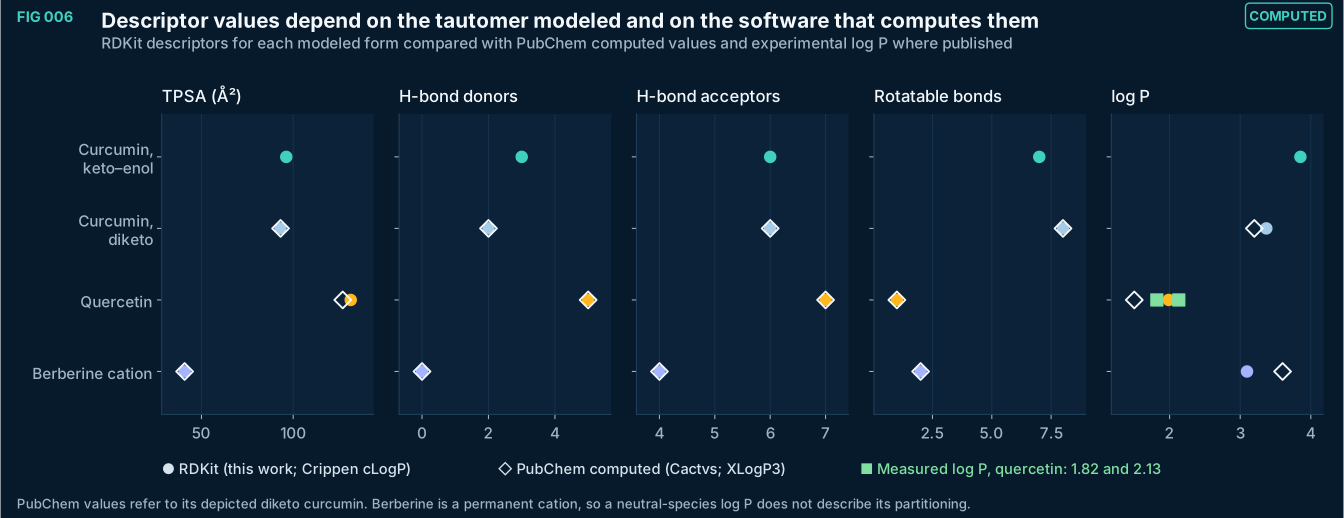
FIG 006Computed
RDKit descriptors of the four modeled forms beside PubChem computed values and published experimental log P for quercetin (1.82, Rothwell et al. 2005; 2.13, Sangster via PubChem). Moving curcumin from the diketo to the keto–enol form adds a hydrogen-bond donor and raises Crippen cLogP by about 0.5; RDKit and PubChem differ by about 4 Ų in quercetin TPSA.
Method, sources and limits
- Method
- RDKit 2026.09.1 descriptors (TPSA without S/P, Lipinski donors/acceptors, rotatable bonds, Crippen logP); PubChem PUG REST computed properties retrieved November 5, 2026.
- Sources and code
- RDKit 2026.09.1 ETKDGv3 embedding (seed 20261105, no pruning) and MMFF94s minimization (maxIters 5000); scripts 01_molecular_structures/s01_compute.py and s01_export_minima.py. Structures from PubChem (CIDs 969516, 5280343, 2353). Experimental quercetin log P: PubChem (Sangster) and Rothwell JA et al. J Agric Food Chem 2005.
- Supports
- The choice of tautomer and software must be fixed and reported for any descriptor-based model.
- Does not support
- Absorption, permeability or bioavailability predictions.
- Limitations
- Descriptors are 2D and conformer-independent.
- Computed log P values are estimates; only quercetin has a measured value here.
- Ionization (FIG 007) changes apparent distribution at physiological pH.
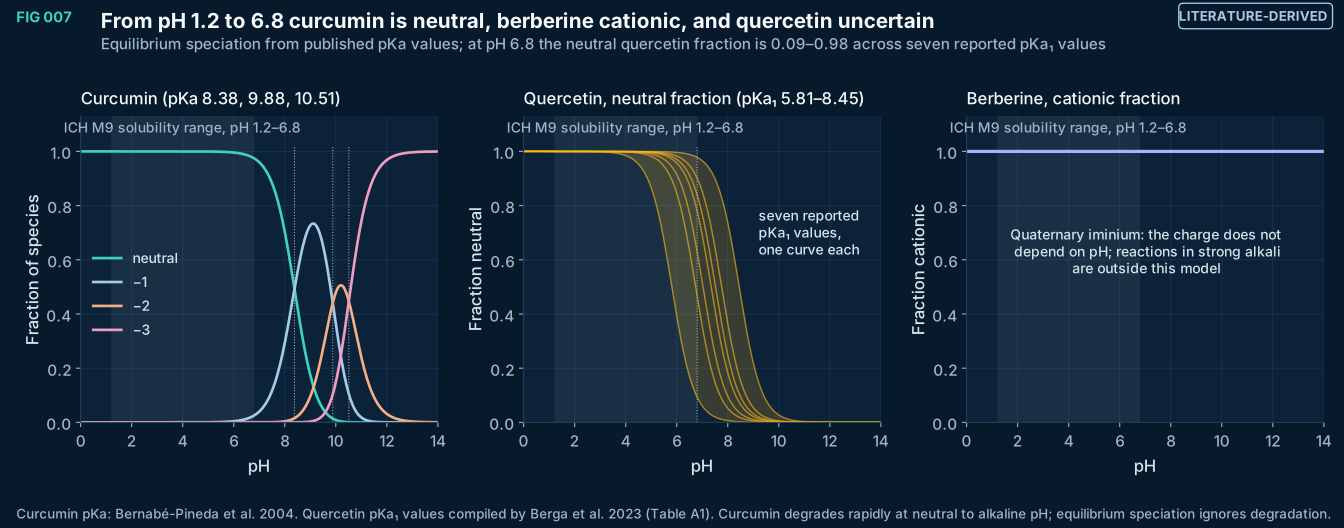
FIG 007Literature-derived
Equilibrium speciation versus pH. Curcumin (macroscopic pKa 8.38, 9.88, 10.51) is 97% neutral at pH 6.8. Seven published values of quercetin's first pKa (5.81 to 8.45) put its neutral fraction at pH 6.8 anywhere from 0.09 to 0.98. Berberine is a quaternary cation at every pH shown.
Method, sources and limits
- Method
- Henderson–Hasselbalch macroscopic speciation, sequential pKa values; quercetin first deprotonation only.
- Sources and code
- Curcumin: Bernabé-Pineda M et al. Spectrochim Acta A 2004;60:1091–1097, doi:10.1016/S1386-1425(03)00342-1. Quercetin: Berga M et al. Pharmaceuticals 2023;16(10):1407, Table A1, doi:10.3390/ph16101407. pH range: ICH M9 (2019) biopharmaceutics classification, solubility over pH 1.2–6.8. Script 01_molecular_structures/s01_figures.py.
- Supports
- Which species should be modeled in each pH region; the need to resolve quercetin's pKa experimentally before pH-dependent modeling.
- Does not support
- Solubility at a given pH; absorption predictions.
- Limitations
- Macroscopic pKa values; microspecies and tautomer-specific ionization are not resolved.
- Temperature and ionic strength of the source measurements differ.
- Degradation of curcumin at pH ≥ 7 is not modeled.
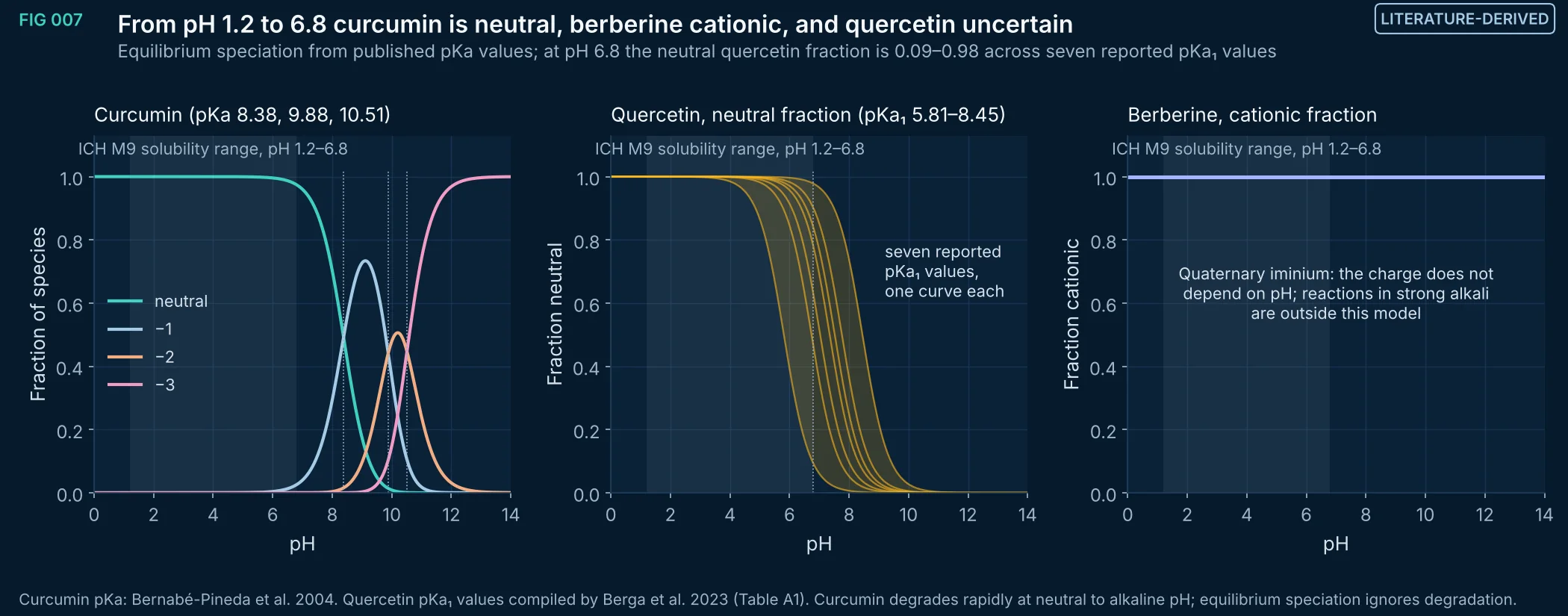
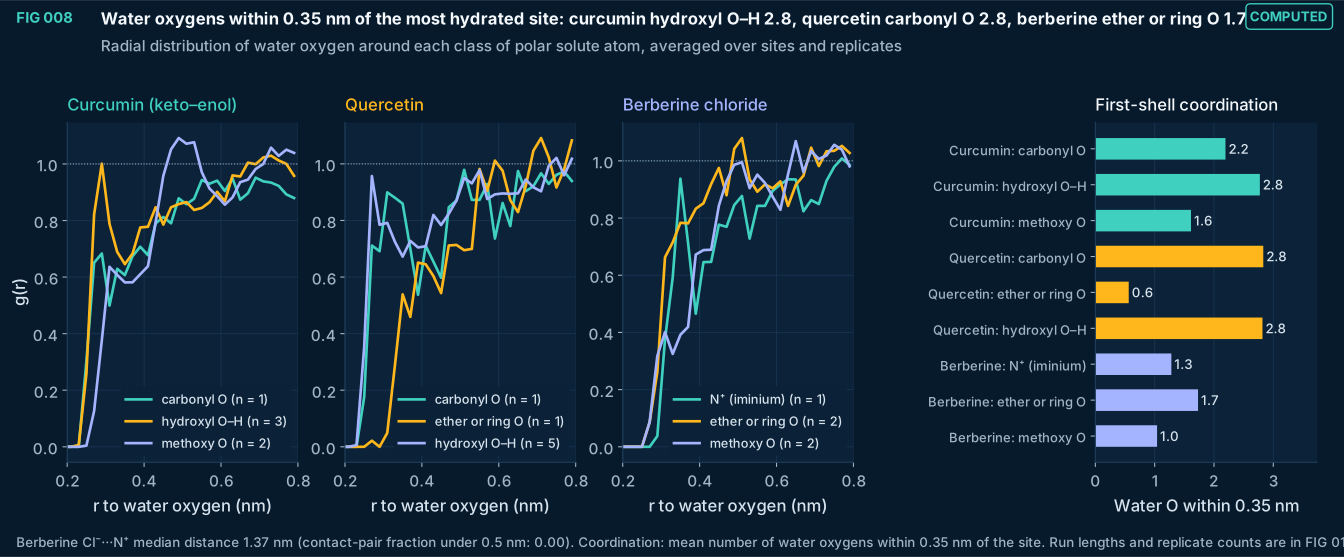
FIG 008Computed
Solvation structure from explicit-solvent molecular dynamics with MMFF94s: radial distribution functions of water oxygen around the polar atoms of each solute, and first-shell coordination numbers. Coordination differs several-fold between site types; in curcumin the hydroxyl that takes part in the intramolecular enol hydrogen bond is partly shielded from water (FIG 009). These are the solute–solvent contacts that continuum solubility models average away.
Method, sources and limits
- Method
- g(r) from minimum-image distances in the cubic NPT box, frame-wise box length, 0.02 nm bins; averaged over equivalent sites and over replicates; coordination counted within 0.35 nm.
- Sources and code
- MMFF94s in OpenMM 8.6.1 (custom forces verified against RDKit), PME, Langevin 300 K, Monte Carlo barostat 1 bar, 2 fs; frames every 0.5 ps. Scripts 02_force_fields_and_MD/md_run.py and md_figs.py.
- Supports
- Which solute sites dominate hydration, as input to solubility and permeability reasoning.
- Does not support
- Quantitative hydration free energies or solubilities.
- Limitations
- Short trajectories (tens of picoseconds per replicate): adequate for first-shell structure and fast hydrogen-bond dynamics, not for conformational sampling or slow events.
- MMFF94s with its own water parameters, not a dedicated water model such as TIP3P or OPC; water density and structure differ from experiment.
- One solute molecule per box; no concentration, aggregation or counter-ion pairing statistics beyond what a single ion shows.
Vector (SVG) · Full-size image · data (coordination) (CSV) · data (rdf) (CSV)
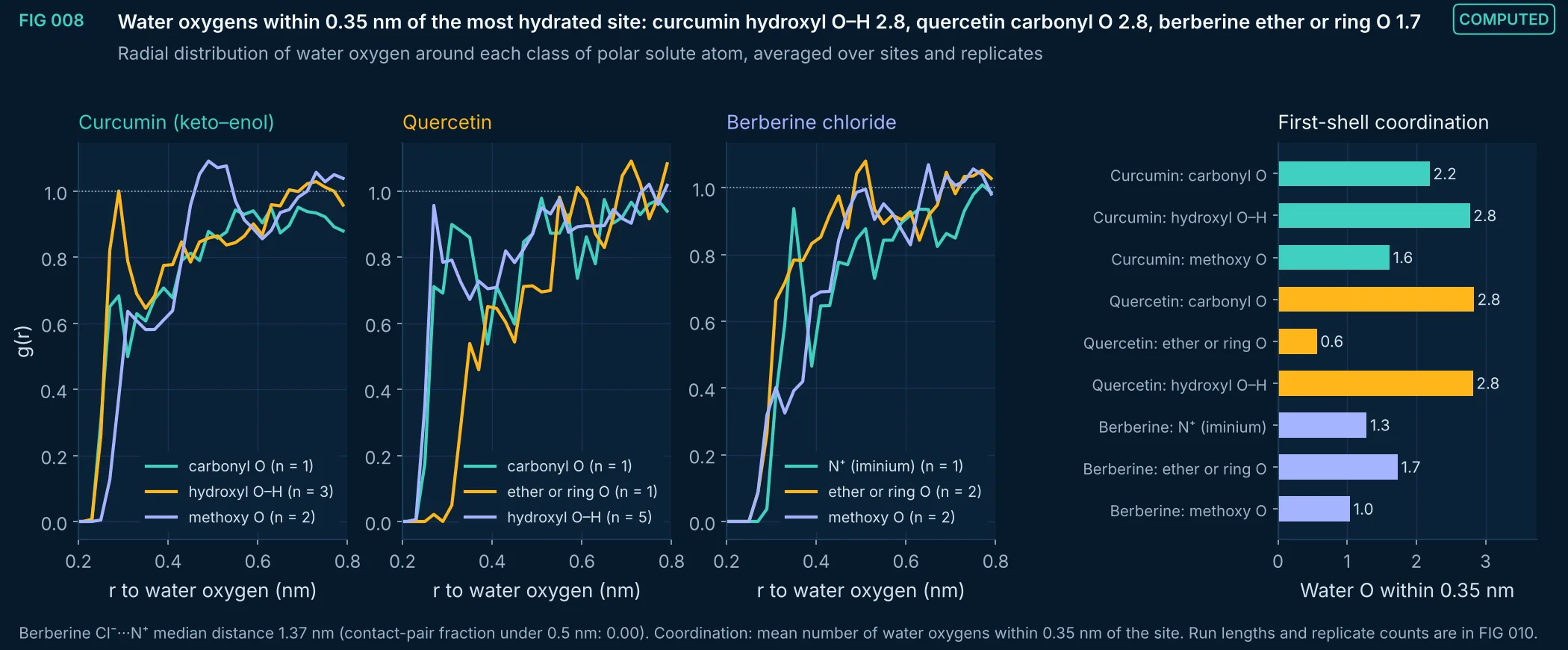
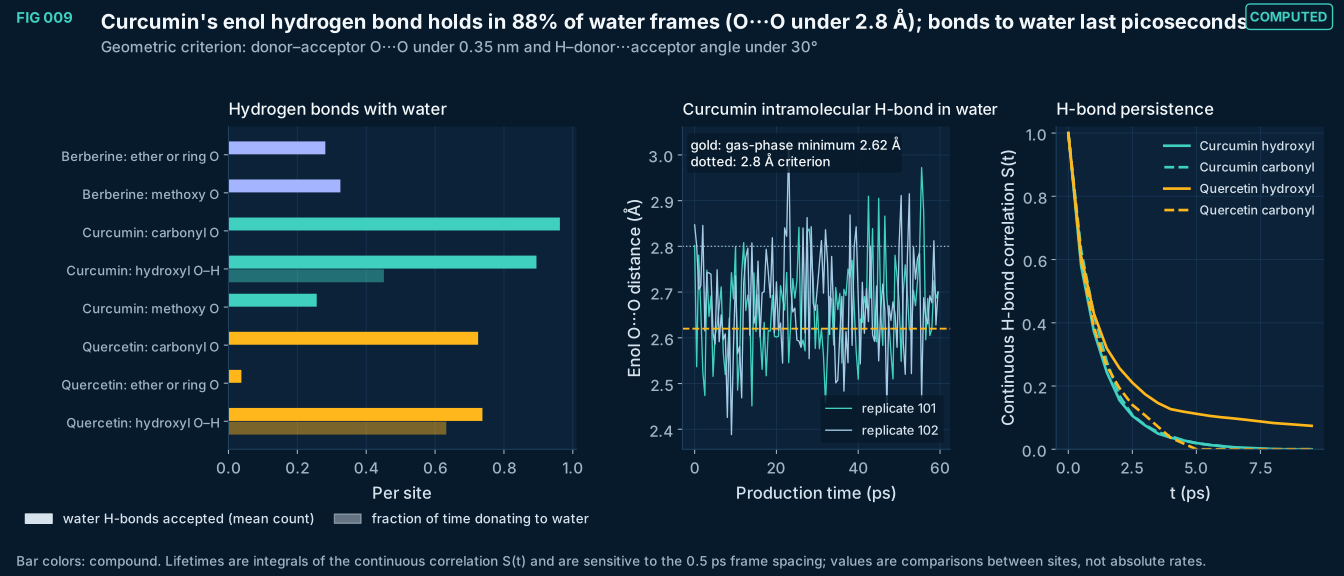
FIG 009Computed
Hydrogen bonding between each solute and water. Hydroxyl groups both donate and accept; carbonyl and ether oxygens only accept. In curcumin the intramolecular O–H···O=C bond of the keto–enol form persists in water for most of the trajectory, which keeps that hydroxyl partly unavailable to the solvent. Solute–water hydrogen bonds persist for only a few picoseconds.
Method, sources and limits
- Method
- Geometric hydrogen-bond criterion on every frame; per-site occupancy; continuous correlation S(t) with 0.5 ps resolution; enol O···O distance time series.
- Sources and code
- MMFF94s in OpenMM 8.6.1 (custom forces verified against RDKit), PME, Langevin 300 K, Monte Carlo barostat 1 bar, 2 fs; frames every 0.5 ps. Scripts 02_force_fields_and_MD/md_run.py and md_figs.py.
- Supports
- Which groups of each molecule interact with water and how long those contacts last.
- Does not support
- Solubility values or tautomer populations in water.
- Limitations
- Short trajectories (tens of picoseconds per replicate): adequate for first-shell structure and fast hydrogen-bond dynamics, not for conformational sampling or slow events.
- MMFF94s with its own water parameters, not a dedicated water model such as TIP3P or OPC; water density and structure differ from experiment.
- One solute molecule per box; no concentration, aggregation or counter-ion pairing statistics beyond what a single ion shows.
- Geometric criteria are conventions; changing the cutoffs changes absolute counts.
Vector (SVG) · Full-size image · data (lifetimes) (CSV) · data (occupancy) (CSV)
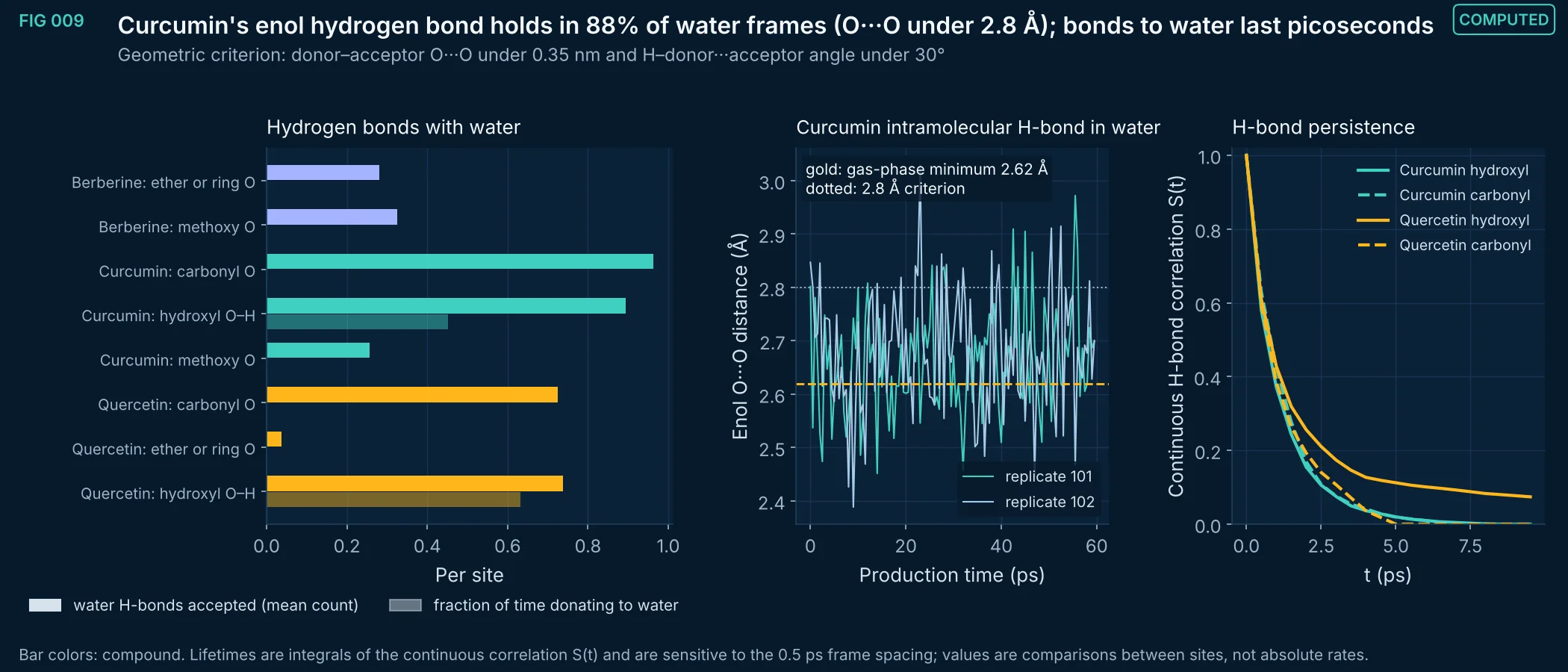
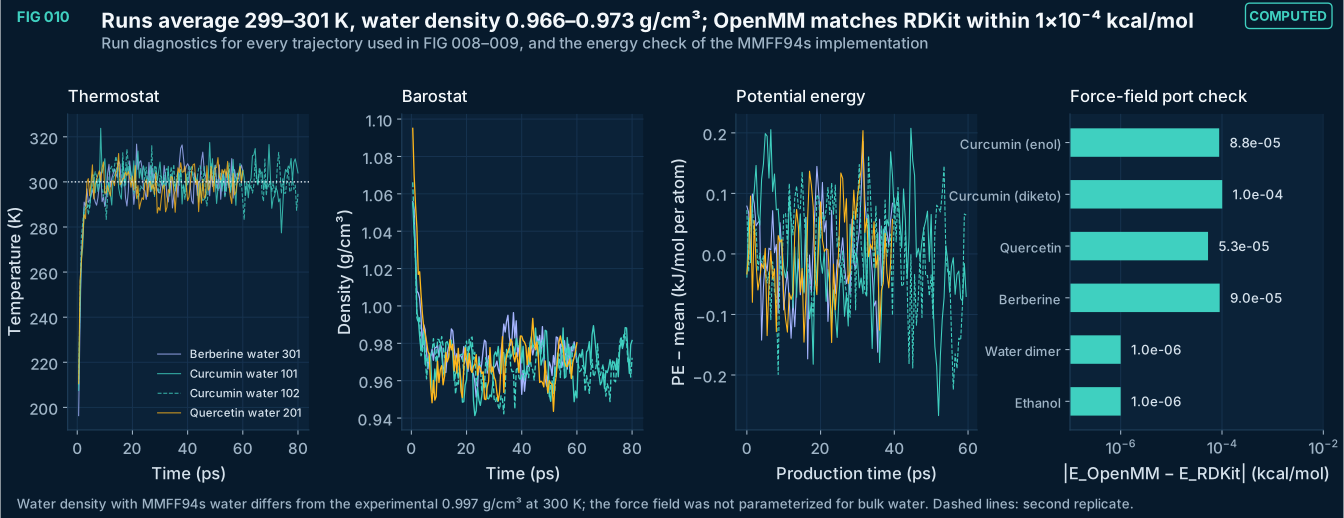
FIG 010Computed
Quality checks for the explicit-solvent trajectories: thermostat and barostat behavior, potential-energy stationarity during production, and the agreement between the OpenMM implementation of MMFF94s and RDKit's reference implementation for every molecule, including a water dimer that tests intermolecular terms.
Method, sources and limits
- Method
- State data every 0.5 ps; production means and SDs; linear drift and 4-block means of potential energy; single-point energy comparison on identical coordinates.
- Sources and code
- MMFF94s in OpenMM 8.6.1 (custom forces verified against RDKit), PME, Langevin 300 K, Monte Carlo barostat 1 bar, 2 fs; frames every 0.5 ps. Scripts 02_force_fields_and_MD/md_run.py and md_figs.py. Verification: 02_force_fields_and_MD/verify_mmff.py.
- Supports
- That the trajectories are equilibrated in temperature and density over their length and that the force field is implemented correctly.
- Does not support
- Convergence of slow conformational transitions.
- Limitations
- Short trajectories (tens of picoseconds per replicate): adequate for first-shell structure and fast hydrogen-bond dynamics, not for conformational sampling or slow events.
- MMFF94s with its own water parameters, not a dedicated water model such as TIP3P or OPC; water density and structure differ from experiment.
- One solute molecule per box; no concentration, aggregation or counter-ion pairing statistics beyond what a single ion shows.
Interpretation
What these results support, and what they do not
Supported
- Carrying a conformer ensemble for curcumin into any property calculation, and stating the tautomer used.
- Treating berberine as a rigid, permanently charged molecule in solubility and permeability models.
- Reporting search size and convergence with every force-field minimum, since a smaller search gave a different answer.
- Measuring quercetin's first pKa before building pH-dependent models of it.
Not supported
- Relative energies of the two curcumin tautomers: MMFF94s energies are not comparable across different atom typings.
- Quantitative rotational barriers or conformer populations in solution; these need quantum chemistry and solvent.
- Any statement about the composition, purity or polymorph of a physical sample.
- Absorption or bioavailability predictions from 2D descriptors.
Next step
Quantum chemistry on the force-field minima, then measured pKa
Part of this step is on the workstation page: the minima were re-minimized with GFN2-xTB and BP86/def2-TZVP conductor energies place the diketo tautomer 32.7 kJ/mol above the keto–enol form (electronic energies, not free energies). Full density-functional optimization with implicit solvent, free energies and checks of the force-field barriers remain to be done. The quercetin pKa question is experimental and is listed with the other planned measurements on the overview.
Status of this note: computed and literature-derived results. Version 1.0, November 6, 2026. Cite as: EUTECNIQ Sciences, Research Note 001, Molecular structure of curcumin, quercetin and berberine (2026).
Health information notice. These statements have not been evaluated by the Food and Drug Administration. Nothing on this site is intended to diagnose, treat, cure or prevent any disease, and nothing here is medical advice.
Read the full notice
The information is for general education only. It does not replace advice, diagnosis or treatment from a qualified health professional, or any medication a clinician has prescribed. Do not start, stop or change any medicine, supplement or herbal product because of something you read here. Talk to your doctor or pharmacist first, especially if you are pregnant or breastfeeding, have a medical condition, take any medicines, are preparing for surgery, or are caring for a child. Research findings, traditional uses and safety data are reported as their sources state them; they are not recommendations or claims about any product. If you think you may have a medical emergency, call your doctor or 911 at once.
EUTECNIQ Sciences sells no supplements or health products today and receives nothing from any product or ingredient mentioned on this site; any commercial interest it later has in an ingredient will be stated on that ingredient’s page.