

Computational research · Case study
Curcumin: from tautomer to plasma
Curcumin dissolves readily in DMSO and acetone but in water only at nanogram-to-microgram per milliliter levels, degrades within minutes to hours at neutral pH, and circulates in people mostly as conjugates. Each of those facts is a design constraint.
Published dataEvery number on this page comes from a cited publication or from a calculation on published data; illustrative or planned figures are labeled.
The problem
What a developer needs to know, and what is usually reported instead
Curcumin products are usually compared by total curcumin in plasma or by a fold change in an animal model. Neither number says how much unconjugated curcumin reaches the circulation, how long the molecule survives in the product, or which solvent will extract it efficiently. This case study asks what published data can and cannot say about each of those questions.
Results
What the computations show
Structure
Two tautomers must be modeled, and the diketo form needs a far larger conformer search than the earlier 100-start version used. FIG 004 FIG 007
Solvation
In explicit water the intramolecular enol hydrogen bond of the keto–enol form stays largely intact, leaving that hydroxyl mostly unavailable to the solvent. FIG 008 FIG 009
Solubility
Measured mole-fraction solubility across 15 solvents spans more than seven orders of magnitude, water included; DMSO and THF exceed ideal solubility, alkanes and water fall far below it, and a Hansen sphere ranks the organic solvents to about 0.6 log units. FIG 012 FIG 013
Data quality
Two laboratories' water solubilities of curcumin disagree about fivefold; alcohol data agree within a few percent. FIG 014
Solvent choice
THF (ICH Q3C Class 2) and DMSO (Class 3, boiling near 190 °C) need the least latent heat per kilogram dissolved; among low-boiling Class 3 solvents, acetone needs the least. FIG 015
Stability
Refitted Arrhenius kinetics reproduce the published activation energies, and the resulting probability surface puts a 10% loss at about 1.3 hours at 25 °C in protein-containing broth. Published half-lives near pH 7 span minutes to hours depending on the medium. FIG 025 FIG 026 FIG 049 FIG 053
Figures
The evidence, figure by figure
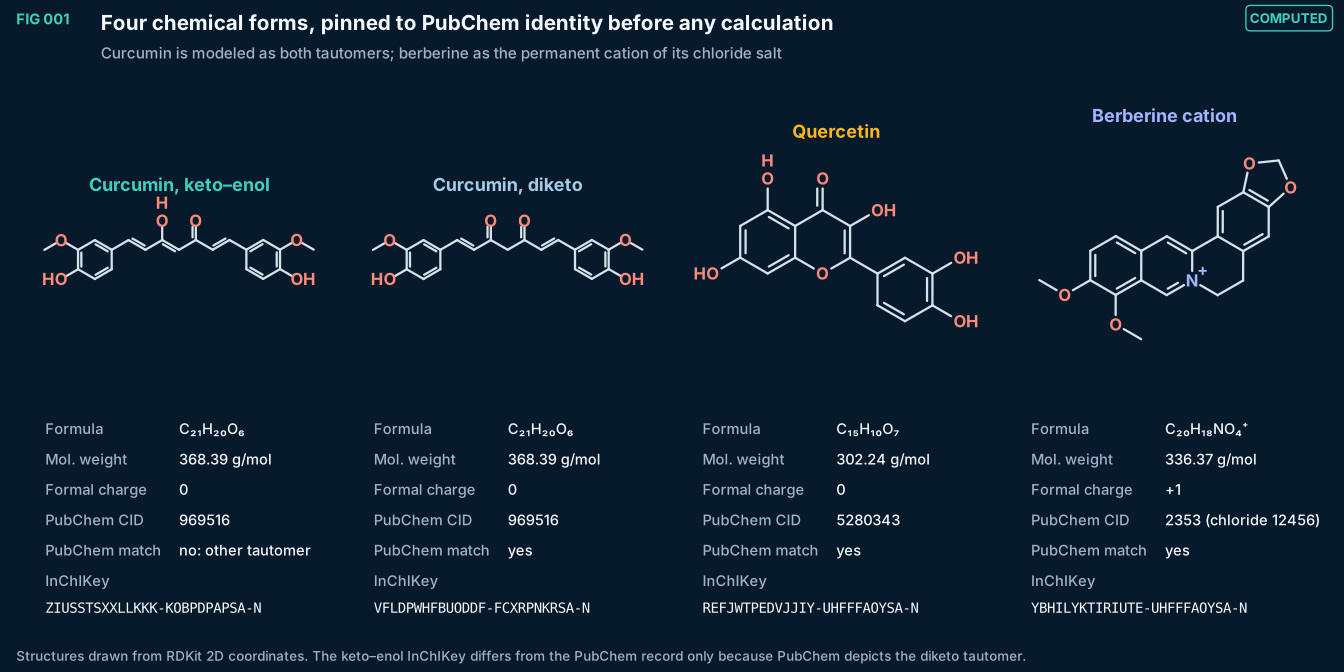
FIG 001Computed
Two-dimensional structures, formulas, molecular weights and InChIKeys of the four modeled forms. The curcumin diketo form, quercetin and the berberine cation reproduce the PubChem InChIKeys exactly; the Z keto–enol tautomer of curcumin is a deliberate second form, because crystal and solution studies place curcumin mainly in the enol form.
Method, sources and limits
- Method
- RDKit SMILES parsing, InChIKey generation and CoordGen 2D coordinates; values compared with PubChem PUG REST records retrieved November 5, 2026.
- Sources and code
- RDKit 2026.09.1 ETKDGv3 embedding (seed 20261105, no pruning) and MMFF94s minimization (maxIters 5000); scripts 01_molecular_structures/s01_compute.py and s01_export_minima.py. Structures from PubChem (CIDs 969516, 5280343, 2353).
- Supports
- Each calculation refers to a defined chemical form traceable to PubChem.
- Does not support
- Any statement about the composition of a commercial ingredient or extract.
- Limitations
- Identity checks confirm connectivity and tautomer, not purity or polymorph of any physical sample.
- Berberine is modeled without its chloride counter-ion except in the MD solvation boxes.
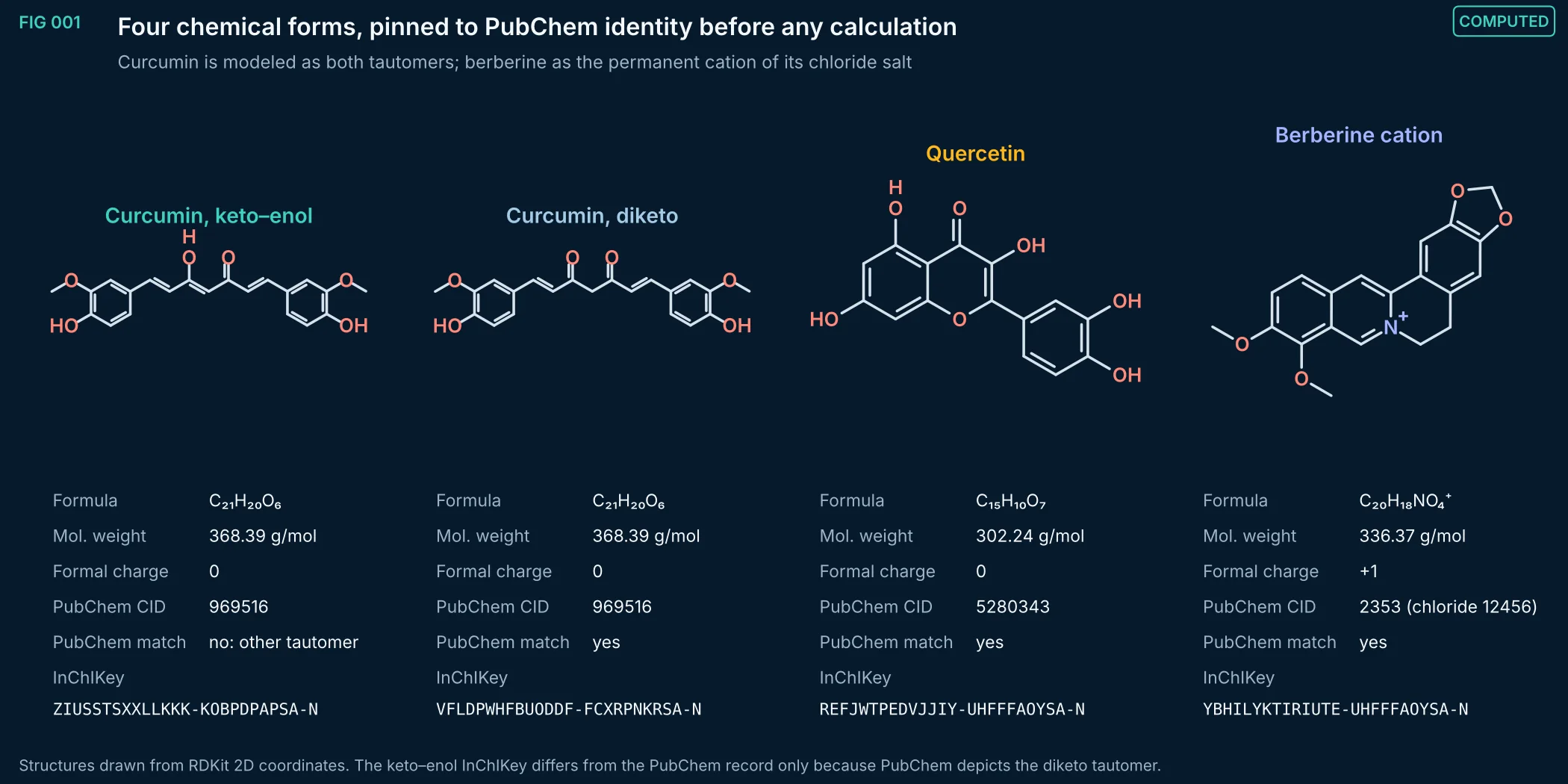
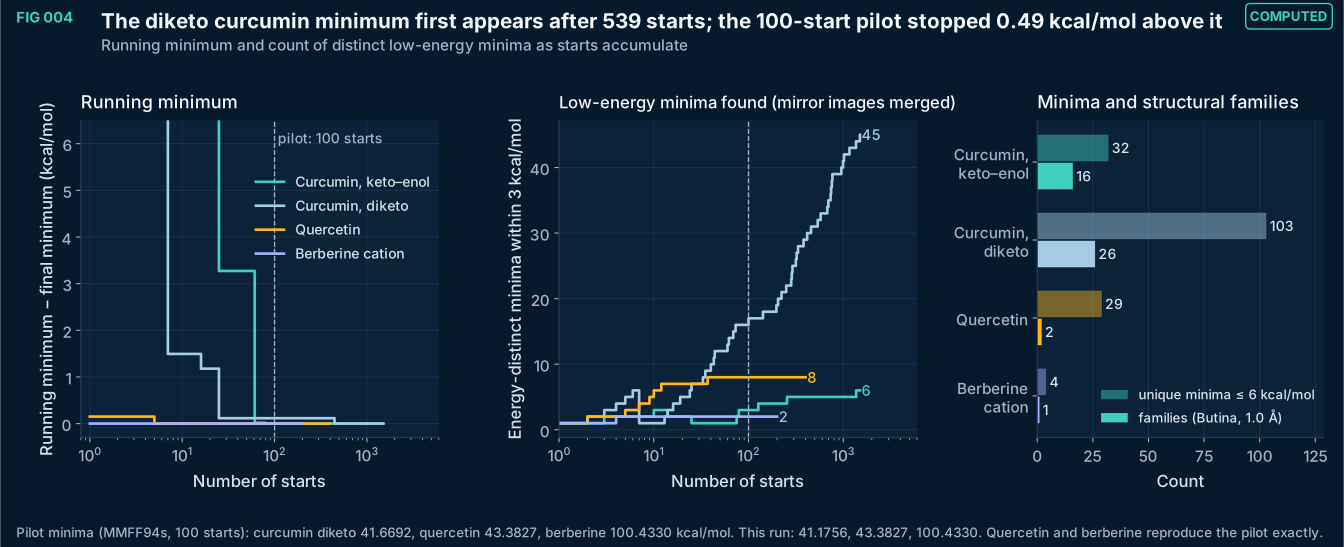
FIG 004Computed
Convergence of the conformer search. The curcumin diketo search reached its lowest minimum at start 539 of 1,500; the 100-start pilot's lowest diketo energy (41.6692 kcal/mol) is 0.49 kcal/mol above this run's (41.1756). Quercetin and berberine reach their minima within the first few starts and match the pilot to four decimals.
Method, sources and limits
- Method
- Running minimum over embedding order; energy-distinct minima (0.005 kcal/mol tolerance) within 3 kcal/mol of the running minimum; unique minima within 6 kcal/mol clustered with Butina at 1.0 Å heavy-atom RMSD.
- Sources and code
- RDKit 2026.09.1 ETKDGv3 embedding (seed 20261105, no pruning) and MMFF94s minimization (maxIters 5000); scripts 01_molecular_structures/s01_compute.py and s01_export_minima.py. Structures from PubChem (CIDs 969516, 5280343, 2353). Earlier 100-start run (version 0 of this calculation): conformer table kept in 00_provenance/.
- Supports
- That 100 starts were too few for curcumin and that 1,500 starts reached a stable minimum.
- Does not support
- Global-minimum certainty; QM or solution energetics.
- Limitations
- Embedding is stochastic and version-dependent; the 100-start run used a different RDKit build, so its individual starts are not reproducible.
- Unique-minimum counts include mirror-image (conformationally enantiomeric) pairs: Curcumin, keto–enol 14, Curcumin, diketo 46, Quercetin 14, Berberine cation 2 energy-degenerate pairs, each superimposable after inversion (RMSD below 0.001 Å).
- No search guarantees the global minimum.
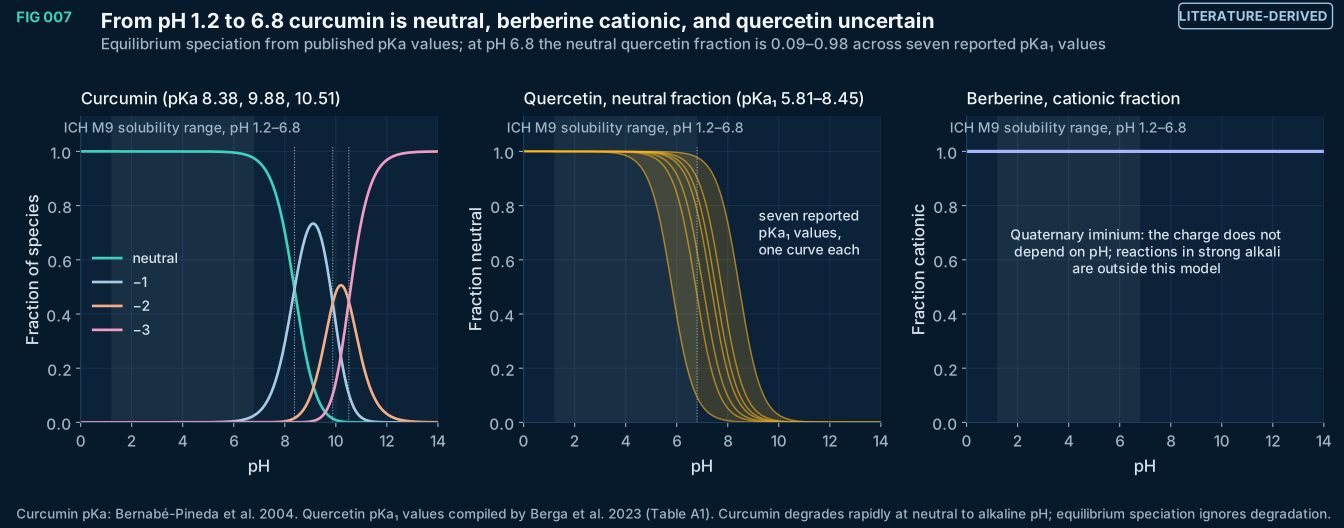
FIG 007Literature-derived
Equilibrium speciation versus pH. Curcumin (macroscopic pKa 8.38, 9.88, 10.51) is 97% neutral at pH 6.8. Seven published values of quercetin's first pKa (5.81 to 8.45) put its neutral fraction at pH 6.8 anywhere from 0.09 to 0.98. Berberine is a quaternary cation at every pH shown.
Method, sources and limits
- Method
- Henderson–Hasselbalch macroscopic speciation, sequential pKa values; quercetin first deprotonation only.
- Sources and code
- Curcumin: Bernabé-Pineda M et al. Spectrochim Acta A 2004;60:1091–1097, doi:10.1016/S1386-1425(03)00342-1. Quercetin: Berga M et al. Pharmaceuticals 2023;16(10):1407, Table A1, doi:10.3390/ph16101407. pH range: ICH M9 (2019) biopharmaceutics classification, solubility over pH 1.2–6.8. Script 01_molecular_structures/s01_figures.py.
- Supports
- Which species should be modeled in each pH region; the need to resolve quercetin's pKa experimentally before pH-dependent modeling.
- Does not support
- Solubility at a given pH; absorption predictions.
- Limitations
- Macroscopic pKa values; microspecies and tautomer-specific ionization are not resolved.
- Temperature and ionic strength of the source measurements differ.
- Degradation of curcumin at pH ≥ 7 is not modeled.
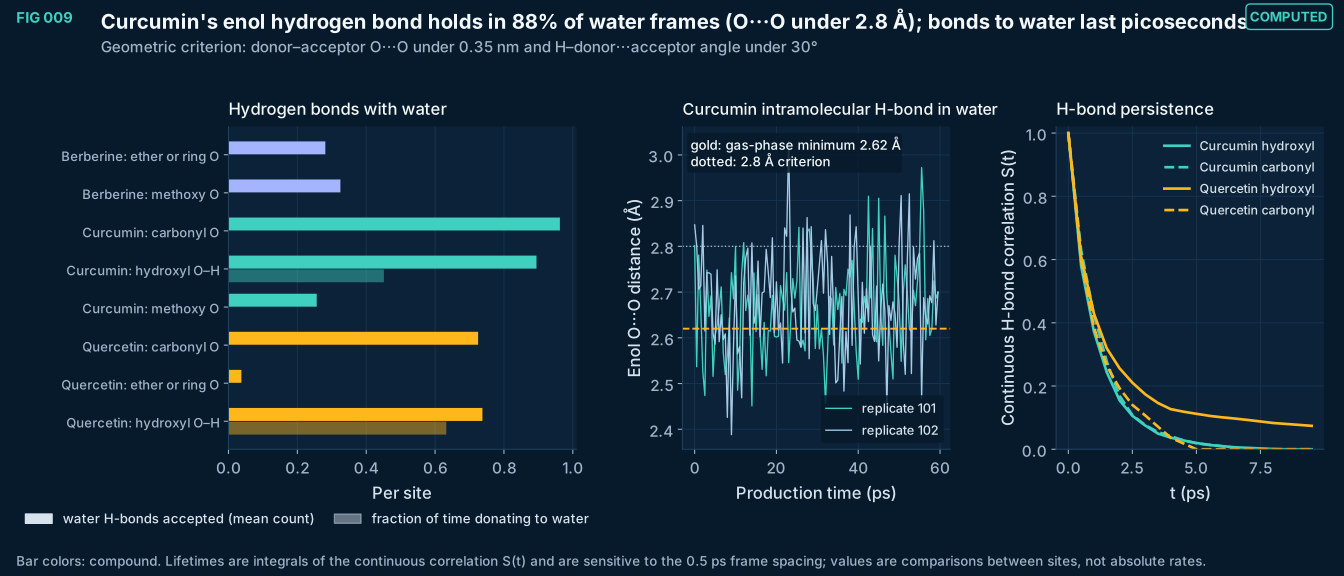
FIG 009Computed
Hydrogen bonding between each solute and water. Hydroxyl groups both donate and accept; carbonyl and ether oxygens only accept. In curcumin the intramolecular O–H···O=C bond of the keto–enol form persists in water for most of the trajectory, which keeps that hydroxyl partly unavailable to the solvent. Solute–water hydrogen bonds persist for only a few picoseconds.
Method, sources and limits
- Method
- Geometric hydrogen-bond criterion on every frame; per-site occupancy; continuous correlation S(t) with 0.5 ps resolution; enol O···O distance time series.
- Sources and code
- MMFF94s in OpenMM 8.6.1 (custom forces verified against RDKit), PME, Langevin 300 K, Monte Carlo barostat 1 bar, 2 fs; frames every 0.5 ps. Scripts 02_force_fields_and_MD/md_run.py and md_figs.py.
- Supports
- Which groups of each molecule interact with water and how long those contacts last.
- Does not support
- Solubility values or tautomer populations in water.
- Limitations
- Short trajectories (tens of picoseconds per replicate): adequate for first-shell structure and fast hydrogen-bond dynamics, not for conformational sampling or slow events.
- MMFF94s with its own water parameters, not a dedicated water model such as TIP3P or OPC; water density and structure differ from experiment.
- One solute molecule per box; no concentration, aggregation or counter-ion pairing statistics beyond what a single ion shows.
- Geometric criteria are conventions; changing the cutoffs changes absolute counts.
Vector (SVG) · Full-size image · data (lifetimes) (CSV) · data (occupancy) (CSV)
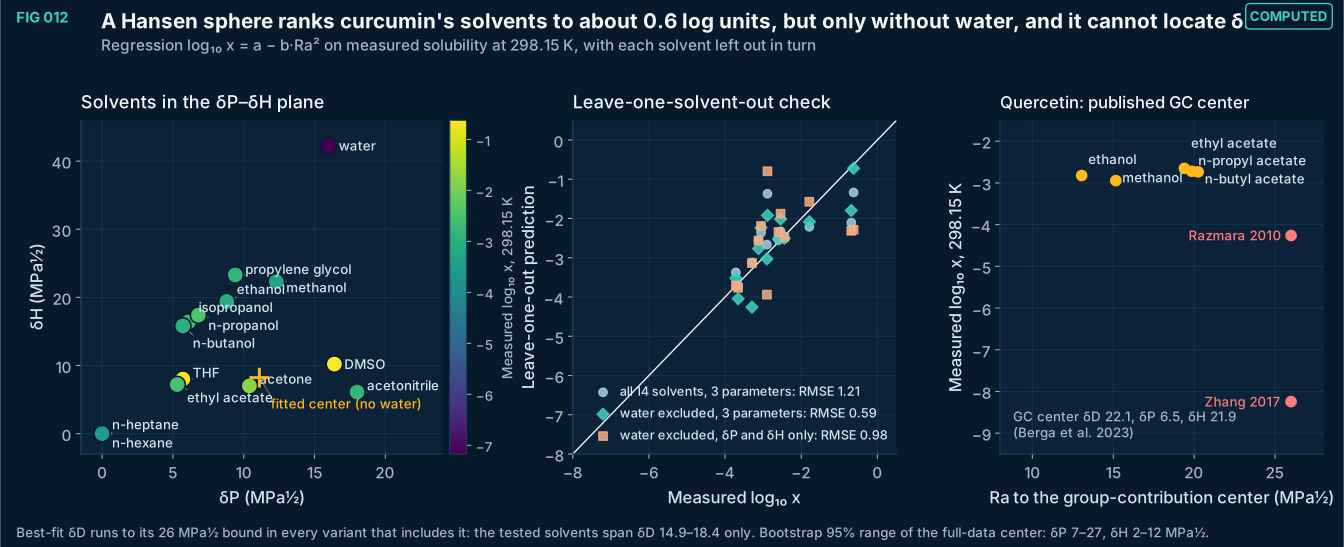
FIG 012Computed
Curcumin solubility at 298.15 K (van 't Hoff interpolation of the measured series) regressed on the Hansen distance Ra to a fitted center. Without water, leave-one-solvent-out RMSE is 0.59 log₁₀ units; including water it rises to 1.21. The dispersion coordinate δD is not identifiable from these solvents. For quercetin, the published group-contribution center orders the organic solvents only weakly and cannot be tested in water, where the two datasets disagree.
Method, sources and limits
- Method
- Least-squares fit of log₁₀ x = a − b·Ra², Ra² = 4(δD−δD₀)² + (δP−δP₀)² + (δH−δH₀)², multi-start; leave-one-out refits; 300-sample bootstrap over solvents. m-Xylene omitted (no Hansen values collected).
- Sources and code
- Krasnov L. et al. BigSolDB 2.0, Zenodo (CSV v2.0; SHA256 879f55f3…). Curcumin rows: Cui et al. J Mol Liq 2021 (10.1016/j.molliq.2021.116795); Shen et al. J Chem Thermodyn 2019 (10.1016/j.jct.2018.11.022); Fluid Phase Equilib 2021 (10.1016/j.fluid.2020.112917). Quercetin rows: Razmara et al. J Chem Eng Data 2010 (10.1021/je9010757); Zhang et al. J Mol Liq 2017 (10.1016/j.molliq.2016.11.036); Montenegro et al. J Chem Thermodyn 2025;203:107434 (10.1016/j.jct.2024.107434). Hansen CM. Hansen Solubility Parameters: A User's Handbook, 2nd ed. CRC Press, 2007; n-hexane: Carré et al. 2024. Berga M et al. Pharmaceuticals 2023;16(10):1407, Table A3 (group-contribution estimate), doi:10.3390/ph16101407 Scripts 03_thermodynamics_CAMD/thermo_compute.py and thermo_figs.py.
- Supports
- Coarse solvent ranking; the need for solvents with higher δD to constrain the center.
- Does not support
- A definitive Hansen parameter set for curcumin or quercetin.
- Prediction of water solubility.
- Limitations
- A Hansen sphere is a correlative model; it ignores temperature, solute melting and specific association.
- Only 13–14 solvents; the center is poorly constrained (wide bootstrap range).
- Values at 298.15 K are interpolated from each published series; where two sources exist their logarithms are averaged.
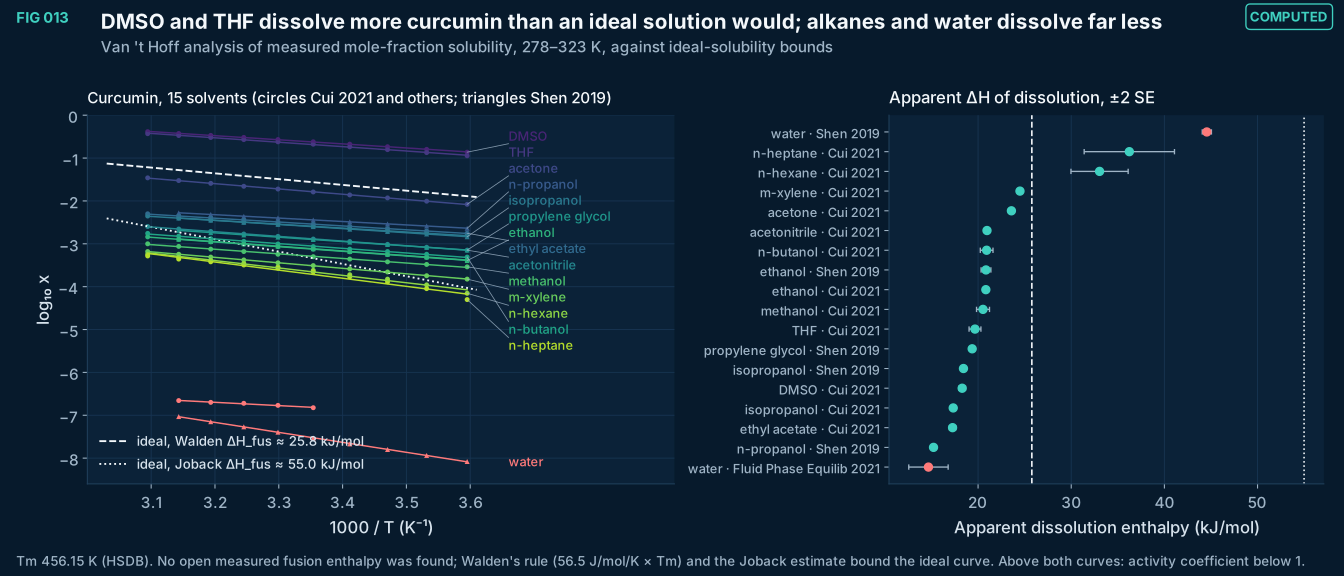
FIG 013Computed
Mole-fraction solubility of curcumin against inverse temperature for 15 solvents, with linear van 't Hoff fits and two ideal-solubility curves that bracket the unknown fusion enthalpy. DMSO and THF lie above both ideal curves, so curcumin's activity coefficient in them is below 1 (favorable specific interactions); n-heptane, n-hexane and water lie far below. The right panel gives each series' apparent dissolution enthalpy; the two water series disagree by about 30 kJ/mol.
Method, sources and limits
- Method
- Ordinary least squares of ln x on 1/T per solvent and source; ΔH_app = −R·slope; ideal solubility ln x = −ΔH_fus/R (1/T − 1/T_m), neglecting ΔC_p.
- Sources and code
- Krasnov L. et al. BigSolDB 2.0, Zenodo (CSV v2.0; SHA256 879f55f3…). Curcumin rows: Cui et al. J Mol Liq 2021 (10.1016/j.molliq.2021.116795); Shen et al. J Chem Thermodyn 2019 (10.1016/j.jct.2018.11.022); Fluid Phase Equilib 2021 (10.1016/j.fluid.2020.112917). Quercetin rows: Razmara et al. J Chem Eng Data 2010 (10.1021/je9010757); Zhang et al. J Mol Liq 2017 (10.1016/j.molliq.2016.11.036); Montenegro et al. J Chem Thermodyn 2025;203:107434 (10.1016/j.jct.2024.107434). Tm: 183 °C, HSDB via PubChem (CRC: 456.15 K). Joback estimate via the chemicals 1.5.2 library. Scripts 03_thermodynamics_CAMD/thermo_compute.py and thermo_figs.py.
- Supports
- The solvent classes that interact favorably with curcumin; the internal consistency of each published series.
- Does not support
- Absolute activity coefficients; extraction yields from plant material.
- Limitations
- Fusion enthalpy is estimated, not measured; the ideal curve could lie anywhere between the two bounds or outside them.
- Apparent enthalpies assume constant ΔH over 278–323 K and no change of the solid phase (solvates or polymorph changes are not checked).
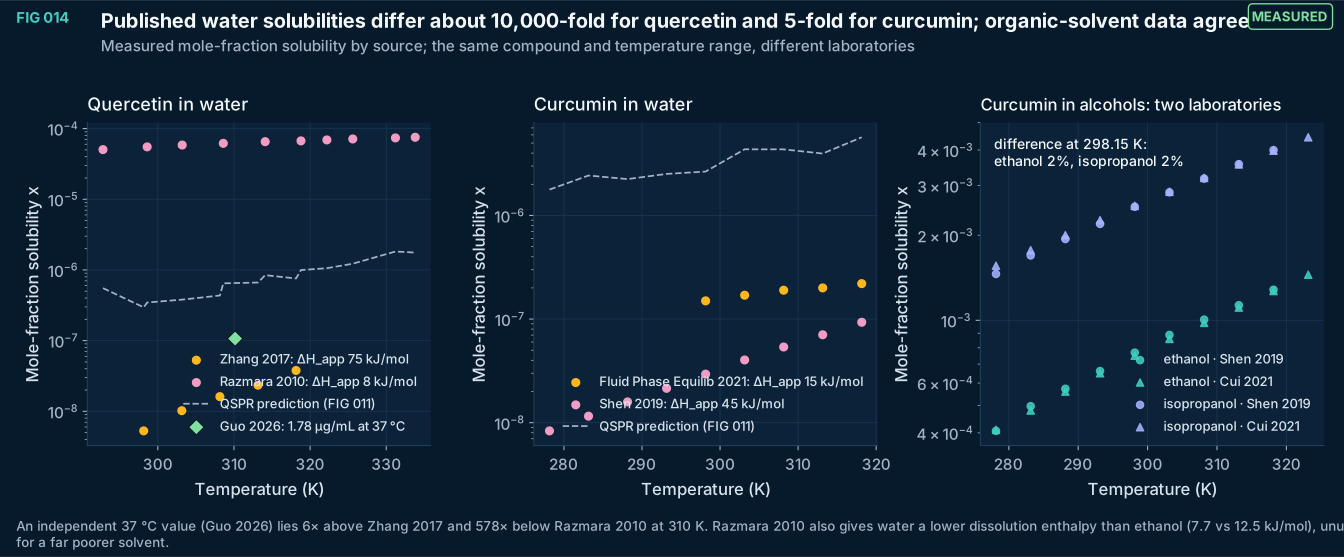
FIG 014Measured
Water solubility of quercetin from two laboratories differs about 10,000-fold at 298.15 K (van 't Hoff interpolation), and that of curcumin about 5-fold, while two laboratories' curcumin data in ethanol and isopropanol agree within a few percent. Water solubility is the quantity most often quoted for these compounds and the least reproducible here.
Method, sources and limits
- Method
- Published measurements as compiled in BigSolDB 2.0; ratios from per-source van 't Hoff fits at 298.15 K; QSPR line from FIG 011 for reference.
- Sources and code
- Krasnov L. et al. BigSolDB 2.0, Zenodo (CSV v2.0; SHA256 879f55f3…). Curcumin rows: Cui et al. J Mol Liq 2021 (10.1016/j.molliq.2021.116795); Shen et al. J Chem Thermodyn 2019 (10.1016/j.jct.2018.11.022); Fluid Phase Equilib 2021 (10.1016/j.fluid.2020.112917). Quercetin rows: Razmara et al. J Chem Eng Data 2010 (10.1021/je9010757); Zhang et al. J Mol Liq 2017 (10.1016/j.molliq.2016.11.036); Montenegro et al. J Chem Thermodyn 2025;203:107434 (10.1016/j.jct.2024.107434). Independent 37 °C quercetin value: Guo et al. Pharmaceuticals 2026;19(10):1625, doi:10.3390/ph19101625. Scripts 03_thermodynamics_CAMD/thermo_compute.py and thermo_figs.py.
- Supports
- Treating aqueous solubility of both compounds as uncertain by orders of magnitude until remeasured under controlled solid form and pH.
- Does not support
- Choosing either published water value for formulation design.
- Limitations
- Sources differ in method (shake-flask, analytical finish), solid form and equilibration time; these details were not re-examined from the full texts.
- The QSPR line is itself trained on public data that include one of the conflicting series' peers and cannot arbitrate.
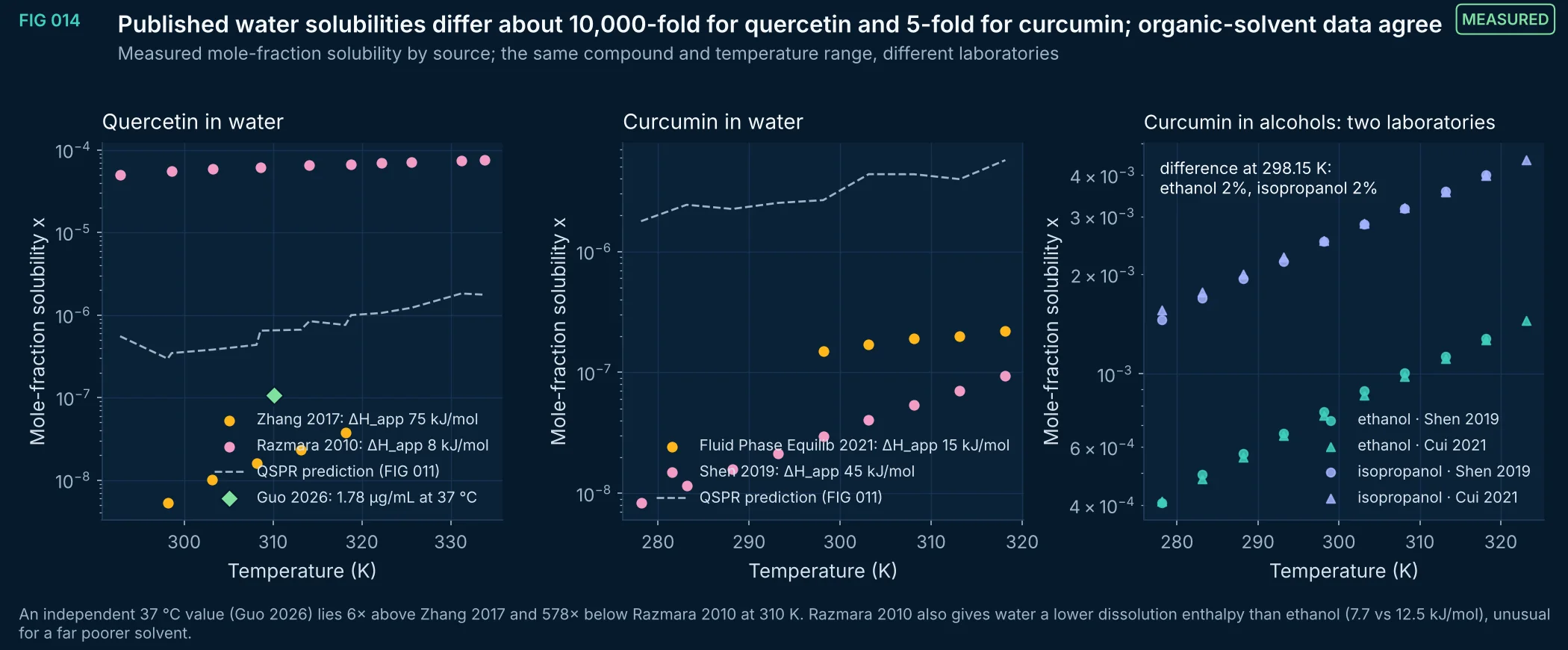
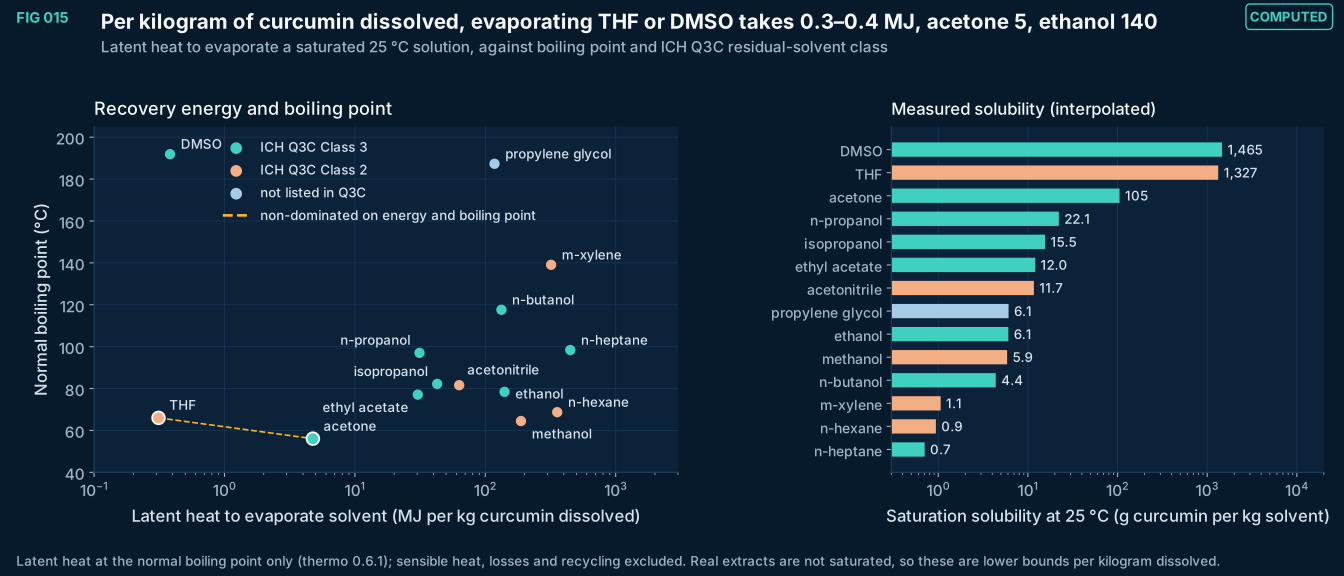
FIG 015Computed
For each solvent with measured curcumin solubility, the mass of solvent needed to dissolve 1 kg of curcumin at saturation (25 °C) times its enthalpy of vaporization, against boiling point, colored by ICH Q3C class. THF and DMSO need 0.3–0.4 MJ per kg dissolved because curcumin is very soluble in them, but THF is Class 2 and DMSO boils near 190 °C. Acetone is the lowest-energy Class 3 solvent with a low boiling point.
Method, sources and limits
- Method
- kg solvent per kg solute = (1 − x)/x · M_solvent/M_curcumin at the interpolated 298.15 K solubility; energy = that mass × ΔH_vap(T_b). Non-dominated set on (energy, boiling point).
- Sources and code
- Krasnov L. et al. BigSolDB 2.0, Zenodo (CSV v2.0; SHA256 879f55f3…). Curcumin rows: Cui et al. J Mol Liq 2021 (10.1016/j.molliq.2021.116795); Shen et al. J Chem Thermodyn 2019 (10.1016/j.jct.2018.11.022); Fluid Phase Equilib 2021 (10.1016/j.fluid.2020.112917). Quercetin rows: Razmara et al. J Chem Eng Data 2010 (10.1021/je9010757); Zhang et al. J Mol Liq 2017 (10.1016/j.molliq.2016.11.036); Montenegro et al. J Chem Thermodyn 2025;203:107434 (10.1016/j.jct.2024.107434). ICH Q3C(R8) Impurities: Guideline for Residual Solvents, Step 4, April 22, 2021, Tables 2 and 3 (database.ich.org). Enthalpies and boiling points from thermo 0.6.1 / chemicals 1.5.2. Scripts 03_thermodynamics_CAMD/thermo_compute.py and thermo_figs.py.
- Supports
- Ranking solvents by recovery energy and residual-solvent class for an early screen.
- Does not support
- A choice of extraction solvent without yield, selectivity and regulatory evaluation.
- Limitations
- A thermodynamic screen, not a process design: selectivity against other rhizome components, solvent hold-up in the marc, viscosity and food-use regulations are not included.
- ICH Q3C applies to medicines; foods and supplements follow other rules (for example, solvent residue limits for spice oleoresins).
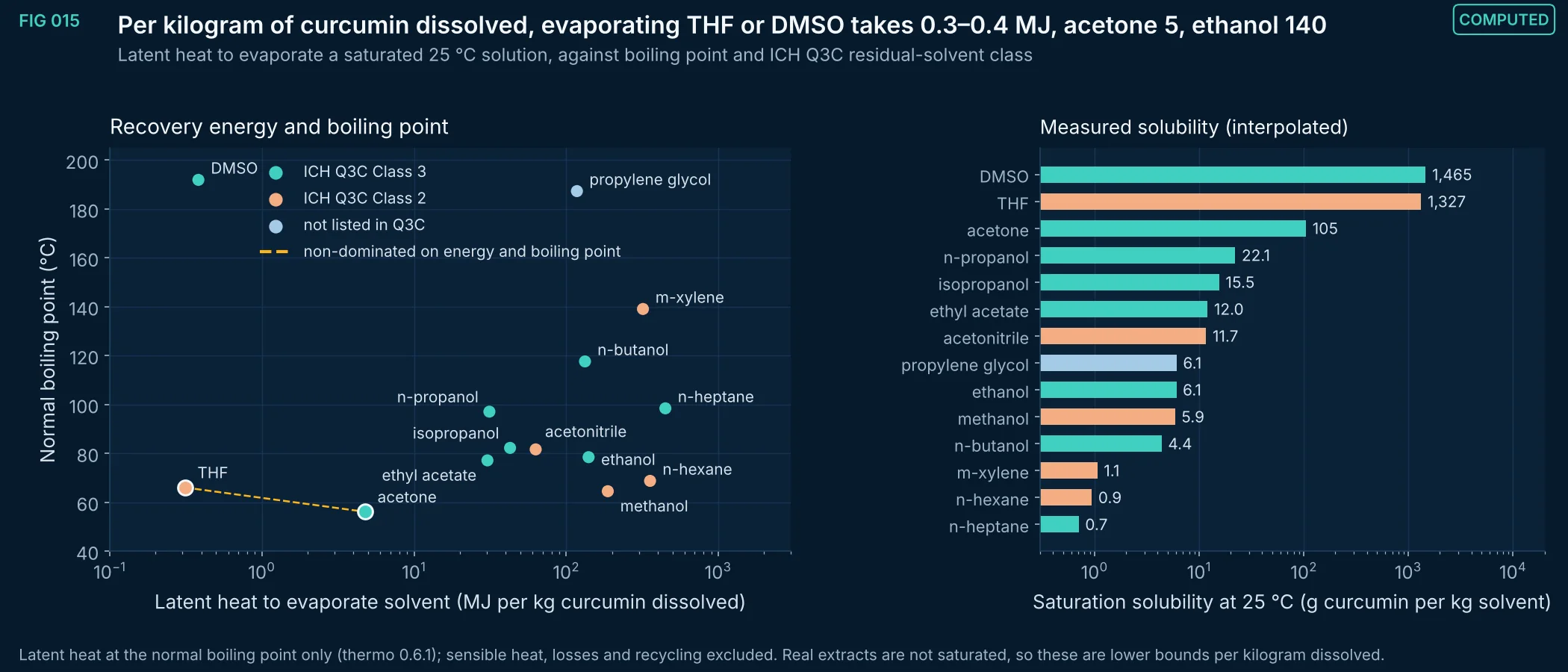
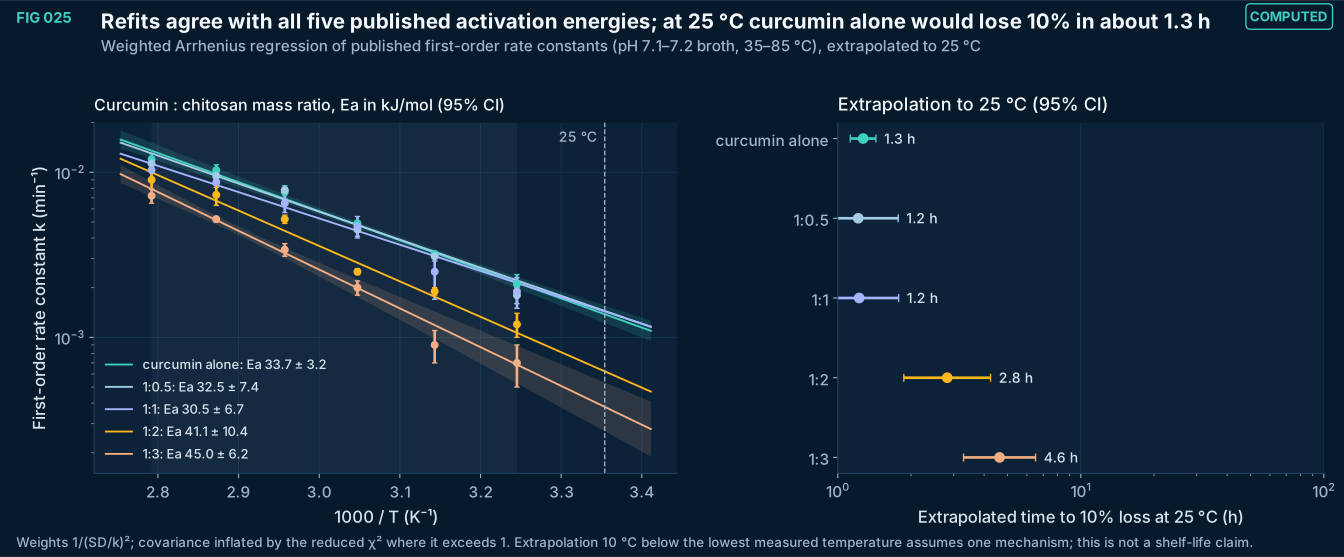
FIG 025Computed
First-order degradation rate constants of curcumin (10 µg/mL) in cation-adjusted Mueller–Hinton broth at pH 7.1–7.2, alone and with chitosan (Dechayont et al. 2026, Table 2), refitted by weighted Arrhenius regression. Every published activation energy lies inside the 95% interval of the refit. Extrapolation to 25 °C gives the time to 10% loss with its 95% interval; higher chitosan ratios lengthen it.
Method, sources and limits
- Method
- Weighted least squares of ln k on 1/T; delta-method intervals for ln k at 25 °C; t₉₀ = ln(10/9)/k.
- Sources and code
- Dechayont B, Brunaugh AD. Chitosan stabilizes curcumin against hydrolysis and potentiates antimicrobial activity against Pseudomonas aeruginosa in a pH-dependent manner. ACS Omega 2026;11(31):46088–46104. doi:10.1021/acsomega.6c02415. PMID 42597930, PMC13470882 Script 05_delivery_QbD/form_figs.py; transcriptions in form_data.py; source XML in 00_provenance/literature.
- Supports
- Using Arrhenius kinetics to plan accelerated stability work for curcumin systems.
- Does not support
- A shelf life for any product.
- Limitations
- Rate constants are for a microbiological broth with 1% DMSO, not a formulation or food matrix.
- UV 420 nm assay measures loss of the chromophore, not identity of products.
- Extrapolation below 35 °C is outside the measured range.
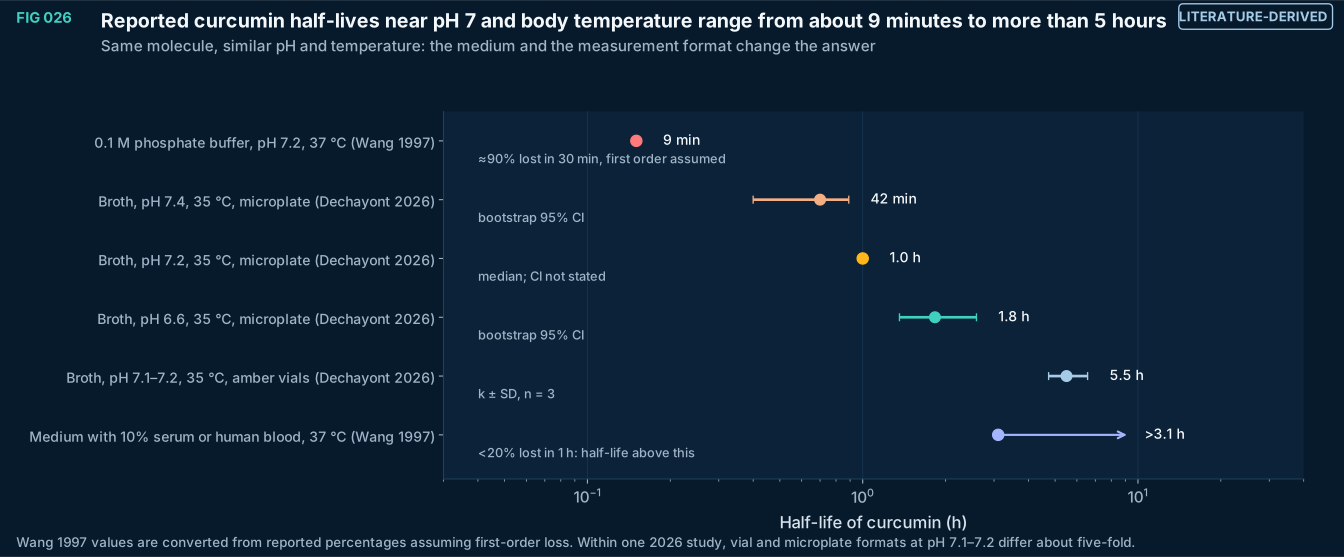
FIG 026Literature-derived
Half-lives of curcumin reported or derived for near-neutral pH at 35–37 °C. Phosphate buffer gives minutes; protein-containing broth gives hours, and the same broth gives different values in amber vials and in microplates. A stability number for curcumin is meaningful only with its medium, container, concentration and assay.
Method, sources and limits
- Method
- Published half-lives and rate constants; percentages converted with t½ = ln 2 / k for first-order loss.
- Sources and code
- Dechayont B, Brunaugh AD. Chitosan stabilizes curcumin against hydrolysis and potentiates antimicrobial activity against Pseudomonas aeruginosa in a pH-dependent manner. ACS Omega 2026;11(31):46088–46104. doi:10.1021/acsomega.6c02415. PMID 42597930, PMC13470882 Wang YJ et al. Stability of curcumin in buffer solutions and characterization of its degradation products. J Pharm Biomed Anal 1997;15(12):1867-76. PMID 9278892 Script 05_delivery_QbD/form_figs.py; transcriptions in form_data.py; source XML in 00_provenance/literature.
- Supports
- Specifying matrix and method for every stability claim.
- Does not support
- A single 'half-life of curcumin'.
- Limitations
- Different curcumin concentrations, co-solvents, light protection and assays.
- Wang 1997 values are taken from the published abstract (about 90% decomposed within 30 min in 0.1 M phosphate buffer, pH 7.2, 37 °C; about 50% remaining after 8 h in medium with 10% fetal calf serum); the full text was not re-examined.
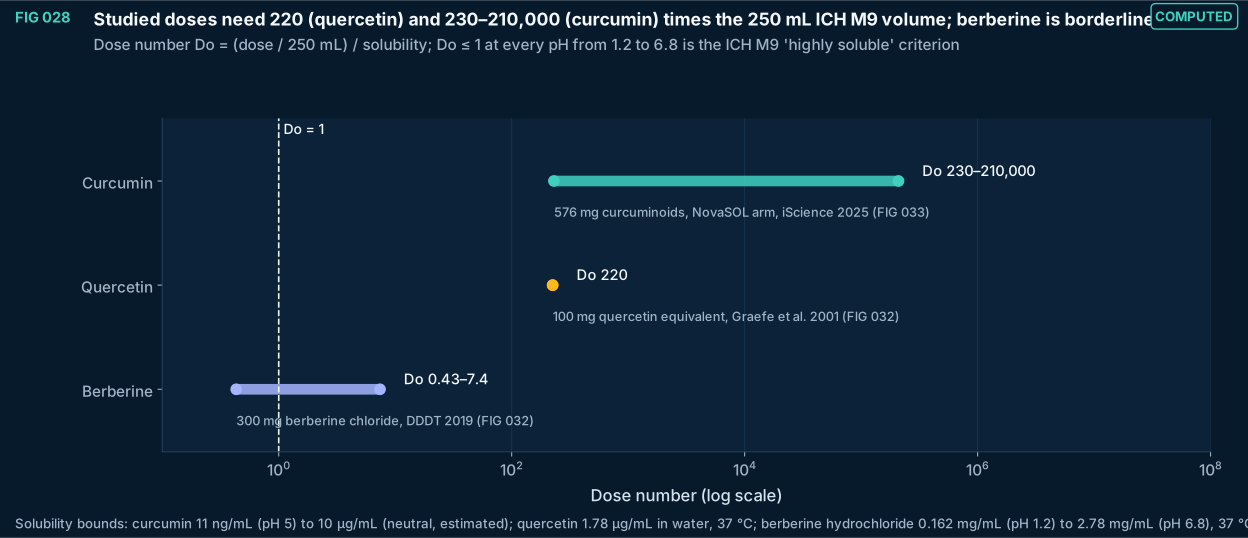
FIG 028Computed
Dose numbers for the main doses in the human studies cited in this note (curcumin about 570 mg, quercetin 100 mg, berberine chloride 300 mg); higher curcumin doses in the cited studies (2.28 g; 10–12 g) give proportionally larger values. Berberine chloride at 300 mg exceeds Do = 1 at pH 1.2 but not at pH 6.8; quercetin and curcumin exceed it by two to five orders of magnitude, so formulation can change dissolution but cannot make these doses dissolve in gastrointestinal volumes as free molecules.
Method, sources and limits
- Method
- Do = (D/250 mL)/Cs (ICH M9 volume); bounds from the lowest and highest solubility values cited.
- Sources and code
- 11 ng/mL at pH 5 (Brotons-Canto et al. Pharmaceutics 2021;13:361, quoting Tønnesen et al. 2002); 1–10 µg/mL estimated at neutral pH (Nelson et al. J Med Chem 2017); 1.78 ± 0.17 µg/mL in water at 37 °C (Guo et al. 2026); berberine hydrochloride 0.162 mg/mL at pH 1.2 to 2.78 mg/mL at pH 6.8, 37 °C (Chen et al. 2024). ICH M9 (2019) Biopharmaceutics Classification System-based biowaivers. Script 05_delivery_QbD/form_figs.py; transcriptions in form_data.py; source XML in 00_provenance/literature.
- Supports
- Why curcumin and quercetin need solubilizing or supersaturating formulations.
- Does not support
- A BCS classification for any product.
- Limitations
- Solubility values come from different laboratories, temperatures and media; biorelevant media with bile salts raise solubility of lipophilic compounds.
- Dose number ignores permeability and metabolism.
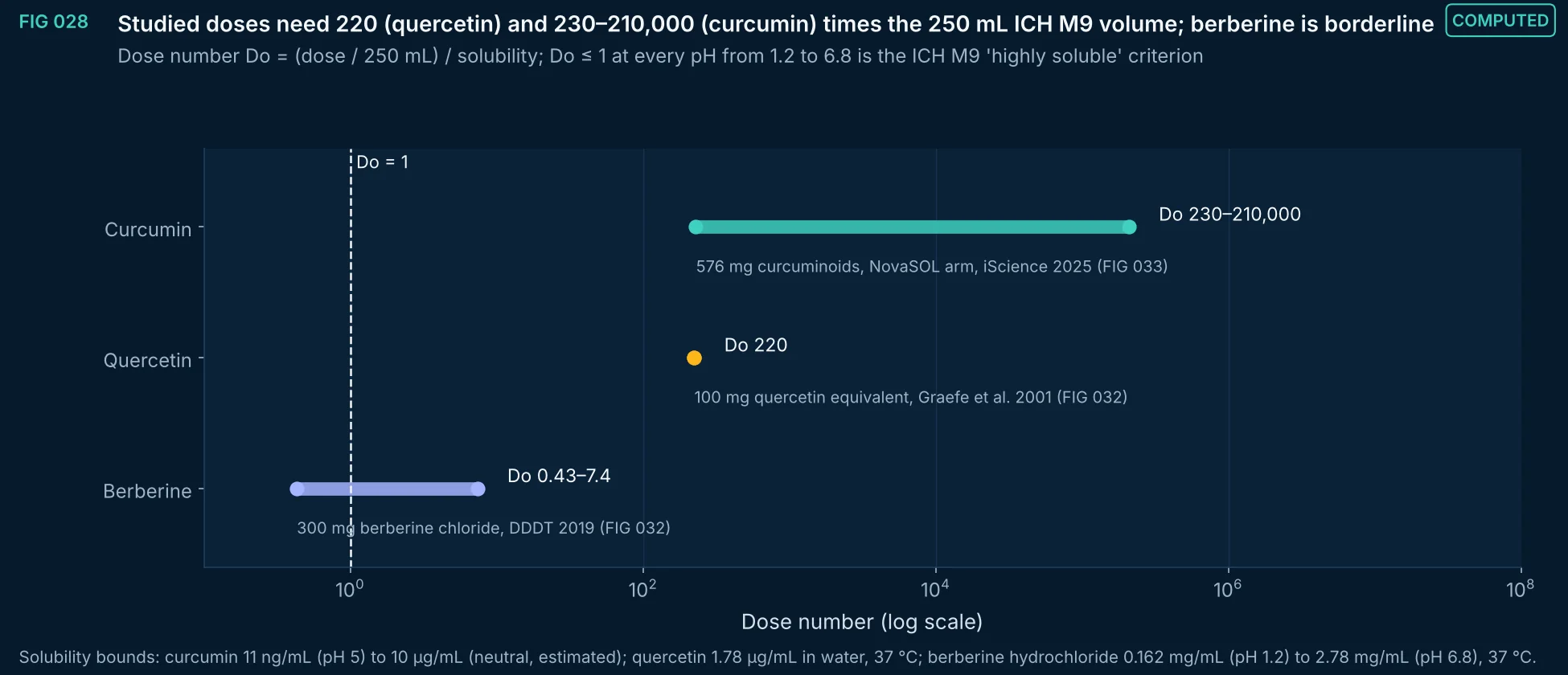
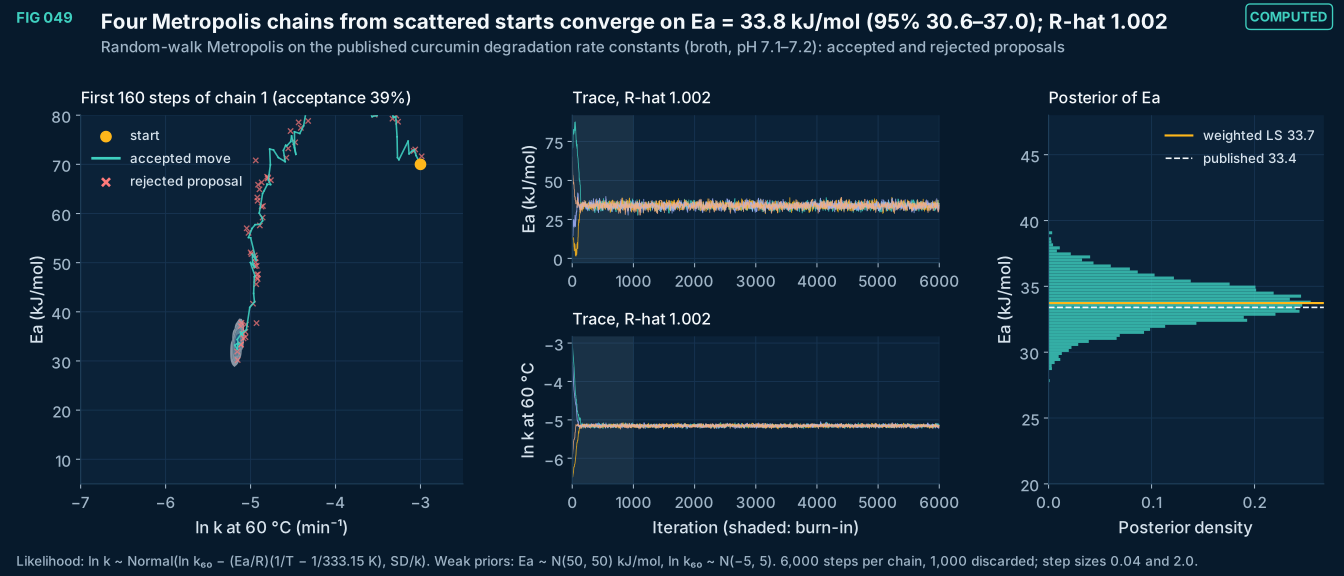
FIG 049Computed
A random-walk Metropolis sampler applied to the published first-order rate constants for curcumin in broth (Dechayont et al. 2026). Left: accepted moves and rejected proposals on the posterior density during the first 160 steps. Middle: four chains started far apart mix within the burn-in window. Right: the posterior of the activation energy agrees with weighted least squares (33.7 kJ/mol) and with the published 33.4 kJ/mol.
Method, sources and limits
- Method
- Random-walk Metropolis, Gaussian proposals, 4 chains × 6,000 iterations, burn-in 1,000; Gelman–Rubin R-hat on post-burn-in draws; temperature-centered parameterization at 60 °C.
- Sources and code
- Dechayont B, Brunaugh AD. Chitosan stabilizes curcumin against hydrolysis and potentiates antimicrobial activity against Pseudomonas aeruginosa in a pH-dependent manner. ACS Omega 2026;11(31):46088–46104. doi:10.1021/acsomega.6c02415. PMID 42597930, PMC13470882 Script 07_MCMC_uncertainty/mc_figs.py.
- Supports
- How a posterior for kinetic parameters is obtained and checked.
- Does not support
- Kinetics outside the measured medium and temperature range.
- Limitations
- Same data and caveats as FIG 025.
- Metropolis is shown for transparency; the PK calibrations (FIG 035–045) use NUTS.
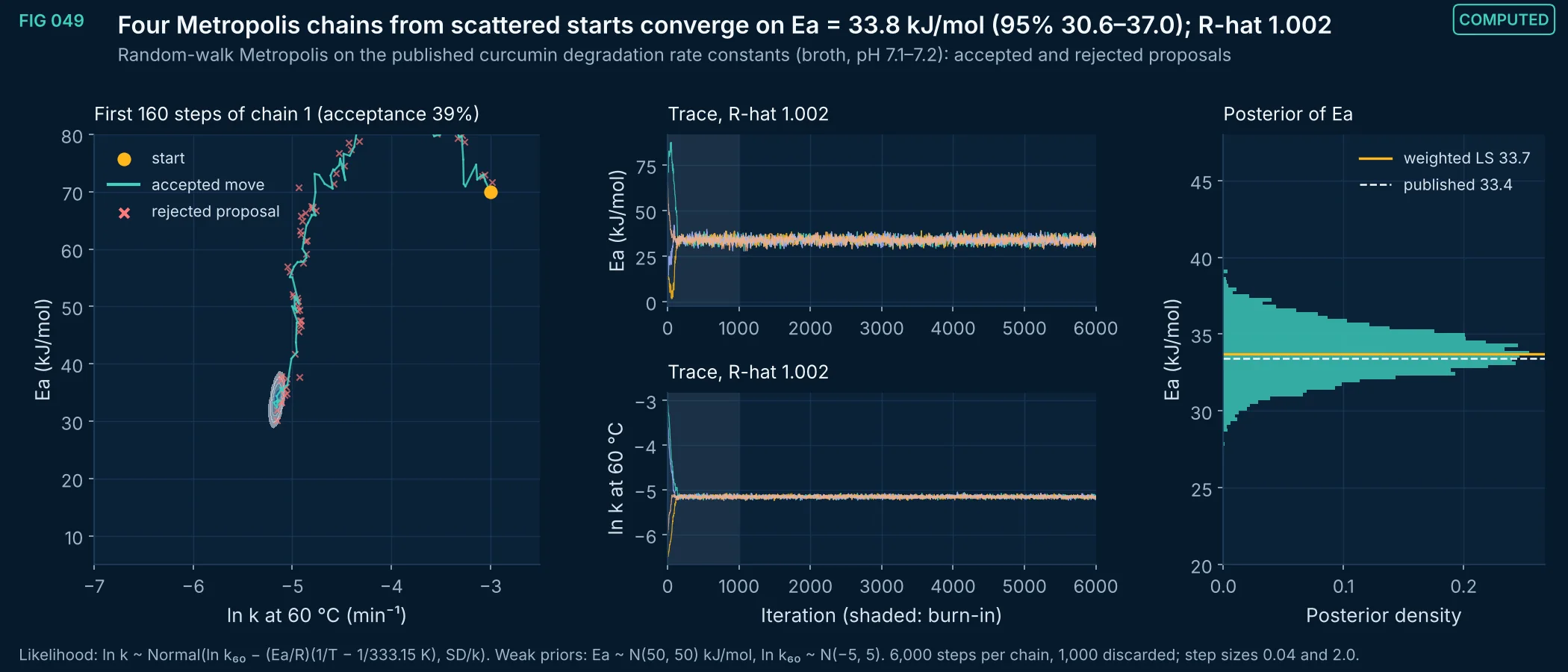
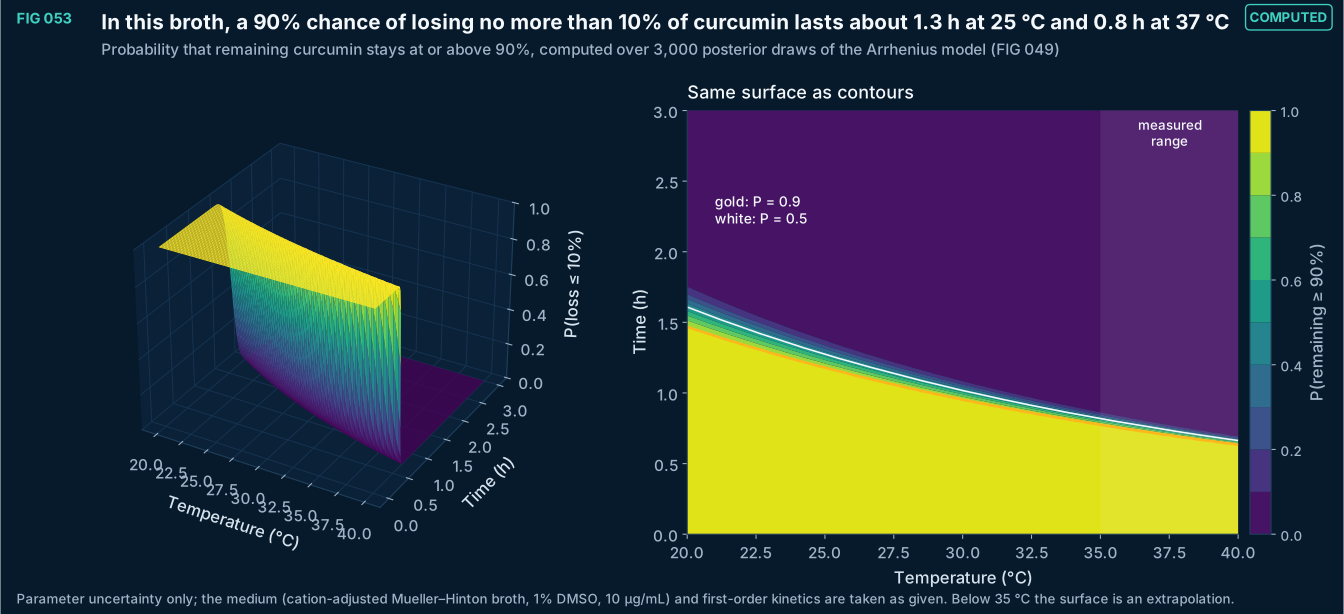
FIG 053Computed
Posterior probability that at least 90% of curcumin remains, as a function of temperature and time, from the Arrhenius posterior fitted to published broth data. The 90% contour is the kind of boundary a stability specification would be set against; for this matrix it is measured in hours, which is why formulation or matrix change is needed before any room-temperature claim.
Method, sources and limits
- Method
- Monte Carlo over 3,000 posterior draws (FIG 049); first-order loss exp(−k(T)t) evaluated on a 41 × 41 grid.
- Sources and code
- Dechayont B, Brunaugh AD. Chitosan stabilizes curcumin against hydrolysis and potentiates antimicrobial activity against Pseudomonas aeruginosa in a pH-dependent manner. ACS Omega 2026;11(31):46088–46104. doi:10.1021/acsomega.6c02415. PMID 42597930, PMC13470882 Script 07_MCMC_uncertainty/mc_figs.py.
- Supports
- How a probability-of-compliance boundary is computed from kinetic data.
- Does not support
- A shelf life for any product or matrix.
- Limitations
- Extrapolation below 35 °C assumes one mechanism.
- Batch-to-batch and analytical variability are not included; the probability reflects parameter uncertainty only.
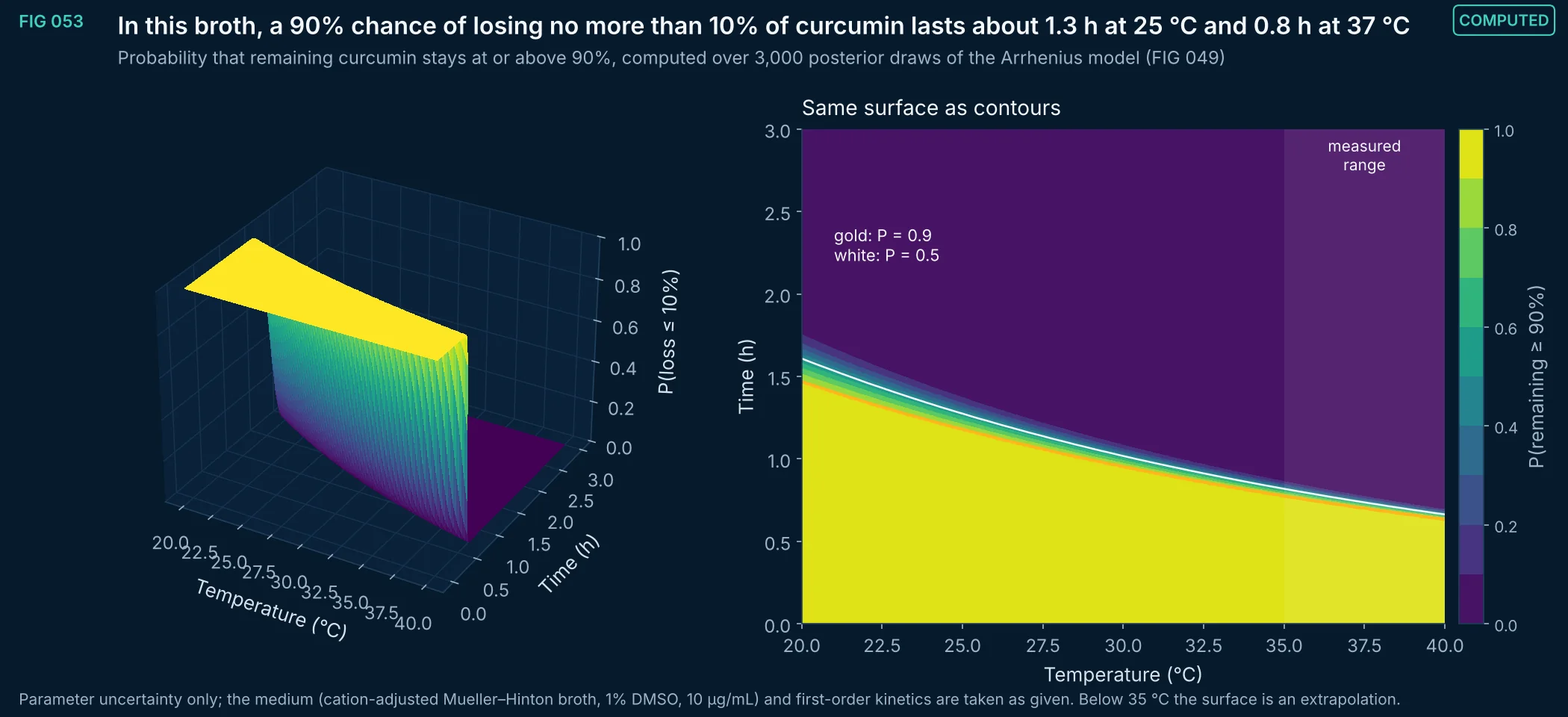
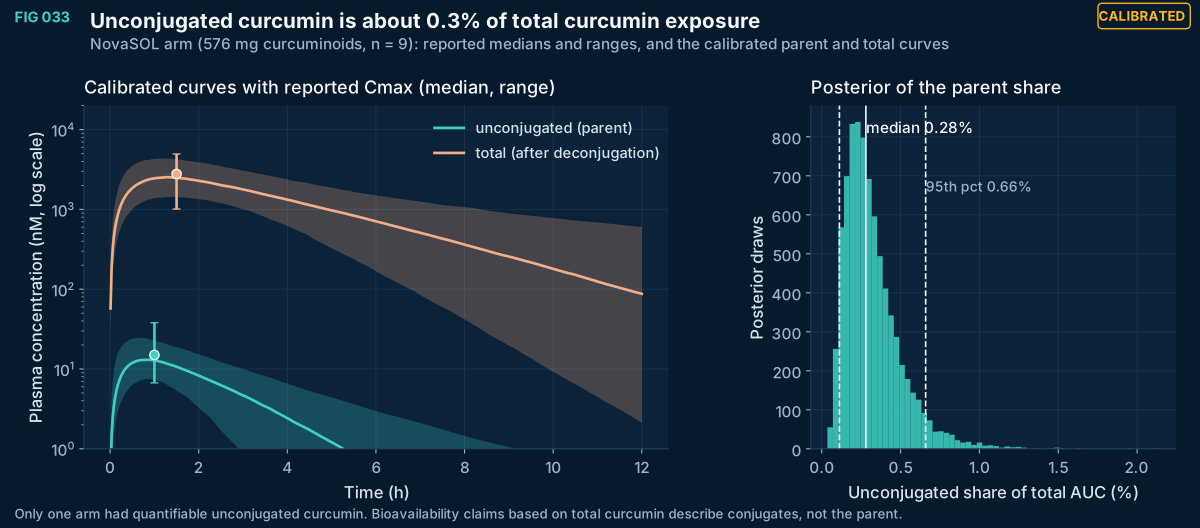
FIG 033Calibrated
Calibrated unconjugated and total curcumin curves for the NovaSOL arm, and the posterior distribution of the unconjugated share of total AUC.
Method, sources and limits
- Method
- Two Bateman curves sharing kₐ; log-normal likelihood on medians (σ_log = ln(max/min)/4) and normal likelihood on Tmax (SD 0.35 h assumed).
- Sources and code
- Kroon MAGM, van Laarhoven HWM, Swart EL, van Tellingen O, Kemper EM. A pharmacokinetic study and critical reappraisal of curcumin formulations enhancing bioavailability. Kroon MAGM et al. A pharmacokinetic study and critical reappraisal of curcumin formulations enhancing bioavailability. Kroon MAGM et al. A pharmacokinetic study and critical reappraisal of curcumin formulations enhancing bioavailability. iScience 2025;28(6):112575, Table 2. doi:10.1016/j.isci.2025.112575
- Supports
- Total and parent curcumin exposures differ by more than two orders of magnitude in this arm.
- Does not support
- Exposure of any other formulation or dose.
- Limitations
- Medians and ranges of n = 9; σ from the range is an approximation.
- The quercetin and berberine metabolite profiles are not modeled: no matched parent and metabolite summary data were extracted.
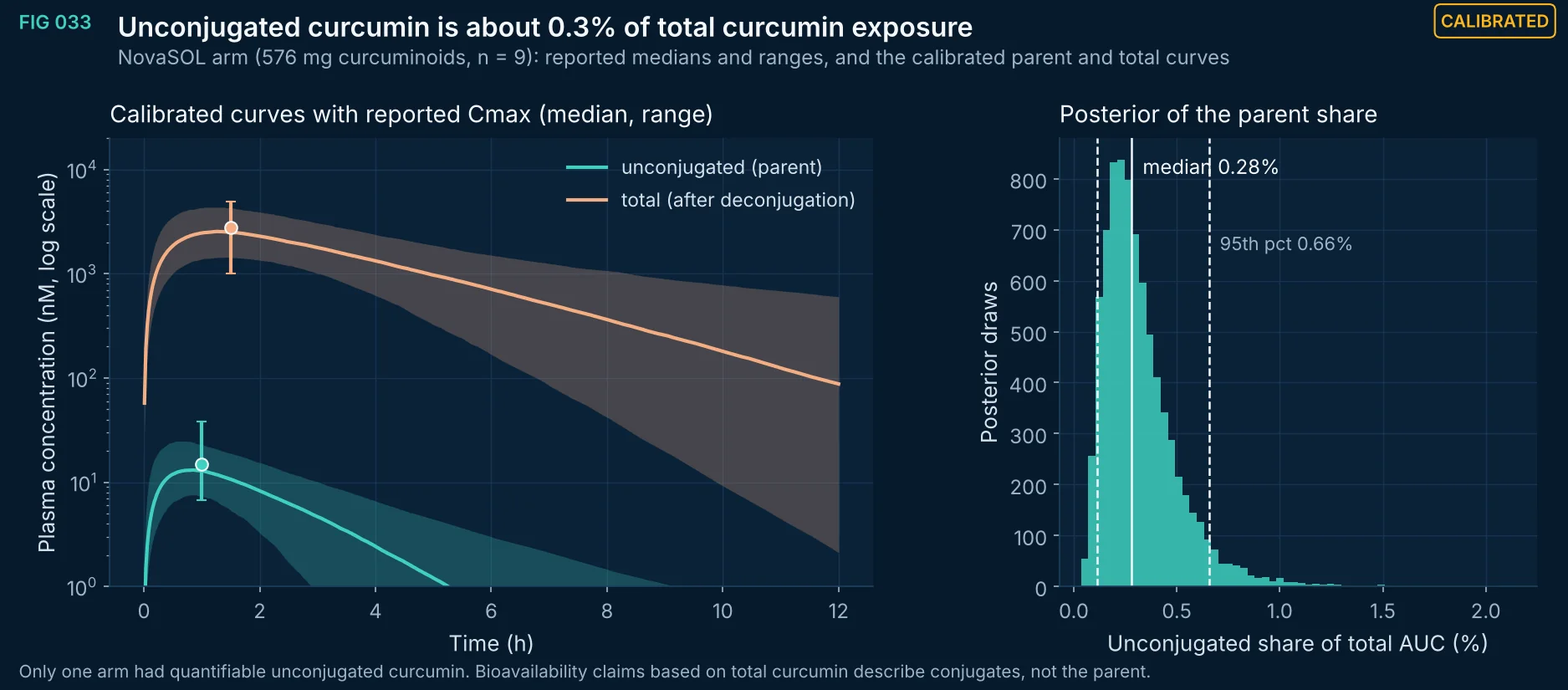
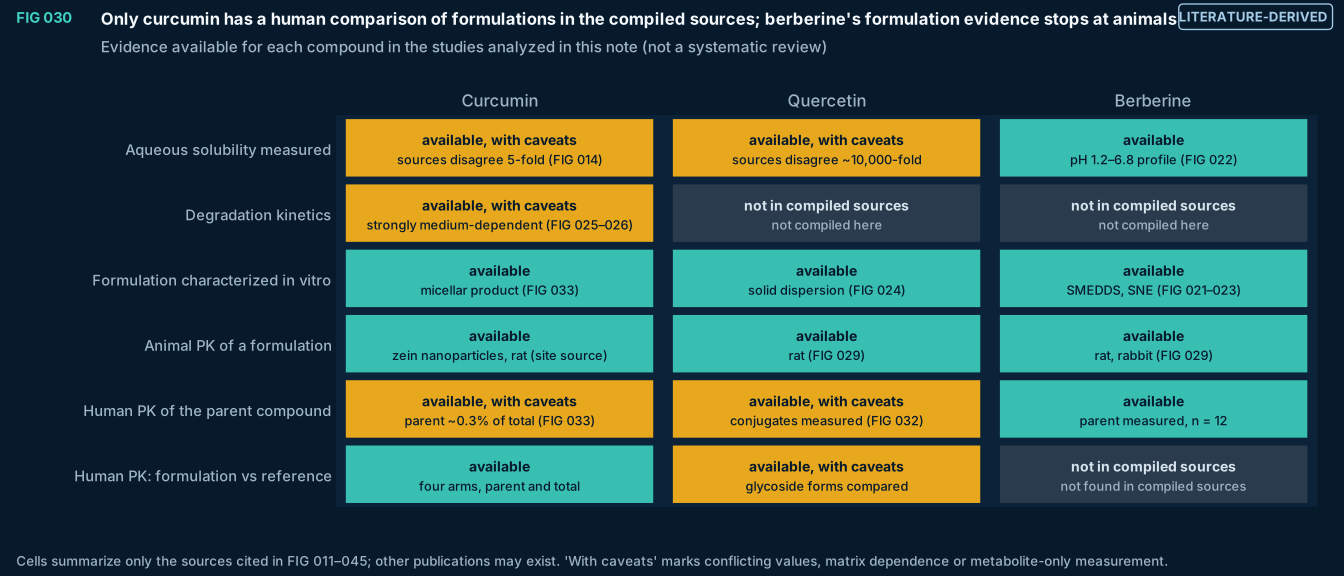
FIG 030Literature-derived
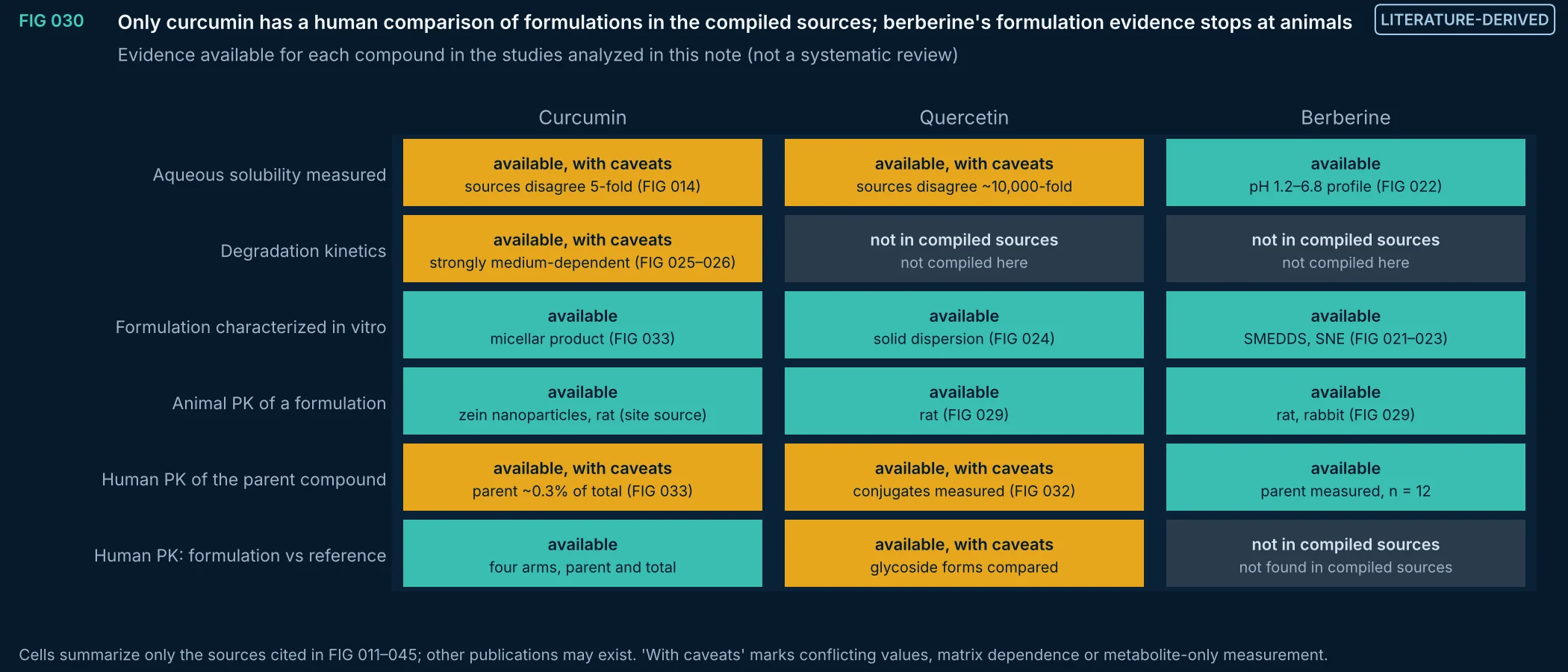
What the studies analyzed in this note do and do not show for each compound. Curcumin has a four-arm human study comparing formulations by unconjugated and total curcumin; quercetin's human data compare glycoside forms by conjugate levels; berberine has human data for the parent compound only, and its formulation data are in vitro and in animals.
Method, sources and limits
- Method
- Structured summary of the cited sources; categories defined before filling the table.
- Sources and code
- Sources as cited in FIG 011–045 and their metadata files. Script 05_delivery_QbD/form_figs.py; transcriptions in form_data.py; source XML in 00_provenance/literature.
- Supports
- Prioritizing human pharmacokinetic studies for berberine formulations.
- Does not support
- Any claim that a study does not exist.
- Limitations
- Not a systematic review; absence here means absence from the compiled sources only.
Interpretation
What the results support, and what they do not
Supported
- Choosing extraction solvents on measured solubility, recovery energy and residual-solvent class together.
- Requiring matrix-specific degradation kinetics before any stability claim.
- Reporting unconjugated and total curcumin separately in any exposure study.
Not supported
- A recommended solvent, process or shelf life for a product.
- Any statement that a formulation increases bioavailability of unconjugated curcumin, beyond the one study analyzed.
Next step and significance
What to measure next, and why it matters for development
- Next step
- Measure the fusion enthalpy and aqueous solubility of the crystal form used, and degradation kinetics in the intended product matrix at three temperatures with LC-MS product identification.
- Why it matters
- For an ingredient developer, the numbers that matter are the parent compound that reaches plasma and the fraction that survives manufacture and storage. Designing to those quantities, rather than to total curcumin, separates a defensible product from one whose claim rests on conjugates.
Health information notice. These statements have not been evaluated by the Food and Drug Administration. Nothing on this site is intended to diagnose, treat, cure or prevent any disease, and nothing here is medical advice.
Read the full notice
The information is for general education only. It does not replace advice, diagnosis or treatment from a qualified health professional, or any medication a clinician has prescribed. Do not start, stop or change any medicine, supplement or herbal product because of something you read here. Talk to your doctor or pharmacist first, especially if you are pregnant or breastfeeding, have a medical condition, take any medicines, are preparing for surgery, or are caring for a child. Research findings, traditional uses and safety data are reported as their sources state them; they are not recommendations or claims about any product. If you think you may have a medical emergency, call your doctor or 911 at once.
EUTECNIQ Sciences sells no supplements or health products today and receives nothing from any product or ingredient mentioned on this site; any commercial interest it later has in an ingredient will be stated on that ingredient’s page.