

A ledger can prove a record is unchanged, not that the plant in the drum matches it
A botanical changes owner, form and customs code several times before it reaches a capsule, and each handoff can substitute, contaminate or relabel it. Part A sets out what is documented and what current rules, standards and pilots do. Part B is EUTECNIQ's proposal: tie each lot's record to physical evidence, then make every later edit visible.
Status. EUTECNIQ operates no ledger, software, laboratory or supply chain and has no partners or customers for one. Part B describes a proposed design; it does not exist and is not in use. The timeline and the hash demonstration use invented lots and records.
Related, not repeated here: Digital lab (Part 11, lot genealogy, FSMA 204 data elements, a live hash chain) · Data asset (four record designs compared) · Global trade data · Botanical identity · Certificate-of-analysis science · A good sample is not a reliable supply
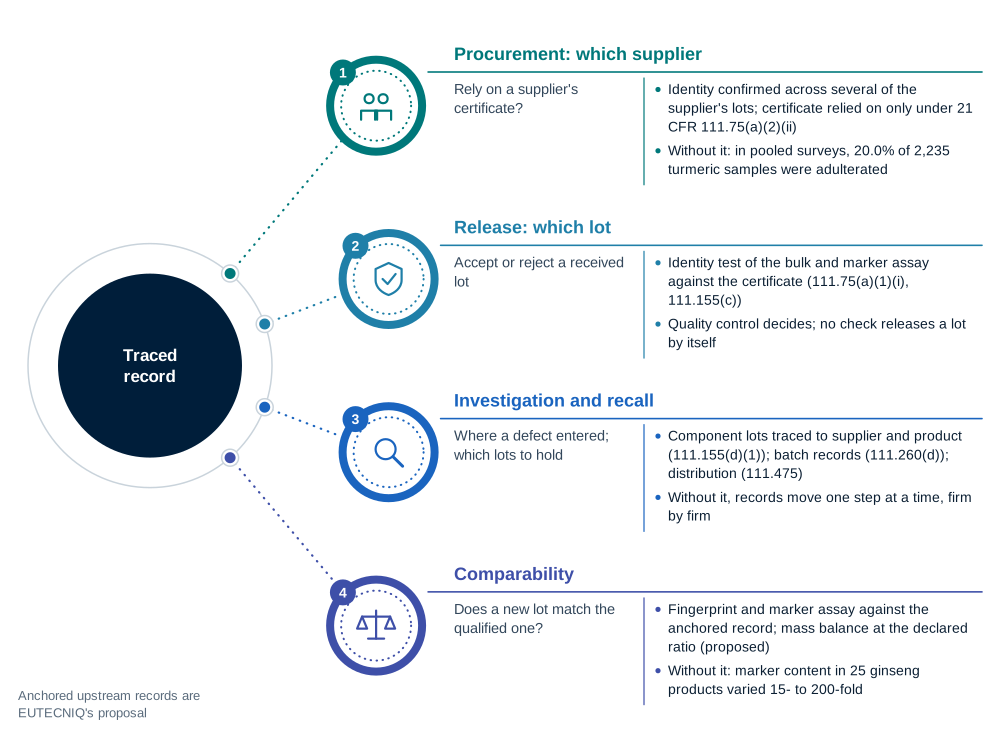
Traceability pays off in four decisions: which supplier, which lot, where a defect entered, and whether a new lot matches the old
Each decision needs a record that links a physical lot to its evidence. Part 111 already requires most of these records; the proposal on this page would add evidence anchored upstream, before the material changes hands.
| Decision | Traced record that answers it | Without it |
|---|---|---|
| Procurement: qualify a supplier and decide whether to rely on its certificate | Identity results confirmed across several of that supplier's lots; a certificate relied on only under the five conditions of 21 CFR 111.75(a)(2)(ii). Proposed: voucher specimen, DNA barcode and pre-shipment fingerprint, anchored before shipment | The buyer relies on a claim it cannot check. Substitution is documented at every stage from field to shelf; in pooled surveys, 20.0% of 2,235 commercial turmeric samples were adulterated |
| Release: accept or reject a received lot | The manufacturer's identity test of the bulk against the botanical reference and the anchored pre-shipment fingerprint; the marker assay against the certificate, within the uncertainty of both results (111.75(a)(1)(i), 111.155(c)) | Quality control can still fail the lot, but cannot tell whether the gap arose in the supplier's sampling or in the bulk, and a supplier record could be revised afterwards without the change being visible |
| Investigation and recall: find where a defect entered and which finished lots to hold | Each component lot traced to its supplier and to the supplement made from it (111.155(d)(1)); component lot identifiers in each batch record (111.260(d)); distribution records (111.475) | Records move one step at a time, firm by firm. Walmart reported almost 7 days to trace mangoes to their farm by phone and email, against 2.2 seconds on its ledger pilot (company-reported; no method published) |
| Comparability: decide whether a new lot, source or extract batch matches the one qualified | Fingerprint and marker assay compared with the anchored record of the qualified material; a mass balance of extract shipped against plant material consumed at the declared drug-to-extract ratio (proposed) | A change of origin or process stays invisible until a test fails. Ginsenoside Rb1 in 6-year ginseng roots varied about twofold between regions, and marker content in 25 ginseng products varied 15- to 200-fold |
The tests decide; the record decides which test result belongs to which lot, and whether it was written before the question arose. No check releases or rejects a lot by itself: quality control decides (§ 111.155(c)).
21 CFR 111.75 and 111.155 (eCFR version of October 1, 2026); 21 CFR 111.260(d) and 111.475, as cited on Quality system; Gafner et al., Pharm Biol 2026 (turmeric scoping review); Xiao et al., J Ginseng Res 2015; Harkey et al., Am J Clin Nutr 2001; Kamath 2018 and LF Decentralized Trust, Walmart case study. Full citations in the sections below and under References. The anchored records are EUTECNIQ's proposal; no system exists.
Plants and extracts cross borders under different customs codes, and no public record links the two
Show data: the flow table
| Country | HS 12.11 imports from other countries | Three largest origins | U.S. HS 13.02 imports from it | Share of U.S. HS 13.02, % |
|---|---|---|---|---|
| China | 337.4 | Viet Nam 68.1; Canada 46.6; Myanmar 43.1 | 359.9 | 21.4 |
| Germany | 504.5 | Canada 90.1; India 78.9; Poland 39.2 | 69.4 | 4.1 |
| France | 141.5 | Germany 19.0; India 18.6; Morocco 12.1 | 128.9 | 7.7 |
| Japan | 335.2 | China 279.1; South Africa 13.4; India 10.0 | 14.6 | 0.9 |
| Korea, Rep. | 129.3 | China 90.9; India 9.5; Indonesia 4.2 | 22.4 | 1.3 |
| All U.S. HS 13.02 imports | — | 85 partners; India 497.6 (29.6%) | 1,678.8 | 100.0 |
Stage 1 values are reported by each importing country; stage 2 values are reported by the United States. Origins sending US$20 million or more to one of the five countries are drawn separately; all others are grouped as other origins.
Customs statistics count value and weight by heading and country. They carry no lot codes, so tracing a botanical from field to capsule needs records the trading partners keep themselves.
How the chart was built, and what customs data cannot show
HS 12.11 covers "plants and parts of plants (including seeds and fruits), of a kind used primarily in perfumery, in pharmacy or for insecticidal, fungicidal or similar purposes, fresh, chilled, frozen or dried, whether or not cut, crushed or powdered". HS 13.02 covers "vegetable saps and extracts; pectic substances, pectinates and pectates; agar-agar and other mucilages and thickeners, whether or not modified, derived from vegetable products". A plant and an extract made from it therefore fall under different headings, and the chart links them only through the countries that trade both.
The five middle countries are the five largest U.S. suppliers of HS 13.02 among the 7 importers other than the United States compiled on the global trade page; the others, Hong Kong SAR (US$0.2M) and Other Asia, n.e.s. (US$3.0M), are not drawn. Values are importer-reported primary values; importers mostly report CIF, exporters FOB, and mirror figures differ, as the global trade page explains. Japan imports large volumes of Chinese plant material but supplies little HS 13.02 to the United States; the chart shows both facts and implies nothing about what happens in between.
Heading texts: World Customs Organization, HS Nomenclature 2022 Edition, headings 12.11 and 13.02 (as also listed in the UN Comtrade HS reference file).
Substitution, contamination and mislabeling are documented at every stage from field to shelf
| Stage | Substitution | Contamination | Mislabeling | Sample-vs-bulk gap |
|---|---|---|---|---|
| Farm or wild collection | ||||
| Aggregator and primary processor | ||||
| Extractor | ||||
| Supplement manufacturer | ||||
| Brand and market |
Select a cell.
The rationale and its sources appear here. All 20 are also listed in the table below.
Text version: all 20 cells with rationale and sources
| Stage and failure mode | Level | Rationale | Sources |
|---|---|---|---|
| Farm or wild collection · Substitution | Named control point | WHO GACP asks growers to verify and record the botanical identity of each cultivated plant, with a voucher specimen where identity is in doubt (section 2.1), and asks collectors to prepare voucher specimens for herbarium authentication (section 3.3). No source cited here measures substitution rates at harvest. | World Health Organization |
| Farm or wild collection · Contamination | Documented here | At 37 wolfberry sites in Ningxia, cadmium was concentrated in the fruit relative to its root-zone soil (bioconcentration factor 5.82) and exceeded the standard limit in fruit at one site. WHO GACP addresses soil and fertilizers (section 2.3.4) and the quality of irrigation water (section 2.3.5). | Zhou T, Wang Y, Qin J, Zhao S, Cao D, Zhu M, Jiang Y; World Health Organization |
| Farm or wild collection · Mislabeling | Carried through | No source cited here places labeling errors at harvest. The name a collector uses travels with the lot until an identity test checks it. | No stage-specific source |
| Farm or wild collection · Sample-vs-bulk gap | Documented here | In ginseng roots aged 3 to 6 years from three regions, ginsenosides Rg1 and Re rose with age, and Rb1 in 6-year roots varied about twofold between regions. The study did not test pooled lots; that one field's sample need not describe a lot pooled from several is an inference from this variation. | Xiao D, Yue H, Xiu Y, Sun X, Wang Y, Liu S |
| Aggregator and primary processor · Substitution | Documented here | In 48 publications covering 2,235 commercial turmeric samples, 20.0% were adulterated, and 20.4% of spice samples. Reported adulterants include artificial dyes, undeclared diluents and synthetic curcumin. The samples were commercial products, so the stage at which adulterants entered is inferred. | Gafner S, Orhan N, Kahraman Ç, Blumenthal M |
| Aggregator and primary processor · Contamination | Documented here | In Bangladesh, a field study found evidence of lead chromate pigment adulteration of turmeric in 7 of the 9 major producing districts; polishers added the pigment to dried turmeric root. In a 2025 Salmonella outbreak, FDA traceback identified a single lot from a direct importer of moringa leaf powder. | Forsyth JE, Nurunnahar S, Islam SS, et al; Centers for Disease Control and Prevention |
| Aggregator and primary processor · Mislabeling | Documented here | Trade names can cover several genera: EMA states that the name Fang ji can describe the roots of Aristolochia fangchi, Stephania tetrandra or Cocculus species. | European Medicines Agency (EMEA), Herbal Medicinal Products Working Party |
| Aggregator and primary processor · Sample-vs-bulk gap | Named control point | EU rules adopted in 2006 described aflatoxins as very heterogeneously distributed in a lot and sampled spice lots of 15 metric tons or more in sublots of 25 metric tons with 100 increments each. Codex warns that no sampling plan can ensure that every item in a lot conforms. | Commission Regulation (EC) No 401/2006 of 23 February 2006 laying down the methods of sampling and analysis for the official control of the levels of mycotoxins in foodstuffs, recital 7 and Annex I part E (text as adopted; repealed from April 1, 2024).; Commission Implementing Regulation (EU) 2023/2782 of 14 December 2023 laying down the methods of sampling and analysis for the control of the levels of mycotoxins in food and repealing Regulation (EC) No 401/2006 (applies from April 1, 2024).; Codex Alimentarius Commission |
| Extractor · Substitution | Documented here | Surveys found 9 of 21 grape seed extract products and 3 of 8 ginkgo products adulterated; the adulterants were peanut skin extract and added free flavonol aglycones, materials of the kind added during extract manufacture. The surveys tested finished products, so the stage is inferred. | Villani TS, Reichert W, Ferruzzi MG, Pasinetti GM, Simon JE, Wu Q; Wohlmuth H, Savage K, Dowell A, Mouatt P |
| Extractor · Contamination | Named control point | ICH Q3C, a pharmaceutical guideline whose scope is drug substances, excipients and drug products, sets limits for residual solvents, which it defines as organic volatile chemicals used or produced in manufacture; solvent extraction is where such solvents would enter a botanical extract. The certificate-of-analysis course explains the classes and limits. | ICH |
| Extractor · Mislabeling | Documented here | The ABC–AHP–NCNPR program documents ingredients substituted, diluted or "fortified" with undisclosed lower-cost ingredients, often by schemes designed to deceive the analytical methods used for authentication. | Gafner S, Blumenthal M, Foster S, Cardellina JH 2nd, Khan IA, Upton R |
| Extractor · Sample-vs-bulk gap | Carried through | No source cited here documents a sample-vs-bulk gap specific to extracts. Extract batches combine raw-material lots, which is why each received lot is sampled again. | No stage-specific source |
| Supplement manufacturer · Substitution | Documented here | In weight-reducing pills taken by the patients Nortier et al. studied in Brussels, Stephania tetrandra was inadvertently replaced by Aristolochia fangchi because of a manufacturing error. In FY2025, FDA's published inspection observations include 66 citing the identity-test requirement for dietary ingredients (111.75(a)(1)(i)). | Nortier JL, Martinez MC, Schmeiser HH, et al; FDA |
| Supplement manufacturer · Contamination | Named control point | Part 111 requires limits on the types of contamination that may adulterate each component and the finished batch (21 CFR 111.70(b) and (e)). | 21 CFR 111.70, What specifications must you establish? eCFR, current as of October 28, 2026. |
| Supplement manufacturer · Mislabeling | Named control point | Part 111 requires finished-batch specifications for identity, purity, strength and composition (21 CFR 111.70(e)); citations of 111.70(e) rose from 1.4% of Part 111 inspection observations in FY2010 to 9.7% in FY2025. | 21 CFR 111.70, What specifications must you establish? eCFR, current as of October 28, 2026.; FDA |
| Supplement manufacturer · Sample-vs-bulk gap | Named control point | Part 111 requires representative samples of each unique shipment and each unique lot within it (111.80(a)), and quarantine until quality control has reviewed the results and approved the component for use (111.155(c)); a supplier's sample does not replace them. | 21 CFR 111.80, What representative samples must you collect? eCFR (version of October 1, 2026, read October 30, 2026).; 21 CFR 111.155, What requirements apply to components of dietary supplements? eCFR (version of October 1, 2026, read October 30, 2026). |
| Brand and market · Substitution | Documented here | Of 37 St. John's wort dry extracts, finished products and bulk herb samples, selected because preliminary tests suggested adulteration, HPTLC showed synthetic dyes in 8 and non-conforming flavonoid fingerprints in 6. In Echinacea products marketed across Europe, DNA metabarcoding detected no Echinacea in 4 of the 38 products retained for analysis. | Frommenwiler DA, Reich E, Sudberg S, Sharaf MHM, Bzhelyansky A, Lucas B; Raclariu AC, Țebrencu CE, Ichim MC, Ciupercǎ OT, Brysting AK, de Boer H |
| Brand and market · Contamination | Documented here | 14 of 70 Ayurvedic products bought near Boston contained lead, mercury and/or arsenic. In 2023–2024, lead in cinnamon used in applesauce pouches was linked to 566 cases in the United States. | Saper RB, Kales SN, Paquin J, et al; Troeschel AN, Buser MC, Winquist A, et al |
| Brand and market · Mislabeling | Documented here | In 25 ginseng products from one U.S. health food store, all were correctly identified as Panax or Eleutherococcus, but marker content differed significantly from labeled amounts, and marker concentrations varied 15- to 200-fold between products. | Harkey MR, Henderson GL, Gershwin ME, Stern JS, Hackman RM |
| Brand and market · Sample-vs-bulk gap | Carried through | A buyer who tests one retail lot learns about that lot. Part 111 places finished-batch sampling with the manufacturer (111.80(c)); the sources cited here report product-to-product rather than retail lot-to-lot data. | 21 CFR 111.80, What representative samples must you collect? eCFR (version of October 1, 2026, read October 30, 2026). |
Every stage has at least one documented failure, so a record that starts at the manufacturer's dock starts too late.
The adulteration evidence base and the identity rules, in brief
The ABC–AHP–NCNPR Botanical Adulterants Prevention Program was founded by the American Botanical Council in 2011, in partnership with consortium members; its partners include the American Herbal Pharmacopoeia and the University of Mississippi's National Center for Natural Products Research. As of early March 2021 it had published 63 peer-reviewed documents, including 22 bulletins and 10 laboratory guidance documents (later counts not verified here). Its 2023 review describes ingredients "intentionally substituted, diluted, or 'fortified' with undisclosed lower-cost ingredients", often by schemes designed to deceive the analytical methods used for authentication. Survey results and the methods that catch each scheme: botanical identity course.
Under 21 CFR Part 111 a manufacturer must conduct at least one appropriate test or examination to verify the identity of every component that is a dietary ingredient, unless FDA grants a petition for an exemption (§ 111.75(a)(1)(i)–(ii)), sample each unique shipment and each lot within it (§ 111.80(a)), and may rely on a supplier's certificate for other components only under five conditions (§ 111.75(a)(2)(ii)(A)–(E)). The rule and the sampling statistics behind it: a good sample is not a reliable supply. Reading the certificate itself: certificate-of-analysis science.
ABC press release, March 9, 2021; Gafner et al., J Nat Prod 2023;86(2):460–472; 21 CFR 111.75 and 111.80 (eCFR version of October 1, 2026).
Current rules trace records one step at a time, and only Part 111 tests the material itself
| System | Legal force | Covers dried botanicals or supplements | Unit traced | Records exchanged | Tests what the material is |
|---|---|---|---|---|---|
| 21 CFR Part 111 (dietary supplement cGMP) | Regulation, in force | Yes | Each component lot, traced to its supplier and to the supplement made from it (§ 111.155(d)(1)) | Kept by each firm; available to FDA on request (§ 111.610) | Yes: an identity test of every dietary ingredient, unless FDA grants an exemption |
| FSMA 204 Food Traceability Rule | Regulation; enforcement barred before July 20, 2028 (Pub. L. 119-37) | Only foods on the Food Traceability List, whose herb entry covers fresh herbs | Traceability lot | Key data elements for 7 critical tracking events; records to FDA within 24 hours of a request, as an electronic sortable spreadsheet when FDA asks during an outbreak, recall or other public-health threat | No |
| Drug Supply Chain Security Act (DSCSA) | Statute, 2013 | No: prescription drugs in finished dosage form | Package: National Drug Code plus serial number, lot and expiry | Interoperable, electronic tracing at the package level | No: it identifies and traces packages |
| GS1 EPCIS 2.0 | Voluntary standard, ratified June 2022 | If trading partners adopt it | Object, lot or quantity (GTIN with lot), at a location (GLN) | Events: what, when, where, why, how; JSON or XML, REST interface | No: it records observations |
| Published blockchain pilots | Voluntary | Pilots named mangoes and pork | As each pilot defined it | Events and uploaded certificates on a shared ledger | No: it stores what participants enter |
The tracing rules move records between partners; Part 111's identity test is the only step that examines the material, and it happens once, at the manufacturer.
FSMA 204, DSCSA and GS1 in more detail, with dates
FSMA 204 Regulation
The rule applies to persons who manufacture, process, pack or hold foods on the Food Traceability List, domestic and foreign. FDA states that its core requirement is to "maintain records containing Key Data Elements (KDEs) associated with specific Critical Tracking Events (CTEs)": harvesting, cooling (before initial packing), initial packing, first land-based receiving, shipping, receiving and transformation. Records must be kept "as original paper or electronic records or true copies" (21 CFR 1.1455(a)(1)).
Compliance date, as of October 30, 2026. The 2022 final rule set January 20, 2026. FDA proposed extending it by 30 months to July 20, 2028 (90 FR 38084, August 7, 2025); the Federal Register shows no final rule adopting that extension. Pub. L. 119-37 (November 12, 2025), § 780, provides that no funds it appropriates "may be used to administer or enforce" the rule "prior to July 20, 2028"; FDA states that it "intends to comply with this Congressional directive". FDA's page (content current as of October 8, 2026) gives both dates: it calls January 20, 2026 the original compliance date, yet its Getting Started section still reads "The compliance date is January 20, 2026." On October 9, 2026, FDA published draft guidance on not enforcing certain requirements for certain retail food establishments and restaurants (91 FR 64629). The data elements, counted per event: digital lab.
DSCSA, for contrast Statute
Title II of the Drug Quality and Security Act (Pub. L. 113-54, November 27, 2013) "outlines steps to achieve an interoperable and electronic way to identify and trace certain prescription drugs at the package level" (FDA). Its product identifier carries the standardized numerical identifier (the National Drug Code with a serial number of up to 20 characters), lot number and expiration date (21 U.S.C. 360eee). The enhanced requirements took effect on November 27, 2023, with a one-year stabilization period; FDA exempted small business dispensers (25 or fewer full-time employees) from certain of these requirements until November 27, 2026 (FDA letter, July 12, 2024). DSCSA defines its "product" as a prescription drug in finished dosage form, so it does not reach dietary supplements.
GS1 identifiers and EPCIS 2.0 Standard
A GTIN (Global Trade Item Number) identifies a trade item; a GLN (Global Location Number) is a 13-digit key for "any location (physical, operational or legal)". EPCIS, ratified as Release 2.0 in June 2022, aims to "enable disparate applications to create and share visibility event data" through five event types: ObjectEvent, AggregationEvent, TransactionEvent, TransformationEvent and the new AssociationEvent. Release 2.0 added the "how" dimension and sensor data, JSON and JSON-LD alongside XML, and REST bindings. Its vocabulary already includes the business steps "sampling" and "inspecting", the dispositions "conformant" and "non_conformant", and a certificationInfo field.
FDA, FSMA 204 page; 21 CFR 1.1455; 90 FR 38084; Federal Register document search (October 30, 2026); 91 FR 64629; Pub. L. 119-37; Pub. L. 113-54; FDA DSCSA page; 21 U.S.C. 360eee; FDA small business dispenser exemption letter (July 12, 2024); GS1 US, What is a GTIN?; GS1 Global Location Numbers (2013); GS1 EPCIS 2.0 standard and JSON schema 2.0.1.
Pilots made tracing faster; a ledger still stores claims and cannot check them against the physical lot
Text version of the schematic
A physical lot is sampled, the sample is tested, and a person, device or system enters the result. Only then is the record hashed, signed and written to the ledger. Errors before that point pass into the ledger unchanged: a sample that does not represent the lot, a wrong, unvalidated or spiked result, a false or mistyped entry, or a sensor on the wrong pallet. After it, the ledger makes a record edited after entry, a certificate swapped for another, a missing or out-of-order event and a reused lot code detectable. Sampling plans, validated methods, trained analysts and second-person review control the first part; hashing and signatures the second.
Show data
| Maturity level | Projects |
|---|---|
| Conceptual stage | 10 (20.4%) |
| Implementation phase | 13 (26.5%) |
| Proof of concept, small pilot | 14 (28.6%) |
| Large-scale case study | 8 (16.3%) |
| Full integration into operations | 4 (8.2%) |
| Total | 49 |
What the most cited pilot reported, and what the sources leave out
| Pilot | Reported result | Not reported |
|---|---|---|
| Walmart and IBM, sliced mangoes (U.S.), on Hyperledger Fabric | Tracing a package to its farm took "almost seven days" by phone and email; on the ledger it took 2.2 seconds | A method for the comparison, or any check that the recorded farm was the true source |
| Walmart and IBM, pork (China) | Certificates of authenticity uploaded to the ledger (LF Decentralized Trust); Kamath describes IBM's platform records as "logged in real time and permanently stored as e-certificates" and the pork chain's tags, cameras and truck sensors | Quantitative results or failures |
| Follow-on | Over 25 products from 5 suppliers traceable; Walmart announced it would require its fresh leafy-greens suppliers to join | Independent evaluation |
LF Decentralized Trust (formerly Hyperledger Foundation), Walmart case study (undated web page, read October 30, 2026); Kamath R, J Br Blockchain Assoc 2018;1(1), a case study drawing on published reports and on interviews with IBM and Walmart representatives.
The documented gain is speed of retrieval. Whether the retrieved record was true still depended on what participants entered.
Six known limits, each with its source
- The oracle problem
- Blockchains "must rely on external systems to obtain accurate information from the real-world", which Kamilaris et al. call oracles: sensors, software and "manual records (i.e. human oracles)". Caldarelli defines the risk of oracles "feeding the blockchain with false information" as the oracle problem, and notes that in supply chains the oracles belong to the company whose goods are tracked. NIST: there "may be no method to determine if the input data reflects real world events".
- Immutability is relative
- NIST: blockchain ledgers "are tamper evident and tamper resistant" but "cannot be considered completely immutable". In a permissioned network the owner or consortium controls who may publish, so "any number of blocks can be replaced through legitimate methods if desired by the owner or consortium".
- Data entry integrity
- Powell et al., reporting a beef export project that combined sensors and a blockchain, conclude that blockchain "does not resolve conventional IoT data quality issues"; data on it "may simply be immutable garbage".
- Cost and adoption
- Kamilaris et al. list the cost of computing and sensor equipment, small firms' difficulty adopting the technology, missing regulations and scalability among the barriers. Duan et al. name raw data manipulation and getting all stakeholders on board among five challenges.
- Interoperability
- A ledger helps only if partners describe events the same way. EPCIS was written to "enable disparate applications to create and share visibility event data" and works with or without a blockchain.
- Privacy
- On a common ledger "users can be identified by their public keys", and many food-chain actors compete with each other (Kamilaris et al.). NIST notes that permissioned networks can "selectively reveal transaction information". Four record designs compared: data asset.
Analytical chemists have proposed storing chemical analysis data in chronological order on a blockchain so that it cannot be altered afterwards (Galvez et al., 2018). Part B builds on that idea and keeps the documents themselves off the ledger.
Kamilaris et al. 2019 (arXiv preprint, section 6 and Table 2); Caldarelli 2020; NIST IR 8202 (2018), sections 2.2, 7.1 and 7.3; Powell et al. 2022 (abstract); Duan et al., Int J Environ Res Public Health 2020;17(5):1784 (abstract); GS1 EPCIS 2.0; Galvez et al., TrAC 2018;107:222–232 (abstract).
The proposed design anchors each lot record to physical evidence before it enters the ledger
Text version of the architecture
- Physical chain. A lot moves from farm or wild collection to an aggregator and primary processor, an extractor, a supplement manufacturer and a brand.
- Physical evidence. Each stage keeps evidence about the material: a voucher specimen and a DNA barcode of a field sample; a retained pre-shipment sample with its HPTLC fingerprint and moisture and aflatoxin results; the extraction batch record with input and output mass and the extract's certificate (marker assay, residual solvents); the manufacturer's identity test of the bulk and its certificate check; release records, label proof and retained samples.
- Digests. Each evidence file is hashed with SHA-256.
- EPCIS 2.0 events. The digests travel in events that record what (GTIN and lot), when, where (GLN), why (business step and disposition) and how (sensor data): an ObjectEvent when the lot is created; sampling and an AggregationEvent for packing; a TransformationEvent for extraction; receiving and inspecting at the manufacturer; shipping.
- Where records live. A permissioned ledger, on which each participant runs a node and signs its own events, holds events and digests but never documents; corrections are new, linked events. Documents stay encrypted with their owners, keys are released by role, and a random salt per document keeps digests unguessable.
- Consistency checks. Four checks raise flags: sample against bulk, certificate digest, mass balance and event sequence. A flag puts the lot on hold and opens an investigation; people decide.
The design adds no new science. It would record, early and in a tamper-evident form, the evidence that Part 111 and good practice already ask firms to produce.
Design choices and why, in more detail
- Evidence, not assertions. An event saying "identity conforms" is a claim; the digest of the HPTLC plate image and densitogram behind it lets a later reviewer confirm that the evidence they receive is the evidence recorded on that date. HPTLC and DNA barcoding answer different questions (fingerprints, DNA barcodes); DNA says nothing about marker content and is weak on processed extracts, so both are proposed upstream and chemistry downstream.
- Digests on the ledger, documents off it. Certificates, chromatograms and supplier names are commercially sensitive. Only SHA-256 digests and event metadata would be shared; a 256-bit digest reveals nothing useful about a document that carries a random salt.
- Standards first. EPCIS 2.0 events with GTIN, lot and GLN mean partners who do not join the ledger can still exchange the same records, and a later move to another ledger keeps the data.
- Flags, not verdicts. No automated check releases or rejects a lot. Quality control decides, as Part 111 requires (§ 111.155(c)(2)–(3)).
Step through one lot's events, and see how a bulk that differs from its sample would be flagged
- 1. Lot created at harvest. ObjectEvent, business step creating_class_instance. Evidence: voucher specimen, DNA barcode of a field sample, plot and date.
- 2. Shipped to the aggregator. ObjectEvent, shipping, disposition in_transit.
- 3. Pre-shipment sample taken and fingerprinted. ObjectEvent, sampling. Evidence: retained sample S-118, HPTLC plate and densitogram, moisture.
- 4. Bags packed onto a pallet. AggregationEvent, packing: the bags are linked to the pallet they travel on.
- 5. Extracted. TransformationEvent: 1,000 kg dried rhizome in, 205 kg dry extract out. Evidence: batch record and extract certificate.
- 6. Shipped to the manufacturer. ObjectEvent, shipping, with the purchase order as business transaction and the certificate digest.
- 7. Received and identity-tested. ObjectEvent, inspecting. The bulk's fingerprint and marker are compared with the anchored sample record; the result sets the disposition.
- 8. Blended and filled. TransformationEvent: extract lot in, finished lot out, with the finished-batch certificate digest.
- 9. Released and shipped. ObjectEvent, shipping. The brand can retrieve the whole lineage of its lot.
Text version: the receipt check in both scenarios
At event 7 the manufacturer tests the received bulk. If the fingerprint matches the botanical reference and the anchored pre-shipment sample, and the marker assay agrees with the certificate within its stated uncertainty, the inspecting event records the disposition "conformant" and quality control may release the lot. If the bulk shows zones absent from the reference and the sample and an assay 38% below the certificate, the event records "non_conformant", the lot stays in quarantine, and the supplier is asked to explain. The supplier's sample record was anchored before shipment, so changing it afterwards to match the bulk would be detectable. The ledger shows that the two records disagree; it does not say which is right. All lots, values and digests are invented for the demonstration; the digests are real SHA-256 values of the evidence descriptions shown.
The flag comes from the receipt test, not from the ledger. What the ledger would add is a sample record dated before the shipment that could not be revised, once the bulk disagrees, without the change being detectable.
The three checks that would flag a sample-vs-bulk gap
- Identity. The bulk's HPTLC fingerprint against the botanical reference material and against the anchored pre-shipment fingerprint; a DNA barcode where the material is unprocessed. A mismatch with the reference fails identity under Part 111; a mismatch with the sample alone points to the supplier's sampling.
- Content. The marker assay of the bulk against the certificate value, judged with the measurement uncertainty of both results (results near a limit).
- Mass balance. Extract shipped against rhizome consumed, using the declared drug-to-extract ratio (DER). A supplier that ships more extract than its recorded inputs could yield at that ratio triggers a question. EMA guidance defines the native DER as the ratio of herbal substance to genuine herbal preparation.
21 CFR 111.75(a)(1)(i), 111.80(a) and 111.155(c); EMA/HMPC/CHMP/CVMP/287539/2005 Rev.1 (DER). Thresholds would be set per material in each specification; none is proposed here.
Each party would see the events that concern it, digests by default and documents only by key
| Role | Events (lot, time, place, quantity) | Evidence digests | Documents (certificates, chromatograms) | Commercial terms |
|---|---|---|---|---|
| Each trading partner | Its own, plus one step up and one step down | Same scope | Its own; others' when the owner grants a key | Its own contracts only |
| Brand that owns the finished lot | Full lineage of its own lots | Full lineage | By key, as quality agreements provide | No |
| Auditor admitted by the participants | The lots under audit | The lots under audit | By key, for the audit | No |
| FDA | Each firm provides its records on request (§ 111.610; for listed foods, within 24 hours under FSMA 204) | As part of those records | As part of those records | As the law requires |
| Public | A lot-status page, if the brand chooses | Optional: a published final digest | No | No |
Nothing on the shared ledger would let a competitor read a certificate or a price; it could only confirm that a document it was given is the one recorded.
Change one character of a certificate and its SHA-256 digest changes beyond recognition
Interactive calculator Change the inputs and the result updates. An educational simulation with stated inputs.
Hashing runs in your browser with the Web Crypto API; nothing is sent anywhere.
- Original, as released
00437cf338ca5cdc6a89dbedef68de8c6a5e561c0a43ac57e57eb71eed2dadc5- Current text
computed in your browser
Method, assumptions and limits: SHA-256 demonstration
- What it calculates
- The SHA-256 digest of the text in the box (UTF-8 encoded), the number of hexadecimal digits and of bits that differ from the digest of the original text, and whether the two digests are equal.
- Equations
- d = SHA-256(UTF-8(text)); bits differing = popcount(doriginal XOR dcurrent).
- Assumptions
- Line endings and spaces count: changing them changes the digest. A real system would fix a canonical form (for example, the released PDF's bytes) before hashing.
- What it does not establish
- A matching digest proves the text is the one released, not that its results are right. The original's results could still be wrong, which only validated methods, qualified analysts and review can prevent.
- Verification
- The original digest shown above was computed independently with a separate SHA-256 implementation from the default text; the page recomputes it in your browser on load and reports a match.
What the proposed design would not do
- An anchored record≠a correct result
- A matching digest≠an authentic plant
- A complete event history≠a representative sample
- A ledger entry≠compliance with Part 111 or FSMA 204
The design would only work if growers, aggregators and extractors joined it and produced the evidence. No participant has agreed to do so, and its cost has not been estimated.
Working on botanical sourcing or supplier qualification?
EUTECNIQ is in formation. Early conversations help decide what a shared evidence record should cover.
Health information notice. These statements have not been evaluated by the Food and Drug Administration. Nothing on this site is intended to diagnose, treat, cure or prevent any disease, and nothing here is medical advice.
Read the full notice
The information is for general education only. It does not replace advice, diagnosis or treatment from a qualified health professional, or any medication a clinician has prescribed. Do not start, stop or change any medicine, supplement or herbal product because of something you read here. Talk to your doctor or pharmacist first, especially if you are pregnant or breastfeeding, have a medical condition, take any medicines, are preparing for surgery, or are caring for a child. Research findings, traditional uses and safety data are reported as their sources state them; they are not recommendations or claims about any product. If you think you may have a medical emergency, call your doctor or 911 at once.
EUTECNIQ Sciences sells no supplements or health products today and receives nothing from any product or ingredient mentioned on this site; any commercial interest it later has in an ingredient will be stated on that ingredient’s page.