

The full case · company in formation
EUTECNIQ in depth. The problem, the method and the evidence.
Botanical ingredients, engineered from molecule to manufacturing.
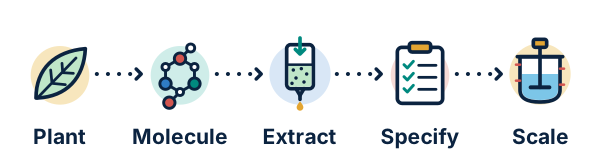
EUTECNIQ is building the Large Botanical Model, a physics-informed scientific AI platform for botanical ingredients. Its first application is regulatory and development intelligence, including new dietary ingredient work; owned ingredients and licenses follow once the platform is validated.
- Computational researchCurcumin, quercetin and berberine: 60 figures with data, code and evidence labels; completed analyses, calibrated models, illustrations and planned experiments, each labeled
- Ingredient developmentThe Ingredient Engine: eight stages, each ending in a recorded decision
- Investment thesisThe first paid service, the gates and what capital would buy
The Ingredient Engine · from plant to specified ingredient
- 0IntakeScreen record
- 1DiscoverCandidate dossier, draft target profile
- 2SourceIdentity passport, supplier file
- 3ExtractProcess description, mass balance
- 4SpecifySpecification, validated methods
- 5DeliverPrototype, delivery dossier
- 6SafetySafety and exposure assessment
- 7ScaleTransfer package, control strategy
- 8MarketClient program, license, supply or partnered drug program
Schematic Each stage produces a record and ends in a go, change or stop decision. Select a stage to open it below.
Completed Computational studies of published data. Proposed Laboratories, trained models and services; none is operating. What exists today
Free tool · Everything I Take
Are your supplements adding up to too much?
Many people take a multivitamin and a few single supplements. The same vitamin can hide in several of them.
- Vitamin D: a multivitamin with 1,000 IU plus a 5,000 IU softgel is 6,000 IU a day, above the 4,000 IU upper limit for adults.
- Read a Supplement Facts panel, find a product in the NIH label database, or add foods.
- See every total in one set of units, against U.S. and EU upper limits for your life stage.
Free, no account, stored only in your browser. A calculator, not medical advice; it does not check medicines.

EUTECNIQ Atlas · evidence
How much research stands behind each compound?
Each point is one of 130 vitamins, minerals, fatty acids, amino acids, carotenoids and plant compounds, placed by how many randomized trials and how many PubMed records carry its name in the title. Point at a compound to read its counts; select it to open its record.
Research volume is not proof of an effect. The compound explorer grades what the trials found.
Source: PubMed, U.S. National Library of Medicine, E-utilities; counts retrieved November 11, 2026. Title-word searches count publications, not quality or effect.
- 130compounds in Atlas
- 355graded findings
- 136interactive calculators
- 60research figures with data and code
What would be new · proposed, not yet built
Eight things EUTECNIQ would do that botanical companies rarely do
Drug makers have used quality by design, process measurement, formal risk tools and validated models for about two decades. EUTECNIQ proposes to bring that toolset to plant ingredients, keep a lot record that cannot be quietly edited, and train models only on data it has measured. Each idea says what it borrows, what would be new and what it cannot do.
- 01A lot record that cannot be quietly editedThe useful part of blockchain, tied to physical evidence
- 02Pharmaceutical quality by design for plant ingredientsTarget profile, design space, control strategy
- 03New plant actives, isolated and standardizedFrom a crude extract to a defined ingredient
- 04Delivery chosen from the molecule's limitsEutectic, self-emulsifying, complexes, dispersions
- 05Models trained on measured botanical dataAdapted, not invented; tested on unseen lots
- 06Physics first, machine learning for what physics missesHybrid models with stated uncertainty
- 07Risk, sensitivity, gap and SWOT analysisWritten down before money is spent
- 08Several independent tests on every lotDifferent physics, different blind spots
New here? · In plain English
What EUTECNIQ does, without the jargon
Plant ingredients are hard to check. The label may not match what is inside, two batches can differ, mixing with other supplements, medicines or alcohol can change what they do, and many label claims rest on thin evidence. EUTECNIQ is being built to check all four in one place.

- 1,938FDA citations under the supplement manufacturing rule, FY2025
- 711of them cite the specifications or the tests that verify them
- 20.0%of 2,235 turmeric samples in 48 published surveys were adulterated (pooled)
- 5.8×range in rutin across 51 ginkgo batches from 25 manufacturers
- 60figures on three bioactives, each with data, code and an evidence label
- 8Engine stages after the intake screen, each ending in a recorded decision
- 0laboratories operating, models trained or samples measured today
The case in 60 seconds
U.S. supplement makers must verify the identity of every dietary ingredient, and FDA cited specifications and their tests 711 times in FY2025. The first customer is a brand, ingredient supplier or importer with one botanical it cannot yet qualify, formulate or scale with confidence.
The problemOne connected workflow from molecule to manufacturing. Computed on published data: once the predicted solubility limit is applied, the curcumin extraction window shrinks from 100% to 34% of a 5–45 °C, 30–100% ethanol grid. That 34% is a model scenario with assumed extraction kinetics, not a verified operating window.
The demonstrationPaid programs come first. Where contracts allow, they leave methods the company keeps; owned ingredients, licensed processes and supply come later, each through its own gate, and are not revenue today.
The focusA Ph.D. on the optimization-based design of ionic liquids, six granted patents from three families at prior employers, industrial experience since 2007. Capital would be released in stages against four checkpoints in 18 months.
The business model01The problem
A botanical is bought by its name. What it is, what it contains and what reaches the body are seldom verified.
Supplement makers must confirm what every ingredient is before they use it. FDA’s own inspection records show how often that step fails.
The verification gap
1,938 FDA citations under the supplement manufacturing rule in FY2025, the most of any year since FY2014. 711 cite the specifications or the tests that verify them.
- All citations under 21 CFR Part 111
- Specifications (111.70) and the tests that verify them (111.75)
3×
Citations of the dietary-ingredient identity test, FY2022 to FY2025: 22, 15, 39, 66.
Three published measurements, one for each thing a buyer cannot see on the label
-
1Identity
20.0%
of 2,235 turmeric samples in 48 published surveys were adulterated (pooled, not market-wide).
A content assay can miss it: HPLC could not separate 6 synthetic curcumin samples from 21 natural ones; a hydrogen isotope ratio separated all of them.
Gafner et al., Pharm Biol 2026; Perini et al., Antioxidants 2023.
-
2Consistency
5.8×
range in one flavonol glycoside, rutin, across 51 batches of ginkgo tablets and capsules from 25 manufacturers.
A trial of one product does not carry over to another sold under the same name; a Cochrane review of St. John’s wort limited its conclusions to the extracts tested.
Liu et al., Chin Med 2022; Linde et al., Cochrane 2008. Apply a specification to the 51 batches
-
3Exposure
6.9–185×
the exposure of unformulated curcumin, across ten formulations of the same compound.
Of 171 systematic reviews of oral curcumin, 3.5% reported bioavailability analyses in their methods. Higher plasma exposure is not evidence of a health effect.
UK COT TOX/2025/09, Table 5; Bučević Popović et al., Pharmaceuticals 2024.
Each failure has an owner: the company whose name is on the label or the specification, which carries the rejected lot, the inconsistent product, the strengthened filing and the process that changes at scale. That function, in quality, product development or regulatory affairs, is the first buyer. Six documented failure modes
02The focus
EUTECNIQ’s focus: turn a botanical into an ingredient a buyer can specify, verify and license.
Two horizons: what earns first, and what could be owned later
Proposed Horizon 1 · near-term commercial entry
Paid programs establish demand
- A paid serviceSupplier qualification and comparability (Package B): whether clients pay for a faster, better-founded accept-or-reject decision on a botanical source.
- Two further packagesIngredient feasibility and delivery selection (A); process optimization and technology transfer (C). Each ends in a go, change or stop recommendation.
Paid as project fees, development fees, transfer milestones
First test day 90: deposit-paid statements of work and a measured margin; letters of intent do not count
Repeatable methods
Methods and decision rules reused on the next client’s source of the same botanical, where contracts allow.
Gate day 365: at least one reusable method the company may keep. Month 18: an owned process or formulation candidate with counsel-reviewed ownership.
Proposed Horizon 2 · long-term potential
Owned ingredients and technology create scale
- An owned ingredientThe flagship case: a turmeric extract with natural origin verified on every lot and a delivery form backed by its own exposure and safety data.
- Delivery technologies and processesValidated where the evidence supports them, licensed to ingredient manufacturers for royalties.
Paid as supply margins per kilogram, licenses and royalties: revenue that does not need a new statement of work
Not yet revenue no customer, program, patent or revenue exists; each step is released by its own gate
03What it can own
The molecule cannot be owned. The method, the data and the ingredient built around it can.
Open a layer to see how it could be protected.
0The moleculeCurcumin, quercetin or berberine as found in nature
Not protectable: a naturally occurring compound is not patent-eligible merely because it has been isolated (Myriad, 2013)
1Process and formulationThe extraction, purification and delivery form
Patentable if new and non-obvious; patents may not issue
2Specification, methods and supplier filesWhat is measured on every lot, how, and against which limits
Trade secrets and contracts
3Paired lot recordsAuthenticated lots linked to measured extraction, formulation, stability and process data
Accumulates with every program the contract allows; client data stay with the client
4Models trained on those recordsPhysics-based and learned models that propose a solvent, a carrier or a process window before material is bought
Released only after their error is measured on data they never saw
1,132,805
entries from 29 open sources in the THEOBROMA aggregate, 79.12% under open-use licenses. A model built only on open data can be rebuilt by anyone.
Hard to rebuild
Authenticated lots paired with measured extraction, formulation, stability and process data, and the physics that connects them, owned by EUTECNIQ where contracts allow.
No data exclusivity
Supplements receive none of the regulatory data exclusivity approved drugs receive (21 CFR 314.108), so processes, trade secrets and contracts must do that work.
Proposed EUTECNIQ owns no method, patent, dataset or trained model today. Integration alone would not set it apart; the case rests on paid work that leaves a method the company may keep, measured at the day-365 checkpoint. The accumulating moat · Scientific Intelligence
04Why now
Enforcement, guidance and computation are moving at the same time.
FY2022 → FY2025
22 → 66
Citations of the dietary-ingredient identity test. A manufacturer may rely on a supplier’s certificate only after confirming its results (21 CFR 111.75(a)(2)(ii)), so every new source creates confirmation work.
FDA Inspection Observations
October 19, 2026
NDI guidance final
FDA finalized its guidance on the identity and safety information for new dietary ingredient notifications; for a nanoscale form, data on the conventional form alone are unlikely to address its safety.
91 FR 66336
2025
Formulations under review
The UK Committee on Toxicity opened the question of formulations designed to raise curcuminoid bioavailability. A form would need its own exposure and safety data to answer it.
UK COT TOX/2025/09
Done here, on published data
Molecule → design space
Density-functional surfaces of three bioactives fed a solubility model checked against 396 measured mixture solubilities, which capped an extraction model mapped as a design space, before any material was bought.
05How it works
One path from plant to specified ingredient, with a recorded decision at every step.

The Ingredient Engine: intake screen (0) and eight core stages (1–8)
- Inner tracks: a result from that compound’s case study at that stage
- Curcumin
- Quercetin
- Berberine
Schematic Select a stage. A proposed system: no laboratory, plant or model is operating.
Four phases, each with its own question
Select a sector of the wheel, or a phase below, to see what a stage decides, how it works and what the case studies found there.
Decide · stage 0
Intake and feasibility screen
Is there a lawful route for the intended use, and can its evidence be produced at a cost the product can carry?
- Proceeds when
- A lawful route exists for the intended use, and its evidence can be produced at an acceptable cost.
- Produces
- A dated screen record that every later gate reads and amends
What is screened
- Regulatory. The category implied by the intended use and claims; whether the ingredient is a new dietary ingredient, which needs a notification at least 75 days before marketing unless the food-supply exception applies; conservation, import and access rules; the drug path where a therapeutic signal exists.
- Economic. The cost of the evidence the route needs, the process cost drivers and the margin the market would support.
What the three case studies found here
Curcumin
Screened per program; not part of the computational case study.
Quercetin
Screened per program; not part of the computational case study.
Berberine
Screened per program; not part of the computational case study.
Proposed capability Stage 0 in full · Regulatory overview · NDI notifications · Legal status and counsel · The four named gates
Decide · stage 1
Discover and prioritize
Which candidates deserve laboratory time, and on what evidence?
- Proceeds when
- The candidate has documented starting evidence, a category hypothesis and a source that can be qualified.
- Produces
- Candidate dossier, active-constituent map, draft target product profile
Technologies evaluated
- Literature, database and traditional-use review; traditional use is one possible starting evidence and is not clinical proof
- Computed molecular descriptors checked against published rules, such as Lipinski’s rule of five
- Bioactivity-guided fractionation, with dereplication to drop known compounds early
- LC-HRMS and molecular networking of MS/MS spectra (GNPS)
What the three case studies found here
Curcumin +1 more
32.7 kJ/mol
The diketo tautomer lies this far above the keto–enol form in the conductor (C-PCM electronic energies, not free energies); three keto–enol conformers lie within 0.4 kJ/mol.
Computed Workstation
Quercetin +1 more
5.81–8.45
Seven published first pKa values place the neutral fraction at pH 6.8 between about 0.09 and 0.98.
Literature-derived FIG 007
Berberine
Cation
A permanently charged quaternary alkaloid. Explicit-water simulations resolve the water shell around the iminium nitrogen and the four ether oxygens (two methoxy, two methylenedioxy), and track the distance to the chloride counter-ion.
Computed FIG 008
Model family
Molecular identity and mechanics
Proposed capability Stage 1 in full · Discovery and characterization · How a model would be judged · Scientific Intelligence program · Computational research on curcumin, quercetin and berberine
Make the material · stage 2
Authenticate and qualify the source
Is the material what the supplier says it is, and can it be supplied consistently and lawfully?
- Proceeds when
- Two orthogonal methods agree with an authenticated reference, adulterant screens are negative, and several documented lots are available.
- Produces
- Identity passport, supplier qualification file, import file
- Re-screen
- A new species, plant part, origin or supplier
Technologies evaluated
- Macroscopy and microscopy of crude material
- HPTLC fingerprint against authenticated reference material (USP ⟨203⟩; see also ⟨563⟩)
- HPLC or LC-MS marker profile, and targeted tests for known adulterants
- DNA barcoding of crude material, through partners
and 2 more on the stage page
What the three case studies found here
Curcumin
20.0%
of 2,235 turmeric samples were adulterated, in a 2026 scoping review of published surveys (Gafner et al.); a content assay cannot tell natural from synthetic curcumin, an isotope ratio can (Perini et al. 2023).
Published evidence Demonstration 4
Quercetin
No sourcing study yet.
Berberine
No sourcing study yet.
Proposed capability Stage 2 in full · Fingerprint and isotope data · Analytical characterization · Traceable supply chain · Global ingredients
Make the material · stage 3
Extract, separate and optimize
Which process gets the actives out at a defined composition, with an acceptable residue and cost?
- Proceeds when
- The process gives the target composition repeatably at laboratory scale, the mass balance closes and the residue fits the category.
- Produces
- Process description, laboratory design space, closed mass balance
- Re-screen
- A new solvent, concentration or purification step
Technologies evaluated
- Maceration and percolation; ultrasound- and microwave-assisted extraction; pressurized liquids
- Supercritical CO₂, with or without a co-solvent; subcritical water
- Purification by adsorbent resins, membranes, liquid–liquid partition, preparative and countercurrent chromatography, and molecular distillation
What the three case studies found here
Curcumin +3 more
> 10⁷
Measured mole-fraction solubility across 15 solvents spans more than seven orders of magnitude, water included; a Hansen sphere ranks the organic solvents to about 0.6 log units.
Quercetin +1 more
1.16 log
COSMO-SAC error with measured melting data and nothing fitted. Quercetin melts while decomposing, so its fusion data are themselves uncertain.
Computed Workstation
Berberine
Not covered yet: the berberine salt’s solubility is an electrolyte problem.
Model family
Solvent and thermodynamic intelligence
- activity coefficients (calculated here)
- solvent screening (calculated here)
- COSMO-SAC solubility (calculated here)
- extraction selectivity (proposed)
- CAMD (proposed)
Proposed capability Stage 3 in full · Extraction and purification · Purification and standardization · Process engineering · Extraction
Make the material · stage 4
Characterize and standardize
What is in the material, how much does it vary, and can every specification be measured reliably?
- Proceeds when
- Every attribute has a fit-for-purpose method, composition falls in a range that can be justified, and contaminants are below the proposed limits.
- Produces
- Specification with reasons for each limit, validated methods, certificate-of-analysis format
Technologies evaluated
- UHPLC with diode-array detection; LC-MS/MS; high-resolution LC-MS for non-targeted screening
- HPTLC and chromatographic fingerprints compared by chemometrics (statistics that compare whole profiles)
- GC-MS; ICP-MS for elements; compendial microbiology; NMR through partners
What the three case studies found here
Curcumin +1 more
≈ 5×
Two laboratories’ water solubilities of curcumin disagree about fivefold; alcohol data agree within a few percent.
Measured FIG 014
Quercetin
≈ 10,000×
Two published water solubilities differ nearly 10,000-fold; an independent 37 °C value falls between them.
Berberine
No specification study yet.
Proposed capability Stage 4 in full · Analytical characterization · Method development · Purification and standardization · Targeted and non-targeted analysis
Make it work · stage 5
Engineer delivery
Which barrier limits the active, and which carrier addresses it in the intended format?
- Proceeds when
- The prototype meets its physical and chemical stability targets, and a stated mechanism links the carrier to the identified barrier.
- Produces
- Formulation prototype, delivery technology dossier
- Re-screen
- A new carrier, particle size or dosage form
Technologies evaluated
- Lipid-based and self-emulsifying systems, classed with the lipid formulation classification system
- Nanoemulsions; phospholipid complexes; cyclodextrin inclusion complexes
- Amorphous solid dispersions; encapsulation; spray drying and freeze-drying to stable powders
What the three case studies found here
Curcumin
10²–10⁵×
At studied doses, curcumin needs hundreds to hundreds of thousands of times the ICH M9 volume to dissolve.
Computed FIG 028
Quercetin
4×
A rat study reports a fourfold AUC gain for a solid dispersion; a nine-run design does not separate its two factors statistically.
Berberine +2 more
17×
Berberine hydrochloride is 17 times more soluble at pH 6.8 than at pH 1.2, and more soluble in that buffer than in any oil or surfactant tested.
Literature-derived FIG 022
Model family
Delivery-system design
Proposed capability Stage 5 in full · Advanced delivery · Emulsions and colloids · Drying and particle engineering · Bioavailability by design
Make it work · stage 6
Establish safety and performance evidence
Is the ingredient safe at the intended intake, and does the product do what its design is meant to do?
- Proceeds when
- No hazard is known at the intended exposure, EDI/ADI is 1 or less, and the performance target set at stage 5 is met by the kind of evidence the intended claim needs.
- Produces
- Safety and exposure assessment, study reports, stability data
- Re-screen
- A new population, dose or claim
Technologies evaluated
- Exposure estimate from the intended use; history-of-use and literature review
- In vitro screens; studies to OECD guidelines at GLP partner laboratories (21 CFR Part 58)
- NOAEL or benchmark dose; the threshold of toxicological concern for minor constituents
- Enzyme and transporter interaction screens
and 2 more on the stage page
What the three case studies found here
Curcumin
0.28%
Unconjugated curcumin is about 0.28% of total curcumin exposure (90% interval 0.11–0.66%). Claims built on total curcumin describe the conjugates.
Calibrated FIG 033
Quercetin
≈ 25×
A Bayesian calibration of the 4′-glucoside and rutin arms recovers absorption rates that differ about 25-fold and an elimination half-life of 10.7 h, with four chains converged.
Berberine +2 more
1.6× · 3.4×
Two animal studies report these exposure gains, from reference arms whose peak concentrations per mg/kg are about 70 and 16,000 times those of the human study.
Computed FIG 029
Model family
Mechanistic biological modeling
- dissolution (proposed)
- digestion (proposed)
- absorption (calculated here)
- metabolism (calculated here)
- PK (calculated here)
- PBPK and PD (proposed)
Proposed capability Stage 6 in full · Toxicology and exposure · NDI notifications · Clinical research · Translational research
Scale and deliver value · stage 7
Scale, validate and transfer
Does a larger process make on-specification material with its critical parameters known, and can another site repeat it?
- Proceeds when
- Consecutive pilot batches meet the specification under a written control strategy, and every release attribute has a validated method.
- Produces
- Process development and transfer package, control strategy
- Re-screen
- A change of process, scale or site
Technologies evaluated
- Pilot extraction, evaporation, solvent recovery and pilot drying
- Mass and energy balances; designed experiments; dimensionless scale-up rules
- Quality by design: critical quality attributes (CQAs) linked to critical process parameters (CPPs), with risk ranking
- Process analytical technology, such as near-infrared monitoring of an extraction
and 1 more on the stage page
What the three case studies found here
Curcumin
No scale-up study yet.
Quercetin
No scale-up study yet.
Berberine
No scale-up study yet.
Model family
Bayesian optimization and robust QbD
Proposed capability Stage 7 in full · Technology transfer · Process engineering · QbD and control strategy · Quality system
Scale and deliver value · stage 8
Commercialize, license, supply or partner
Which route turns the evidence into value: a client program, a license, supply or a partnered drug program?
- Proceeds when
- A customer or partner commits, ownership and data terms are agreed before work starts, and counsel has reviewed freedom to operate.
- Produces
- IP and commercialization assessment, supply and quality agreements, or a partnering file
- Re-screen
- New claims, a new market or a drug use
Tools evaluated
- Prior-art and patent landscaping; ownership mapping under written agreements
- Freedom-to-operate review by patent counsel
- A commercial model and a supply plan
- Market-access assessment by category and country
What the three case studies found here
Curcumin
No commercial route chosen.
Quercetin
No commercial route chosen.
Berberine
No commercial route chosen.
Proposed capability Stage 8 in full · Scientific deliverables · Services · Legal status and counsel · Supplement or drug
The same system as flow charts:
Computation proposes before material is bought; material moves through Engine stages 2 to 8, and measured lot data flow back to the models.
Molecule to manufacturing, as one system
- Material path
- Recorded decision: progress, repeat or stop
- Predictions
- Measured data
Eight stages take a candidate from first screen to a commercial outcome. Lawful route and economics are screened at intake and again whenever material, process, formulation or intended use changes, so a program can stop before its next, costlier step.
- Stage 3 back to 2: requalify source
- Stage 4 back to 3: re-optimize
- Stage 6 back to 5: reformulate
- Stage 7 back to 3: drift at scale: redesign process
- Stage 8 back to 6: claim needs more evidence
- 0Intake and feasibility screenScreen record
- 1Discover and prioritizeCandidate dossier, draft target profile
- 2Authenticate and qualify the sourceIdentity passport, supplier file; re-screen if the material changes
- 3Extract, separate and optimizeProcess description, mass balance; re-screen if the process changes
- 4Characterize and standardizeSpecification, validated methods
- 5Engineer deliveryPrototype, delivery dossier; re-screen if the formulation changes
- 6Establish safety and performance evidenceSafety and exposure assessment; re-screen if the intended use changes
- 7Scale, validate and transferTransfer package, control strategy; re-screen if the process changes
- 8Commercialize, license, supply or partnerClient program, license, supply or partnered drug program; re-screen if the intended use changes
One chain of models, from molecule to robust design.
Each stage passes defined quantities to the next, so a molecular or formulation decision can be traced to its effect on extraction, exposure and process robustness. Select a method to open the figure behind it.
EUTECNIQ · proposed multiscale development engine
Molecular identity and mechanics
- Tautomer, charge state, conformer ensemble and descriptors
Solvent and thermodynamic intelligence
- Activity coefficients (calculated here, FIG 013)
- solvent screening (calculated here, FIG 012)
- COSMO-SAC solubility (calculated here)
- extraction selectivity (proposed)
- CAMD (proposed)
- Solubility by solvent and excipient, residual-solvent class, recovery energy
Delivery-system design
- Dose form, drug loading, droplet size, release in each medium
Mechanistic biological modeling
- Dissolution (proposed)
- digestion (proposed)
- absorption (calculated here, FIG 038)
- metabolism (calculated here, FIG 033)
- PK (calculated here, FIG 032)
- PBPK and PD (proposed)
- Exposure of the parent compound and its metabolites, with uncertainty
Bayesian optimization and robust QbD
Experimental results would feed back into every model. None has been measured yet.
- calculated here
- published data reanalyzed
- shown on illustrative inputs
- proposed
- planned
Scientific Intelligence: the six proposed model families and their gates
Workstation
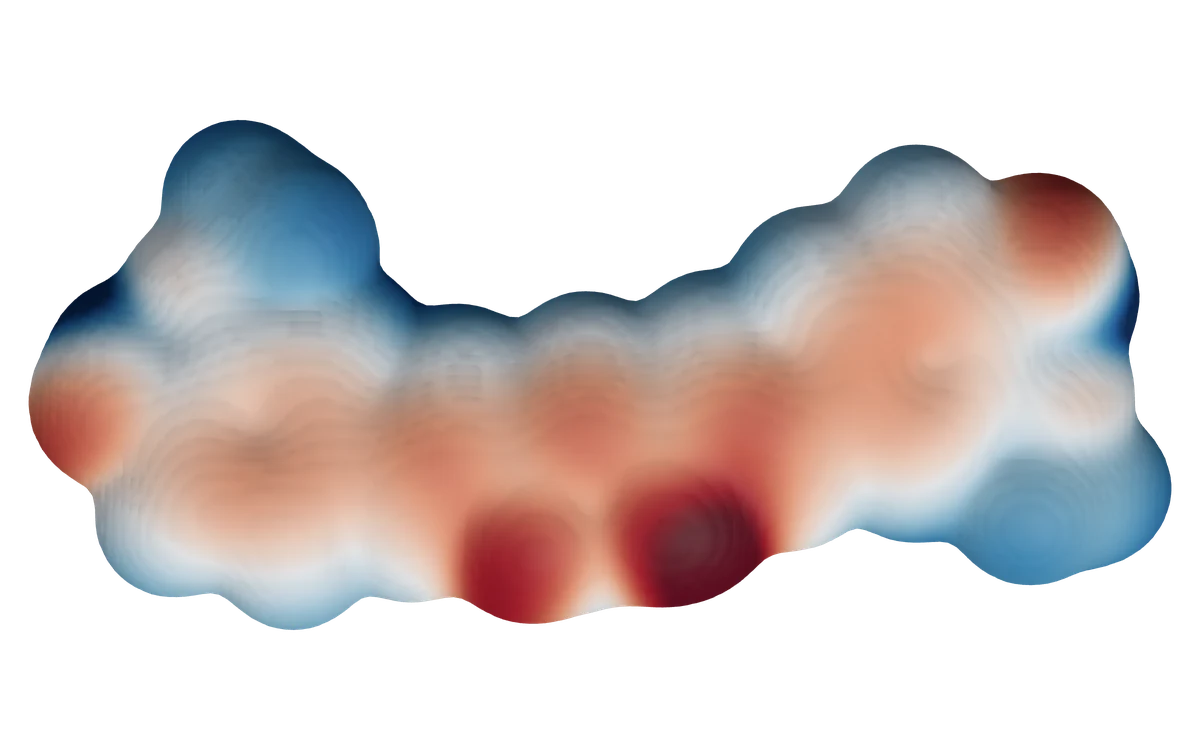
Three bioactives, from computed molecular surfaces to an extraction design space
Density-functional surfaces of curcumin, quercetin and berberine feed a solubility model that is checked against 396 measured mixture solubilities; that solubility caps an extraction model, and the result is mapped as an extraction design space. Links without a model are shown as gaps.
06Proof of concept · computational research on published data
Three compounds, three hard questions, answered as far as published data allow.
Three difficult bioactives, worked on published data before a laboratory exists, to test the method rather than to sell these compounds: a poorly soluble, unstable molecule (curcumin), a molecule whose basic data conflict (quercetin) and a permanently charged one that crosses membranes poorly (berberine).
Sixty figures on curcumin, quercetin and berberine, each with its data, its code and a label for the kind of evidence it is. Choose a compound to see one result in full.
Computed on published data Scenario kinetics One result, one decision
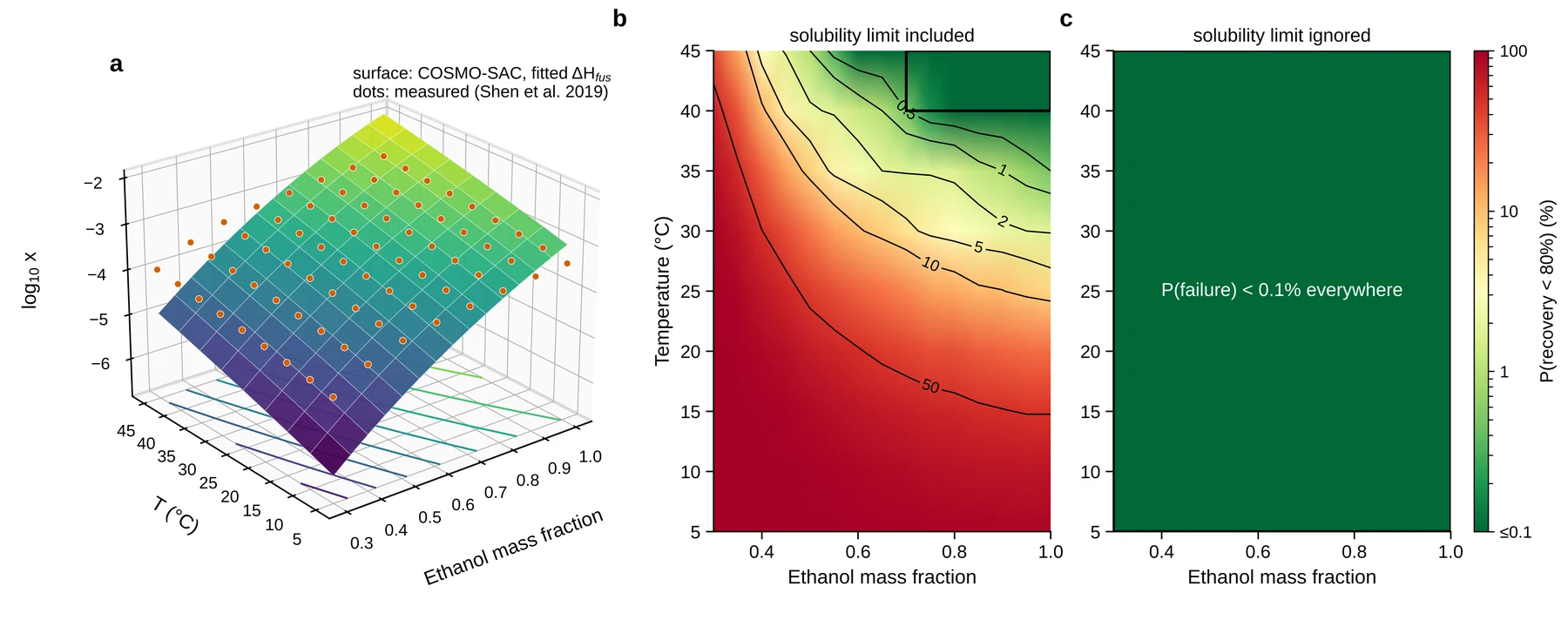
Which water–ethanol mixtures can pull curcumin out of turmeric in an hour? Two connected models give a different answer from either alone.
The problem
Curcumin dissolves in water only at nanogram-to-microgram per milliliter levels, so an extraction model that ignores solubility can promise recoveries the solvent cannot hold.
Data used
170 measured solubilities in 15 pure solvents; 396 measured solubilities in alcohol–water mixtures (Shen et al. 2019, via NIST ThermoML), none used in the fit; curcumin content of the rhizome, 3.14% w/w (Tayyem et al. 2006).
What was calculated
Density-functional surfaces of the molecule → solubility by COSMO-SAC with one fitted parameter → a diffusion model of extraction capped by that solubility → Monte Carlo over the uncertain inputs. 0.25 mm particles, 8 kg solvent per kg, 60 minutes.
Alternatives compared
Diffusion alone against diffusion with the solubility limit; three keto–enol conformers and the diketo tautomer; a semi-empirical against a density-functional geometry.
Finding
In the model, diffusion alone gives at least a 90% chance of recovering 80% of the curcumin on 100% of the 5–45 °C, 30–100% ethanol grid; with the solubility limit, 34%, a model-dependent scenario rather than a measured operating window. At 45 °C the boundary sits at 40% ethanol. Conformer choice moves predictions by at most 0.01 log units, the geometry by 0.04.
Limitation
The kinetic inputs are scenarios, and the solubility model is up to 100-fold low at 10–40% cosolvent, so the boundary is a hypothesis to test, not a process setting.
Next experiment
Measure curcumin solubility in the actual extraction solvent at the chosen ethanol fraction and temperature (shake-flask, HPLC); measure extraction kinetics on milled rhizome of the specified particle size to replace the scenario diffusivity.
Why it matters commercially
Solvent choice sets the residual-solvent class, the energy to recover solvent and the cost per kilogram; solvent recovery usually sizes the plant. A computed window tells the first extraction runs where to look. No saving in cost or time is claimed until those runs are done.
Curcumin: from tautomer to plasma
Curcumin dissolves readily in DMSO and acetone but in water only at nanogram-to-microgram per milliliter levels, degrades within minutes to hours at neutral pH, and circulates in people mostly as conjugates. Each of those facts is a design constraint.
- 0Intake
- 7Scale
- 8Market
Stage 1 · Discover
32.7 kJ/mol
The diketo tautomer lies this far above the keto–enol form in the conductor (C-PCM electronic energies, not free energies); three keto–enol conformers lie within 0.4 kJ/mol.
Computed Workstation
Stage 1 · Discover
0.49 kcal/mol
A 100-start conformer search misses the lowest diketo minimum by this much: two tautomers must be modeled, and the diketo form needs a far larger search.
Stage 2 · Source
20.0%
of 2,235 turmeric samples were adulterated, in a 2026 scoping review of published surveys (Gafner et al.); a content assay cannot tell natural from synthetic curcumin, an isotope ratio can (Perini et al. 2023).
Published evidence Demonstration 4
Stage 3 · Extract
> 10⁷
Measured mole-fraction solubility across 15 solvents spans more than seven orders of magnitude, water included; a Hansen sphere ranks the organic solvents to about 0.6 log units.
Stage 3 · Extract
0.70 log
COSMO-SAC error over 170 pure-solvent points from DFT surfaces, with one fitted parameter (enthalpy of fusion, 46.8 kJ/mol); 1.19 on 396 aqueous mixtures not used in the fit.
Calibrated Workstation
Stage 3 · Extract
34%
of the 5–45 °C, 30–100% ethanol grid gives at least a 90% chance of recovering 80% of the curcumin once the predicted solubility limit is applied, against 100% for diffusion alone. The kinetic inputs are scenarios.
Illustrative Workstation
Stage 3 · Extract
Acetone
needs the least latent heat per kilogram dissolved among low-boiling ICH Q3C Class 3 solvents; THF (Class 2) and DMSO (Class 3, boiling near 190 °C) need the least overall.
Computed FIG 015
Stage 4 · Specify
≈ 5×
Two laboratories’ water solubilities of curcumin disagree about fivefold; alcohol data agree within a few percent.
Measured FIG 014
Stage 4 · Specify
≈ 1.3 h
to a 10% loss at 25 °C in protein-containing broth, from refitted Arrhenius kinetics; published half-lives near pH 7 run from minutes to hours.
Stage 5 · Deliver
10²–10⁵×
At studied doses, curcumin needs hundreds to hundreds of thousands of times the ICH M9 volume to dissolve.
Computed FIG 028
Stage 6 · Safety
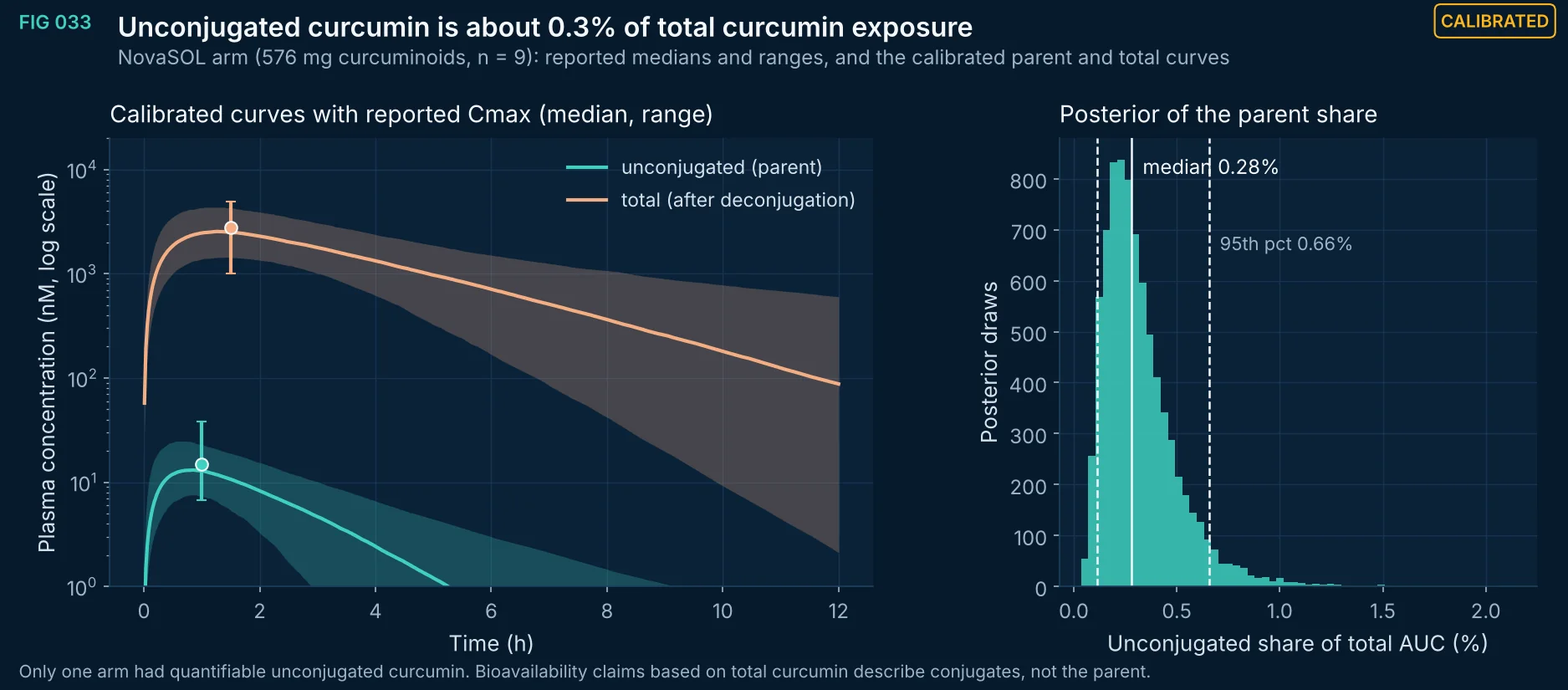
0.28%
Unconjugated curcumin is about 0.28% of total curcumin exposure (90% interval 0.11–0.66%). Claims built on total curcumin describe the conjugates.
Calibrated FIG 033
Stages without a result yet
- 0 Screened per program; not part of the computational case study.
- 7 No scale-up study yet.
- 8 No commercial route chosen.
Proposed What EUTECNIQ would measure next
- 1Measure the fusion enthalpy and aqueous solubility of the crystal form used.
- 2Measure degradation kinetics in the intended product matrix at three temperatures, with LC-MS product identification.
- 3Run a crossover study of a candidate ingredient that reports parent curcumin and its conjugates separately.
Why it matters. For an ingredient developer, the numbers that matter are the parent compound that reaches plasma and the fraction that survives manufacture and storage. Designing to those quantities, rather than to total curcumin, separates a defensible product from one whose claim rests on conjugates.
The results support
- Choosing extraction solvents on measured solubility, recovery energy and residual-solvent class together.
- Requiring matrix-specific degradation kinetics before any stability claim.
- Reporting unconjugated and total curcumin separately in any exposure study.
They do not support
- A recommended solvent, process or shelf life for a product.
- Any statement that a formulation increases bioavailability of unconjugated curcumin, beyond the one study analyzed.
Featured result
Curcumin
How much unconjugated curcumin reaches the blood?
- Method
- Two one-compartment models calibrated with Markov chain Monte Carlo (PyMC, NUTS) to the published medians and ranges of one human arm (micellar curcumin, 576 mg, n = 9).
- Finding
- Unconjugated curcumin is about 0.28% of total curcumin exposure (90% interval 0.11–0.66%). Claims built on total curcumin describe the conjugates.
- Limits
- One study arm of nine people, summary statistics only; the spread of each median was inferred from its range.
- Next experiment
- A crossover study of a candidate ingredient that reports parent curcumin and its conjugates separately.
Quercetin: resolving conflicting data before modeling
For quercetin, the limiting factor is not the models but the data: its first pKa and its water solubility are each reported over a range wide enough to change any conclusion drawn from them.
- 0Intake
- 2Source
- 7Scale
- 8Market
Stage 1 · Discover
5.81–8.45
Seven published first pKa values place the neutral fraction at pH 6.8 between about 0.09 and 0.98.
Literature-derived FIG 007
Stage 1 · Discover
6 sites
Explicit-water simulations of the neutral aglycone resolve the water shell around each of its five hydroxyl groups and its carbonyl.
Stage 3 · Extract
1.16 log
COSMO-SAC error with measured melting data and nothing fitted. Quercetin melts while decomposing, so its fusion data are themselves uncertain.
Computed Workstation
Stage 3 · Extract
Weak
The published group-contribution Hansen center orders the organic solvents only weakly and cannot be tested in water.
Computed FIG 012
Stage 4 · Specify
≈ 10,000×
Two published water solubilities differ nearly 10,000-fold; an independent 37 °C value falls between them.
Stage 5 · Deliver
4×
A rat study reports a fourfold AUC gain for a solid dispersion; a nine-run design does not separate its two factors statistically.
Stage 6 · Safety
≈ 25×
A Bayesian calibration of the 4′-glucoside and rutin arms recovers absorption rates that differ about 25-fold and an elimination half-life of 10.7 h, with four chains converged.
Stages without a result yet
- 0 Screened per program; not part of the computational case study.
- 2 No sourcing study yet.
- 7 No scale-up study yet.
- 8 No commercial route chosen.
Proposed What EUTECNIQ would measure next
- 1Measure solubility at 25 and 37 °C on three lots, with the solid form checked by X-ray powder diffraction before and after.
- 2Measure the pKa potentiometrically in a co-solvent series.
- 3Calibrate dissolution models against the measured values.
Why it matters. A formulation built on a solubility value that is wrong by orders of magnitude is likely to fail in scale-up or in the clinic. Settling these two numbers is inexpensive compared with the development work that depends on them.
The results support
- Remeasuring quercetin’s water solubility and first pKa under controlled conditions before modeling.
- Treating glycoside form as a primary design variable for absorption rate.
They do not support
- Choosing either published water solubility for formulation design.
- Any human bioavailability claim for an aglycone formulation.
Featured result
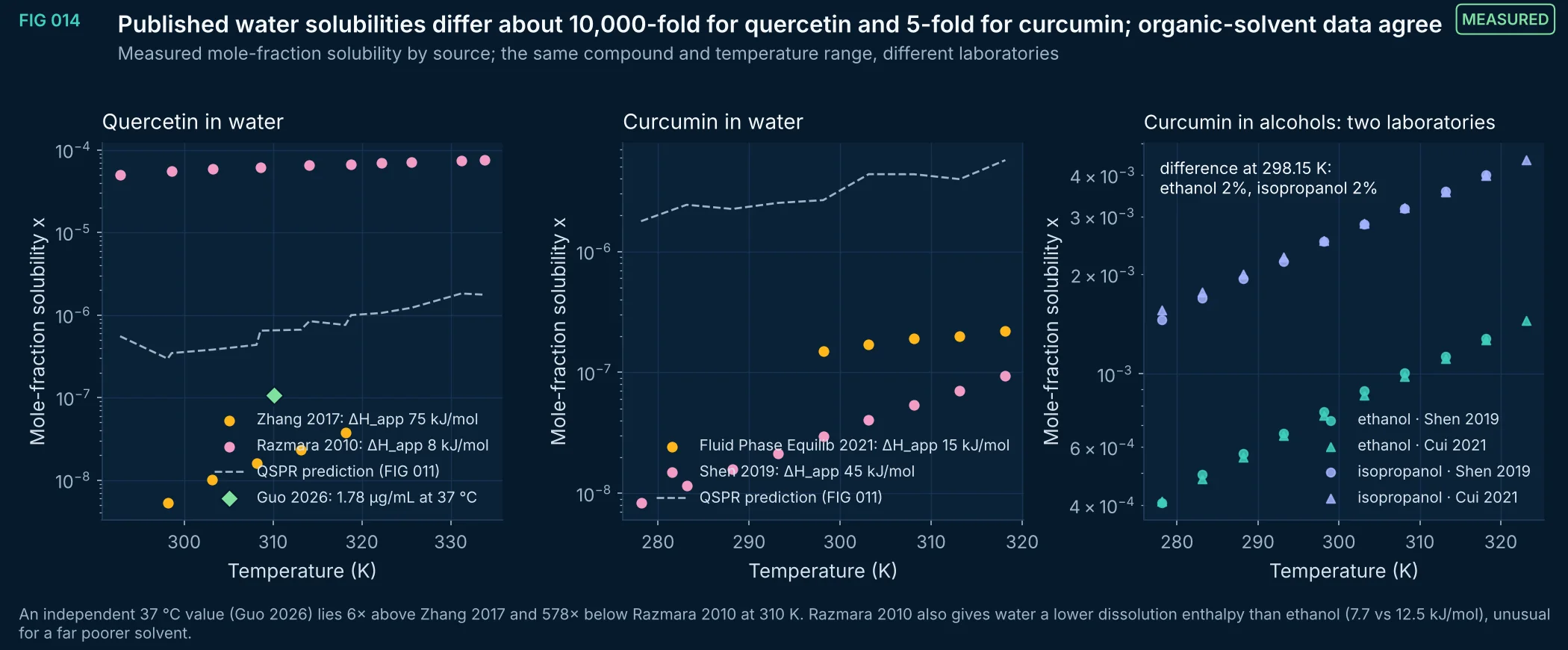
Quercetin
How soluble is quercetin in water?
- Method
- Published mole-fraction solubilities (BigSolDB 2.0) fitted source by source with van 't Hoff equations and compared at 25 °C, with an independent 37 °C measurement as a check.
- Finding
- Two laboratories' water solubilities of quercetin differ about 10,000-fold, while two laboratories' curcumin data in ethanol and isopropanol agree within a few percent.
- Limits
- The sources' solid forms, equilibration times and analytical finishes were not re-examined; neither value is excluded.
- Next experiment
- Shake-flask solubility at 25 and 37 °C on three lots, with the solid form checked by X-ray powder diffraction before and after.
Berberine: a cation with a permeability problem
Berberine dissolves reasonably well at intestinal pH but crosses membranes poorly and varies widely between people. Lipid systems help in animals; human formulation data are still missing.
- 0Intake
- 2Source
- 3Extract
- 4Specify
- 7Scale
- 8Market
Stage 1 · Discover
Cation
A permanently charged quaternary alkaloid. Explicit-water simulations resolve the water shell around the iminium nitrogen and the four ether oxygens (two methoxy, two methylenedioxy), and track the distance to the chloride counter-ion.
Computed FIG 008
Stage 5 · Deliver
17×
Berberine hydrochloride is 17 times more soluble at pH 6.8 than at pH 1.2, and more soluble in that buffer than in any oil or surfactant tested.
Literature-derived FIG 022
Stage 5 · Deliver
20 mg/g
Only combinations with Kolliphor RH 40 formed nanoemulsions in a 46-combination screen; loading tops out at 20 mg/g before the system crystallizes.
Stage 5 · Deliver
12 runs
A D-optimal mixture design around the published composition, and a linkage map from product targets to inputs, set out the next experiments.
Stage 6 · Safety
1.6× · 3.4×
Two animal studies report these exposure gains, from reference arms whose peak concentrations per mg/kg are about 70 and 16,000 times those of the human study.
Computed FIG 029
Stage 6 · Safety
16×
The middle 90% of 4,000 simulated subjects spans a 16-fold range of AUC, and the summary data cannot tell fast absorption from slow absorption.
Stage 6 · Safety
Elimination
Elimination and apparent volume dominate AUC; absorption rate dominates Tmax, so faster-releasing formulations sharpen the peak without much change in AUC.
Stages without a result yet
- 0 Screened per program; not part of the computational case study.
- 2 No sourcing study yet.
- 3 Not covered yet: the berberine salt’s solubility is an electrolyte problem.
- 4 No specification study yet.
- 7 No scale-up study yet.
- 8 No commercial route chosen.
Proposed What EUTECNIQ would measure next
- 1Run the D-optimal mixture design for droplet size, emulsification time and loading.
- 2Run a human crossover study against a reference product, measuring berberine and its main metabolites.
Why it matters. Because AUC in people is set mainly by elimination and volume, a formulation can change the shape of the curve more easily than the total exposure. Knowing that before a clinical study is the difference between a realistic and an unrealistic target.
The results support
- Mapping the SMEDDS composition space with a designed experiment instead of one-factor screens.
- Sizing any berberine study for wide between-subject variability.
- Measuring metabolites or using intravenous data to identify absorption kinetics.
They do not support
- A human bioavailability claim for any berberine formulation.
- Transferring animal fold changes to people.
Featured result
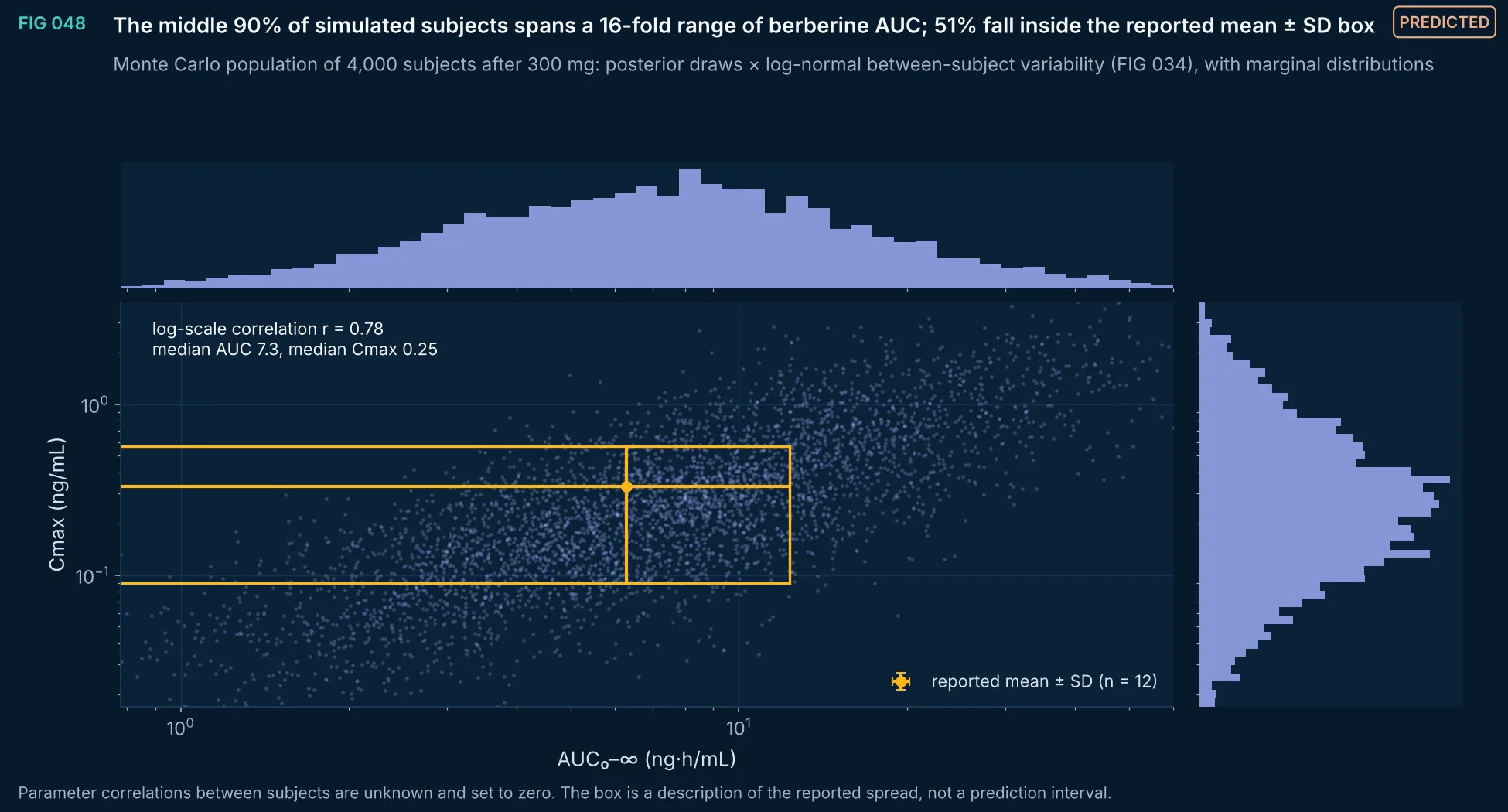
Berberine
How variable is berberine exposure from one 300 mg dose?
- Method
- A typical-subject model calibrated to the published summary data (n = 12), combined with between-subject variability matched to the reported coefficients of variation: 4,000 simulated subjects.
- Finding
- The middle 90% of simulated subjects spans a 16-fold range of AUC, and the published data cannot tell fast absorption with slow elimination from the reverse.
- Limits
- Variability is inferred from summary coefficients of variation, with no covariates and no individual concentration data.
- Next experiment
- A human crossover study against a reference product that measures berberine and its main metabolites.
The 60 figures by kind of evidence
- 21
- Completed computational analyses force-field, statistical and flow calculations, including one benchmark
- 7
- Published measurements reanalyzed compiled, converted or re-plotted, without a fitted model
- 15
- Literature-calibrated models 10 calibrated to published human data and 5 predictions made with them
- 15
- Illustrative simulations methods shown on a simulator or simulated data with stated inputs
- 2
- Planned experiments designed, not yet run
- 0
- Trained proprietary models or laboratory results the learned models remain proposed
The problem, measured
The same name on the label can hide a 5.8-fold difference in one constituent.
Rutin, one flavonol glycoside, measured in 51 batches of ginkgo tablets and capsules from 25 manufacturers. Add the rules of an example specification one at a time and see how many batches it would release.
- Released
- Held for supplier history
- Outside the example specification
51 batches, no rule applied.
Hypothetical example The rules are the example specification of Demonstration 3, not a monograph or a legal limit. A batch outside it is outside that example. That is not a finding that any product was unsafe, adulterated or unlawful.
Demonstration 4 · one program
Five decisions on one turmeric extract, all based on published evidence.

ISourceStage 2
Turmeric rhizome
Content reported for the dry rhizome, by source and measure
Published Priyadarsini 2014; JECFA 2004; EMA 2018
IIAuthenticateStage 2
Natural or synthetic?
27 samples; the content assay cannot see what the isotope ratio can
Published Perini et al. 2023
IIIExtractStage 3
Four solvents, one rhizome
Acetone: the richest oleoresin, recovery within error of the highest
Measured Barriga-Sánchez et al. 2024
IVSpecifyStage 4
Draft specification
Each line exists because an earlier stage put it there
- Curcumin, demethoxy- and bisdemethoxycurcuminReported each and total
- Natural originNatural reference range
- Lead≤ 2 mg/kg
- Residual acetone≤ 30 mg/kg
Proposed Limits adopted from JECFA 2003 and 21 CFR 173.210
VDeliverStage 5
Exposure, not dose
Times a standard extract’s plasma exposure of total curcuminoids, one study, 12 adults (curcumin alone: 85× for the γ-cyclodextrin form)
Published Purpura et al. 2018
The Ingredient Engine
One development system leads to several commercial outcomes.
- 8
- Engine stages, each ending in a documented decision to proceed, repeat or stop
- 6
- Proposed model families, each released only by a measured test
- 1
- First paid service. U.S. supplement makers must verify the identity of every dietary ingredient (21 CFR 111.75); in a 2026 scoping review of published surveys, 20.0% of 2,235 turmeric samples were adulterated (Gafner et al.)
- 0
- Laboratories operating, models trained or samples measured today; funding follows measured gates
The eight stages, their gates and repeat loops are drawn under How it works: decisions and loops. From stage 8 a program can go four ways:
- Develop for a client
- License a process
- Supply an ingredient
- Partner a drug candidate
Four demonstrations, worked on published data
- 04 · All stagesOne program, end to endChange five decisions on a turmeric extract and see which stages proceed, reopen or stop.
- 01 · Stage 5Solubility and deliveryWhether a poorly soluble active needs a carrier, and which carriers its limiting barrier rules out.
- 02 · Stage 3ExtractionWhich solvent and conditions to use, weighing yield against selectivity and residue limits.
- 03 · Stage 4Lot consistencyWhether a series of lots can be released against a specification, or the process must change first.
07Business model · path to value
From one paid problem to ingredients the company owns.
Each step depends on evidence from the one before it; none follows automatically. Laboratory spending would begin only after 90 days, and only if clients have paid deposits and the work shows a measured margin.
Proposed flagship case · not a program
A turmeric extract with verified natural origin and measured exposure
- Natural origin verified per lot by hydrogen isotope ratio
- The three curcuminoids specified by a validated HPLC method (AOAC 2016.16), with proposed limits of 2 mg/kg lead and 30 mg/kg residual acetone
- A delivery form with its own exposure and safety data
- Made at first by qualified cGMP contract manufacturers; no plant of its own
$141.8MU.S. mainstream multi-outlet sales of turmeric supplements, 2024 (fourth among herbal supplements)
$37.1MSPINS natural channel, 2024, where turmeric ranked first for the third consecutive year
Smith, Lang and Craft, HerbalGram 2025 (SPINS data; scanned channels exclude direct-to-consumer sales). No program, customer, patent or revenue exists; nothing here is a forecast. The flagship case
Why this would differ from a testing laboratory
- What is sold
- A result for each sampleA specified ingredient per kilogram, or a license to make it
- Revenue repeats when
- The client sends the next sampleThe customer reorders under a supply or license agreement
- What stays with the company
- Little: data and results belong to the clientThe specification, process know-how, the safety and exposure file, and any patent that issues
Fee-for-service testingProposed ingredient owner
- FeeA paying problemA fixed-scope package, starting with supplier qualification and comparability (Package B)
- FeeContracted revenueAccepted deliverables, invoiced and paid
- Know-howRepeatable methodsMethods and decision rules reused on the next program, where contracts allow
- Owned assetA proprietary ingredientOnly where ownership is established: work on EUTECNIQ’s own account, or rights assigned in contract
- RecurringSupply and licensesPaid per kilogram or per license, without a new statement of work
Each step rests on the one before; heights show order, not amounts.
Proposed capability The value path, the flagship case and the first test
08Founder
A published scientific record and industrial operating experience.
Dr. Amir H. Mehrkesh
Public record, checked October 22, 2026
- 2015
- Ph.D., University of Colorado Denver; dissertation on the optimization-based design of ionic liquids
- 13
- Publications, 2010–2016 (12 journal articles, 1 proceedings chapter), 9 as first author
- 6
- Granted patents in the United States, Japan and Europe from three invention families, as co-inventor; not EUTECNIQ intellectual property
Industrial experience since 2007 Founder-reported
Botanical and functional products.
Built and led a research and quality-control group, and designed, equipped and qualified an in-house laboratory. Human PK/PD studies informed product decisions, and he led technology transfers into manufacturing.
Pharmaceutical manufacturing.
Led engineering and operations teams across a multi-site cGMP network making active pharmaceutical ingredients; managed multi-million-dollar capital and OPEX projects, including cGMP expansions.
Advanced materials.
Took R&D programs from laboratory proof of concept to pilot scale with molecular modeling, design of experiments and machine-learning screening.
Industrial extraction and separation.
Process design, debottlenecking and energy optimization with simulation and techno-economic evaluation.
Results belong to the prior employers, which are not named, and not to EUTECNIQ. He is the company’s only team member today. Publications, patents and the specialists still to recruit
For collaborators
Start with one ingredient or one question. A first message needs no confidential information; a mutual nondisclosure agreement comes before any formula or process detail.
For investors
The proposed phases, uses of capital and milestones, with the founder’s record and the risks.
Information only. Not an offer of securities.
Health information notice. These statements have not been evaluated by the Food and Drug Administration. Nothing on this site is intended to diagnose, treat, cure or prevent any disease, and nothing here is medical advice.
Read the full notice
The information is for general education only. It does not replace advice, diagnosis or treatment from a qualified health professional, or any medication a clinician has prescribed. Do not start, stop or change any medicine, supplement or herbal product because of something you read here. Talk to your doctor or pharmacist first, especially if you are pregnant or breastfeeding, have a medical condition, take any medicines, are preparing for surgery, or are caring for a child. Research findings, traditional uses and safety data are reported as their sources state them; they are not recommendations or claims about any product. If you think you may have a medical emergency, call your doctor or 911 at once.
EUTECNIQ Sciences sells no supplements or health products today and receives nothing from any product or ingredient mentioned on this site; any commercial interest it later has in an ingredient will be stated on that ingredient’s page.